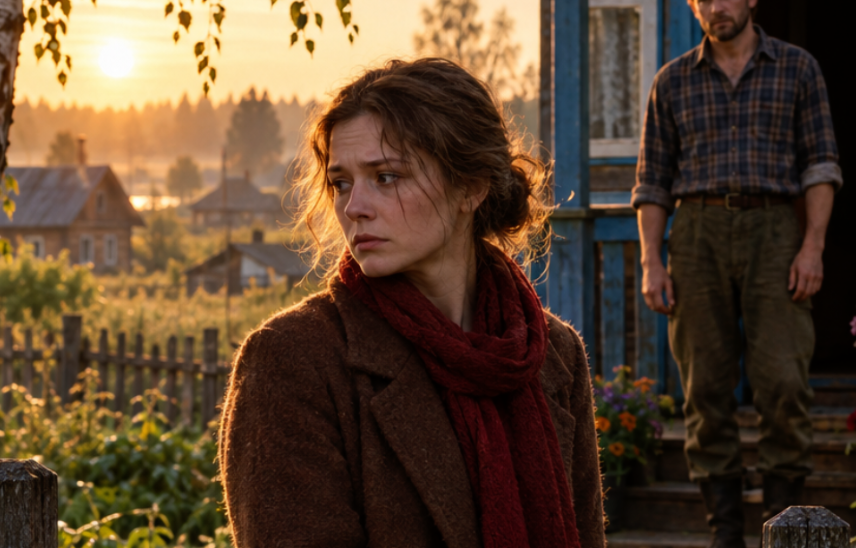
The gate swung open slowly with a long, creaking sound, as if it resented being disturbed and pleaded to be left alone. The May morning was cool and dry. In the air mingled the sharp scent of birch bark and the fresh aroma of nettles glistening with last night’s dew. Tatyana set her heavy canvas bag down onto the wooden walkway, adjusted the burgundy scarf around her neck, and turned back. Over the past few months, her face had grown noticeably gaunt. Faded from constant lack of sleep, dark circles lay underneath her eyes, and she looked so pale it seemed as though all her strength had left her.
Andrei stood on the porch, feet planted wide apart in battered old slippers, hands on his hips, squinting toward the rising sun. His sturdy, broad-shouldered figure radiated the smugness and habitual confidence of a man who considered himself master of the situation.
“Well, go ahead and leave if that’s what you want,” he said mockingly, his hands still buried in the pockets of his work pants. “Look at you, running off for a vacation! Off to see your mother for a whole month, supposedly to recover your nerves! What’s so wrong in your life, Tanya? What exactly are you needing to recover from? Idleness? The washing machine does all the laundry, the robot vacuums the floors for you, the stove is gas—no need to build a fire, just turn the knob. You’ve never even worked properly with a shovel or carried a heavy sack in your whole life! Meanwhile, I’m on my knees in the garage all day under the logging trucks, earning a living and providing for the family. And you act like you’re exhausted from a few pots and pans! So go! The kids and I will finally get some peace, without your tasteless borscht and endless complaints. I bet you’ll be running back in less than three days!”
Tatyana didn’t answer him. Her lips barely trembled before pressing together into a thin pale line. Saying nothing, she bent down, grabbed the sturdy canvas bag by its handles, and headed down the sandy road toward the main highway. There, she would wait for the first bus to the district center, and from there, take the ferry to the distant village across the river where her mother lived.
She never looked back. She didn’t glance at the well as she passed it, nor did she pause at the turn by the village council building.
Andrei spat contemptuously from the porch, smirked with satisfaction, and went back into the warm house. The clock showed six in the morning. Nine-year-old Yegor and five-year-old Polina were still fast asleep in their room. The house was filled with peace and quiet—a peacefulness Andrei welcomed as long-overdue freedom.
“She’s really showing her attitude!” he thought as he poured himself the cold tea left over from yesterday. “She tried to scare me, threatening to leave. Let’s see how she lasts a whole month! Her mother’s place doesn’t have proper internet, or hot water. She’ll have to fetch water with a yoke, and tend the vegetable garden too. She’ll soon realize home is better and beg to come back. In the meantime, we’ll live like real men. It’ll be our own men’s republic!”
The First Day Without Tatyana
The first day was all about total freedom. Andrey decided not to bother with complicated cooking and grabbed a pack of dumplings from the freezer. He boiled them for lunch, added lots of mayonnaise, and figured food problems were solved.
Yegorka was over the moon: he spent the whole day riding his bike without a care in the world, completely forgetting about homework. Five-year-old Polinka was also loving her unexpected freedom. She settled down on the carpet with her playdough, gleefully spreading colorful pieces all over the room and even smearing some onto the sofa upholstery.
In the evening, dad and the kids cooked up some fried potatoes with pork fat in a heavy cast iron skillet. They ate dinner piping hot, washing it all down with sweet soda. Andrey never even thought about washing the dirty plates and pan. He just left everything in the sink, deciding that chore could wait.
“No big deal, I’ll take care of it tomorrow. The dishes aren’t going anywhere,” he reassured himself.
They didn’t head to bed until way past midnight. The TV kept blaring in the living room for a long time, playing some noisy action movie.
But the carefree life Andrey had dreamed of ended much sooner than he expected.
Real chaos erupted on Tuesday, right at six forty…
The alarm clock blared. Andrey could barely lift his heavy, lead-like head from the pillow. His mouth was dry, and the unpleasant aftertaste of last night’s fried pork fat made his morning even worse. When he finally made it to the kitchen, he was met with a depressing sight: a mountain of dirty dishes in the sink, the leftovers so dried out they wouldn’t budge under running water. The kettle was empty, and there wasn’t even a crumb left in the breadbox.
“Dad, where’s the porridge?” Yegorka asked sleepily, appearing in the doorway and rubbing his eyes. “Mom cooks rice porridge by seven every morning… And I need a clean shirt. We have a choir and marching inspection today!”
“You’ll get everything, just stop bothering me,” Andrey replied grumpily.
He opened the cupboard and started looking for grains. Inside were identical tin canisters with no labels. Andrey grabbed a handful of something white at random, poured it into a small saucepan, added milk, and placed it on the stove. In just a couple of minutes, the milk started boiling over, spilling foaming liquid all over the stove. The whole house filled with the unpleasant smell of burnt milk. As he tried to scrub the messy stove down with a rag, the porridge stuck fast to the bottom of the pan.
That’s when a loud, desperate cry from Polinka came from the bedroom.
Andrey rushed to the room. The little girl was sitting on the bed sobbing, barely able to get her words out:
“Daddy! My leg is itchy! And I need braids too… Make them like mommy does! Fish tail!”
“What even is a fish tail?!” Andrey shouted, grabbing a wooden brush from the dresser.
Trying to tame his daughter’s unruly hair quickly turned into a real ordeal for him. The strands tangled, the teeth of the comb got stuck, and Polinka screamed so loudly it sounded like she was in unbearable pain. In the end, Andrey managed to gather her hair and tied it with an ordinary office rubber band. The result was a lopsided bun sticking out to the side. His daughter looked at herself and burst into tears again:
“Now I look like a monster! Everyone at daycare will laugh at me!”
A morning gone totally wrong
Soon, another problem popped up: there wasn’t a clean school shirt for Egor anywhere. All the kids’ clothes had been dumped in the laundry basket in one big pile. In a hurry, Andrey tossed everything into the washing machine, eyeballed the detergent, and picked the first program he saw, setting the temperature to ninety degrees.
An hour later, disaster struck. Egor’s once-bright white school shirt had turned a dirty grayish-pink and shrank so much it could barely fit a three-year-old. Turns out, a red wool sock had somehow ended up in the wash with everything else.
Egor ended up going to school in a wrinkled t-shirt, looking upset and on the verge of tears. Andrey practically dragged Polinka by the hand to daycare. They had just five minutes left before the gate would close. The girl looked messy, upset, and was even wearing mismatched socks.
As for Andrey, he didn’t make it on time either. He showed up at the garage forty minutes late for work and got a serious reprimand from his supervisor.
But all these were only the first of many troubles.
Household duties Andrey never thought about
Before, country life seemed so normal and almost unnoticeable to Andrey. He saw the daily chores as just a background to his tough job, never stopping to think about how much time and effort they really demanded. Now, it felt like his daily routine had come alive and crashed onto him like a heavy, crushing boulder.
Gradually, he realized the house was like a bottomless pit, always demanding attention and more work. Dust never went away on its own—in just a couple of days, it covered the furniture in a thick gray layer. The chickens in the barn didn’t just lay eggs: every morning they needed a warm mash of feed, and the perches had to be cleaned out regularly.
He also learned that the chained dog couldn’t be fed nothing but dry scraps all the time. And the vegetable garden behind the fence would quickly become choked with stubborn weeds if it was ignored. To keep that from happening, it was necessary to go out every weekend and tackle the weeding.
By the end of the first week, the kitchen sink was piled high with dirty dishes. There weren’t any clean plates left, so Andrey started serving food directly from the pot. Meanwhile, a mountain of laundry grew in the hallway, and no one had any intention of ironing it.
But what exhausted him the most wasn’t the pots, the laundry, or the cleaning. The true challenge was helping Egor with his schoolwork.
Every evening turned into an argument
After work, Andrey tried to help his son with homework, but there was no peace in these evenings. The new third-grade curriculum seemed completely baffling to him and made him absolutely furious.
“What kind of equation-based solution is this?!” he shouted near eleven at night, his eyes bloodshot as he stared at his son’s notebook. “We used to solve this in just two steps! Why do you need this X here?! Why didn’t you write down the problem statement?!”
“The teacher told us to do it this way!” Egor sobbed, smearing tears and snot across his textbook pages. “You don’t understand anything! Mom always helps me and you just yell!”
“I’m not yelling! I’m trying to explain it to you, blockhead! Do as I say and write it down!”
Meanwhile, Polina continued to fuss nearby—the little girl hadn’t been put to bed on time by her father. Thanks to all the dry food and store-bought meals lately, her stomach hurt and she’d developed a mild fever. She climbed onto Andrey’s lap, hugged him, and kept asking for a story about a rabbit. But her father didn’t know that story and honestly didn’t want to figure out what exactly his daughter needed.
Andrey would finally make it to bed only around two in the morning, collapsing onto the crumpled, long-unwashed sheets without even changing clothes. And already by five a.m., he’d jerk awake in panic—remembering he forgot to iron Egor’s school pants or realizing he hadn’t given the chickens water.
An unexpected discovery in his wife’s room
On the Sunday of the second week, Andrey finally gave in. He walked into the bedroom and stopped by the bed. On Tatyana’s nightstand was an unusual, almost painfully tidy order. He sat on the edge of the mattress and suddenly noticed the faint familiar scent of her inexpensive lily-of-the-valley perfume, which still lingered in the room.
A large notebook in a blue vinyl cover was lying on the nightstand. Andrey grabbed it and opened to the first page without thinking.
It turned out to be a diary. But not the kind filled with personal worries, secrets, or deep thoughts. What he had in front of him was a real work journal of her endless domestic slog.
Andrey started leafing through the pages, one by one. With every new entry, a cold chill swept through him, and unpleasant goosebumps ran down his spine.
A month later, Andrey realized just what price his wife had paid for his comfort
“May 7. Need to buy Egor special notebooks for class. Polina needs ointment with succession: a rash popped up on her cheek. Apply twice a day, at eight in the morning and eight in the evening, always after meals. Cut out all sweets for now. The zipper broke on the left pocket of Andrey’s favorite work jacket—need to change it before he loses the garage keys. Remember to order firewood for the cold season and check the stove flap in the bathhouse—it’s not drawing well for some reason. Also wash the curtains. Make a pot of bean borscht for a few days—Andrey especially likes that.”
May 12. Egor is still struggling to understand fractions. We spent two hours on homework today, but he’s just not getting it yet. I’m going to ask our neighbor, Maria Ivanovna, a retired teacher, to help him out. I’ll thank her with a jar of honey. This morning Andrey’s blood pressure shot up to 140 over 90. I need to brew some hawthorn tea, fill a thermos, and pack it for him. As for his pills, better to leave them in the car’s glove box, otherwise, he’ll get stubborn again and refuse to take them.
May 18. My legs ache so badly I couldn’t sleep at all last night. Up on my feet since four in the morning: first I baked bread, then opened up the greenhouses, watered the plants, got the kids ready, and then rushed to the post office to sort out parcels. Andrey came home irritable. He said the soup was too salty and complained that I hadn’t done anything useful all day, just chatted. My head is spinning, I have almost no strength left. God, please help me not to cry or snap at the kids. Tomorrow I’ll have to get up even earlier to make sure Andrey’s shirts are ironed for Saturday…
Andrey’s fingers relaxed involuntarily, and the notebook slipped onto his lap.
The house was so quiet you could hear water dripping at steady intervals from the kitchen faucet that wasn’t closed tightly. Every sound echoed in the empty house with particular clarity.
Suddenly, Andrey remembered that very evening—May eighteenth. He had come back from his shift completely exhausted, tossed his dirty boots in the hallway, and sat down for dinner. The soup really did seem a bit salty. Because of this, he gave Tatyana a real scolding, lecturing her at length and with some satisfaction, accusing her of living off him while he ruined his health at work for the family.
She was standing by the stove then, clutching a damp towel to her chest. Her face was pale, her fingers trembling noticeably. In a barely audible voice, she said:
“Andryusha, I’m just very tired… Please, don’t.”
And he just laughed in response:
“What could you be tired from?! You sat on a chair all day?!”
Now those memories hit him so hard that hot tears sprang from his eyes. Andrey quickly covered his mouth with his hand, trying not to break down sobbing in the empty house.
He—a strong man, a top-level mechanic who always prided himself on being able to dismantle and reassemble a logging machine’s gearbox single-handedly—now found himself completely helpless before everyday household chores. Just fourteen days were enough to shatter his confidence. His hands dropped, his eye twitched constantly, and the never-ending noise from the kids’ tantrums, crying and chaos filled his ears. Dirty dishes, homework, colds, medicines, laundry, cooking, chickens—it all came down on him at once.
Tatiana managed all of this for ten whole years. Every single day, without a break, without calling in sick or taking a vacation, without ever just stopping and saying, ‘I can’t do this anymore, leave me alone.’ Silently, she took care of thousands of little things, always trying to smile, greeting him with a hot dinner ready, handing him a freshly ironed shirt, and gently asking if his head hurt, if he’d eaten, if he was tired.
And during all this time, he never once tried to understand what it was costing her to live this way.
‘God…’ Andrei whispered softly, staring into the void. ‘What a bastard I am… What a blind idiot…’
He suddenly stood up, wiped his wet cheeks on his sleeve, and glanced at the calendar. There were still two weeks left until Tatiana returned. Fourteen long days.
Andrei got to work around the house.
By the very next day, people in the village started looking at Andrei with surprise. It was as if the once self-assured man had been completely transformed.
He didn’t go to the bus station to beg his wife to come back early. His pride wouldn’t let him admit defeat and ask Tatiana to return to the mess he’d let happen. Instead, Andrei decided to get the house in order himself. He threw himself into the task with a determination he’d never even shown during the hardest repairs at the sawmill.
Now his mornings started at five o’clock. Without any grumbling or angry shouts, he’d get out of bed and get started on chores. First, he washed all the piled-up dishes, scrubbing them with baking soda until the plates and pots were squeaky clean. Then he tackled the mountains of laundry. He had to learn how to sort lights from darks, figure out the wash cycles, and set the temperature on the washing machine correctly.
In the evenings, Andrei would sit next to Egor and help him with his homework. Now, he made a real effort to keep his temper, never raising his voice or snapping at his son. When the boy couldn’t understand another math problem, his father would grab some scrap paper and patiently draw apples, divide lines into sections, and explain the material over and over. In the end, Egor figured out those dreaded fractions on his own and got his first well-earned top mark in a month at school.
But the changes didn’t stop there.
Andrei learned how to braid Polina’s hair. At first, his fingers, used to gripping heavy wrenches with confidence, just didn’t cooperate. They got tangled in his daughter’s fine golden hair, struggled to separate the strands, and fasten them properly. But the man didn’t give up—he kept practicing. By the end of the third week, Polina would proudly march to preschool with two neat identical braids decorated with bright red ribbons.
One day, the teacher saw the girl’s hairstyle and didn’t hide her surprise:
‘Andrei Nikolaevich, you really have a talent!’
During this time, the man managed to whitewash the stove, replace the faulty gasket in the leaky tap, tidy up the garden, and tie up the tomatoes in the greenhouse. For that last task, Tatiana’s notes in the blue notebook were a huge help. He followed her instructions carefully, making sure not to miss a single detail.
He even started making borscht himself now. And not just any borscht—he cooked it exactly with beans, the way Tatiana liked, and he never rushed to take the pot off the stove, letting it simmer gently so the flavors would develop just right.
In two weeks, Andrey changed noticeably. He lost six kilograms, dark circles appeared under his eyes, and his face became gaunt. But at last, the house was truly tidy—something he never appreciated before. Now, he understood how much daily work went into clean floors, homemade meals, groomed children, and neatly folded laundry.
Tatiana Comes Home
Finally, the thirtieth day arrived. It had been exactly a month since Tatiana left that morning to stay with her mother.
Andrey woke up early and immediately started getting the kids ready. He helped them wash up, dressed both in their cleanest and most festive outfits. For himself, he pulled out the dark blue sweater his wife knitted for last New Year, pressed his pants carefully, and got ready to leave.
Before heading to the bus stop, he went past the edge of the village to the meadow by the river. There he picked a huge bouquet of wild daisies. The white petals framed yellow centers, looking like tiny suns. The flowers smelled of honey and warm summer, which was slowly coming to an end.
Andrey and the kids arrived at the village bus stop half an hour before the midday bus.
The bright sun lit up the dusty dirt road, turning it into a shimmering silver ribbon. High above, the larks sang their hearts out. The man stood under the wooden shelter, gripping the stems of the daisies tightly. His fingers were numb, but he was afraid to loosen his hold. His heart was pounding so hard it seemed it might leap out of his chest. He felt like an awkward seventeen-year-old, waiting for a girl on a first date.
What if Tatiana changed her mind and didn’t come? What if she decided to stay with her mother for good? No one could blame her—after all the insults and humiliation she endured with him, she had every right not to return.
Finally, an old yellow bus appeared over a small hill. It bounced over the uneven road, then came to a stop with a loud squeal of brakes. A cloud of dry dust rose up.
With a metallic clang, the door swung open.
Tatiana appeared on the steps. She wore the same beige windbreaker, her travel bag slung over her shoulder. During her time at her mother’s, she’d gained a little weight, and a healthy blush colored her cheeks. But as soon as she glanced toward her home village, her face grew serious. Her eyes showed nervousness and a deep, hidden sadness. She was coming back home, already bracing herself for scolding, her husband’s dissatisfaction, and the usual chaos.
“Mommy! Mom’s back!” Polinka shouted joyfully, racing toward the bus before anyone else.
Right after his sister, Egor dashed forward, his sneakers hitting the road with a lively beat.
Tatiana didn’t even have time to put her bag down. She let it fall from her hands, dropped right into the dusty road near the bus wheel, and pulled her children into a tight hug. She kissed their heads, cheeks, and little noses, holding them close, unable to let go.
“My dears… My precious ones… I missed you so much! Did you miss me too? How did you get by without your mom?”
“Mommy, Dad learned how to make borscht!” Polinka blurted out, stumbling over her words in excitement. “And he does braids for me! He can do it himself now! And it doesn’t hurt at all, not one bit! And Egor got an A in math!”
Tatiana suddenly fell silent. She slowly lifted her head and looked in the direction her daughter was pointing.
Standing in front of her was Andrey. He’d changed a lot in the past month: his face looked leaner, more tanned, with deep shadows under his eyes. But what struck Tatiana most was his gaze. The old look of mockery and smugness had vanished. In its place was quiet tenderness, sincere regret, and a certain vulnerability she’d never noticed in her husband—even in the early years of their marriage.
Andrey took a few steps toward her. Then he dropped down on one knee right there on the dusty roadside and reached out to his wife with a bouquet of daisies.
“Hello, Tanyusha,” he said, his voice gruff and trembling despite his efforts. “Welcome home.”
She stared in confusion at his rough, scratched hands holding the flowers and then looked up at his apologetic face. Standing before her was a completely changed man, barely recognizable as the arrogant Andrey who had seen her off with jokes and sarcasm just a month ago.
“Andryusha… What’s happened to you?” Tatiana asked quietly, her voice trembling with fear.
He carefully took her small, rough hand and pressed it to his lips. For a moment, he closed his eyes, like he was gathering his strength.
“Forgive me, Tanya,” he said hoarsely, trying to speak so that the children wouldn’t hear every word. “Forgive me for everything. For every piece of bread, for every hurtful word, for all the years I didn’t notice or didn’t want to see. Only now do I realize what holds our home together. All this time, it has rested on you. On your shoulders, your endless patience and care. I will never let you carry it all alone again. Do you hear me? Never! I’ll be by your side. From now on, we’ll do everything together.”
Tatiana looked at her husband as hot tears slid slowly down her cheeks. But now, these weren’t the bitter tears of helplessness she’d shed a month ago when she left home. These tears held a mix of surprise, relief, and hope.
She gently moved closer to Andrey, hugged him around the shoulders, and nestled her face into his familiar broad shoulder. She breathed in the smell of sun-warmed blue sweater and wild daisies, then quietly exhaled:
“Let’s go home, Andryusha. Let’s go feed the kids.”