Drops from the old brass washstand fell with a heavy, measured thud into the enamel basin below. That sound had haunted Nadezhda for twenty-eight years—ever since, at just twenty-two, she first stepped into this tiny five-wall cottage as its rightful mistress. The entryway was filled with the scents of damp wool, dried dill, and an old resentment that, even after all these years, refused to leave the house.
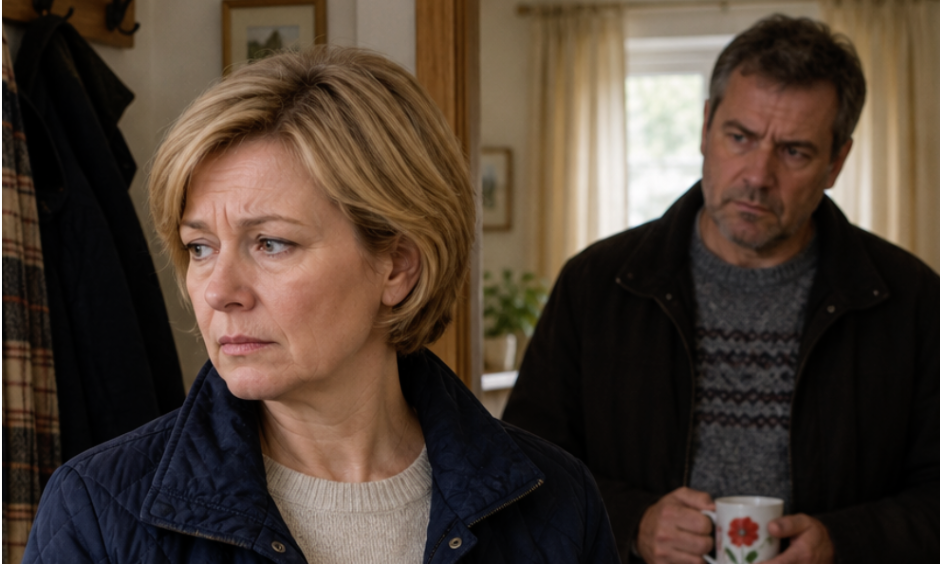
Nadezhda zipped up her small brown leather bag. She didn’t have much: two changes of bed linen, a warm beige sweater, her passport, her agronomy diploma she’d once tucked away in the bottom of her linen cabinet and never taken out again, and her mother’s silver brooch with a faded river stone. Straightening up, she adjusted her dark blue quilted jacket and left her set of keys on the wooden shelf beside the cracked mirror.
The smell of fried pork fat drifted in from the kitchen. In the doorway appeared Viktor—a heavyset man of fifty-three with thick, overhanging brows and a perpetual look of displeasure at his mouth. In his hand, he held a mug of tea that had already gone cold.
“And where are we off to at the crack of dawn?” he rasped, eyeing the bag at her feet with his usual sneer. “Putting on another show? You think I’ll run after you all over the village, get down on my knees and beg you to come back?”
Nadezhda didn’t answer. She looked at his weathered face, bloated from comfort, and suddenly, with complete clarity, realized: inside, she had nothing left. No hatred, no fear, no tears left to cry after twenty-eight years of living what felt like endless hard labor together. Just emptiness. Clear and pure, like a freshly washed window.
“I’m leaving, Vitya,” she said calmly, her voice steady. “For good.”
Viktor choked on his tea, then burst into a hoarse, mocking laugh.
“For good?! Have you looked in the mirror lately, you wreck? You just turned fifty last week! Who’d want you now, all washed up? Who needs a woman with no money, no man, and no roof over her head? You couldn’t last a day at a decent job—you lived off me all this time, just leeching off what I earned! You’ll come crawling back in two days, begging to wash my feet just so I’ll let you back on the porch!”
Nadezhda didn’t argue. She picked up her bag by its worn strap, flung open the front door, and walked out of the house.
Morning greeted her with a thick, biting chill from the autumn fog. The air carried the smell of rotting alder and approaching frost. Behind her, the gate clanged shut. Nadezhda walked down the frozen track in her old boots, surprised by how light her steps felt, as if an enormous stone she’d carried for years had finally been lifted from her shoulders.
For twenty-eight years, she hadn’t lived her own life. Once, after finishing technical college, Nadezhda dreamed of working in greenhouses, breeding northern varieties of berries, feeling the earth in her hands and seeing the results of her own labor. But after the wedding, Viktor quickly and methodically destroyed all her plans.
“A woman’s job is to stand by the stove and work in the garden. Stay home—there’s no need for you to wander around collective farms and embarrass me,” he told her, making it clear how he saw her place in the family.
He never raised a fist against her, but his words could cut like a knife. He did it every day, carefully picking exactly the words that would hurt most. Even at the dinner table, every piece of bread came with a comment: “I’m the one earning this with my back.” Whenever Nadezhda bought herself a new coat, it meant a whole week of icy silence and obvious disapproval.
“Spendthrift! You’ve drained me dry! All you know how to do is waste money!” he would snap at her, making no attempt to hide his contempt.
And still, she kept enduring. For the children, for the family, and for the hope that maybe, someday, things would change.
Her daughter Olechka was just four years old when Victor first humiliated Nadezhda in front of others, calling her an airhead at a collective farm celebration. Her son Artyom had just turned seven when, in a furious rage, his father threw his mother’s books on plant breeding out into the snow. He announced that those useless tomes did nothing but collect dust in their home and served no purpose.
Nadezhda gathered her books from the snow, doing her best not to look at her husband. She cried quietly, hiding in a corner, pressing her apron to her face so the children wouldn’t hear her sobs. And then, again and again, she tried to convince herself:
“Just let them grow up. Let them become independent, stand on their own… The family has to stay together. I can’t get divorced, it’s shameful. What would people say?”
The years passed, and the children finally grew up. Olechka graduated from college, got married, and moved far from home. Artyom served in the army and got a job as an engineer at a drilling site up north. They each started their own lives, found their own concerns and plans.
During her last visit, her daughter sat with Nadezhda in the bathhouse. The mother quietly gathered her hair, while Olya looked at her hunched back, unable to hide her sadness.
“Mom, who are you living like this for? Dad doesn’t even treat you like a person! Leave him. Come stay with us, help me with your grandson. Why do you keep putting up with all this?”
But Nadezhda didn’t want to move in with her children. She was afraid of being a burden to her daughter and son-in-law in their young family, taking up space in someone else’s apartment and having to depend on other people’s decisions. This was not why she had held onto her home and endured so many years of humiliation.
She wanted something entirely different. Not someone else’s help, not pity, and not the need to explain her every move. She just dreamed of finally breathing freely. To eat at her own table without fear that someone would watch her plate and start complaining. To fall asleep at night without dreading another shout. To wake up in the morning and know that no one would try to control her life.
The local bus took Nadezhda to a large village at the crossroads of taiga roads. In her bag were all her few belongings, and in her pocket, thirteen thousand rubles—the money she had quietly managed to save over the summer. Part of it came from selling runners of her prized strawberries, and the rest she earned knitting several pairs of warm mittens.
These were her own savings. For the first time in many years, she could spend money without asking for her husband’s permission, without justifying herself or enduring humiliating remarks.
Nadezhda stepped off the bus, gripped her bag’s strap tighter, and looked around. Ahead of her lay a life she barely recognized, one where she would have to make her own choices. Was she scared? Of course. But for the first time in twenty-eight years, her fear didn’t make her want to turn back.
She took a deep breath of the cold autumn air and walked forward.
Nadezhda headed straight for the local forestry nursery office. She’d heard back in summer that the manager was looking for workers in the greenhouses: young people were all leaving for the district center, and with almost a million pine and cedar seedlings to care for, there were no hands left. These young trees needed someone who would look after them.
The manager, a bulky gray-haired man in camouflage clothing, examined her diploma, earned thirty years earlier, for a long time. He kept flipping the document and rereading it as if trying to figure out where its owner had disappeared to all these years.
“Smirnova Nadezhda Mikhailovna? Graduated from technical college with honors… So where have you been all these years, agronomist?”
“I stayed at home,” Nadezhda replied, meeting his eyes. “My husband wouldn’t let me work. But my hands remember everything. I can prepare cuttings, transplant seedlings, graft all sorts of plants. Give me at least a trial period. I just need a place to stay—anywhere, even in a shed by the warehouse.”
The manager grunted, looked again at her hands—clean but roughened by hard work—then gave a nod of approval.
“We do have a shed. It’s heated by a wood stove, there’s electricity and a hotplate. You’ll have to bring water from the well. Pay isn’t much, but the seedlings can’t wait—they need planting right away. So go ahead and move in.”
The shed was just a tiny room in a small log outhouse on the edge of the nursery. Inside was a metal bed with a mesh frame, a round table by the wall, a small cast-iron stove, and the only window looked right out onto endless rows of greenhouses under plastic covers.
That first evening, Nadezhda lit the stove with birch logs. Then she sat down on a stool, placed her hands on her knees, and sat completely still for a long time. The room was filled with an unusual, almost ringing silence. No one was banging the fridge door. No one was yelling from the next room:
“Where are my socks?! The tea’s cold, you idiot!”
She could sip her tea slowly and in peace. She could accidentally miss the saucer with her spoon, and no one would call her clumsy. She could simply sit there and do nothing—without waiting for another rebuke.
Nadezhda lay down on the hard mattress, covered herself with a government-issued cotton blanket, and for the first time in twenty-five years, fell asleep without her usual lump in her throat. She didn’t have to listen for heavy footsteps, try to read her husband’s mood, or come up with excuses for things she hadn’t done.
Work quickly took over her whole life. The land became exactly the saving grace her weary soul had been waiting for. Inside the greenhouses, a rich and dense aroma of damp peat, pine needles, and fresh greenery filled the air. From early morning until dusk, Nadezhda tended to the tiny cedar seedlings, protected the saplings from root rot, adjusted the drip irrigation, and carefully watched over every plant.
She knew much more about plants than any textbook could teach. Nadezhda sensed them with her fingertips: she could tell when the soil was thirsty, noticed the faintest changes in a leaf, and always spotted when a young shoot needed special care.
After three months, the women in her crew wouldn’t trim a plant without Mikhailovna’s advice. They came to her for recommendations, listened to her opinions, and trusted her with the most important tasks.
Gradually, Nadezhda stood taller. The deep frown line between her eyebrows, etched there by years of constant worry, started to smooth away. Her eyes softened with warmth, and her steps grew lighter and more confident. She trimmed her thick dark-chestnut hair into a neat, strict style, and with her first paycheck, she bought herself a simple but beautiful beige turtleneck sweater.
Soon, the people in town began greeting her in a completely new way.
“Good day, Nadezhda Mikhailovna!”
Now they called her by her full name, respectfully asked about her life, and sought her advice. To everyone around, she was no longer just ‘Vitya’s wife’ or ‘Smirnikh’s woman.’ For the first time in many years, Nadezhda was seen as her own person—with a profession, knowledge, and self-respect.
Meanwhile, back in their home village, Viktor was losing his composure more and more each day.
During the first week, he tried to act confident. He was sure his wife would brood a little, get upset, and come home by the weekend. In Viktor’s mind, Nadezhda was just trying to scare him with her departure—a simple wait, and she’d realize she couldn’t live without him.
But a week went by, then another, then an entire month—and his wife still hadn’t returned.
The house was falling into disrepair fast. Without Nadezhda, the stove started smoking, his shirts turned stiff as boards, and Viktor had to make his own meals. More and more often, his diet consisted of store-bought dumplings clumped together into one shapeless mass.
The neighbors watched from behind their fences, never missing a chance to tease him.
“So, Vityok, your little bird has flown the coop?” they laughed. “But you always bragged that you took care of her. Looks like she’s been carrying you on her back all these years!”
Remarks like these only fueled Viktor’s frustration. At first, he tried to defend himself; then he started complaining to the kids. One day, he called their son, who was away on a job.
“Artyom! Your mother’s lost her mind! At her age, she just ran off and made me a laughing stock! Track her down, talk some sense into her!”
His son replied quietly, but so firmly that Viktor was instantly silenced.
— Dad, Mom put up with your antics for thirty years. She deserves a peaceful life now. Leave her alone. If you so much as lay a finger on her, I’ll come myself. And then our conversation will be very different.
His daughter responded even more briefly. She refused to listen to her father’s complaints, simply ended the call, and then sent a message:
“Leave Mom alone.”
By April, Viktor’s patience had completely run out. Through some driver friends, he found out exactly where his wife was working, put on his best brown vest, and took the morning bus to the plant nursery.
The day was bright and spring-like. Drops dripped from the greenhouse roofs, and the snow around was slowly melting into clear streams. Viktor purposefully pulled open the heavy glass door to the main greenhouse. He planned to stage a dramatic scene with his wife, force her to make excuses, and order her to come back home.
Already in his head, he was giving the familiar command: “Get home now, you cow!”
But as soon as he walked inside, all the words he had prepared caught in his throat.
In the sunlit aisle stood Nadezhda. She held a watering can with warm water and was carefully tending to the blooming primroses. Her young colleague was telling her something, and Nadezhda laughed—clear and girlish, almost like a teenager.
She wore a clean work apron, her cheeks rosy from the warmth, and her chestnut hair shone in the sunlight. She looked ten years younger than before: calm, beautiful, confident—a woman who was nothing like the frightened, worn-out wife who had grown used to someone else’s rudeness.
“Nadya…” Viktor croaked, taking a step onto the concrete path.
Nadezhda turned around. The smile slowly faded from her face, but there was no fear in her eyes. She looked at her husband calmly and indifferently, as if she had only spotted a stray plastic cup blown in by the wind.
“Hello, Viktor. Why did you come?”
“You… what are you doing here?” he stammered in confusion.
Suddenly, Viktor felt like a clumsy, awkward bear among the tender green shoots. He couldn’t reconcile his old image of his wife with this new woman, who was looking at him without a trace of fear.
“Enough nonsense, Nadya. You tried being independent—now that’s enough. Let’s go home. You’ll clean the stove, wash the curtains… I’ll even buy you new boots for the fall. Don’t be mad, let’s just forget everything that happened.”
Nadezhda barely smiled, just the corners of her mouth rising. There was so much calm confidence in that restrained smile that Viktor involuntarily took half a step back.
“Home? I don’t have a home with you anymore, Vitia. And I never really did. It was a prison that I locked myself into for the sake of what others would think. I’ve already filed for divorce at the district court. I don’t plan to split any property. Choke on your five-walled house. I don’t even need a rusty button from you.”
“You… Who do you think you even are without me?!” Viktor tried to protest.
But instead of a fierce roar, only a pathetic, trembling voice escaped his throat.
The workers nearby were already starting to turn around. One of the men frowned and gripped the handle of his shovel tighter as he watched what was happening. Suddenly, Viktor realized that no one here was going to support his usual way of talking to his wife.
Nadezhda straightened up and spoke clearly, without even a hint of nervousness:
“I am Nadezhda Mikhailovna. An agronomist. Now go, Vitia. The bus will be here in twenty minutes. If you miss it, you’ll have to walk through the mud.”
For a few seconds, Viktor just stood there, gasping for air. Then he spat on the concrete and, slouching even more, made his way toward the exit. He left, dragging his feet like a beaten dog that had nothing left to prove.
Two years passed.
On the outskirts of the village where the nursery was, a small wooden house appeared, recently built from fresh timber. Its decorative window frames looked cheerful, and the fence was almost hidden by blooming double lilac bushes. In the garden, rare northern flowers were blooming—flowers Nadezhda had grown herself and lovingly transplanted.
Nadezhda was able to buy this house with a loan from the state farm and help from her son Artyom. Now, every summer, he came to visit his mother on vacation and tried to spend as much time with her as possible.
On a warm June evening, Nadezhda sat on the wide wooden steps, warming her hands around a cup of tea made with currant leaves and mint. The sun was slowly setting, painting the endless taiga in golden hues. The light seemed to flow between the trees like thick amber honey.
From the yard, Pavel approached, wiping his hands with a clean towel. He worked as a carpenter in the workshop, was a quiet fifty-two-year-old widower, and was known for his kind nature. Soft wrinkles gathered at the corners of his clear blue eyes, giving his face a special warmth.
That evening, Pavel was repairing the carved gazebo in the yard. Just a week ago, Nadezhda had mentioned she’d always dreamed of a little spot like that, where she could sit on summer nights, drink tea, and listen to the birds sing. He didn’t make any promises—he just picked up his tools and got to work.
Pavel was never one for big words or fancy speeches. He showed how he felt through his actions. The man carefully sat down next to Nadezhda on the step, looked out at the smooth river in the distance and quietly said,
“The smell of your tea fills the whole street, Nadyusha. Are you tired today?”
“Not at all, Pavlik,” she answered affectionately, covering his broad, rough hand with her own warm palm. “The earth takes your strength, but it also gives it back.”
Nadezhda leaned her shoulder against his strong one and closed her eyes. She was fifty-two. Ahead of her was a whole new life where there was no more place for humiliation, shouting, or fear.
Now her days were filled with peaceful conversations, the scent of evening tea, blooming lilacs, and the care of a man with whom she never had to explain herself or be afraid to say what she truly felt.
At that moment, Nadezhda understood more clearly than ever: sometimes you just have to close that old creaky door behind you and step into the unknown to finally find your own life. Even if it seems like it’s too late to start over, simple human happiness could still be waiting ahead.