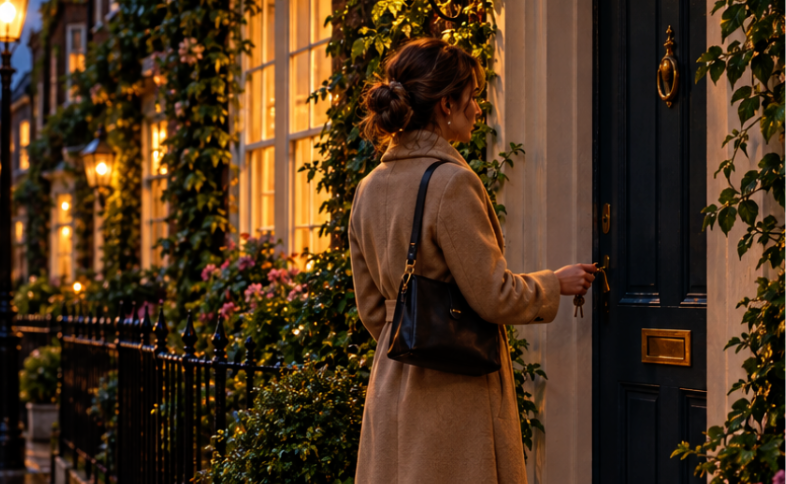
Galina came back from her mother’s place four days later. Her key wouldn’t turn in the lock. She stood at the door for a moment, slipped the keyring into her pocket, and headed back down to her car. She didn’t call. She didn’t knock. She just drove away.
The key wouldn’t turn.
Galina tried again, slower this time, as if being careful might make a difference. But the metal hit metal, and it was clear. She pulled the key out, looked at it—at the notches she knew by heart—and stuffed the keys back into her coat pocket.
The stairwell smelled damp and a little sour, just like it always did after rain. The light on the third floor kept flickering. Galina stood at the door for about twenty, maybe thirty seconds, then picked up her bag from the floor and walked downstairs.
She didn’t call.
She didn’t knock.
She just walked out of the apartment building, got into her car, and placed her hands on the steering wheel. Her fingers were cold, even though it was late May and the air smelled of bird cherry blossoms. She sat there for about five minutes, staring at the third-floor windows. The kitchen and bedroom lights were on. He was home.
Four days ago, she had left for Kaluga to stay with her mom. Her mom had called on Wednesday evening, her voice dull and lacking its usual energy. She said she’d fallen at the dacha, hurt her knee, and was having trouble getting around.
“Come if you can. I can’t manage on my own here.”
“Of course, Mom. I’ll leave in the morning.”
Galina put her phone down on the table and looked at Artyom. He was sitting on the couch, scrolling through something on his tablet without lifting his head.
“Mom fell. I’m going to stay with her for a couple days.”
“Okay.”
He didn’t ask what happened. Didn’t ask how her mom was. Didn’t even take his eyes off the screen. His finger just kept sliding along the tablet glass. Up, down. Up, down.
Galina opened the closet in the hallway and took out a travel bag. The beige one with the worn handle. They had bought that bag together in Anapa, seven years ago, back when they still travelled together. Back then, Artyom had bargained with the market seller, cracked jokes, and Galina looked at him and thought: this is my person.
The bag smelled of dust. It hadn’t been used in a long time.
She packed her things in fifteen minutes. Tossed in underwear, a few T-shirts, face cream, a charger, a bag of medicine for her mom. Artyom didn’t get up from the couch the whole time.
“I’ll leave you some borscht in the fridge. And the cutlets.”
“Okay.”
“Artyom.”
“What?”
“Nothing.”
She wanted to say: look at me. But why ask for what should happen by itself? Galina zipped up the bag, and the sound seemed louder than it needed to be.
The drive to Kaluga took three hours. Galina drove down the highway listening to the radio. The host talked about the weather, then about a new movie, then some song started playing that she didn’t know. She switched it off for silence.
Her mother met her at the door, leaning on a cane.
“Oh, Galya. Why did you come? I could have managed.”
“Mom, you called me yourself.”
“Well, I called. Just to complain a little. Did you really leave your husband alone because of me?”
Galina put her bag down in the hallway, took off her shoes, and walked into the kitchen. There was a vase of lilacs on the table. Purple bunches hung over the edge, and a few petals had already fallen onto the oilcloth.
“Pretty.”
“A neighbor brought them. Valentina, remember her? From the fifth house.”
Mom sat down on a chair and stretched out her injured leg. Her knee was wrapped with an elastic bandage, and a yellow-green bruise, already spreading, peeked out from under the edge.
“Does it hurt?”
“I can handle it. When I’m not walking, I barely notice it at all.”
“And when you do walk?”
“When I walk, I feel it.”
She said it just like she said everything else: briefly, without complaint. Zinaida Pavlovna had only ever complained once, when Dad left. Galina was eleven then. Mom sat in the kitchen, legs stretched out just like now, and spoke into the emptiness: “Well, that’s it. Well, that’s it.” She never said those words again.
Galina poured tea and pulled medicine out of her bag—ointment for joints, painkillers, vitamins. She arranged everything on the table like a little pharmacy.
“This one in the morning, this one at night, and this one after meals.”
“Oh, Galya, I’m not dying. Just banged up my knee.”
“Mom.”
“Alright, alright.”
They drank tea in silence. Outside, the neighbor’s rooster was crowing. Then it stopped. Then it started again. Mom stirred her tea with a spoon, even though the sugar had already dissolved.
“How’s Artyom?”
“He’s fine.”
“Fine, you say.”
Mom looked at her over the rim of her cup. It was that same look Galina remembered from childhood: I see more than you say, but I won’t ask.
“Really, Mom. He’s fine.”
The first day was spent in busy work. Galina washed the floors, cooked lunch, did Mom’s laundry, and went to the store for groceries. Her hands were full, and her mind was quiet. That was a relief.
That evening, she texted Artyom: “I made it. Mom’s doing okay, more or less. I’ll stay two or three days.”
He answered an hour later. Just one word: “Ok.”
Galina reread that “Ok” four times. The letters on the screen never changed. She put her phone face-down on the nightstand and went to make the bed in her old room.
Her room hadn’t changed. Same wallpaper with tiny flowers, same closet with the mirror where she’d spun in front of before a date at sixteen. On the shelf sat a porcelain dog with a broken ear. Galina picked it up and turned it over in her hands. The dog was light and smooth, and smelled of something forgotten—dust and childhood.
She lay down in bed and couldn’t fall asleep. On the other side of the wall, Mom was coughing. Outside, a dog was barking. There were cracks in the ceiling she hadn’t noticed before. Or maybe they’d always been there, and she just never paid attention.
When she closed her eyes, Artyom’s face appeared before her—not the indifferent one from today, but from long ago. The way he used to look at her in their first year together: attentive, with a hint of surprise, as if he couldn’t believe she was really there.
Where did that person go? It was a familiar question—she’d been asking herself for three years. She still didn’t have an answer.
On the second day, Mom felt better. Her knee still hurt, but now she was walking without a cane, holding onto the walls for support.
“You should go out for a walk, Galya. Why are you just sitting here with me?”
“Well, who else would I sit with?”
Mom just grunted and didn’t say anything more.
Galina went out into the yard. May was warm and humid. The grass on the lawn was bright green and juicy, just as it gets at the end of spring, when the earth is still moist. She walked down the street to the store, bought bread and milk, and paused at the ice cream stand.
A woman walked by with a stroller. Her baby was sound asleep, one arm tossed behind his head. The woman was laughing as she talked on the phone. Galina watched her and remembered all the times she used to push Lesha around just like that. Lesha is sixteen now, living with Artyom’s mother in Tula, studying at the lyceum. He left in September, and since then the apartment has been quiet. Not empty—just quiet. As if someone had turned off the sound.
Without Lesha there, Galina started noticing things she never paid attention to before. She and Artyom barely talked anymore. They had dinner in different rooms. He would go to bed without saying “good night,” and she pretended not to notice.
Galina went home, put the milk in the fridge, and called Artyom. The phone rang for a long time. He finally picked up on the fifth ring.
“Yeah?”
“Hi. How are you?”
“I’m fine. When are you coming back?”
“Tomorrow or the day after. Mom is up on her feet again.”
“Alright.”
There was a pause. Galina could hear the television in the background, the tone of the commentator made it clear it was some sports channel.
“Artyom, we need to talk. When I get back.”
“About what?”
“About everything.”
He was silent for a moment, then said:
“Alright. We’ll talk.”
And he hung up. Galina stood there holding the phone, staring at the screen. The call lasted one minute and fourteen seconds. In one minute and fourteen seconds, you can say a lot. But they said nothing.
On the third day, Valentina arrived—the neighbor from the next building over. Big, loud, wearing a colorful dress and holding a jar of jam.
“Zinaida Pavlovna, I brought you some cherry jam! Last year’s, but it’s still good, not crystallized.”
“Thank you, Valya. Meet Galina, my daughter.”
“Oh, I remember you when you were little! You used to ride around on a red bicycle, remember?”
Galina remembered. The bicycle had red paint and white handles, and she would race it around the yard until dark. Her mom would call out from the window: “Galka, time to come home!” But Galina would do just one more lap, and then another—stopping felt impossible.
“I remember.”
“Are you staying for long?”
“No, I’ll leave tomorrow.”
“That’s a shame. Your mom and I get lonely here. Everyone’s gone off to Moscow.”
Valentina sat down at the table, and the three of them had tea with cherry jam. It was thick, dark, with whole cherries. Galina put a spoonful in her mouth and closed her eyes. The taste was straight from childhood—from a time when everything made sense and nothing had to be decided.
“Delicious.”
“Right? It’s my mom’s recipe, but I use citric acid instead of a second round of sugar.”
Valentina chatted non-stop, skipping from one topic to another: the garden, her grandchildren, her blood pressure, the neighbor from the third building who got divorced and moved to her sister’s in Bryansk.
“Can you believe they were married for twenty-three years? And bam. She comes home one day, and he’s changed the locks. Just like that. Her key didn’t fit. He left a note on the door: ‘Pick up your things on Saturday.’”
Galina set her cup down on the table—slowly.
“He changed the locks?”
“Just like that. She went to visit her daughter for a week, and when she got back, her key wouldn’t fit. He’d already put in a new lock and packed up her things in boxes. She knocked and knocked. He opened the door, stood there, and said, ‘You don’t live here anymore.’”
Galina’s mom was silent, stirring her tea.
“And what did she do?”
“So what happened? She cried a bit, went to the local officer. And he told her: the apartment is his, it’s privatized in his name, there’s nothing to be done. Go to court.”
“And the kids?”
“The kids are adults now. Her daughter is twenty-five, her son is twenty-two. He hasn’t paid child support in ages, they’re doing their own thing now.”
Galina felt something unpleasant stir inside her. It wasn’t fear. It was something else. A feeling she quickly dismissed, like shooing away a fly.
“That’s horrifying, Val.”
“It’s horrible, really horrible. And just a month later he brought in another woman. Young, not even thirty.”
Mom looked up at Galina. That same look: I see everything. But I won’t say it.
In the evening, Galina sat on the porch and smoked. She’d quit two years ago, but found an old pack in her mom’s drawer. The cigarette was dry and bitter, the smoke scratched her throat.
Valentina’s story wouldn’t leave her thoughts. The woman went away for a week, returned, and the home wasn’t hers anymore. Twenty-three years, and all it took was one lock changed.
What if?
No. That’s silly. Their apartment is in both their names. They bought it together, for both of them, ten years ago. Galina remembered signing the documents at the paperwork center. The pen was blue, government-issued, and Artyom stood beside her, both of them smiling, because it was their very first own place.
But something still nagged at her. She remembered how, half a year ago, Artyom had asked her to sign some papers.
“It’s for the tax office, Galya. Just routine paperwork.”
She signed without looking. He stood over her and waited, and she signed because she didn’t want to ask questions, didn’t want to hear the answers.
What kind of papers were they?
She stubbed out her cigarette on the step. Her fingers smelled of tobacco. Galina sniffed them and made a face.
Maybe it’s nothing serious. Maybe it really was for the tax office. Maybe she’s just obsessing because of Valentina’s ridiculous story. People are different. Artyom isn’t like that. He’s just distant. Just tired. Just.
She called his number. The ringtone rang. One, two, three, four, five, six. No answer. Galina put her phone on her knee and stared at the sky. There were no stars, the clouds covered everything from edge to edge.
Half an hour later, a message came: “Was in the shower. What did you want?”
She typed: “I miss you.” Looked at the word. Deleted it. Typed: “I’ll come by tomorrow evening.” Sent.
“Ok.”
Again, “Ok.”
Day four. Morning. Galina packed her things, put ointment on her mom’s knee, and left the medicines on the table with little notes: “morning,” “evening,” “after meals.”
“Mom, call me if anything happens.”
“Galya.”
“What is it?”
Mom stood in the doorway, leaning against the frame. She wore a worn-out robe with daisies, the same one Galina remembered from school. That robe was pretty much immortal.
“You know you’re always welcome here, right?”
“Of course, Mom.”
“No, listen to me. You’re always welcome. Remember that.”
Galina hugged her. Mom was small, a head shorter, smelling of laundry soap and lilacs. She could feel her ribs through the robe. When did she get so thin?
“Mom, are you eating properly?”
“I am, I am. Now go.”
Galina got into the car. In the rearview mirror, she saw Mom standing on the porch, waving. Then she turned and went inside. The door closed.
Three hours on the road. Highway, fields, a gas station, more fields. Galina didn’t bother turning on the radio. She drove in silence, lost in thought. Her mind raced like that dog outside her mother’s window: circling, barking at nothing.
She kept thinking about that conversation she promised Artyom. “Everything.” But everything about what, exactly? About living together like neighbors? That he hasn’t looked at her in a whole year? That their apartment is quieter at night than an empty elevator? He’d just say, “You’re imagining things.” And she wouldn’t be able to prove otherwise—there were no texts, no strange perfume, no phone calls at 2 AM. There was just silence. And you can’t present silence as evidence.
Right before Moscow, she hit a traffic jam for an hour. While waiting, she checked her phone. Nothing from Artyom. No “Where are you?” Not even a “What time will you get back?” As if her coming home didn’t matter. As if she’d left not for four days, but forever, and he was already used to it.
The traffic eventually cleared. Galina got home by six in the evening. She parked in the courtyard, grabbed her bag, and walked up to the third floor.
Her key wouldn’t turn in the lock.
She stood at the door, staring at the keyhole. The lock was different. Not the one from four days ago. Brand new, shiny, with a tiny scratch on the side, as if someone had installed it in a hurry.
Galina ran her finger along the metal plate. Cold. Smooth. Not hers.
It was quiet inside the apartment. She pressed her ear to the door. Nothing. Then she heard footsteps, muffled, in slippers. He walked from the room to the kitchen. Opened the fridge. Closed it.
She could have rung the doorbell. Could have knocked. Could have called his phone and asked, “Have you lost your mind?” Could have yelled right there in the stairwell, loud enough for the neighbors to poke their heads out.
But she just stood there in silence.
Something inside her already knew. Not her head, not her mind—her body. Her legs knew. Her hands knew. Her stomach, knotted with something heavy, knew. This wasn’t a mistake. Not some weird accident. This was a decision he made while she was rubbing cream on her mother’s knee and sipping tea with cherry jam.
She remembered those papers. “For the tax office.” Signed without looking.
She recalled how he answered “okay” when she suggested they talk. Not “let’s do it,” not “of course.” Just “okay.” Like stamping an envelope you have no intention of mailing.
Galina picked up her bag and walked down. On the second floor, she smelled fried fish. On the first, one of the neighbors had left a box of seedlings by their door. Tomatoes, tiny, planted in old yogurt cups.
She stepped outside. The air was warm and smelled of rain-soaked asphalt. Somewhere in the distance, a train rumbled. Or maybe she imagined it.
She sat in the car for a long time. Didn’t cry. Just stared at the steering wheel, at her fingers, at her wedding ring. Thin, gold, with a small worn patch on the inside. Twelve years. She’d worn it for twelve straight years.
She took it off.
She put it in the glovebox, next to the car papers and an old napkin.
She dialed a number. Not Artyom’s.
— Larisa, hi. Can I come over?
— Gal? What happened?
— Can I or not?
— Of course you can. Where are you?
— I’m on my way.
Larisa had been a friend since college. They hadn’t seen each other in half a year, but that never mattered. There are people you can show up to at six in the evening without warning. Larisa was one of those people.
The drive took forty minutes. Galina crossed the whole city, battling traffic and stoplights, and for the first time in four days, her mind was blank. Her head felt light and empty, like after a fever breaks—when the heat is gone but you still don’t have any strength.
Larisa opened the door, looked at her, and didn’t ask a single question. She simply stepped aside. The apartment smelled of coffee and cinnamon. The kitchen light was on.
“Are you hungry?”
“No.”
“Tea?”
“Yes.”
They sat in the kitchen. Larisa poured tea into a big mug with a cat drawn on it. The mug was warm, and Galina wrapped both hands around it, even though she wasn’t cold.
“He changed the locks.”
Larisa slowly set her own mug down on the table.
“While you were at your mom’s?”
“Yes.”
“And you?”
“I didn’t even ring the doorbell.”
Larisa stayed silent, just watching her. Then she got up, opened the closet, took out a blanket and laid it on the sofa in the living room.
“Lie down. We’ll sort things out in the morning.”
“Larisa.”
“What?”
“Thank you.”
“Don’t mention it. Just get some rest.”
Galina lay down on the couch, pulled the blanket up to her chin. The blanket smelled like laundry detergent—floral, unfamiliar. Not the kind she bought for home. She lay there listening to Larisa washing dishes in the kitchen. The water ran, a spoon clinked, then everything went quiet.
The silence here was different. Not empty like at home. It was alive.
In the morning, Galina woke up to the smell of pancakes. Larisa was standing by the stove in a striped apron, flipping a pancake with a spatula.
“Good morning. Come have a seat.”
“Larisa, you don’t have to.”
“Sit down, I said.”
The pancakes were thin and lacy, full of little holes. Galina ate three and was surprised at her own appetite. Yesterday, she couldn’t even look at food, and today she was eating as if she hadn’t eaten for four days.
“They’re delicious.”
“Grandma’s recipe. Made with kefir and boiling water.”
After breakfast, Larisa sat across from her and folded her hands on the table.
“Tell me everything.”
And Galina did. Everything. From the very beginning, from that evening when her mother called. Even earlier, from the moment Lesha left for Tula and the apartment grew quiet. From those papers she signed without reading. From the “Ok” instead of words. From the tablet he never let out of his hands.
Larisa listened without interrupting. Only once did she ask:
“Did you read the papers?”
“No.”
“Gala.”
“I know.”
“Was the apartment in both your names?”
“It was in both our names.”
“Was?”
Galina closed her eyes. Her fingers clenched into fists on the table, and she forced herself to open them one at a time, like unsticking a jammed lock.
“I don’t know, Laris. I don’t even know what I signed.”
“You need a lawyer.”
“I know.”
“Right now.”
Larisa grabbed her phone and dialed a number. She spoke quickly and businesslike, mentioning some surnames. Galina sat and listened, feeling like this was all happening to someone else. As if she was watching a film about a woman who came back from her mother’s and realized her husband didn’t need her anymore. And the woman in the film sat in someone else’s kitchen, eating pancakes, waiting for her friend to find her a lawyer.
“Tomorrow at ten. Bring your passport and any documents you have.”
“I don’t have any documents. They’re in the apartment.”
“All of them?”
“Marriage certificate, apartment papers, everything.”
Larisa looked at her with a long, thoughtful glance. Then she said:
“It’s fine. We’ll figure it out.”
Artem called during lunch. Galina saw his name flash on the screen and watched the letters blink for a few seconds. Then she pressed “answer.”
“Where are you?”
“At a friend’s place.”
“Did you come by?”
“I did.”
“And you didn’t even ring the doorbell?”
He spoke calmly—not angry, not guilty. Just calm. Like people talk about the weather.
“Why would I? You changed the locks.”
A pause. Long and quiet. Galina could hear him breathing.
“I wanted to talk.”
“Through a closed door?”
“No. Properly.”
“Properly. Everything between us has been ‘proper’ for twelve years, Artem.”
He went silent again. Then:
“Come over. I’ll let you in.”
“No.”
“Galya.”
“No, Artem. You changed the locks. I didn’t leave. You shut the door.”
She hit “end call” and put her phone face down on the table. Habit. The phone lay screen-down, and the world behind the glass seemed darker than the one she was sitting in.
Larisa peeked in from the other room.
“Was that him?”
“It was.”
“What did he say?”
“Come over, he’ll open the door.”
“And you?”
“I’m not going.”
Larisa nodded and went back. Not a single extra word. This was exactly what Galina needed right now: someone nearby who doesn’t push advice, doesn’t say “I told you so,” doesn’t fuss. Just someone present.
The lawyer turned out to be a woman about fifty, with short hair and glasses on a chain. The office was small, on the second floor of an old building. It smelled of paper and air conditioner.
“Galina Sergeyevna, please tell me everything from the beginning.”
Galina shared her story. The lawyer listened, took notes, sometimes asked for clarification.
“The papers you signed six months ago—do you remember anything? The title, the format, number of pages?”
Galina strained her memory. One page. Maybe two. Artem was holding them and slid them over when she was sitting at the table.
“One or two sheets. He said it was for tax purposes.”
“It could’ve been a gift agreement. Or consent to sell. Or a waiver of your share.”
“Waiver of my share?”
“That’s when one of the owners voluntarily gives up their share of the apartment in favor of the other.”
Galina felt the floor shift under her. She gripped the armrests of the chair. Her nails dug into the upholstery.
“But I didn’t know what I was signing.”
“We’ll need to prove that. We’ll request information from the registry. If the ownership changed, we’ll file a lawsuit to have the deal declared invalid—on the grounds of being misled.”
“What are the chances?”
“It depends on exactly how the document was worded and signed. Was it notarized or just in writing?”
“I don’t know. I don’t remember.”
The lawyer took off her glasses and set them on the desk.
“Galina Sergeyevna, first: don’t panic. Second: don’t talk to your husband without witnesses. Third: if he asks you to come back, don’t agree until you see the documents.”
Galina nodded. Her mouth was dry, so she asked for some water. The lawyer poured her a cup from the cooler. The water was cold and tasteless.
“We’ll sort this out. This isn’t the first case like this.”
Not the first. Galina remembered Valentina and her story about her neighbor. Twenty-three years—and then suddenly, everything changed.
Three days later, the registry statement arrived. Larisa picked up the envelope from the service center and brought it over, unopened.
“Here. Open it yourself.”
Galina sat in the kitchen, clutching an envelope in her hands. It was plain white, standard, with a blue stamp. Inside was the truth—and she wasn’t sure she wanted to know it.
She opened it.
She read it.
The sole owner: Rogov Artyom Viktorovich.
Date the changes were registered: November of last year.
Six months ago. Those same papers. “For the tax office.”
She sat, staring at the statement. The letters were not blurry. Everything was clear, precise, listed point by point. Official font, stamp, registrar’s signature. Her whole life fit onto one A4 sheet.
Larisa was standing nearby, leaning against the fridge.
“Well?”
Galina put the statement down on the table.
“The apartment is his. He transferred my share to himself six months ago. I signed it myself.”
Larisa let out a long sigh, through her teeth.
“Call a lawyer.”
“I will.”
“Now.”
“I’ll call, Lar.”
But she didn’t call right away. She stood up, walked to the window, and stood there for a few minutes looking down at the yard. Children played on the playground. A woman in a red jacket walked her dog. A car pulled up to the building and a man got out with grocery bags.
Just an ordinary evening. An ordinary courtyard. Regular people coming home, their doors opening.
She remembered how twelve years ago she had stood at this very window. No, at another one, in that old apartment. They had just moved in, the rooms still smelled of fresh paint, and Artyom hugged her from behind, rested his chin on her shoulder, and said, “Ours.”
Ours.
That evening, Artyom messaged her. He didn’t call—he wrote. A long message, the kind Galina never expected from him.
“Gal, I didn’t want it to happen like this. I wanted you to come and we’d talk. I changed the locks because I lost the keys—not because of you. It just happened that way. Please come, I’ll explain everything.”
Galina read the message twice. Lost the keys. Just a coincidence.
And was the statement from the real estate registry just a coincidence too?
And the “Ok” instead of real words—was that just a coincidence?
And the fact that he hadn’t asked about her mom in four days—another coincidence?
She typed her reply: “Artyom, I saw the statement. The apartment is now in your name. We both know it wasn’t about the keys.”
She sent it.
He read it right away. He typed for a long time, then stopped. Then started again. Then the message came:
“This is hard to explain by text. Can we meet?”
She didn’t respond.
She put her phone face-down on the nightstand. Laid down on the couch, under Larisa’s blanket, which already smelled familiar. Closed her eyes.
Her mom had said, “You’re always welcome here. Remember that.” Her mom knew. Of course she did. Moms always know before their daughters.
A week later, Galina filed a lawsuit. The lawyer prepared all the documents. The grounds: the transaction was made under a misconception, without legal explanation of the consequences, and without notarization.
“You have a good chance, Galina Sergeyevna. In cases like this, the court often sides with the deceived spouse—especially if the document was signed without a notary.”
Galina nodded. She’d already visited the lawyer’s office three times, and every time she left feeling like she was standing on something solid. Not on happiness, not on hope. On her rights.
She rented a small room from her acquaintance Larisa, with a window overlooking the rooftops. Every evening, she could see a long, pink sunset like those in June from there. Galina would stand by the window, sipping tea from someone else’s plain white mug, and think how strange it was: she wasn’t scared. Worried, yes. Sometimes lonely. But not afraid.
Artyom called every day. She didn’t answer. He texted: “Let’s talk”, “This is a misunderstanding”, “You got it all wrong.” She read the messages, but didn’t reply.
One day he wrote: “I miss you.”
She stared at those two words for a long time. Then she closed the chat.
She called Lyosha on Sunday. He picked up instantly, his voice cheerful and boyish.
“Hi Mom! How are you?”
“I’m fine, son. How’s school?”
“It’s good. Mom, what’s going on? Dad called me, he seemed weird.”
“Dad and I are living separately for now.”
“Why?”
“Because it’s better this way right now.”
He was silent for a moment. Then he said:
“Mom, if anything happens, just tell me. I’ll come.”
“No need, Lyosha. Focus on your studies.”
“Mom.”
“Everything’s fine. Really.”
She said “really,” and it was almost true. Not fine, but not the rock bottom she used to fear. She was standing on her own two feet. The ground beneath her was solid.
The court date was set for August. Galina waited. She went to work, cooked her own meals, and visited her mom every Saturday. Her mom never pried. Only once, when they were sitting on the veranda drinking tea with that cherry jam, her mom spoke up:
“I never told you this, Galya. The last time you visited with him. Two years ago, remember?”
“I remember.”
“Your eyes looked different then.”
“How?”
“Empty.”
Galina turned her cup in her hands. The handle was warm.
“And now?”
“Now they’re angry. That’s better.”
She laughed. Her mom did too. Their laughter was soft, just for the two of them, and faded into the evening air like steam rising from their tea.
In July, Artyom showed up at her work. He stood by the entrance to the business center, hands in his jeans pockets. He looked thinner—or worn out, maybe both. Shadows under his eyes, and his shirt was wrinkled, like he’d pulled it out of the washing machine and put it on without ironing.
“Galya.”
“Artyom, I don’t want to talk.”
“Just two minutes.”
“No.”
“Galya, please.”
She stopped. People walked around them, avoiding them as you would a pole on the sidewalk. The heat was thick, and the asphalt shimmered.
“I messed up. I know. I was trying to play it safe, just in case you left. I thought you’d leave.”
“So you decided to help me leave without the apartment?”
“No. I wasn’t thinking.”
“Exactly, Artyom. You weren’t thinking.”
He stood there looking at her, and in his eyes was something she hadn’t seen in a long time. Maybe fear. Maybe shame. She didn’t try to figure it out.
“My lawyer will contact your lawyer. I have nothing to say to you.”
She walked past him and entered the building. The doors closed. The air conditioner in the lobby hummed softly and evenly. Galina walked to the elevator, pressed the button, and waited, watching the numbers above the door. Three, two, one. The doors opened. She stepped in.
There was a mirror in the elevator. She looked at herself. Her face was calm. Her eyes, maybe, really were angry. But not empty. Her mom was right.
The court hearing went by faster than she expected. Her lawyer laid everything out clearly: the document was signed without notary certification, there was no explanation of its contents, and no witnesses were present. Artyom didn’t even come to court. Instead, he sent a young representative in a suit who spoke in rehearsed phrases and got mixed up with the dates.
The judge delivered the decision: the deal was declared invalid. Property rights would be restored to their original state. Both shares.
Galina stepped out of the courthouse and sat down on a bench. It was August, evening, with a warm breeze. The poplar leaves rustled, sounding like the pages of a book being flipped quickly. She took out her phone and called her mom.
“Mom, I won.”
“I knew it, Galya.”
“How did you know?”
“I just knew.”
Galina smiled. She put her phone away, sat on the bench, and watched people pass by. A woman with a child. An old man with a cane. Two teenagers on scooters.
She thought about the apartment. About the new lock that Artyom had installed. About standing by the door, listening to his footsteps. Hearing him open and close the fridge. About how she turned around and left.
She could have knocked then. Could have caused a scene, demanded explanations, burst into tears. But she left. And that was the only decision that belonged to her alone.
The wind died down. The leaves stopped moving. Galina got up, slung her bag over her shoulder, and walked towards the metro.
On her ring finger was a pale mark. The place where a ring had sat for twelve years. Her skin hadn’t tanned there yet, and the line was clearly visible.
She didn’t hide her hand in her pocket.