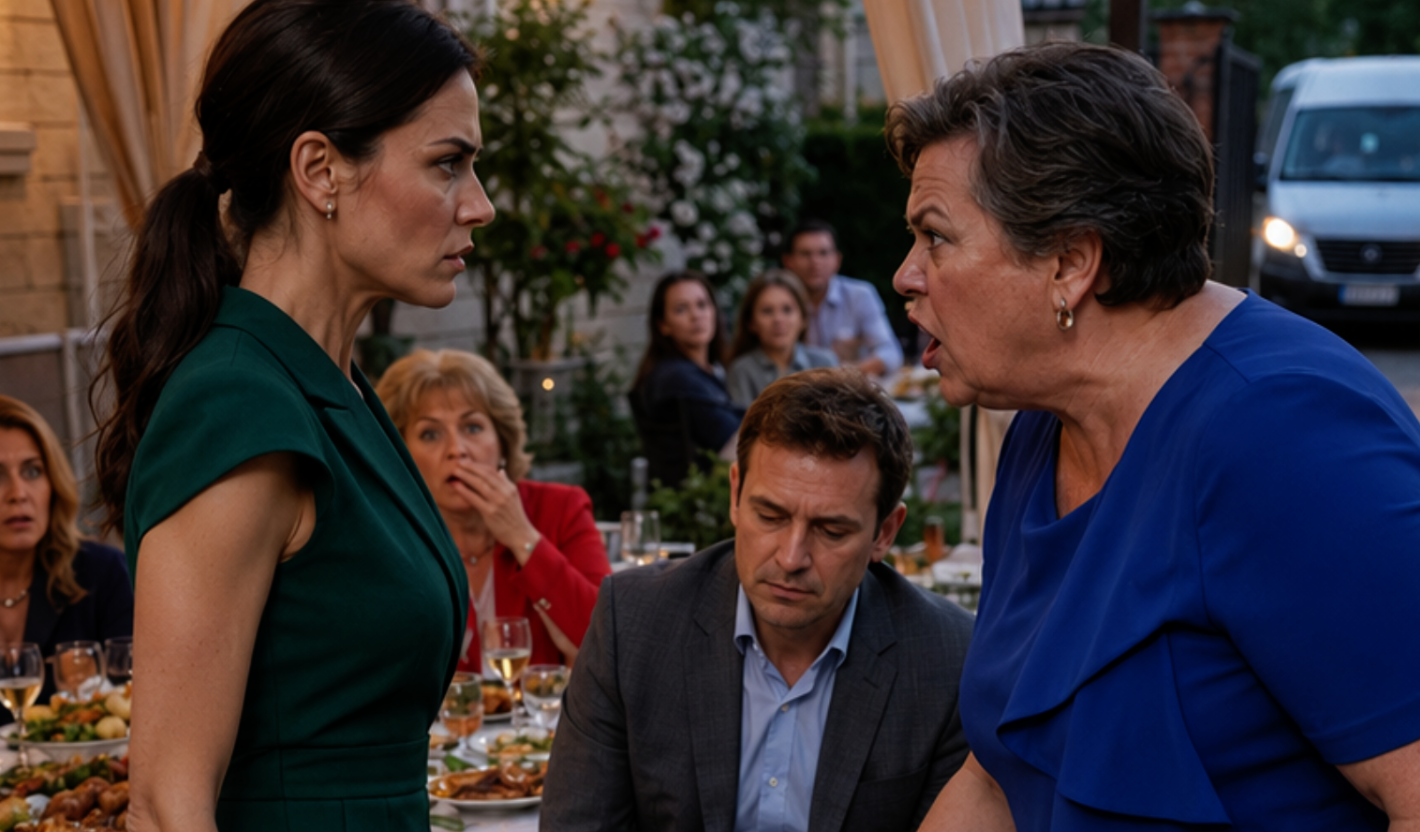
“Until You Apologize, You’ll Pick It All Up Yourself,” My Mother-in-Law Said, Dumping the Roast at My Feet—So I Took the Hot Food Away from Her Anniversary Party
My mother-in-law dumped a plate of roast onto my shoes and ordered me to pick the meat up from the floor—without realizing who owned the van parked outside her gate.
The plate struck the edge of the table, and thick sauce splashed across Lada’s pale shoes. A piece of meat slid beneath a chair, brushed against one of its legs, and stopped near a folded tablecloth.
Zinaida Yakovlevna looked down at the mess with one hand pressed dramatically to her chest, as though she were the one who had just been humiliated in front of the guests.
“Until you apologize, you’ll pick it all up yourself,” she said. “No one comes into my house and tells me how to welcome my relatives.”
The clatter of forks around the table stopped.
Lada’s husband, Roman, did not look up. He carefully straightened the edge of the napkin he had been crushing on his lap only a minute earlier.
A timer clicked in the kitchen, and that brief sound seemed louder than the guests’ whispers.
Lada straightened her back.
Sauce was running down the toe of her shoe toward the heel, yet for some reason she suddenly remembered that she might have forgotten to switch off the desk lamp in her office that morning.
It was a meaningless little detail that had nothing to do with what was happening, but it was the only thing she could think about.
Roman first mentioned the celebration three weeks before Zinaida Yakovlevna’s birthday.
He was sitting in the kitchen, drinking tea from a mug with a chipped handle and scrolling through photographs of other people’s banquets on his phone.
“Mom is turning sixty,” he said. “I want to do it properly. Not serve herring in a giant bowl like we always do. I want people to remember it.”
Lada agreed too quickly.
In their marriage, she often agreed before she had time to think.
She worked as the purchasing manager of a cafeteria at a large machine-building factory. She knew suppliers, understood how to negotiate, and could put together an excellent banquet for less money than any restaurant would charge.
Her acquaintance Arseniy ran a small catering business. He had a van, two cooks, dishes packed in crates, folding tables, and a firm habit of never confusing promises with payment.
Lada ordered the hot dishes, appetizers, and cake.
Roman swore he would personally transfer the money for the food. Then his manager fell ill, his bonus was cancelled, and his cousin’s car broke down. So many excuses appeared that Lada eventually stopped remembering them.
In the end, she paid the deposit from her own savings, while Roman agreed to cover the drinks and the remaining cost of the kitchen staff.
“I’ll settle everything on the day of the party,” he assured her. “Just don’t make me look poor in front of Mom.”
Lada did not want to make anyone look poor.
She asked for only one thing: that he not touch the money she kept on a separate card for the payments on her apartment.
The apartment belonged to Lada. She had bought it before meeting Roman, and in recent months she had been paying the mortgage, utilities, and his insurance herself.
Roman usually replied that a family should not divide things into “mine” and “yours,” after which he gladly made use of everything she owned.
Zinaida Yakovlevna’s house stood outside Bryansk, beyond a railway crossing, surrounded by old apple trees and crooked fences.
By evening, a white marquee had already been erected in the yard, and Arseniy was arranging the tables underneath it.
His gray van stood beside the gate with its doors closed. The hot dishes were waiting inside. He planned to serve them later so that the meat would not dry out.
Zinaida Yakovlevna came onto the porch wearing a blue dress with glittering embroidery and immediately embraced her son.
“Romochka, you really did organize a proper celebration for your mother,” she announced loudly enough for the women standing near the gate to hear. “I knew my boy would never abandon me.”
Roman squared his shoulders proudly.
Lada was holding a box containing a foot massager that her mother-in-law had shown her in an online shop back in the spring.
Zinaida Yakovlevna glanced at the box and nodded toward the kitchen.
“Put it somewhere. Then go help the girls. They haven’t arranged the cold cuts yet.”
“I came as a guest,” Lada replied. “Everything has already been delivered. All that remains is to set the table.”
Her mother-in-law smirked.
“In our family, guests don’t sit around doing nothing. Especially people who are used to having everything done for them.”
Roman cleared his throat quietly but said nothing.
There was something familiar and sticky about that silence.
Lada carried the present inside, removed her coat, and went into the kitchen anyway, even though she had promised herself in the car that she would not.
She decided it would be easier to wash a few plates than spend the entire evening listening to accusations about how arrogant she was.
That thought was her first mistake.
Before returning to the guests, Lada glanced into a small room where a shawl prepared for her mother-in-law lay on the sofa.
Zinaida Yakovlevna had chosen it during a video call, complaining that her shoulders were always cold in her old one.
Lada unfolded the fabric, checked that the fringe had not caught on anything, and unnecessarily adjusted the paper bow on the box.
Then she heard Roman speaking in the hallway.
“Mom, just don’t start talking about money. She gets nervous about that.”
“You shouldn’t let her boss you around,” Zinaida Yakovlevna answered. “You train a woman to obey you in the beginning, and later she’ll thank you for having a man beside her.”
Lada put the box back down.
The shawl remained on the sofa, neatly folded in half.
The kitchen smelled of roasted peppers.
Aunt Evdokia, Zinaida Yakovlevna’s older sister, shoved a tray into Lada’s hands without even greeting her.
“Take this to the table. And fold the napkins in half. Don’t arrange them as though we’re at a funeral.”
Lada took the tray.
The small glasses trembled on it, each holding a slice of lemon. Her hands were occupied, so she could not respond immediately.
Aunt Evdokia noticed this and smiled, pleased with her little display of authority.
Lada was seated at the edge of the table near the door leading into the house.
Roman’s place was beside his mother, and on his other side sat Kira, a neighbor’s daughter who had recently returned from Moscow.
She wore a red jacket and kept leaning close to Roman so that she could hear him over the music.
“We’ve known each other for years,” Roman said when he noticed Lada looking at them. “Don’t start.”
She nodded.
She nodded first and regretted it afterward.
Why was she always being told not to start something she had never started?
Zinaida Yakovlevna raised the first toast to her son.
She explained how he had “found the people himself, arranged everything himself, and paid for everything himself,” and the guests cheerfully lifted their glasses.
Lada noticed that Roman was not merely remaining silent. He was smiling and accepting their gratitude.
His phone lay near the edge of the table.
The screen lit up with a message, and she managed to read only one line:
“Rom, don’t forget about the whiskey. Arseniy is waiting for the payment before serving the hot dishes.”
Lada’s spoon struck her plate.
Roman grabbed the phone, saw her expression, and immediately leaned toward her.
“Later,” he whispered. “Not now.”
She did not argue in front of the guests.
When he went behind the shed for a cigarette, Lada followed him.
The evening was warm for September, but the grass was already damp, and her heel sank into the loose earth.
“You haven’t paid for the van?” she asked.
Roman rubbed the back of his neck.
“Not all of it. I thought people would give Mom money today, and then I could settle the bill immediately.”
“You promised to transfer the money before the party began.”
“Lada, don’t get worked up. Mom has been saving for this day all year. It matters to her that she doesn’t look worse than Vera Nikolayevna. You know that after Dad died, these celebrations became the only thing holding her together. She feels that as long as people are sitting around a large table, the house is still alive.”
For one brief moment, Lada saw her mother-in-law as more than a woman who constantly stabbed her with cruel remarks.
She imagined the old house, the empty bedroom of her late husband, the adult daughter living in another city, and the son who visited more often to ask for money than simply to see her.
Lada almost said that she would pay.
Then Roman added, “I’ll make it up to you later. You’re not going to abandon me over forty thousand rubles, are you?”
Everything immediately fell back into place.
He was not asking her.
He had already made the decision for her.
“I’m not promising anything,” Lada said.
Roman frowned.
“Don’t humiliate me.”
“You’re doing that yourself.”
She returned to the table and sat silently for a while, watching Kira wipe a spot of sauce from Roman’s jacket collar.
Lada wanted to leave, collect her coat, and call a taxi.
The van stood beside the gate, Arseniy was working, the guests were eating, and she suddenly felt like an outsider at a celebration she had organized with her own hands.
Then Roman approached from behind, placed a hand on her shoulder, and spoke quietly.
“I talked to Mom. She won’t bother you anymore. And I’ll explain everything about the money myself. Just stay until the hot food is served, all right?”
Lada turned toward him.
He looked confused and even slightly ashamed.
She wanted to believe that there was still enough decency left in him for her to rely on.
“All right,” she said. “Until the hot food.”
It felt like a temporary truce.
Aunt Evdokia brought her a clean plate, Kira went to dance with one of Roman’s cousins, and Zinaida Yakovlevna stopped giving orders for a few minutes.
Lada watched the string of lights stretching from the apple tree to the shed.
The bulbs swayed in the wind, and one of them flickered intermittently.
When Arseniy opened the van, the smell of roast duck drifted across the yard.
The guests became animated and began shifting their chairs.
Roman rose, took the first lid from one of the catering containers, and announced loudly, “Well, Mom, here comes the main course. Everything is for you.”
Lada waited for him to say something else.
He had promised.
Instead, Zinaida Yakovlevna slapped him affectionately on the shoulder and said, “Now that is a real man. Unlike some people who earn a few pennies and suddenly think everyone should bow to them.”
Aunt Evdokia laughed.
Kira lowered her eyes.
Roman did not interrupt his mother.
“Actually, I paid for the order,” Lada said.
She did not speak loudly, but everyone at the table heard her.
Zinaida Yakovlevna slowly put down her glass.
“What did you say?”
“I told the truth. Roman still hasn’t paid Arseniy for the drinks or the hot food.”
Roman turned pale.
“Lada, that’s enough.”
“I was only clarifying.”
“You can clarify things at home,” her mother-in-law snapped. “You’re dragging my son through the dirt at my anniversary celebration.”
“I’m not dragging anyone through the dirt. You should not call something his money when he did not pay for it.”
Zinaida Yakovlevna rose sharply.
A spoon clattered against a plate. She grabbed the platter of roast that the cook had just placed on the table and tipped it onto the ground.
“Then pick it up, since you’re so honest!” she shouted. “Until you apologize, you’ll collect it from the floor yourself. People know how to behave properly in my house.”
Pieces of meat and potatoes fell around Lada’s feet.
One of the children whimpered quietly, and his mother covered his mouth with her hand.
Roman did not stand up.
He remained motionless, staring somewhere in the direction of the van.
Lada bent down only to remove her stained shoe.
She placed it on the edge of the porch, wiped her fingers with a paper napkin, and looked at Arseniy.
“How much food is still inside the van?”
At first, he did not understand.
“Two batches of hot dishes, appetizers packed in crates, and the drinks. I thought we’d bring them out after the toast.”
“Don’t bring them out.”
Roman jumped to his feet.
“What are you planning?”
Lada walked toward the van.
She did not shout, which made her voice even more noticeable.
“Arseniy, load everything that hasn’t been placed on the table back into the van. The alcohol, hot dishes, cakes in the boxes—everything. I have paid for what they have already eaten. Roman can order the rest from you himself when he finds the money.”
“Lada!” Roman took a step toward her. “You can’t leave my mother without dinner!”
“She isn’t without dinner. There is enough food on the table for twenty people. You promised to pay for everything that came afterward. So pay for it.”
Zinaida Yakovlevna came onto the porch, still clutching a napkin in one hand.
Her face trembled with anger.
“Did you deliberately decide to ruin my celebration?”
“No,” Lada replied. “I simply stopped paying for it.”
She took out her phone and called the bank.
Speaking calmly, she gave the operator the final digits of the card.
Roman listened as she requested that the supplementary card he used for fuel and small expenses be blocked.
There was no talk of divorce and no dramatic performance.
Only brief answers and the tap of her fingernail against the screen.
“Have you lost your mind?” he hissed. “I have to go to work tomorrow.”
“You have a salary, Roman.”
“I won’t receive it until Friday.”
“Then take the bus.”
The guests exchanged uneasy looks.
Aunt Evdokia initially tried to object, but Arseniy was already closing the doors of the van.
The dishes rattled dully inside.
That sound finally split the celebration into two parts.
Before it, Roman had been the generous son.
After it, he was simply a man who could not even pay for the things he had boasted about providing.
“Mom, I’ll sort this out,” he said hurriedly.
Zinaida Yakovlevna looked at her son.
Not at Lada—at him.
For the first time that evening, she did not see a handsome man in a new jacket.
She saw his empty hands.
“How will you sort it out?” she asked quietly.
Roman opened his mouth but found no answer.
Lada collected her coat, the gift, and her second shoe.
The foot massager was still inside its box near the wall. She lifted it by its handle, even though the cardboard cut painfully into her fingers.
On the porch, Zinaida Yakovlevna tried to block her path.
“Give the present back. It belongs to me.”
“You never accepted it,” Lada said. “You simply left it in the hallway.”
She walked past her.
No one tried to stop her.
Roman arrived at her apartment by taxi that night.
Lada saw him through the peephole. His jacket hung from one shoulder, and a dark wine stain covered one sleeve.
He rang the doorbell for a long time and then began pounding on the door with his palm.
“Open the door. We need to talk.”
She did not let him in.
She sat on the floor in the hallway, leaned her back against the door, and waited for him to leave.
The box containing the foot massager stood beside her. She had not even opened it.
A lightbulb flickered in the corridor.
Lada watched it and thought that she would change the lock the following morning.
She did not pack Roman’s belongings into garbage bags.
She took clean boxes from the storage room and carefully packed his shirts, documents, chargers, and chipped mug.
By lunchtime, a locksmith had replaced the cylinder in the front-door lock.
Then Lada sent Roman a single message:
“Your belongings are with the concierge. All further questions should go through my lawyer.”
He answered immediately.
“You have no right to treat me like this.”
Lada read the message, muted her phone, and went to work.
A month later, Arseniy called her.
He disliked becoming involved in other people’s family problems, so he spoke without emotion.
“Roman finally paid the bill. He sold a car. Not his own, though—the one his mother had planned to buy for the country house. Zinaida Yakovlevna is now telling everyone that selling it was her idea.”
“Why are you telling me this?”
Arseniy paused.
“Because yesterday Roman asked me for a job. I refused. He promised to pay me for the catering ‘by Friday’ too.”
Lada thanked him and ended the call.
That evening, she visited a shoe-repair shop to collect her shoes.
A small dark stain remained on the toe, and the repairman had been unable to remove it completely.
He offered to paint over it, but Lada refused.
At home, she put the kettle on, sliced some apples, and opened the window.
Cars hummed behind the apartment buildings, and warm light fell across the windowsill.
A small cake from the same bakery that had made the anniversary cake stood in her refrigerator.
Lada cut herself a slice, sat beside the window, and ate it slowly, without rushing to clean the crumbs from the table.