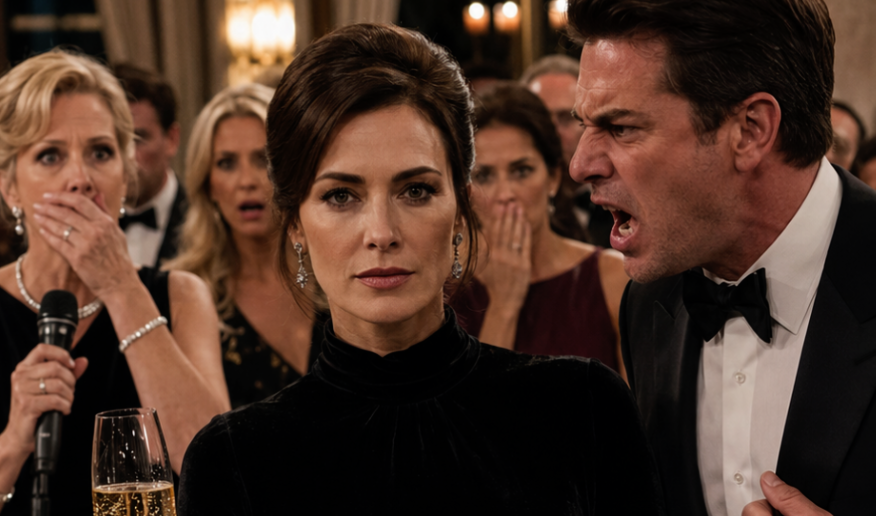
“Sit down and keep your mouth shut. Don’t embarrass us at my mother’s anniversary!” her husband snarled, unaware that one minute later, Zhanna would raise a toast and announce their divorce.
The Venice banquet hall was drowning in the scent of lilies. Their heavy, cloying fragrance had soaked into the tablecloths and curtains; even the air itself seemed sticky with it.
Zhanna hated lilies.
They smelled like funerals, as her mother had once said, and ever since then, their scent had filled her with a dull sense of unease. But Rosa Lvovna adored lilies. Naturally, lilies decorated every table, every column, and every step leading to the entrance.
Zhanna stood beside the main table, adjusting a bouquet. White flowers with yellow stamens were tied together with a golden ribbon. One rose slipped out of the arrangement and fell onto the tablecloth. Zhanna reached for it, careful not to knock over the champagne glasses.
“Clumsy hands,” a quiet but distinct voice sounded behind her. “You ruin everything. Put it down and step away. Stop hovering in front of the guests.”
Rosa Lvovna appeared as if from nowhere.
At seventy, she looked no older than sixty. Her face was firm and carefully maintained, expensive pearls encircled her neck, and her couture dress had cost as much as half the annual salary of an average Moscow family.
Her mother-in-law looked at Zhanna with a particular expression that had been perfected over years of contempt. She smiled coldly and appraisingly, as though Zhanna were a stain on the tablecloth that no amount of scrubbing could remove.
“I was only fixing the bouquet, Rosa Lvovna,” Zhanna answered quietly. “It was leaning slightly.”
“It was perfect until you touched it.”
Her mother-in-law took the rose from Zhanna’s hand and placed it back into the arrangement with deliberate precision.
“There. Don’t touch anything else. Your job today is to smile and keep quiet. That is what you do best, isn’t it?”
Zhanna said nothing.
She moved toward the window, feeling something hot and bitter beginning to boil inside her. Outside, it was May. Lilacs were in bloom, and evening traffic flowed along the Garden Ring in glowing streams.
Somewhere out there, in that enormous city, lived people who had no idea what it was like to spend twenty years married to a man who had never once taken your side.
She took her phone from her clutch. She only meant to check the time, but she noticed a notification.
It was a message from the notary.
Zhanna opened it and read:
“Zhanna Igorevna, the documents concerning your father’s inheritance are ready. The amount will pleasantly surprise you. This changes everything. I am waiting for your call.”
Her heart slammed against her ribs.
She read the message three times before its meaning fully sank in.
Her father had died a month earlier, quietly and in his sleep, in his small apartment on the outskirts of the city. Maxim had not even attended the funeral. He claimed he had an important meeting with a client.
At the time, Rosa Lvovna had remarked, “Why are you grieving so much, darling? Your father was, how shall I put it gently, not exactly one of us. A failed little professor who spent his entire life earning a miserable salary. What could he possibly have left you? Unpaid utility bills?”
Zhanna tightened her grip on the phone.
She did not yet know the exact figures, but the notary would not have written “this changes everything” over a few hundred thousand rubles.
Her father had been a genius.
For years, he had worked on some kind of patent, drawing diagrams and writing equations. Maxim had called him a “mad inventor” and laughed about him behind his back.
And now…
“Zhanna!”
The sharp shout pulled her from her thoughts.
Maxim stood in the aisle between the tables. Tall and broad-shouldered, he wore an immaculate tuxedo. Gray at his temples gave him an air of authority, and expensive cuff links glittered beneath the chandeliers.
He looked like a man who was accustomed to winning—in court, in business, and in life.
His partners feared him. His competitors respected him. His mother worshipped him.
Only Zhanna knew what he was like at home.
She knew, but she had always remained silent.
“Come here,” he ordered through clenched teeth.
Zhanna approached him.
Maxim seized her by the elbow and pulled her behind a column, away from the guests’ eyes. His fingers tightened too hard, digging into her skin and leaving marks that would become bruises by morning.
“What have you done now?” he hissed, leaning close to her ear. “I saw the way Mother was looking at you. Did you ruin something again? Can’t you behave normally for once in your life?”
“I didn’t do anything, Maxim. I only adjusted the flowers.”
“You only adjusted the flowers!”
He gave a bitter laugh.
“You can’t even arrange flowers properly. Everything falls apart in your hands. Listen to me carefully.”
He turned her to face him.
Cold fury swirled in his eyes. Zhanna had seen that fury dozens of times throughout their marriage. It never became shouting in public, but at home, it turned into hours-long lectures about her worthlessness.
“Sit down and keep your mouth shut. Don’t embarrass us at my mother’s anniversary. You are nobody here. Smile and be grateful they even let you sit at the table. Understand? Just try opening your mouth tonight, and I will make your life so miserable that you’ll regret the day you agreed to marry me.”
He released her arm, straightened his jacket, and walked back toward the guests.
Zhanna remained behind the column, feeling the skin throbbing where his fingers had been.
She watched him walk away and thought about how long twenty years really was.
For twenty years, she had been nobody.
The woman who always smiled in public and cried in the bathroom at night.
She took out her phone again and looked at the notary’s message. Then she turned her gaze toward the guests taking their seats.
Rosa Lvovna sat at the head table like a queen upon a throne. Maxim moved from guest to guest, shaking hands and embracing important-looking men in expensive suits.
No one looked at Zhanna.
No one noticed her.
She smiled.
For the first time that evening, she smiled sincerely.
Because she knew that everything would change tonight.
She would no longer be nobody.
The evening began with toasts.
One guest after another stood before the microphone and spoke about Rosa Lvovna. There were honored cultural figures, former colleagues from the theater, and old family friends.
They all used the same words.
“A remarkable woman.”
“An extraordinary mother.”
“A role model.”
Zhanna listened and thought about how none of them knew what Rosa Lvovna was like at home. They did not know how she could destroy a person with a single sentence. They did not know how she had tormented her daughter-in-law for years while everyone pretended not to notice.
Zhanna remembered the first time she had met her mother-in-law, twenty-two years earlier.
She had been a young graduate of the faculty of philology when she came to meet Maxim’s parents.
Rosa Lvovna had looked her up and down and said, “Well, my dear, for a provincial girl, you are not entirely hopeless.”
Zhanna had said nothing.
She thought perhaps it was simply Rosa Lvovna’s manner of speaking. She thought things would improve with time.
Nothing improved.
A year later, she and Maxim married.
Zhanna abandoned her postgraduate studies because Maxim had said, “Why do you need that nonsense? I earn enough. You should take care of the home instead.”
And so she took care of the home.
She cooked, cleaned, and did the laundry.
Then Styopa was born.
At the christening, Rosa Lvovna raised a glass of cognac in front of the guests and declared, “Let us drink to the new mother, who never managed to play a single respectable role in life before going on maternity leave! Fortunately, the child has a father who can provide for him.”
The guests laughed.
Zhanna smiled.
Later, Maxim told her, “Don’t take it personally. Mother only wants what is best for us.”
The years passed.
Styopa grew up, enrolled in a university abroad, and moved away.
Zhanna remained alone in the large apartment with a husband who came home after midnight smelling of another woman’s perfume.
She knew he had someone else.
She knew, but she stayed silent.
She stayed silent when she found receipts from expensive restaurants in his pockets.
She stayed silent when he forgot their wedding anniversaries.
She stayed silent every time Rosa Lvovna told her, “You should be grateful my son puts up with you.”
Once, Zhanna overheard Maxim speaking to a friend on the phone.
She had accidentally picked up the kitchen receiver, thinking the call was for her, and heard her husband say:
“I can’t leave her yet. Zhanna is a habit. It’s convenient having someone keep the house clean and cook borscht. I’ve got an important deal coming up, and I don’t need a scandal. I’ll tolerate her until autumn, and then we’ll see.”
Zhanna had quietly replaced the receiver and sat down on the kitchen floor.
She sat between the stove and the refrigerator, staring at nothing.
Then she stood up and began preparing dinner.
Maxim would be home soon.
The borscht had to be hot.
The banquet grew louder.
The guests had finished their second and third rounds of drinks. Some were already dancing. Waiters carried out the main courses.
Then Kira burst into the hall.
Kira was Maxim’s niece, the daughter of his younger sister.
She was twenty-eight, a blogger, and a spoiled rich girl who had never worked a day in her life but considered herself an expert on everything.
She had long blond hair, eyelash extensions, and a habit of speaking as though her presence were a favor to everyone around her.
Kira carried a portable camera. She was filming “content” for her channel, where she talked about the glamorous lives of wealthy young people.
“Grandma!” she shrieked, rushing toward Rosa Lvovna. “Happy birthday, my queen! You look like a style icon! Honestly, you have to tell me all your beauty secrets!”
Rosa Lvovna lit up.
She embraced her granddaughter and allowed Kira to cover her cheeks with kisses.
“Kira, darling, you’re late,” she cooed. “We have already started.”
“I was editing my new episode!” Kira announced loudly enough for the entire hall to hear. “I have two hundred thousand followers now. Can you imagine? Television producers are already inviting me onto their shows!”
She turned and scanned the hall.
Her eyes landed on Maxim.
“Uncle Max!”
She rushed toward him, threw her arms around his neck, and clung to him.
“You look so handsome! A real macho man! Listen, do you remember Alisa?”
Maxim tensed almost imperceptibly.
“Which Alisa?” he asked in a neutral tone.
“You know, that Alisa! The one Grandma Rosa wanted you to meet! Her friend’s daughter! I saw her recently, and she has become absolutely gorgeous. Such a beauty! She says she still remembers you.”
Kira glanced at Zhanna.
The look contained everything: contempt, mockery, and provocation.
Zhanna sat with her hands folded in her lap, staring straight ahead. She had long ago learned not to react to such attacks.
At least not visibly.
“Kira, don’t talk nonsense,” Maxim said, though there was no firmness in his voice.
He sounded mildly annoyed, as though scolding a beloved dog for making a mess in the hallway.
“Oh, come on!” Kira laughed. “We’re all family here! Zhanna won’t be offended. She’s used to it.”
Then something happened that Zhanna had not expected.
As Kira walked past her, her hand “accidentally” struck a cup of tea.
The cup overturned.
Hot tea spilled across the tablecloth and splashed Zhanna’s dress. Several drops landed on her hand, and the skin immediately turned red.
“Oh, I’m sorry!”
Kira pressed a hand to her chest in fake horror.
“I’m so clumsy! You didn’t burn yourself, did you?”
Maxim looked at his wife as though the entire incident were her fault.
His expression was filled with irritation.
“Zhanna, go and clean yourself up,” he said through clenched teeth. “You look like a dishwasher.”
Zhanna silently stood and walked toward the ladies’ room.
Behind her, Kira resumed her cheerful chatter. The guests laughed, and glasses clinked.
No one paid attention to the woman with a wet stain on her dress crossing the hall as quietly as she could.
The restroom was cool and silent.
Zhanna approached the mirror and looked at her reflection.
A forty-year-old woman with tired eyes and gray threads in her dark hair stared back at her.
There were fine lines around her mouth, her skin was pale, and her eyes looked lifeless.
When had she last felt happy?
She could not remember.
Zhanna turned on the faucet and held her burned hand beneath the cold water.
Her thoughts tangled together.
The notary’s message.
Maxim’s words.
Kira’s laughter.
The guests looking through her as though she were invisible.
And the nauseating scent of lilies.
She stepped into one of the stalls and locked the door.
She only wanted to sit in silence for a few minutes.
But silence did not come.
The restroom door flew open, and heels clicked against the tiled floor.
Two young female voices filled the room, carrying the particular arrogance possessed only by people who were both extremely wealthy and extremely foolish.
“Did you see her face?” Kira said. “She just sat there like a mouse and didn’t say a word! Poor Uncle Max. I don’t understand how he has lived with that gray little nobody for so many years.”
“What else can he do?” answered the second voice.
Zhanna recognized it as Karina, Kira’s cousin.
“Divorce her? She would take half the property. Their apartment near Patriarch’s Ponds is amazing. Grandma Rosa says it is actually her apartment because she gave it to Maxim before the marriage. But that woman—what is her name again? Zhanna—might take them to court.”
“She won’t,” Kira said confidently. “She’s nobody. No family, no background. Her drunk of a father died recently. What could he have left her? Unpaid bills? Just wait. Grandma Rosa will pressure Uncle Max until he throws that gray mouse out. By New Year’s, she’ll be begging in the streets while we drink champagne in her bedroom.”
The girls laughed.
The sound was like glass beads scattering across a stone floor.
“She is strange anyway,” Kira continued. “Always sitting with her books and never speaking. Grandma says everyone in her family is like that—completely insane. Her mother was quiet too, and then one day she slit her wrists.”
It was a lie.
Zhanna’s mother had died of a heart attack when Zhanna was fifteen.
But Kira clearly did not care.
Neither did Rosa Lvovna, who had invented the story.
“Come on, let’s go,” Karina said. “They are bringing out the cake. I want to film a story.”
Their heels clicked toward the exit.
The door slammed.
Silence returned.
Zhanna stepped out of the stall and approached the mirror.
Her face had not changed.
She still wore the same calm expression and had the same tired eyes.
But something inside her had shifted.
A spring she had been compressing for twenty years had begun to uncoil.
She fixed her hair, took out her lipstick, and applied a fresh layer. Then she returned it to her clutch.
At that moment, she saw her phone again.
The notary’s message was still glowing on the screen.
Zhanna opened her clutch and took out a folded sheet of paper.
She had told no one about it.
It was a copy of an independent valuation report.
Her father had not merely left her money.
He had left her a patent.
It was a technology that the major Rostekh industrial corporation was currently attempting to purchase.
The same corporation with which Maxim’s law firm was negotiating a legal services agreement.
The deal that was supposed to make Maxim a millionaire.
Zhanna carefully folded the paper and placed it back inside her clutch.
She studied her reflection.
For the first time in many years, she did not see an exhausted woman in the mirror.
She saw someone else.
Someone who had not yet surrendered.
She left the restroom.
The lights in the hall were already being dimmed in preparation for the birthday cake. Waiters placed dessert plates on the tables. Guests returned to their seats.
Rosa Lvovna glowed in the candlelight as she accepted congratulations.
Maxim stood beside his mother, holding a glass of champagne.
Kira switched on her camera again. She pointed the lens at the guest of honor, already imagining the video title she would upload the next day:
“Legendary Grandmother’s Anniversary: How the Elite Celebrate.”
Zhanna returned to her seat.
Maxim gave her a quick, appraising, cold glance.
Once he had confirmed that his wife had made herself presentable again, he lost interest in her.
“And now, we would like to invite the people closest to our guest of honor to say a few words!” the host announced. “Friends, let us ask Rosa Lvovna’s son, Maxim, to make a toast!”
The hall erupted in applause.
Maxim smiled his signature smile—confident and victorious.
He took the microphone and adjusted his tie.
“Dear Mother,” he began in his carefully trained public voice. “Today is a wonderful day. You are seventy, but looking at you, it is impossible to believe. You are eternally young and full of energy. You have devoted your entire life to this family. You raised me and helped me become the man I am today. I will always be grateful to you for that.”
He paused to allow the guests to applaud.
“I want to raise this glass to you, Mother. To your wisdom, your beauty, and your ability to bring people together. You are the heart of our family. As long as you are with us, we are invincible.”
“Bravo!” someone shouted.
“Wait.” Maxim raised a hand. “I am not finished yet. I would also like to thank my wife, Zhanna.”
A brief silence fell over the hall.
Several guests exchanged glances.
Kira snorted.
“Zhanna,” Maxim continued, and his voice took on the familiar note that she knew so well.
Condescension.
“You do not always manage your responsibilities as the lady of the house, but I know you try. And I appreciate that. Mother has taught you a great deal. I hope you will continue listening to her because she would never give you bad advice. Let us drink to family!”
He raised his glass.
The guests reached for theirs.
Then Rosa Lvovna approached the microphone.
Her eyes glittered, either from the champagne or from pleasure.
“May I say a few words too?” she asked, smiling like a cat that had reached the cream. “Zhanna, darling, forgive an old woman for being direct. I remember the day you entered our home wearing that dreadful little coat. My goodness, what a sight you were! I remember thinking, ‘Dear God, what could my son possibly see in her?’”
A few guests chuckled.
“But time passed, and I watched you try. I taught you how to dress. I taught you how to behave in society. I taught you how to be a wife. And do you know what? I think I succeeded!”
Rosa Lvovna gestured toward Zhanna.
“Look at her now. Sitting there and smiling. Beautiful! So let us drink to her continuing to learn her lessons and maintaining the standard I have set. Hold on tightly to your man, sweetheart. No one else would ever want you.”
The hall applauded.
Someone laughed.
Someone shouted, “Kiss!”
Kira pointed the camera at Zhanna, expecting to capture an embarrassed smile, a confused expression, or anything that would confirm Zhanna’s status as a “gray mouse.”
But Zhanna was neither embarrassed nor confused.
She stood.
Slowly and calmly, as though she had all the time in the world.
She lifted her glass of champagne.
She looked at Rosa Lvovna, then at Maxim, and finally at the guests.
And she began to speak.
“Rosa Lvovna, my dear,” she said in a gentle, almost affectionate voice. “Thank you for those words. Thank you for all the lessons. I truly learned a great deal from you.”
Her mother-in-law nodded with satisfaction, believing that Zhanna had finally accepted her place.
Maxim relaxed and smiled as well.
Kira kept filming, eagerly anticipating the moment she would later post online.
“For example,” Zhanna continued, her voice becoming stronger, “I learned how to endure. For twenty years, I endured humiliation, mockery, and being constantly told that I was worthless. When I wore that same ‘dreadful little coat’ you love mentioning so much, I loved your son so deeply that I would have sold a kidney to free him from the debts you pushed him into for the sake of your showy lifestyle.”
Rosa Lvovna’s smile disappeared.
Maxim frowned.
“Zhanna, what are you—” he began, but stopped.
“But I stayed silent,” Zhanna said more loudly. “I always stayed silent because you convinced me that I was nobody. That I was worthless. That I should be grateful simply because you allowed me into your family.”
Maxim lunged toward her, attempting to seize the microphone.
“Zhanna, stop this immediately!” he hissed.
“Don’t, Max.”
She pulled away and looked directly into his eyes.
“Keep your mouth shut. That is what you wanted, isn’t it? You told me to sit down, keep quiet, and not embarrass you. Remember?”
The hall became completely silent.
Even the waiters froze.
Someone coughed nervously.
Kira lowered her camera, beginning to understand that the evening was going terribly wrong.
“So,” Zhanna continued, turning back toward the guests, “today I am no longer nobody. Today is a wonderful day, and I would like to raise this glass so that everyone in this room may finally learn the truth.”
She took a folder from her clutch.
It was the folder she had received from the notary that morning.
“You all know my husband as a successful attorney. You know him as the man who is about to close the deal of a lifetime with the Rostekh corporation. You believe he is the genius, the provider, and the savior.”
She paused.
“But do you know something? The technology he is trying to sell does not belong to him. It belonged to my father. The same ‘failed little professor’ you all despised. And as his sole heir, I am withdrawing the patent from the transaction. There will be no deal.”
A murmur spread throughout the hall.
Someone gasped.
Rosa Lvovna clutched her chest, sincerely this time.
Maxim stood as pale as chalk.
His lips moved soundlessly.
“That is not all.”
Zhanna placed her phone on the table.
“There are photographs on it. Recent ones. You are welcome to look. My husband did not simply cheat on me with his secretary. He drove her around in our family car. He bought her jewelry using money he earned through connections provided by my family.”
She turned toward Maxim.
“And I am demanding a divorce. Right now. Officially. In front of witnesses.”
Rage filled Maxim’s eyes.
It was so intense that it seemed he might strike her in front of everyone.
“You…” he choked out. “You destroyed everything! Do you understand what you have done? I will destroy you! You won’t get a single kopek! You—”
“Careful, Maxim,” Zhanna said calmly, though there was steel in her voice. “The bruises on my arms have already been documented by a physician. Public aggression in front of witnesses would not be in your best interest. You are a lawyer. Calculate the risks.”
He froze.
His hand, already raised as though to strike her, hung in the air.
Zhanna looked at him without fear.
For the first time in twenty years, she looked at her husband not as a victim but as an equal.
“You lost, Maxim,” she said quietly enough for only him to hear. “In every possible way. As a husband, as a son, and as a businessman. Now step aside. I have somewhere to go.”
She placed her glass on the table, fixed her hair, and walked toward the exit.
Behind her came shouting, sobbing, and the sound of breaking glass.
Rosa Lvovna shrieked.
Kira struggled to switch her camera back on.
The guests jumped from their seats.
But Zhanna did not look back.
She crossed the lobby, passed the cloakroom without taking her coat, and stepped outside.
The May evening air struck her face, carrying the scent of lilacs and gasoline.
An old Volga was parked near the entrance.
It was the same car her father had driven.
Uncle Kolya, her father’s old friend who had once taught Zhanna how to ride a bicycle, sat behind the wheel.
“Well, Zhannochka,” he asked as he opened the door for her, “did you win your battle?”
“No, Uncle Kolya,” she answered. “I have only begun.”
The car moved away.
Zhanna leaned back in the seat and closed her eyes.
She did not know what would happen tomorrow.
She did not know where she would live, what work she would do, or how she would build her new life.
But for the first time in many years, the unknown did not smell like fear.
It smelled like lilacs.
Six months passed.
October rain tapped against the windows of a small café near Chistye Prudy.
Two women sat at a table beside the window, laughing.
Zhanna looked different.
She had lost weight, cut her hair, and was wearing a bright scarf. The frozen emptiness that had frightened her whenever she looked in the mirror during the final ten years of her marriage was gone from her eyes.
She spoke with animated gestures, freely and naturally, without constantly checking how others might react.
Across from her sat Alisa—the same Alisa whom Rosa Lvovna had once intended Maxim to marry.
They had met by accident one month after the divorce.
Zhanna had been gathering documents for the court case and visited a legal consulting office.
Alisa worked there as an attorney.
She recognized Zhanna, raised her eyebrows, and suddenly laughed.
“You are the famous Zhanna? I have heard so much about you. Mostly terrible things, naturally. But when I learned what you did at Rosa Lvovna’s anniversary, I gave you a standing ovation.”
They began talking.
It turned out that Alisa had never wanted to marry Maxim. Her parents and Rosa Lvovna had attempted to arrange the marriage, but Alisa had escaped.
She had been living her own life for years and was perfectly happy.
“You know,” Alisa had said, “I have an idea. You mentioned that you want to start a literary club. I have been looking for a partner for a social project. Why don’t we combine our efforts?”
That was how the Free Women’s Club was created.
It became a place for women who had recently left difficult relationships.
Women who had lost themselves in marriage.
Women who needed support.
Zhanna organized literary evenings, while Alisa helped members with legal matters.
The project was doing well, financially and, more importantly, in terms of purpose.
That day, they were celebrating the club’s six-month anniversary.
Alisa brought champagne, and Zhanna ordered pastries.
They sat talking and laughing while the rain outside made the café feel warm and comfortable.
“Listen,” Alisa suddenly said seriously. “Have you seen the latest news?”
“Which news?”
“About Maxim’s firm. I came across an article a few days ago. They are in serious trouble. The Rostekh contract fell apart, several partners left, and lawsuits have been filed. It seems your former husband is not doing very well.”
Zhanna shrugged.
“I heard. Uncle Kolya told me. He has been following the story.”
“And how do you feel?” Alisa asked, studying her carefully.
Zhanna thought about it.
She honestly searched inside herself for something—malicious satisfaction, joy, or a sense of victory.
She found nothing.
The things that had once caused her so much pain now produced no emotion at all.
It was as though she were observing everything from a great distance.
“Nothing,” she finally answered. “I feel absolutely nothing. It’s strange. I thought I would be happy to see him fall. But I don’t care. He is no longer part of my life. He is simply… nobody.”
Alisa smiled and raised her glass.
“Then let us drink to that. To former partners becoming nobody.”
They clinked glasses.
The champagne was cold and sharp, and the bubbles pleasantly tingled on Zhanna’s tongue.
She set down her glass and looked through the window.
The rain blurred the streetlights, transforming them into golden stains.
She remembered her father.
His small apartment crowded with books and technical drawings.
His quiet voice:
“My daughter, the most important thing is never to betray yourself. Glass, no matter how transparent, can be mistaken for air. But strike it, and it will cut you until you bleed. It is better to be a diamond—something people notice immediately and do not dare to break.”
At the time, she had not understood what he meant.
Only now did she finally understand.
That evening, Zhanna returned home.
To her new apartment—bright and quiet, with large windows and books lining the shelves.
She removed her shoes, went into the kitchen, and put the kettle on.
On a shelf in the living room stood an old photograph of her father in a wooden frame.
Beside it was a bundle of his letters tied with twine.
Letters she had reread dozens of times during the years she lived with Maxim.
She picked up one of them—the first letter her father had written after her wedding.
“Zhannochka, I met your husband. I did not like him. But you love him, and I respect your decision. Just remember that if you ever need help, I will be here. And remember one more thing: you are stronger than you believe. You are my daughter.”
Zhanna pressed the letter against her chest.
Then she carefully folded it and placed it back with the others.
She approached the window.
The rain had stopped, the sky had cleared, and the first stars were appearing above the city.
Zhanna looked at her left hand.
Her wedding ring was still there.
She had not removed it after the divorce.
The previous week, however, she had taken it to a jeweler and asked him to replate it.
A new layer of rhodium now covered the old gold.
It had a cold, steel-like shine.
The ring was no longer a symbol of her marriage.
It had become a symbol of the fact that the past could not be erased, but its structure could be transformed.
You could take the thing that had tormented you and turn it into a source of strength.
Zhanna removed the ring, turned it between her fingers, and placed it back on her hand.
Then she smiled.
Tomorrow, new classes awaited her at the club.
New women with lifeless eyes would come searching for support.
There would be new texts for her to read aloud.
And there would be the new life she was building for herself, without looking over her shoulder or seeking anyone’s approval.
The doorbell rang.
Zhanna opened the door.
A courier stood outside holding a bouquet.
Not lilies.
Lilacs.
“These are for you,” he said, handing her the flowers. “They are from Alisa. There is a note inside.”
Zhanna accepted the bouquet, thanked him, and closed the door.
She found the note.
“You are a diamond. I am glad you exist. A.”
Zhanna laughed.
She arranged the lilacs in a vase, poured herself a cup of tea, and sat in the armchair beside the window.
The apartment smelled like spring, even though it was October.
For the first time in many years, she felt comfortable being alone with herself.
For the first time, she was not waiting for anyone to call.
She was not afraid of anyone’s words.
Zhanna took a book from the shelf, opened it at random, and began to read.
Tomorrow would be a new day.
And she would meet it with her back straight.