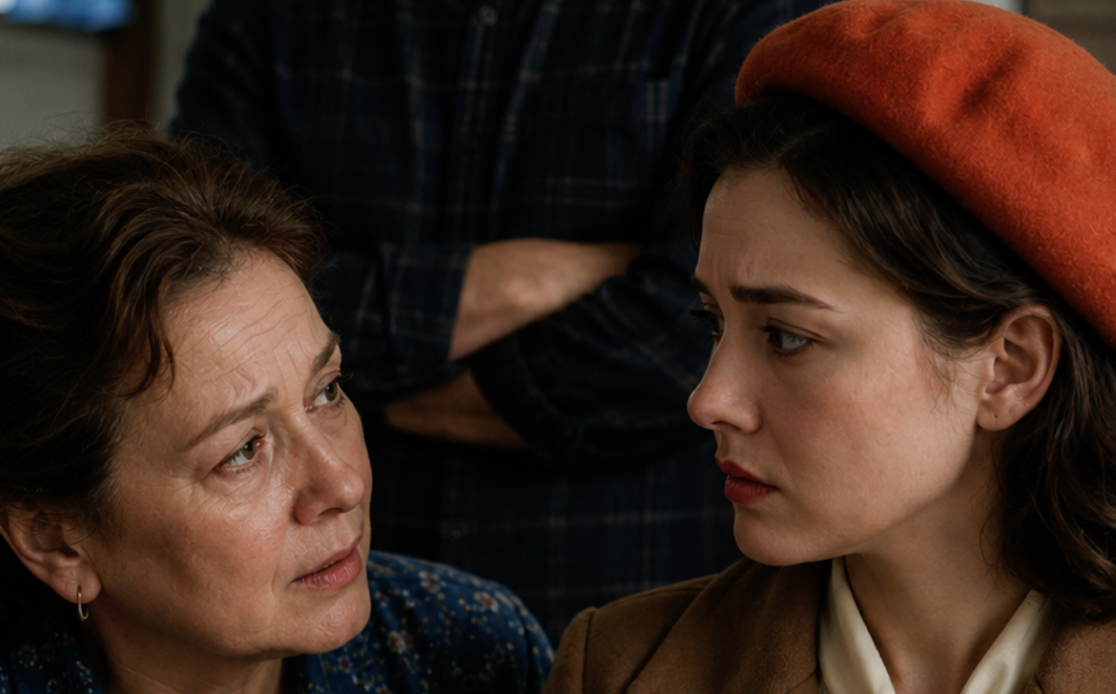
I Cooked for Three Hours. My Mother-in-Law Ate My Dinner — and I Left Forever
Vera opened the refrigerator at eight in the evening and saw an empty pot.
Three hours standing at the stove, a Hungarian recipe she had found in an old magazine — all of it had turned into the clean bottom of a dish.
Enamel, with a scratch down the middle, like the mark of her twenty-eight-year marriage.
She placed the pot on the table. She simply stood there and stared at that bottom, as if she were seeing it for the first time.
She had spent half an hour choosing the beef at the store — marbled, expensive, without trying to save money. She had bought real Hungarian paprika from a specialty shop, not some powder from a packet.
She had chopped the onions so finely that her eyes watered. She had simmered everything over low heat for two and a half hours, stirring every fifteen minutes. She had stood by the stove, thinking about herself. About the fact that tonight she would not be sharing dinner with anyone.
For herself. For the first time in many years — simply for herself.
Vera lifted her eyes to Galina Petrovna. Her mother-in-law was sitting in an armchair, covered with a blanket, watching a health program. On the screen, a female doctor was explaining something about joints. Galina Petrovna nodded as if she understood everything.
“Galina Petrovna, did you eat the goulash?”
“Huh?” Her mother-in-law tore her eyes away from the screen and frowned with annoyance. “What goulash?”
“The one that was in the refrigerator. In this pot.”
“Oh, that,” her mother-in-law’s face relaxed. “Yes, I ate it. So what?”
Vera felt something tighten inside her. Not anger. Not hurt. Something colder, heavier. Something that had been building for years.
“Galina Petrovna, I cooked it for three hours. For myself. For dinner.”
“Well, you didn’t write a note,” her mother-in-law spread her hands, as if that explained everything. “I thought it was for everyone. I was hungry after coming back from the clinic. I opened the fridge, saw the goulash, it smelled good. So I ate it. What’s the big deal?”
“You came back from the clinic at four o’clock. Why didn’t you call me at work? I would have explained.”
“Why should I call?” Galina Petrovna frowned, and offense appeared in her voice. “We’re family. Am I supposed to ask permission? In my son’s home? This is our apartment, our food. Or do you think otherwise?”
Vera was silent. For twenty-eight years she had been silent when her mother-in-law rearranged the furniture in their bedroom — “It will be brighter this way, trust me.” When she threw away Vera’s expensive French cream, which Vera had saved up for two months to buy — “What a waste of money, it doesn’t do any good. You should have given me that money for medicine.”
When she taught her how to cook borscht properly, even though Vera had been cooking since she was seventeen and knew dozens of recipes by heart. She stayed silent when her mother-in-law criticized her hairstyle, her dresses, her work.
Twenty-eight years of silence.
“You could have at least left half,” she said quietly.
“Verochka, what’s wrong with you?” Galina Petrovna switched on the tone of an offended old woman; her voice became thinner, more pitiful. “I didn’t know it was your personal food. You can cook more. You’re young, you have hands. Why get upset over food?”
Fifty-four years old. “Young.”
Vera took the pot and slowly walked to the kitchen. Behind her, the sound of a key in the lock rang out — Andrey had come home. Her husband’s voice sounded loud and cheerful:
“Hi, Mom! How are you? Verka, is dinner ready?”
Vera froze by the sink. She turned around. Her husband was standing in the hallway, taking off his jacket and throwing it onto the hanger. Galina Petrovna was already hurrying toward him — small, hunched, but quick.
“Andryusha, she’s upset with me,” her mother-in-law said in a pitiful tone. “I ate the goulash that was in the fridge, and now she’s making accusations. She says she cooked it for three hours. But I didn’t know!”
“What goulash?” Andrey entered the room and looked at Vera. “What are you talking about?”
“The one I cooked for three hours,” Vera said evenly. “For myself. Your mother ate all of it. To the very last spoonful.”
“So what?” Andrey shrugged and hung up his jacket. “Mom was hungry. You could have left a note if it was especially for you. Normal people do that.”
Vera looked at him. At this man with a tired face, a stain on his shirt, and gray hair at his temples. The man she had lived with for twenty-eight years. The man who always, always took his mother’s side. Always. Without exception.
“A note,” she repeated slowly.
“Well, yes. So Mom would know it was yours. Then there wouldn’t have been a problem. Normal people warn others. It’s basic politeness.”
“Normal people,” Vera put the pot in the sink and heard how loudly it hit the enamel. “Normal people don’t eat someone else’s entire dinner. Normal people call and ask, ‘Can I take this?’ Normal people think about someone besides themselves.”
“Verka, why are you going crazy?” Andrey walked into the kitchen, opened the refrigerator, and looked inside. “You’re making a scandal over some goulash. Give me something to eat. I’ve been at the construction site since morning, I’m tired as a dog.”
“It’s not about the goulash,” Vera said quietly.
“Then what is it about?”
She was silent. How could she explain it? Goulash was just food. Just three hours she had spent after work, after a meeting, after her boss had scolded her for a mistake in the calculations.
Just her exhaustion, her desire for something delicious, cooked with care, for herself, without thinking about anyone else. Just one more small boundary that had been erased without asking. One more “you don’t matter.” One more time.
“It’s because you’re always on her side,” Vera finally said. “Always, Andrey.”
“Mom is right,” he snapped, taking sausage out of the fridge. “You should have written a note. And besides, she’s old, sick, hungry after the clinic. You should have felt sorry for her. She’s your mother-in-law, almost like a mother.”
Vera looked at him — and suddenly understood. With piercing, painful clarity. For twenty-eight years she had been waiting. Waiting for him to take her side someday. For him to say, “Mom, that was wrong. You should have asked.”
For him to choose his wife over his mother at least once. Just once. One single time.
He would not. Never.
“All right,” she said quietly. “I understand.”
Andrey became wary. He was not used to this tone — without tears, without hurt, without arguments.
“What do you understand?”
“Everything.”
She left the kitchen. She walked past Galina Petrovna, who was sitting in the armchair pretending to watch television. She entered the bedroom. Closed the door. Sat down on the bed.
She took out her phone. Called Lena. Her friend answered after the third ring.
“Verka? What happened? Your voice sounds strange.”
“Lena, can I come to you?”
“Of course, anytime. Why?” Anxiety appeared in Lena’s voice. “Vera, what’s wrong? Did something happen?”
“I need to leave. For a while.”
“For how long?”
Vera looked at the door. Behind it was their apartment. A three-room apartment in the Moscow suburbs. Bought in 2010, paid off by 2020. They had renovated it together.
In that apartment she had cleaned, cooked, endured. For twenty-eight years she had endured. Dissolved. Disappeared.
“I don’t know,” she said honestly. “Maybe for a long time.”
“Come,” Lena said immediately, without questions. “You know where the key is. I’ll be home in an hour.”
Vera hung up. She opened the wardrobe. Took out an old travel bag. She began packing clothes: underwear, a sweater, jeans, warm socks. A makeup bag. Documents. A bank card. A phone charger. A photograph of her daughter.
The door opened. Andrey came in.
“What are you doing?”
“Packing.”
“Where are you going?”
“To Lena’s.”
He stood in the doorway, not understanding. Vera zipped the bag and placed it on the floor.
“Verka, are you being stupid because of the goulash? Mom ate it, so what? You’ll cook more. Why are you making such a drama?”
“Because of everything,” she said, looking into his eyes. “Because of twenty-eight years, Andrey.”
“What do you mean, ‘twenty-eight years’? What are you even talking about?”
Vera lifted the bag. She looked at her husband.
“I’m talking about the fact that you never chose me. Not once, Andrey. It was always Mom. Mom is right, Mom is old, Mom is sick. And me? Don’t I get tired? Don’t I want my own space? Don’t I have the right to my own goulash?”
“Are you jealous of my mother?!” His face turned crimson. “She’s my mother! Have you lost your mind?”
“No. I’m just tired of being second. Or not even second. Third. Tenth. Invisible. I’m tired, Andrey.”
She took the bag and walked past him. Galina Petrovna was standing in the hallway, her face anxious and frightened.
“Verochka, where are you going? Is it because of me? I didn’t mean to… I didn’t know, honestly…”
“It’s all right, Galina Petrovna,” Vera said evenly. “It’s not your fault.”
That was a lie. But she had no strength to explain. And no point.
She put on her jacket. Took her bag. Opened the door.
“Vera, stop.” Andrey grabbed her by the arm. “What are you doing? She’s my mother! Where are you going?!”
“I don’t know,” Vera said, freeing her hand. “I honestly don’t know. Maybe not for long. Maybe for a long time. But I need to think. I need to be alone. I need to understand who I am without you.”
She opened the door.
Outside the window, it was November — cold, dark, with wind and rare streetlights. Vera stepped into that November with the feeling that, for the first time in twenty-eight years, she was doing something for herself.
Vera walked along the empty street, breathing in the cold November air. The wind ruffled her hair, stung her cheeks, and blew under her jacket. Somewhere in the distance, a dog barked. The rare streetlights illuminated the asphalt in patches of yellow light. The bag pulled at her shoulder.
Never before had she left her own home like this — without hysteria, without a scene, without loud words, without slamming the door. Just quietly. She simply took her bag and left. As if she had been doing it all her life.
Her husband’s usual phrase — “You’re being stupid” — sounded ironic after twenty-eight years of concessions. For twenty-eight years she had said, “It’s all right,” “Fine,” “I’m not offended,” “Don’t worry.”
She had said it so often that she herself had believed it. She had learned not to feel.
The taxi ride to Lena’s apartment took half an hour. The driver was silent and kept the radio low. An old song was playing: “I am free, like a bird in the sky.” Vera smirked in the darkness. Free? We’ll see. She did not even know what freedom was. Twenty-eight years.
“You’re here?” Lena met her with a smile. And hot tea in Vera’s favorite mug with daisies. “Don’t explain now. Just be here.”
Vera nodded with relief. They sat in the kitchen until midnight, and Lena was silent more than she spoke. She simply listened. Vera told her everything: about the wedding, when her mother-in-law had said, “My daughter-in-law must know how to cook,” about the borscht she had remade three times until Galina Petrovna approved it, about the goulash, about the note, and about “normal people.”
About everything. About twenty-eight years of small concessions that had turned into one great loss of herself.
“Don’t be surprised, you’re not the only one,” Lena finally said when Vera fell silent. “I went through this with Pyotr. My mother-in-law bossed everyone around for ten years. Only I didn’t have the strength to leave. I stayed. Then he passed away, and so did my mother-in-law, and I realized I had lost myself forever. You’re stronger, Vera.”
“And I’m not scared,” Vera admitted. “Do you know why? Because there is nothing left. Fear of losing what you don’t have is not fear. It’s relief.”
“That’s not true,” Lena placed a hand on her shoulder. “You still have yourself, your recipes, your character. Your life, Vera. It is only beginning.”
Vera smiled crookedly, wearily. She went to bed in someone else’s room, under someone else’s blanket, but she slept deeply, without dreams. She woke up to silence. No one was shouting, “Where’s the coffee?” No one was demanding, “Wash my shirt.” No one was commenting on her hairstyle. Just silence. Unfamiliar, frightening, but so desired.
The next day Andrey called. His voice was quiet — not like usual.
“Vera, where are you?”
“At Lena’s.”
“Will you be there long?”
“I don’t know.”
“Mom is worried. She doesn’t feel well. I’m worried too. Come home. Come on, really, you’re acting like a child. You got offended over nonsense.”
“Let her worry,” Vera said evenly. “Maybe that’s even good. Maybe she’ll learn to ask. Maybe she’ll understand that other people have feelings too.”
“Are you serious?! Making drama over some goulash? Mom is old and sick!”
“You don’t understand, Andrey.”
“I do understand. You’re tired. It happens. But that’s no reason to destroy a family.”
“Tired is the smallest part of it,” Vera looked out the window. It was raining outside. “I no longer want to be an ‘addition.’ I want to be myself. I want my opinion to mean something.”
Andrey fell silent. Vera could hear his breathing tremble. How he tried to say something and could not.
“Vera, what if Mom leaves? I’ll talk to her. Let her move in with my sister for a while.”
“Then it will be your turn to choose,” Vera said. “Who you truly choose.”
“I love you. I still love you.”
Vera smiled sadly. “You love me, Andrey? Then why didn’t you protect me? Why didn’t you ever tell your mother, ‘This is wrong’? Love is not words. It is actions.”
“Mom is elderly… It’s hard for her…”
“And for me?”
The phone went silent. Vera turned it off. She did not want to answer anymore. Not now. Not so quickly.
Later, her eldest daughter, Marina, called. She had been living in Moscow for a long time and rarely visited. She worked at some company, always busy, always with no time.
“Mom, why did you leave? Dad says it was because of some nonsense with food.”
“It’s not nonsense, Marinochka. I’m just tired of living for others. Tired of being invisible.”
“But Grandma is old… She needs help…”
“I’m fifty-four,” Vera said quietly. “I’m not eternal either, Marina. I also have the right to my own space.”
“Maybe you can come to us? I have a sofa. You can stay and rest.”
“No, I need to figure things out. Alone. Thank you, my dear.”
A week passed. Then a second one. Vera did not call home and did not answer her mother-in-law’s messages. Lena surrounded her with care, did not ask questions, did not try to teach her, did not give advice. She simply stayed close.
And in that strange space — far from her husband and mother-in-law — Vera suddenly felt silence. True silence — in the apartment, in her soul, in her thoughts.
She began keeping a cooking diary. Every evening she wrote down a recipe she had cooked that day. Not for someone else — for herself. She was surprised by how little she had cooked truly for herself before.
All the time — for her husband, for her mother-in-law, for guests, for anyone at all. Just not for herself.
One morning Lena was urgently called to work, and Vera stayed alone. She sat in the kitchen and poured herself coffee. She looked at the shelves with food. And suddenly decided: I’ll make goulash. Again. For myself.
She went to the store. Bought expensive beef — without saving money, as she had always done at home. Bulgarian paprika, fresh and fragrant. Good onions. She spent two hours in the kitchen, chopping, stirring, tasting. Enjoying the process.
When the goulash was ready, she covered the pot with a lid. And placed a note next to it: “Only for Vera. Please do not touch.”
Then she laughed. Lena would not touch it anyway. She wasn’t like that. But the note was necessary. Not for Lena — for herself. A boundary. A symbol. Personal space. Self-respect.
At that moment, she understood — it was not a note that had been needed in that apartment. What was needed was a space where her boundaries were respected. Where she was a person, not a servant.
That evening Lena came home, glanced into the kitchen, and laughed.
“I didn’t know goulash was such an important dish for a strong woman.”
“It’s not goulash,” Vera said. “It’s a way to stop being treated like a second-class person. Do you understand? It’s a symbol.”
“I understand,” Lena hugged her. “I understand very well, Vera.”
The next week Andrey called again. His voice was tired, confused.
“Vera, Mom has fallen ill. She’s lying down. Fever. Maybe you could come? I can’t handle it alone.”
“I can’t. I won’t be coming back for now.”
“Why?!”
“You need to understand, Andrey. I will not come back until my boundaries become more important than your habits. Until I mean at least something.”
“Is this all because of a note?!”
“It’s because you never once asked me how I was. Whether it was convenient for me. Whether I wanted something. Whether I needed something. I was a function, Andrey. Not a wife. A function.”
“I’m asking now! Come back!”
“It’s too late, Andrey. Far too late. Twenty-eight years too late.”
He hung up. Vera felt relief, though also a little sadness. Pity. But no desire to return.
A month passed. Vera rented a separate room — small, bright, with a kitchen and a large window. She began working from home — her boss allowed her to work remotely and met her halfway.
Lena went on a business trip. Andrey wrote rarely. Marina visited twice, looking at her mother with surprise — as if seeing her for the first time. She said, “You’ve changed, Mom. You’ve become different.”
And her mother-in-law called once a week. With reproaches, with tears.
“You abandoned your family. Aren’t you ashamed? What will people say?”
“I didn’t abandon them. I left so I could remain myself.”
“Andrey is suffering. He barely eats. He has lost weight.”
“Let him learn to respect people, Galina Petrovna. Let him learn to ask. Let him learn to think not only about himself.”
One evening, Vera bought herself a new dress. Not for a holiday, not for guests, not for her husband. Simply for herself. Blue, simple, beautiful. The dress hung on the hanger in her room like the first sign of her own life. Her own choice.
A friend invited her to a small gathering: a small circle, conversations about books, films, and travel. No one discussed borscht. No one asked, “When are you going back to your husband?” They simply talked about life, dreams, and plans.
Vera suddenly understood — she had forgotten what it meant to be interesting. Not a wife, not a daughter-in-law, not an accountant. Just Vera. A person with an opinion, with desires. With the right to her own life.
One day she received a text message from Andrey: “Mom apologized. She said she was wrong. She wants to talk. Is it too late?”
Vera stared at the phone screen for a long time. Thinking. Remembering. Analyzing. Finally, she replied: “I don’t know, Andrey. I need time. I need to understand who I am without you. Then I’ll decide.”
The ending of the story was not cold, but respectfully cautious. Vera was no longer afraid to be alone — she had learned to be first in her own kitchen, at her own table, with her own note. She did not know whether she would return. But now she knew for certain: if she returned, it would only be on her own terms. With boundaries. With respect.
With the right to her own goulash.
The boundary had been drawn again. And no one dared erase it.
Here are stories about those who found the strength to say: enough.