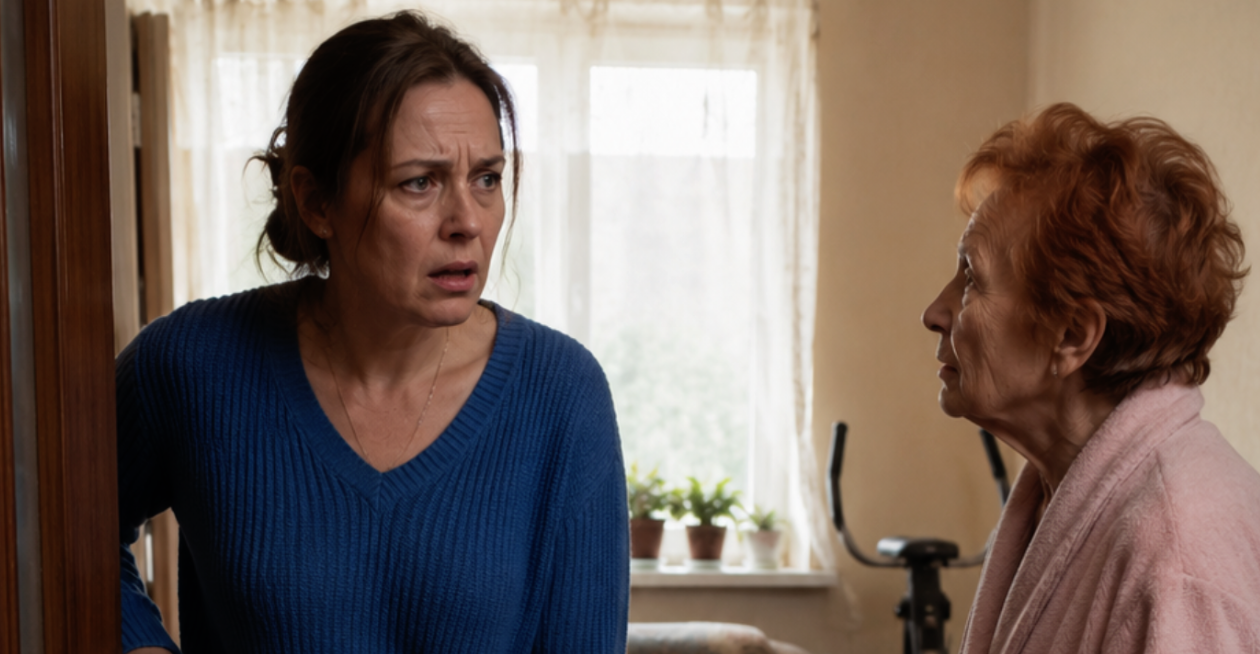
My Parents Decided to Move My 83-Year-Old Grandmother In With Me: I Found a Way Not to Become the Guilty One
I hadn’t even had time to take off my jacket. The phone rang while I was pulling off one boot with one hand and holding a grocery bag with the other. The screen said “Mom.” Half past seven in the evening, Tuesday. I had just come home from work — eight hours on the sales floor, my legs buzzing with exhaustion. I put the bag down on the hallway floor, sat on the little ottoman, and answered.
“Ol, hi. Are you home already?”
Mom’s voice was cheerful. Too cheerful, even. She sounded like that when she had already decided something and was now going to methodically lead me toward it.
“I just walked in. What happened?”
“Nothing happened. Your father and I talked it over. Basically, Grandma needs to move in with you.”
I stared at my grocery bag. On top lay a pack of cottage cheese and a bunch of dill — damp, fresh from the store refrigerator. And I thought: I need to sort this out and put it in the fridge, otherwise it’ll wilt by tomorrow. And Mom, on the phone, was talking about Grandma.
“What do you mean — with me?” I asked.
“I mean exactly that. You live alone in a two-room apartment, one room is empty. Your father and I live in a one-room apartment. Where are we supposed to put Grandma? In the kitchen?”
I am thirty-four years old. I work as an administrator in a grocery supermarket. My schedule shifts around: sometimes day shifts, sometimes evenings, sometimes weekends. The salary is average, but it’s enough for me. The apartment is mine. A two-room place in a nine-story panel building on the outskirts of the city. I got it after my divorce: my ex-husband and I sold our shared three-room apartment, I added my savings and bought this one, and he took his share in cash.
Four years have passed since then. I live alone. I don’t have children. The second room really was empty — it had a wardrobe with clothes, an exercise bike I bought on sale and used twice, and boxes of winter shoes.
But Mom spoke as if that room was no longer mine, but communal property.
“You understand,” she continued, “Grandma is eighty-three. It’s hard for her alone. She’s on the third floor with no elevator, you know that. Lately she can barely go downstairs to the store. You have an elevator, ninth floor, but at least she won’t have to climb stairs.”
“Mom, are you serious right now? My elevator is an argument?”
“Why wouldn’t it be? It’s actually very important. And besides, you have two rooms. You’re alone. What would it cost you?”
In the background, I heard my father. He muttered something indistinctly, and Mom fell silent for a second, listening to him, then said:
“Your father says it’s temporary. Until she gets really weak. Then we’ll see.”
“And why not with you?” I asked.
“Ol, think with your head. Our room is sixteen square meters, the kitchen is six. You’ve been to our place. Where would we put her? On a folding bed?”
I said nothing. I looked at the bag. I leaned down and took out the dill.
“Does Grandma know about this conversation?”
Mom sighed.
“Not yet. We wanted to decide with you first.”
There it was. “We wanted to decide with you first.” Meaning they had already decided, and now all that was left for me to do was agree.
“And Dad?” I asked. “What does he say?”
“I told you: he agrees. He thinks this is the right thing to do.”
The right thing. I suddenly remembered how two years earlier, when I asked my father to help with the bathroom renovation, he said, “Ol, it’s your apartment, so handle it yourself. My back hurts, I can’t lift heavy things.” I paid for that renovation with my own money, called a repairman, paid for every hour of work. And now, apparently, my apartment was shared, and we had to decide things together.
“Mom, let me call you back tomorrow. I just got home from work, I’m tired, I need to think.”
“What is there to think about? Grandma isn’t a stranger.”
“I’m not saying she’s a stranger. But I need to think.”
“Think. Just not for long. We wanted to move her this weekend. While the weather is still good.”
She hung up.
I sat in the hallway and stared at the phone. On the screen was the wallpaper: the time, the date, an icon with a basket and a green apple — the app for our store. I changed clothes, put the groceries in the fridge, made tea. I sat in the kitchen and thought.
Mom had worked as an accountant for a property management company all her life. Numbers, receipts, utility bills. A person used to counting everything, optimizing everything. To her, an empty room was unused space. Like an empty warehouse where goods could be stored. And it didn’t matter that the “goods” were a living person — my grandmother, who picked me up from school when I was a child, fed me borscht, and told me how she had worked at a design institute, drafting parts for pumps on a drawing board. Mom didn’t take that into account, because in her system of coordinates, feelings had no value.
I called Grandma myself. I didn’t wait.
She didn’t answer for a long time. Then she picked up, out of breath.
“Olenka, I was in the bathroom, I didn’t hear. How are you?”
I imagined her hallway — long, narrow, with a coat rack by the entrance and an old bench where Grandma always left the phone when she talked. The wallpaper there was beige with little flowers.
“I’m fine, Granny. How are you?”
“Oh, nothing much. Today I was looking for one recipe and went through all my papers. You know, yesterday I made cutlets, the way you like them, from minced chicken, with onions. They turned out good, juicy. You should come over, I’ll fry some for you.”
“Granny, have you ever thought about moving? Maybe it’s hard for you alone?”
She was silent for a moment.
“Move where? To your mother’s? There’s no room there.”
“And what about to me?”
“To you? Ol, what are you saying? You have your own life, work. Why would you need me there? I’m still all right, I manage.”
“Well, look. If anything, tell me.”
“I’ll tell you, of course. Are you eating properly yourself? You’re so thin, I remember you’re always at work, snacking on whatever you can.”
We talked for another ten minutes. About my work, about her flowers on the windowsill. I listened to her voice and thought: here is a person who does not want to move. For her, her apartment is forty years of life. Everything happened there: from the time Grandpa passed away to my graduation. She knows every crack in the stairwell, every creak of the floorboards. Moving for her would not be just a change of place, but a loss of herself.
But Mom and Dad didn’t see that.
Two days later, my father called. Friday, around nine in the evening. I was sorting through the mess in the hallway, organizing boxes of shoes and throwing some away.
“Ol, hi. Your mother asked me to find out if you’ve thought about it.”
I leaned my shoulder against the doorframe.
“Dad, I’ve thought about it. I’m not ready.”
“What do you mean, not ready?”
“I mean exactly that. I can’t take Grandma in.”
He was silent. In the background, the television was on — some talk show, voices, music.
“Ol, are you serious?” His voice became harder. “She’s an elderly person. She needs help. Don’t you understand?”
“I understand. But I live alone, I work, I’m often on evening shifts. Who will sit with her when I’m at the store until ten?”
“Then switch to day shifts. Talk to your boss.”
“Dad, I can’t switch. Our schedule is made a month in advance, there are seven people per shift, and if I leave the evening shift, they’ll have to rearrange everything.”
“Well, find another solution. You’re not a child.”
I had heard that argument since childhood. “You’re not a child.” When I was ten and asked for help with homework. When I was fifteen and couldn’t decide where to apply for university. When I was twenty-five and my ex-husband and I were dividing property. “You’re not a child.” Meaning I was adult enough to deal with any problem on my own, but not adult enough to have the right to say “no” to my parents.
“It’s not about age, Dad. I just don’t want to.”
The line went quiet. Then my father said slowly:
“So you don’t want to.”
“I don’t.”
“All right. I’ll tell your mother.”
And he hung up.
On Saturday morning I went to Grandma’s myself. Without calling, I simply got up and went. At my own store, I bought a pack of cottage cheese, sour cream, and a sliced loaf of bread. I climbed to the third floor on foot. Grandma’s door was upholstered with faux leather from the eighties, worn down to the fabric in places. The doorbell ran on a battery; I pressed it and heard footsteps inside.
Grandma opened the door in her robe and threw up her hands.
“Olenka! Why didn’t you call? I would have prepared!”
“Granny, come on, I’m not visiting formally, I just came to check on you.”
She fussed and led me to the kitchen. There was a pot on the stove, something bubbling inside. It smelled like boiled chicken.
“I’m making broth for soup,” she explained. “Sit down, I’ll put the kettle on.”
I sat at the table. It was old, with a plastic surface, covered with a large checked oilcloth. A salt shaker shaped like a duck, a pepper shaker shaped like a mushroom — I remembered them from early childhood.
“Granny, I want to talk seriously.”
She turned from the stove.
“Did something happen?”
“Mom wants you to move in with me.”
Grandma sat down on the stool. Her face became confused.
“Why with you?”
“Because I have two rooms. I’m alone. And they have a one-room apartment.”
She was silent. Then she said:
“I’m not going there. To their one-room place — especially not. And to you — why? You’re young, you have your own life. I won’t burden you.”
“Granny, I’m not saying you’re going. I just want you to know: Mom and Dad have already decided everything, and they presented me with a fact.”
Grandma sighed and adjusted her robe.
“Ol, they’re always like that. You were still little, and they were already deciding everything. Remember how they signed you up for music school? You didn’t want to go. And your mother said, ‘Irochka’s daughter plays, why is ours worse?’”
I remembered. Three years of suffering through piano, which I hated.
“I told Mom I wouldn’t take you. Not because I don’t love you. But because it’s wrong.”
Grandma looked at me carefully. Her eyes were light blue, almost transparent, but her gaze was still sharp.
“That’s right,” she said. “I’ll manage somehow. I’m still in my right mind.”
We drank tea. Grandma took those same chicken cutlets out of the refrigerator and warmed them in the microwave. I ate and thought that Mom was probably beside herself by now.
That evening, I called her myself.
“Mom, I went to Grandma’s.”
“And?” Her voice was dry.
“She doesn’t want to move. Not to me, not to you.”
“What does it matter what she wants? She’s an elderly person, she needs someone nearby. What if she feels sick at night? Who will help?”
“She has a phone. And her neighbor, Lyudmila Semyonovna, lives right through the wall, they talk.”
“Lyudmila Semyonovna is a stranger. And you are her granddaughter. Her own blood.”
I felt something heavy rising inside me.
“Mom, when was the last time you went to Grandma’s yourself? Not for some errand, but just like that?”
A pause on the line.
“I have work. I get tired.”
“I work too. And I get tired. But I go.”
“Ol, are you accusing me now?”
“No. I’m just asking.”
She sighed. Long and wheezing, the way she always did when she was nervous.
“Here’s the thing. Your father and I believe Grandma should live with you. It’s reasonable. You have space. You’re alone. Are you really so sorry to spare a room for a family member?”
“It’s not about the room, Mom. It’s about the fact that I would have to change my whole life. Switch schedules. Give up training trips. Once a quarter I go to the regional center for administrator training. Last time they taught us how to work with new cash register equipment. It’s all necessary for my job. If I take Grandma in, I won’t be able to leave.”
“You’ll find a solution. Maybe I’ll come on those days.”
“Will you be able to? You have work.”
Another pause.
“Mom,” I said, “you want to shift everything onto me. So that I change my schedule, give up trips, take care of her. And you two get to keep your lives the same. That’s convenient for you. Do you understand?”
“You only think about yourself,” Mom said quietly. “You don’t think about family at all.”
And she hung up.
My father called the next day. I was at the store, checking the product display. The sales floor was noisy — customers, carts rattling. I went into the back room and closed the door.
“Ol, your mother is upset. You said things to her yesterday.”
“Dad, I didn’t attack her. I explained my position.”
“Position. Fancy word. Did you think about the family? Grandma is eighty-three. How much time does she have left? Do you want her to be alone in an empty apartment?”
The back room smelled of cardboard and laundry detergent — unopened boxes of household chemicals were stacked nearby. I looked at the shelf with price tags and thought: how do I explain to a grown man, my own father, that I am not obligated? That my life is my life, not a branch office of their decisions?
“Dad, why don’t you move in with her yourself? Temporarily. Live with her. Help her.”
“Are you joking? I have work. And your mother is here. I can’t.”
“But I can?”
“You have a room!” he almost shouted. “A free one! Don’t you understand simple things?”
I closed my eyes.
“I understand. There is a room. But there is no me. It’s as if I don’t exist. There’s only the room.”
My father fell silent. Then he said more quietly:
“Are you serious?”
“I am. You decided without asking me. You gave me a condition. Meanwhile, neither you nor Mom are willing to change anything yourselves. It’s convenient for you to shift the responsibility onto me. And I don’t want that.”
“Then sit alone in your apartment,” he said.
And he disconnected.
I stood in the back room and looked at the phone. On the screen was again the wallpaper with the basket and the apple. I work in a grocery store. Every day I see hundreds of people who come in for bread, milk, cereal. Each of them has their own life, their own problems. But I doubt even one of them thinks that a supermarket administrator is a person who has no right to refuse.
I put the phone in my trouser pocket and went back to the sales floor. I needed to check whether the promotional sugar had been put out.
A week later, on Friday, I came to Grandma’s after my shift. She opened the door in her robe, but her face was puffy, as if she hadn’t slept.
“Granny, what happened?”
She waved her hand.
“Your mother came. The day before yesterday.”
“Why?”
“To persuade me.”
I went into the kitchen. On the table stood an unwashed cup and a plate with dried porridge.
“Tell me.”
“She came with your father. They sat right here. And started: move, move. I said I didn’t want to. And they said: it’s bad for you alone, you need help. I said: what help? I do everything myself. And your mother said: Olenka doesn’t want to take you in, can you imagine? Your own granddaughter refuses.”
Something broke inside me.
“She said that?”
“Exactly that. I told her: Olya isn’t refusing, I don’t want to go myself. And she said: she turned you against us.”
Grandma fell silent, looking out the window. Outside the glass was a view of the neighboring nine-story panel building and a poplar tree growing right under the windows. Its branches almost touched the glass.
“Ol, I don’t want to quarrel. They are my daughter and son-in-law. You are my granddaughter. I love all of you. But I will not move. Not to anyone. As long as I can still walk, I will stay here.”
I hugged her. Grandma smelled of the same laundry detergent she had bought all her life, and a little bit of mint.
“Granny, don’t worry. I’ll handle it.”
But it turned out I wasn’t the one who had to handle it.
Two days later, Mom called. Her voice sounded as if she had been crying or shouting — I couldn’t tell right away.
“Olga, do you know what happened?”
“What?”
“Grandma called me at night, crying. She said she was very scared alone. I didn’t sleep all night, I was worried. And you? You didn’t even call her!”
Everything inside me tightened.
“Where is she now?”
“At home. But understand, she’s alone, completely alone! What if something happens?”
I called Grandma immediately. She answered in a calm voice.
“Olenka, don’t listen to your mother. Everything is fine. I just got upset, called Tanya, cried a little. She exaggerated, as always. Nothing terrible happened.”
“Granny, maybe I should come? Right now?”
“No need. It’s nighttime. Come in the morning.”
I hung up and sat down on the bed. It was almost midnight. Outside the window was darkness, the windows of the neighboring building glowing. I thought: what if it’s true? What if Grandma really gets scared and needs help, and I’m not nearby? What if Mom is right?
But then I remembered: Mom has keys to Grandma’s apartment. Dad does too. If they wanted to, they could have gone there themselves. That very night. But they didn’t. Instead, Mom called me to accuse me.
I came to Grandma’s in the morning, on Saturday. She was already sitting in the kitchen, cheerful. The kettle had boiled, sandwiches were on the table.
“Granny, how are you?”
“I’m fine. I rested, and everything passed.”
“Are you sure you’re okay?”
“Absolutely. Your mother panics for nothing.”
I sat beside her and took her hand.
“Granny, I really can’t take you in. Not because I’m stingy with the room. But because I won’t be able to manage. I work ten hours a day, sometimes on weekends. You’d be sitting alone in a strange apartment. That wouldn’t be better than here.”
She nodded.
“I understand. I’m not asking you to.”
“But Mom and Dad think I’m obligated.”
“They always thought that. Don’t pay attention.”
But not paying attention was impossible.
That same evening I called my parents. My father picked up.
“Dad, I want you to understand: Grandma doesn’t want to move.”
“She’s an elderly person. What does it matter what she wants?”
“Dad, she is in her right mind. And she has the right to decide for herself.”
My father snorted.
“And you decided for her, then.”
“I didn’t decide anything. I just asked her. And she said, ‘No.’”
“Well, fine,” he said. “Let her sit alone. But if something happens, it will be on your conscience.”
And he hung up.
I sat in my apartment. The very one with the free room. The one where an exercise bike and boxes of winter shoes stand. The one where I choose when to get up, what to eat for dinner, and how to spend my weekends. Where every corner is mine — earned, paid for. And suddenly I understood: to my parents, this is not my apartment. To them, it is family space that I am temporarily occupying. And since I occupy it, I must use it for the purpose they assign.
I went to the window. Down in the courtyard, the streetlights were on. People were walking from the bus stop with bags from the supermarket. The very one where I work. I thought: I wonder, does that woman with the bag also have relatives who think she owes someone something? Or that man with the backpack — does he also have a spare room? And what does he do with it?
A few days later, Grandma felt better. I visited her every evening after work: sometimes I brought soup, sometimes I just sat and talked with her. One day she said:
“Ol, you know, your mother called yesterday. She apologized.”
“For what?” I asked in surprise.
“For what she said. For pressuring me. She said, ‘Mom, I was just scared for you.’ I told her, ‘Tanya, don’t be scared for me. I’m still strong. And when I become weak, then we’ll talk.’”
I listened to her and thought: so Mom understood too. Not right away, but she understood.
That evening, I rode home on the bus. Houses, billboards, store signs flashed past the window. I looked at all of it and thought about the spare room. About how a room is not just square meters. It is part of my life, my space, my freedom. And I am not obligated to give it up to anyone. Even to the people closest to me. Because living together is not about square meters. It is about readiness. And readiness cannot be assigned by order. It either exists, or it doesn’t.
When I entered the apartment, it was quiet and dark. I turned on the hallway light, took off my jacket and shoes. I walked to the door of the spare room and opened it. Inside stood the exercise bike, covered with a thin layer of dust, and three boxes of shoes. I thought, “Maybe I should sort it out after all?” But I didn’t. I simply closed the door, went to the kitchen, and turned on the kettle. Tomorrow I had work, first shift. I needed to sleep.