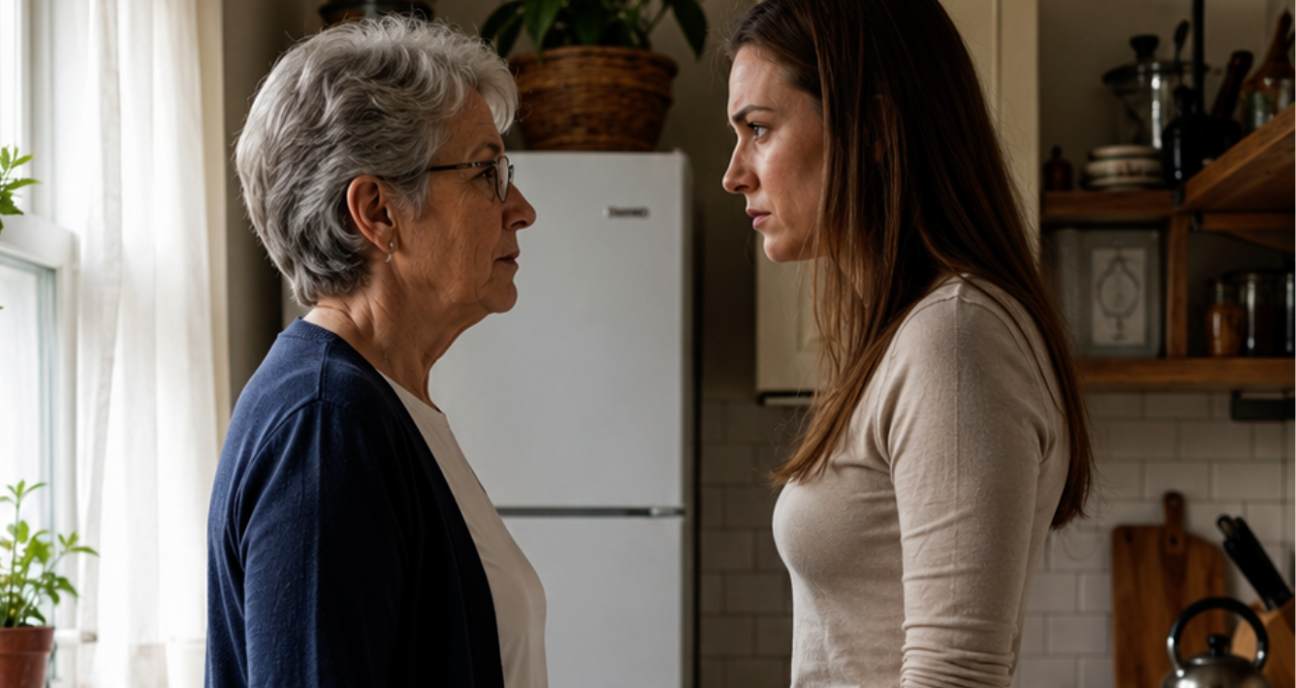
“My dear, your husband has every right to discipline you! And if he slammed you into something, then it simply means you deserved it.”
“Too salty.”
It was not a question or a reproach. It was a statement of fact, spoken in an even, almost indifferent tone that was more frightening than any shout. Vadim slowly placed his spoon on the table beside his plate, carefully, so as not to make any unnecessary sound. He did not look at Olga. His gaze was fixed on the center of the table, on the woven placemat beneath the breadbasket, as though he were studying its intricate pattern.
Olga froze with her fork in her hand. She felt the appetizing smell of the rich borscht, which she had been so proud of only five minutes earlier, turn into acrid, suffocating smoke. The air in the kitchen thickened, became heavy, as if all the oxygen had been pumped out of it at once.
“Vadim, I’m sorry, I… I must have been distracted when I salted it,” she said quietly, trying to defuse the tension with her usual guilty smile. But the smile came out crooked, pitiful, and she felt it.
At last he raised his eyes to her. His gaze was cold and assessing, like that of an entomologist examining an overly fidgety insect.
“You are always thinking about something, Olya. And your main duty is to think about making sure that when I come home from work, I can eat properly. I’m not asking you for the stars in the sky. I’m asking for simple order in the house and edible food on the table. Is that so much?”
He spoke quietly, but each word settled on her shoulders like a separate weight. He was not scolding. He was disciplining her. Methodically, coldly, driving into her an understanding of her place in this apartment, in this life. He was not merely a husband. He was an employer, and she was a negligent employee who had once again failed an important assignment.
“I understand. I just… I was tired today, running around,” her voice grew quieter and quieter, as if she were trying to shrink, to become smaller and less noticeable, so that the storm would pass her by.
“Tired?” he smirked, though the corners of his lips did not even move. “You’re tired from sitting at home while I earn money so that you can sit at home and get tired? Interesting logic. Maybe you should get less tired and concentrate more. For example, on how many spoonfuls of salt you throw into the pot.”
He stood up from the table. Not abruptly, but smoothly, with the lazy grace of a well-fed predator. Olga instinctively pressed herself into the back of her chair. He walked around the table and stopped behind her. She felt his presence with every cell of her skin, the way one senses an approaching thunderstorm. Without a word, he took her by the wrist. His fingers closed around her hand not as though it were the hand of a woman, but as though it were the handle of a tool that was failing to perform its function properly.
And then he shoved her. He did not hit her, did not swing at her — he simply pushed her hard and confidently to the side. Her body, losing its balance, flew a meter and struck the wall with her shoulder and temple, the wall covered in coarse vinyl wallpaper. The shove was calculated perfectly — strong enough to humiliate and cause pain, but not strong enough to leave serious marks. That was his art.
“You need to think less and do better,” he said to her back in the same calm, instructive tone.
She slid down the wall to the floor, stunned not so much by the impact as by that icy, murderous calm. She heard him return to the table, push away the plate of borscht, and take a package of sausages from the refrigerator. A minute later, oil hissed in the frying pan. He simply continued his dinner.
Olga sat on the floor, pressing her palm to her throbbing temple. She looked at her wrist. Purple marks from his fingers were already blooming on the delicate skin, and a little higher, on her shoulder, beneath the fabric of her blouse, the place where she had hit the wall was beginning to burn. She did not cry. There were no tears. There was only a ringing emptiness in her head and a cold, hard decision born from shock and humiliation. To Mom. She had to go to Mom. She was the only one who would understand. Who would protect her. Slowly, holding onto the wall, Olga got to her feet and, without looking in his direction, went to the hallway.
“He didn’t even shout, Mom. That’s the whole point,” Olga said, looking at her hands wrapped around a hot cup of tea, though she could not feel its warmth. She was sitting at the old kitchen table with cracks in its enamel surface, the table at which her entire childhood had passed. The air smelled the same as it had twenty years ago — a mixture of baked goods, old wood, and something vaguely medicinal. It was the smell of home, the smell of safety. But today it did not calm her; it only emphasized the full horror of what had happened.
Her mother, Lyudmila, sat opposite her. She did not fuss, did not gasp. She slowly and methodically stirred sugar in her cup with a spoon, and that quiet, rhythmic clinking against the porcelain was the only sound in the room. Her face was calm, almost impenetrable, like that of a judge listening to a witness’s confused testimony.
“He just said the soup was too salty. And that was all,” Olga reached across the table, pulling back the cuff of her blouse. On the white skin of her wrist, an ugly dark-purple bruise was blooming, where the faint impressions of his fingers could still be made out. “Here. And then he pushed me. Just silently.”
Lyudmila cast a brief, assessing glance at the wrist and returned to her tea. She took a small sip, set the cup down on its saucer, and only then began to speak. Her voice was even, stripped of all emotion, as if she were explaining the proper way to preserve cucumbers.
“A man comes home from work. He is tired. He has been running around all day, solving problems, earning money for your family. For you, for the apartment, for everything. The only thing he wants at home is peace and a hot dinner.”
Olga looked at her mother, and the tiny, desperate hope for sympathy with which she had come here began to melt like snow on a hot stove.
“Mom, he hit me! Because of soup!”
Lyudmila sighed heavily, as though she had been exhausted by having to explain obvious things. She moved her cup aside, folded her hands on the table, and looked her daughter straight in the eyes. Her gaze was as hard as steel.
“My dear, your husband has every right to discipline you! And if he slammed you into something, then it simply means you deserved it!”
The phrase was not shouted. It sounded ordinary, like advice to take a pill for a headache, and because of that ordinariness Olga felt physically cold. The entire familiar world, in which her mother had been synonymous with protection and love, shattered into tiny, sharp fragments. She looked at the woman opposite her and did not recognize her.
“What do you mean — deserved it?” Olga whispered, but there was no hurt in her voice, only icy bewilderment.
“That is exactly what I mean,” Lyudmila snapped, gaining strength. “You need to be wiser, Olya. Keep silent somewhere, be gentler somewhere else. Give in. A man is the head of the family; you must not anger him over trifles. You oversalted it — that means you were at fault. Admit it, apologize, bring him something else. And what did you do? I’m sure you started arguing, making excuses, making a displeased face. You provoked it yourself. That is our woman’s lot — to be smarter, more cunning, to adapt. I lived my whole life that way with your father, and nothing happened. See? I’m alive and well.”
Olga slowly lowered the sleeve of her blouse, hiding the ugly bruise. She no longer wanted it to be seen. Especially by this woman. She slowly stood up; the chair scraped across the old linoleum.
“I understand you, Mom. I came to you for help, and I found his second lawyer. You know, he was right about one thing. He said no one needed me. Thank you for confirming it.”
She turned and walked toward the exit. Her movements were slow and precise; there was no more confusion or shock in them. Only cold, crystalline clarity.
“Where are you going?” Lyudmila called after her, and for the first time anxious notes cut through her voice.
Olga stopped in the doorway but did not turn around.
“Back. To my family. To learn how to be obedient.”
She was silent for a moment, then added, putting all the poison of her disappointment into every word:
“When he slams me harder next time, don’t worry. After all, I deserved it.”
The nighttime city rushed past the bus window in blurred, indifferent lights. Olga sat with her back straight and looked not at the street, but at her dark reflection in the cold glass. There, in the murky depths, a stranger looked back at her — a woman with tightly compressed lips and empty, dark eyes. She no longer felt the pain in her temple or the humiliation of the bruise on her wrist. Those sensations had remained there, in her mother’s kitchen, buried beneath a pile of calm, murderous words about “a woman’s lot.”
Her mother’s words had not broken her. They had performed surgery on her consciousness — without anesthesia, roughly and precisely. They had cut out of her everything she had once mistaken for love, duty, and patience, leaving in its place a smooth, cold scar. Two phrases spoken by the two people closest to her revolved in her head with frightening clarity.
“You need to think less and do better,” her husband had said.
“Your husband has every right to discipline you,” her mother had said.
They were talking about the same thing. They had outlined a world for her with very simple and understandable rules. A world where there are those who discipline and those who are disciplined. Where rightness is determined by strength, not justice. For many years she had tried to live by other laws — the laws of understanding, forgiveness, compromise. But it turned out she had been playing a different game, alone against everyone. Today, at last, they had explained the rules to her. And she understood them. She understood them as deeply as she had never understood anything in her life.
She got off at her stop and walked toward the house. Her steps were even and firm, without her former haste or uncertainty. She did not look around. The whole world had narrowed to the lit window on the third floor. Her window. Her home. Her cage. She inserted the key into the lock, and it turned with a dry, businesslike click.
Vadim was sitting in an armchair in front of the television. He did not turn his head when she entered. He only threw over his shoulder, without taking his eyes off the flickering screen, where some people were laughing loudly at an unfunny joke:
“Had your walk? Go clean up the table.”
That phrase, tossed out with the careless air of a master addressing a servant, became the final element falling into place. It completed the picture. He was not merely sure that he was right. He was sure she would return, sure of her obedience, sure that the lesson had been learned and that she, with her tail between her legs, would take her usual place.
Olga silently took off her jacket and hung it on the hook. She did not throw it, did not crumple it — she hung it neatly. Then she walked past him toward the kitchen. He still did not look at her. To him, she was a function, part of the interior.
The kitchen was in the mess he had left behind. A plate of half-eaten borscht, a greasy frying pan on the stove, crumbs on the table. But Olga’s gaze slid past all of it. It stopped on two objects lying in their usual places. The heavy, almost eternal cast-iron skillet with a thick bottom, of which she had been so proud. And the old, weighty wooden rolling pin made from a solid piece of beech, which had belonged to her grandmother.
Her movements became slow, almost ritualistic. She took the skillet in her left hand, feeling its solid, substantial weight. Then with her right hand she took the rolling pin. The smooth wood, polished by years, settled perfectly into her palm. There was no anger in her head, no rage. Only a cold, ringing silence and one single thought, formulated in her mother’s words: it was time for the disciplinary process. She had simply learned the lesson very well. She turned around and, with those two objects in her hands, slowly walked back into the room where her husband, her chief disciplinarian, sat in the armchair.
Her steps made no sound on the thick carpet in the living room. The television muttered some comedy program, and the occasional bursts of recorded laughter seemed sacrilegious in that atmosphere. Vadim heard her only when she stopped a couple of meters from his chair, blocking the light from the floor lamp. He turned his head irritably, ready to deliver another portion of moral instruction.
“Why are you standing there? Have you gone deaf or what? I told you, go to the kit—”
The words stuck in his throat. His gaze fell to her hands. To the cast-iron skillet in her left hand and the heavy beech rolling pin in her right. For a second, bewilderment flashed in his eyes, immediately replaced by a contemptuous smirk. He did not see a threat, but a ridiculous, pathetic rebellion of kitchen utensils.
“What is this masquerade? Trying to make me laugh? Drop that nonsense and march to the kitchen. I don’t repeat myself twice.”
He began slowly rising from the armchair, straightening his shoulders, demonstrating superiority with his entire appearance. That was his mistake. He still saw before him the Olga who pressed herself into the wall. He did not see the woman who had returned from her mother.
“Sit down,” she said.
Her voice was quiet, even, and stripped of all emotion. It was not a shout and not a plea. It was an order.
He froze halfway up, struck not by the words themselves, but by that dead, calm tone. There was no hysteria in it that he could mock, no anger he could crush. There was only a final, undeniable full stop.
“What did you say?” he asked, and for the first time uncertainty sounded in his voice.
“I said sit down,” she repeated, taking a tiny step forward. “The disciplinary process is not over yet. Today we have simply switched roles.”
He looked at her face and did not recognize it. It was like a mask, calm and focused. And at that moment he became afraid. Not of the skillet and not of the rolling pin. He was afraid of this new, unfamiliar woman standing in his living room. Slowly, awkwardly, he lowered himself back into the armchair.
“Olya, what is this nonsense… Let’s talk. You’re tired, I understand…”
“No,” she interrupted him in the same icy tone. “You don’t understand. You never understood. But I will teach you. My mother said that you have every right to discipline me. That if a man slams a woman into something, then she deserved it. It is a very simple rule. It just took me a long time to learn it. And now I want to check whether it works in reverse.”
She took another step. Now there was no more than a meter between them. The laughter from the television faded, replaced by an intrusive advertising jingle.
“This is for the salty soup,” she said, and made a sharp, precise thrust with the rolling pin. She did not swing it; she lunged with it, like a fencer. The heavy end of the beech rolling pin struck his kneecap with a dull, cracking sound.
The howl that burst from his throat was not masculine, not angry, but high, almost squealing, full of animal terror and pain. He grabbed his shattered knee, his face twisted with shock. He slid from the armchair onto the floor, unable to believe what was happening.
“And this,” she continued, stepping toward him and looming over him, “is for the fact that I think too much.”
This time she used the skillet. She did not strike with the flat side. She turned it and, with a short, calculated movement, hit his hand — the hand with which he was trying to shield himself — with the heavy cast-iron edge. There was a nauseating crunch of breaking bones. He screamed again, but now more quietly, choking on pain.
She stood over him. He, her strong, self-assured husband, her master, writhed on the floor like a crushed insect, looking up at her with eyes full of tears and primal fear. She looked at him without hatred, almost with investigative interest.
“See?” she said softly, addressing either him or the emptiness. “The rule works. You understand everything. You are a very capable student.”
She fell silent, giving him the opportunity to feel the full depth of the lesson. Then, with a deafening clang that echoed through the suddenly silent apartment, she dropped the skillet and the rolling pin on the floor beside him. She took a step back, stepping over his outstretched leg with disgust. Her mission was complete. The discipline had taken place.
She went into the hallway, took her phone from the cabinet, and dialed a familiar number. The line rang, then her mother’s sleepy, displeased voice answered.
“Mom?” Olga said in her new, calm voice. “Don’t worry. I’m home. I disciplined him. Just the way you taught me. He understood everything.”
She ended the call without waiting for an answer. The apartment was very quiet. Only from the television screen, where some program had started again, carefree recorded laughter continued to pour out.