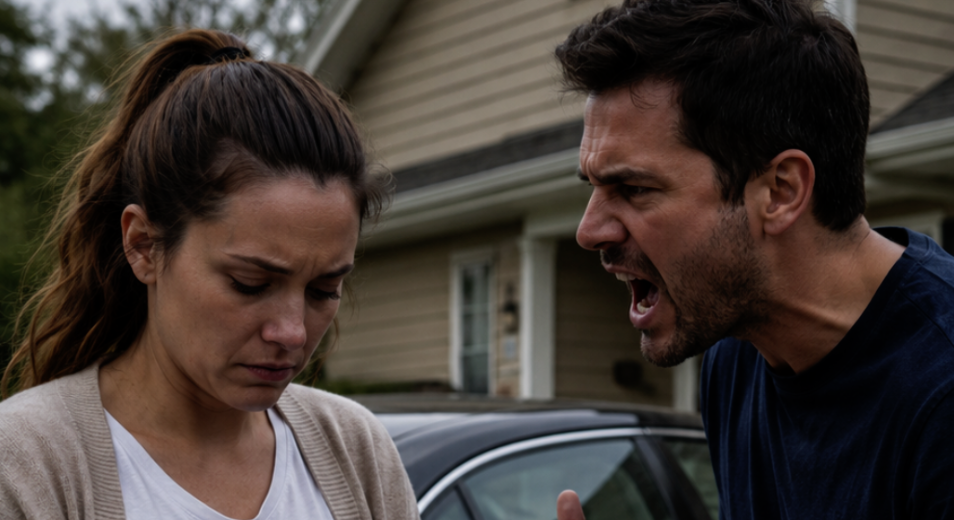
“My brother will take our car whenever he wants! He has a family to drive around!” — I silently put the keys in the safe
Sergey showed up on Sunday at half past seven in the morning — without calling, without warning, as usual.
I was standing in the kitchen in my robe, drinking coffee and looking out the window at the silver 2021 Skoda Octavia parked by the entrance — my car, bought on credit and paid off by me down to the last kopeck in March of this year. I made the final payment myself — 18,740 rubles — through the app, and then spent another ten minutes just staring at the screen that said, “Loan closed.”
Sergey rang the doorbell three times in a row, as always — impatiently, as if he lived here, not me.
“Vik, open up, it’s me.”
I opened the door. He was wearing sweatpants and the jacket he had owned since university. He smelled of cigarettes and something sour. He walked past me into the hallway without taking off his shoes, left black sneaker marks on the light laminate floor, and held out his hand.
“Give me the car keys. I need to go to Auchan. Marinka wrote a shopping list three pages long.”
I looked at the marks on the floor. Then at his hand. Then into his eyes.
“Sergey, the car is mine. I bought it. I paid for it.”
“So what?” He shrugged and picked at a hangnail on his thumb. “We’re family. My car broke down, you know that. I need to drive the kids around, buy groceries. You’re alone. Where do you need to go in it every day?”
“To work.”
“Well, there you go,” he smiled, as if I had just agreed. “On weekdays you’re at work, and the car just sits there. We’ll take it and bring it back. No big deal.”
I gave him the keys.
I do not know why I did it. Probably because Mom had always said, “Vitya, you’re the older one, you’re sensible, give in.” I had been giving in for twenty years. To my brother — the room in our parents’ apartment, because “he needs to start a family.” To my mother — money for renovations, which she gave to Sergey for his down payment. To myself — nothing, except a one-room apartment mortgage in Butovo and a loan for the Skoda.
Sergey returned the car eight hours later. The tank was empty. On the back seat, there was a carton of children’s juice lying there, frozen to the upholstery.
Over the next three months, Sergey took the car an average of four times a week.
The pattern was well established: a call in the morning, sometimes no call at all — he would simply show up and wait outside the door. If I said, “I can’t, I need it,” it began:
“Vitya, you’re selfish. I have two children.”
“Mom will be upset if she finds out.”
“We’re not strangers.”
“You want your nephews to walk everywhere?”
Marinka, his wife, never once called me herself. Everything came through Sergey: “Marinka needs to go to the clinic,” “Marinka needs to go to the market,” “Marinka is going to Savyolovsky for curtains.” I did not see family in this. I saw a free taxi with a driver who paid for insurance, inspection, and tires herself.
In October, I took the car in for scheduled maintenance. The mechanic at the service station in Chertanovo, an older man with motor oil ingrained into his palms, shook his head.
“Ma’am, you drive a lot. The front brake pads are almost gone. When did you change the oil?”
“In March.”
“Since March, the mileage is twenty-two thousand kilometers.”
Since March, I had only driven to work and back. My office was in Moscow City, forty minutes from Butovo by car. Five days a week. Altogether, at most, eight thousand kilometers in seven months.
Fourteen thousand belonged to Sergey.
I paid 34,600 rubles for the maintenance. Silently. I got into the car. Opened the notes app on my phone and started calculating.
Fuel: average consumption of 9 liters per 100 kilometers, price 57 rubles per liter — about 7,200 rubles. Tire and brake pad wear: roughly 18,000 rubles proportionally. Depreciation of the body and engine: according to the formula, about 9,000 rubles. Total for seven months: 34,200 rubles.
Sergey had not paid me a single ruble.
I closed the notes app and drove home.
The next day, Sergey called at eight in the morning.
“Vik, I need the car for the whole day. Marinka is going to IKEA, then to Mom’s, then…”
“Sergey,” I interrupted. “Fine. But I’m introducing a new arrangement. Starting today, we follow the rule: ‘family means family.’”
“What?”
“You said it yourself: we’re family, so everything is shared. Do you accept that?”
There was a pause. I could hear him sipping tea on the other end.
“Well… yes. Why?”
“Excellent. Write this down.”
I read from the sheet I had printed the evening before:
First. The car is shared. But under the principle of “everything is shared,” starting today I am included in the family budget. My car expenses are split equally: insurance is 42,000 rubles a year, so your share is 21,000 rubles. All at once or in installments — your choice.
Second. Based on the proportion of use — you drive about 60% of the total mileage — your share of maintenance, tires, and oil for this year is 20,760 rubles. I have the receipts.
Third. Renting a car of a similar class on the market starts at 2,500 rubles per day. As a friendly gesture, I am giving you a 40% discount. Total: 1,500 rubles per day. For seven months — approximately 90 days of use — that comes to 135,000 rubles.
Sergey was silent for so long that I checked whether the call had dropped.
“You… are serious?” he finally forced out.
“Absolutely. You said it yourself: we’re family, everything is shared. I agree. I’m waiting for your bank details for the first payment, or cash — whichever is more convenient. And yes, the keys are now in the safe. Car bookings must be made one day in advance, in writing, on WhatsApp. For documentation.”
“Vika, are you completely…”
“Don’t forget: the insurance is renewed in January. Your half is 21,000. I’m warning you in advance.”
I hung up.
Twenty minutes later, Mom called.
“Victoria, what have you done to your brother?! He’s sitting there white as a sheet!”
“Mom, I simply agreed with his principle. Everything is shared means everything is shared.”
“That’s different! He’s a family man, he has children! You’re alone, you don’t have expenses like that!”
“I have a mortgage. 54,000 rubles a month. And I had a car loan, which I paid off myself.”
“So what? You earn good money!”
“Mom,” I said evenly, without raising my voice, “Sergey used my car as if it were his own. I calculated the damage. It comes to 135,000 rubles for seven months if we count it at market rental price. Plus half the maintenance costs — another roughly 42,000. Total, almost 177,000 rubles. Do you want me to gift him that money?”
“But he’s your brother!”
“Mom, would you gift me 177,000 rubles just because I’m your daughter?”
Silence.
“That’s… different,” Mom said after a pause.
“Fine. Then tell me: how is it different?”
She did not answer.
Instead, Sergey wrote a long message in the family chat about how I was “a miser in a skirt,” “had always been cold,” “didn’t know how to love,” and “would grow old alone with cats.”
I read it. Liked it. Then sent him a PDF file privately with the expense spreadsheet, signed and dated by me. With a note: “For the record.”
Sergey did not pay anything. Just as I expected.
But a week later, he called again:
“Vik, listen, we really need the car. Marinka has an ultrasound tomorrow at 10 a.m. Just make an exception, as a human being.”
“Fine,” I said. “1,500 rubles. Sber card. You know the number. After payment, you get the keys.”
“Have you lost your mind? Charging your own sister?”
“You said, ‘We’re family, everything is shared.’ I agree with that principle. Payment in advance.”
“Fine,” he said after a pause. “I’ll pay. But this is the last time.”
He paid. I gave him the keys. Marinka went to her ultrasound. The car was returned on time, and the tank was full — for the first time in seven months.
Then it happened three more times. Each time, 1,500 rubles in advance. Each time, Sergey called with the tone of a man being robbed in broad daylight. I did not argue. I accepted the payment. I handed over the keys.
On the fourth time, he did not call at all.
Instead, he tried to make a duplicate key. I found out by accident when a mechanic from the auto service on Varshavka called me directly.
“Victoria, your brother is here trying to make a duplicate, but we can’t do it without you present — it’s a chip key, we need the original and the owner’s documents.”
I thanked the mechanic.
Then I called the insurance company and added a note to the policy: any transfer of keys to third parties only with the written consent of the owner; otherwise, an insurance claim would not be covered. Formally, that had already been the case, but now it was recorded separately.
Sergey came over that evening. Angry, red-faced.
“You are humiliating me on purpose!”
“I’m protecting my property,” I said. “It’s called ownership rights. Article 209 of the Civil Code, if you’re interested.”
“Mom will find out!”
“Mom already knows. I sent her the expense table.”
He left, slamming the door so hard that the photo frame in the hallway swung.
In January, Sergey bought himself a used 2017 Renault Logan for 620,000 rubles — he took out a consumer loan at 19.9% annual interest. The monthly payment was about 14,200 rubles. I found out from Mom, who complained that “Seryozha is drowning in debt now.”
Marinka returned to work after maternity leave and discovered that during her three years away, she and Sergey had managed to accumulate 78,400 rubles of housing and utility debt. The utility company took them to court, bailiffs came, and Sergey’s bank card was blocked. He called me and asked me to “understand the situation” — to lend him money.
I understood the situation.
I sent him a link to a legal aid website for housing and utility debts, and the phone number of the Multifunctional Center.
My Octavia had its second maintenance service in February. The mileage for the year since I put the keys in the safe was exactly 9,200 kilometers. Only my trips. The brake pads were fine. The oil was clean. The body had no new scratches.
In March, I was promoted to head of department. My salary increased by 40%. I enrolled in mountain driving courses — I had long wanted to learn how to brake properly on descents.
Sergey stopped calling with requests in April. Mom sometimes sighs into the phone: “You and your brother don’t communicate at all anymore.” I answer, “Mom, we do communicate. Just now, it’s according to the rules he invented himself.”
She does not understand.
But it is no longer my job to explain.
The keys are in the safe.
That is where they belong.
Was Victoria right to start charging her brother for using the car, or is “family family,” and should she simply have refused once and for all, without any price lists?