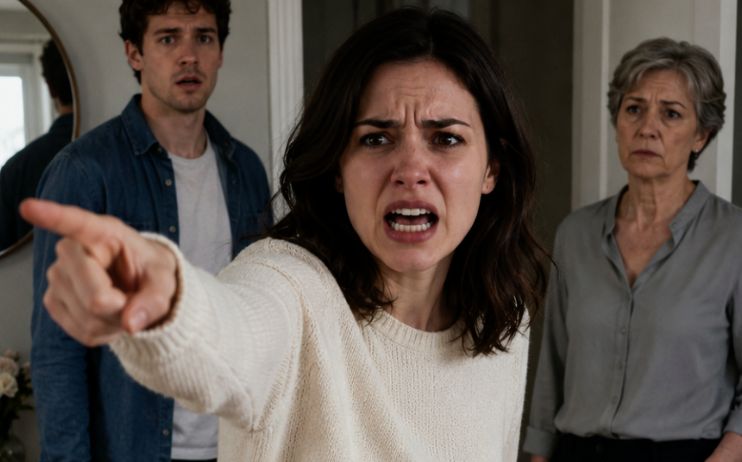
“Have you even looked at yourself? Who would need someone like you, tell me? No money, no use, no brains, but pride like a government minister!” Zinaida Pavlovna’s voice rang through the narrow hallway as if she weren’t arguing, but drilling through the walls.
“Please don’t shout,” I said without taking off my coat. “I got home from work ten minutes ago. I’ve had five requests since morning, two scandals in the department, and a bus that got stuck on the bridge. Let me at least take off my boots without your performance.”
“She wants to take off her boots!” my mother-in-law snorted, adjusting her shiny patent-leather handbag on her shoulder and looking me up and down as though I had rolled in mud just to spite her. “First tell me, since when do I need to ask permission in this house?”
Igor was standing by the kitchen doorway in an old gray T-shirt and sweatpants, his hands shoved into his pockets. He looked as if the conversation were about the weather. Only his eyes kept darting from his mother to the floor, then somewhere past me.
“Mom, come on,” he said weakly. “Why start right at the door?”
“When should I start? At the cemetery?” she snapped at once. “Or when she finally drives us out of the apartment? Just look at her. Walks around like she owns life itself. Say one word to her and she makes a face as if we came begging for charity.”
I slowly put my bag on the small cabinet. Exhaustion rose inside me in a heavy wave, familiar to the point of nausea. I already knew the sequence by heart. First my mother-in-law would pick on some household detail. Then she would drag in money. Then she would move on to my appearance, age, character, and background. Then Igor would pretend to be furniture. Then I would stay silent. Then at night my heart would pound and I would lie awake, staring at the ceiling.
Five years. Five years of the same thing, adjusted only for the season and the price of groceries.
“What is it this time?” I asked. “The soup wasn’t salty enough? The towels are hanging wrong? Or did I greet you in the wrong tone again?”
“And now you’re mocking me?” my mother-in-law stepped closer. “For your information, I’m telling the truth. My son carries everything on his back, and all you know how to do is twist your face. You shuffle your papers, sniff dust in the archive, and then come home like some great breadwinner.”
“Mom, don’t,” Igor muttered.
“Don’t what? Is it not true?” She turned sharply toward him with her whole body. “Do the utility bills pay themselves? Does food appear in the fridge by itself? Does the car fill itself with gas?”
I even gave a small laugh. The car. Their sacred cow. Igor’s foreign car on credit, which he worshipped like an icon. For its sake he took side jobs, postponed repairs, whined that “times are hard,” and still never noticed that we were running out of detergent, toilet paper, oil, medicine; that the kitchen faucet was leaking; and that the electricity bill somehow came in my name and was somehow paid by me too.
“Utilities,” I repeated. “How convenient that you remembered. And groceries. And cleaning supplies. And internet. And your son, who for the third time this year promised to buy himself winter boots, but instead paid for another ‘urgent’ car repair.”
“Don’t you dare count someone else’s money!” Zinaida Pavlovna shrieked.
“Someone else’s?” I finally looked straight at her. “So in your opinion, it’s not my money? Then here’s an interesting question: who has been buying food in this house for the last three years? Who paid for the washing machine repair? Who ordered the new refrigerator when the old one died? Who paid to install the doors after your son said, ‘Well, maybe later’?”
“Oh, what lies!” My mother-in-law even slapped her palm against the cabinet. “Igor does everything! Everything! And you latched onto a man, sucked him dry, and settled in! And now you show your character! Who needed you before him? What did you come with? One bag! No family, no background, no dowry! He lifted you up!”
“Mom, quieter,” Igor said, but not for me. Not to protect me. He said it the way people speak to someone shouting too loudly in the stairwell. “The neighbors will hear.”
That was when something inside me clicked completely cold.
Not, “Mom, don’t you dare speak to my wife like that.”
Not, “Stop.”
Not, “You’re wrong.”
No. “The neighbors will hear.” In other words, as always, the problem was not that I was being smeared across the wall in my own home. The problem was that someone might hear exactly how.
“Wonderful,” I said. “A model man.”
“Don’t start, Lena,” Igor sighed, as if I were the one who had come in and caused a scandal. “You always wind yourself up. Mom said it rudely, but in essence…”
“In essence?” I repeated calmly. “Go on. Finish. I’m very interested in what today’s ‘essence’ is.”
He twitched his shoulder like a schoolboy before a test.
“Well… lately you really have been acting as if… as if everyone owes you something. You snap back. You’re rude to Mom. You’re constantly unhappy. I come home and your face looks like you’re at a funeral.”
“Of course,” I nodded. “That’s because I get up at six in the morning, travel across half the city to work, then stop for groceries after work, then come home and listen to your family explain what a worthless creature I am. You know, few people glow after that.”
“See?” Zinaida Pavlovna immediately jumped in. “See, Igorek? She’s even making you guilty. Just look at her. No looks, no money to her name, but she talks as if she bought this apartment and supports all of us!”
She said it without realizing that she had hit the exact spot where a nail had long been lying — the nail they would both end up sitting on.
I took off my scarf, carefully placed it on the cabinet, and suddenly felt a strange relief. As if the scandal hadn’t begun, but ended. As if I hadn’t come home, but entered a doctor’s office where an obvious diagnosis was about to be spoken aloud.
“You know what,” I said. “You’re right. It’s time to clear up a few misunderstandings.”
“What misunderstandings?” my mother-in-law grimaced. “And don’t use that tone with me. I’m not one of your girls from work.”
“That’s obvious,” I replied. “You should hear yourself from the outside once in a while.”
“Lena,” Igor finally took a step toward me, “enough. Apologize to Mom and we’ll close the subject. I’m hungry.”
I turned to him.
“Are you serious right now? I’m supposed to apologize? For what exactly? For not dying of happiness when I was called a beggar? Or for not wanting to see a person rummaging through my closets in my own apartment?”
My mother-in-law turned crimson.
“What do you mean, your own apartment? Have you completely lost your mind?”
“I mean it literally,” I said.
“Lena, stop it,” Igor said, now irritated. “Don’t start this theater. We live in company housing. How long are you going to keep chewing over the same thing?”
I looked at him and suddenly understood completely how deeply he had not only made himself comfortable, but had believed his own version of reality. Truly believed it. Five years ago he had come to me with one sagging suitcase, two T-shirts, a box of tools, and a car loan, and now he stood in the middle of this hallway saying “we live here” with such confidence, as if his name were engraved in gold on every document.
“No, Igor,” I said quietly. “That is how you live. In an imaginary story where you are the owner, your mother is the inspector, and I am temporarily feeding off someone here. But today something will be different.”
I took my bag, unzipped it, and pulled out a blue plastic folder. The same one I had picked up from the safe at work earlier that day, not even fully understanding why. Probably because sometimes exhaustion is smarter than a person.
“What is that?” my mother-in-law asked suspiciously.
“Papers,” I said. “The ones I supposedly shuffle all day, as you put it.”
“Put away your circus.”
“No. On the contrary. Now the most interesting part begins.”
I unfolded the pages and handed them to Zinaida Pavlovna.
“Read. Your glasses are on a chain, I can see them.”
She snatched the papers sharply, as if expecting to catch me in a lie. Igor stepped closer and peered over her shoulder. For several seconds they were both silent. Then my mother-in-law blinked, stared again at the top line, then the middle, then at the bottom where the seal and signature were.
“What is this?” she asked in a different voice now. Not high. Not triumphant. Ordinary, confused.
“An extract from the Unified State Register of Real Estate,” I answered. “And an archived copy of the deed of gift. The apartment belongs to me. Since 2018. My grandmother transferred it to me three years before the wedding.”
The silence was so deep that I heard a drop of water fall from the poorly tightened tap in the bathroom.
“Wait,” Igor said. “Wait. You said… you said this was old housing from work. That it was through the archive. That… that it wasn’t yours.”
“I said exactly as much as I considered safe,” I said. “And as you can see, not without reason.”
“So you lied to your husband?” my mother-in-law finally breathed out.
“I was testing boundaries,” I replied. “And I got an exhaustive result. As soon as you decided the apartment belonged to no one, both of you very quickly felt like owners. You — with keys, advice, and shrieking in my hallway. He — with the habit of eating, sleeping, and giving orders without asking unnecessary questions.”
“Don’t you dare speak to my son like that!” she lunged. “He’s a man! He does everything in this house…”
“Everything what?” I interrupted. “Screwed in light bulbs? Bought a bath mat? Or maybe promised three times to fix the wardrobe and instead once again carried half his salary to the repair shop because something in the car was ‘knocking’?”
Igor turned so pale that even his lips went gray.
“Lena, this is too much. We’re family.”
“No,” I said. “We would be family if you had said to your mother even once in all these years, ‘Enough.’ Just once. Not ‘Mom, the neighbors will hear,’ but ‘Don’t you dare.’ But you always stood there and pretended it was supposed to be this way.”
“That’s because you drive people to it!” he suddenly snapped. “Always with that sour face, always something wrong! Mom tries, she helps, she comes over, and you…”
“Helps?” I even laughed. “Is that what you call it now? Coming in without calling, opening the fridge, saying my soup tastes like slop, rearranging my things in the closet, throwing away my cup just because you don’t like it, and spending two hours explaining that I’m not good enough for your son? That’s help?”
“I was raising you!” my mother-in-law screamed.
“You weren’t raising me,” I said. “You were looking for a place to assert yourself. And you found one. But the site is closing.”
She stared at me as if I had struck her.
“What are you trying to say?”
“One very simple thing,” I answered, taking the documents back from her. “You are now standing in my apartment. You, Zinaida Pavlovna, are a guest here. An unwanted one. And you, Igor, are a temporary resident. And that temporary period is over.”
“You’re throwing us out?” she said, unable to believe it.
“You — right now. Him — within the hour.”
“Have you gone insane?”
“No. I think, on the contrary, I’ve come to my senses for the first time in five years.”
Igor stepped toward me quickly, no longer lost but angry.
“Lena, don’t go too far. You’re emotional right now. We’ll discuss everything. We’ll calm down. Mom will leave. I’ll stay. You’ll cool off.”
“No,” I repeated. “You will leave too.”
“Where am I supposed to go in the evening?”
“To your mother’s. She’s so sure you’re the main provider and support. So now you can test it in field conditions.”
“You have no right!” my mother-in-law shrieked. “He’s your husband! Lawful! He has things here!”
“Things are not property rights,” I said. “I can even name the article if you want.”
“You’re a filthy thing,” she breathed out. “A sly, calculating filthy thing. You sat and kept quiet all this time! Waited! Tested! A normal woman doesn’t do that!”
“A normal woman,” I said, “shouldn’t have to live in survival-test mode in her own home. But apparently I was abnormally patient for too long.”
Igor rubbed his palms over his face, then said sharply:
“Listen, enough with this comedy already. Fine, the apartment is yours. So what? I’m your husband. We’ve been together for five years. It’s still family, shared property, shared household…”
“Shared household,” I nodded. “Especially when someone has to carry bags, pay bills, and stay silent. But the moment property comes up, suddenly it’s ‘we’re family.’ Convenient.”
“You’re twisting everything on purpose!” he raised his voice. “And anyway, if it comes to that, I invested in this apartment too!”
“How much?” I asked. “Give me a number. Go on. How much did you invest in this apartment besides a bath mat, two faucets, and your show-off attitude?”
He opened his mouth and shut it. My mother-in-law immediately jumped in:
“I don’t have to report to you! My son lived like a human being, and you used him! His best years went to you!”
“His best years?” I looked at her almost with pity. “Zinaida Pavlovna, in the last five years your son learned only one thing: how to stay silent conveniently. It’s a skill, of course, but not one to be proud of.”
“Lena,” Igor said quietly now, “don’t do this. Seriously. Let’s talk normally. Without Mom. I understand everything.”
“No,” I said. “You don’t understand. You’re scared. Those are different things.”
“What do you want?”
“For both of you to walk out that door.”
“And if I don’t?” he looked at me stubbornly.
I silently took out my phone, unlocked the screen, and opened the local police officer’s number I had already prepared. I wasn’t planning to call anyone. But from the look on his face, it was clear he believed it instantly.
“Have you completely lost it?” he whispered.
“No. I’m simply not going to persuade you to be decent people for the first time.”
Zinaida Pavlovna hissed like a kettle on an old stove:
“Igor, pack your things. Don’t humiliate yourself in front of her. If she doesn’t want to do this the nice way, we’ll do it the hard way. She’ll come crawling back. She’ll understand who she lost.”
“Of course,” I said. “Especially after I take your spare set of keys out of the dresser and change the locks.”
Her face twitched.
“What keys?”
“The ones you were supposed to use ‘only during our vacation,’ but then somehow kept for yourself. I knew for a long time. I was just watching how far you’d go without brakes.”
“You were spying on me?!”
“And you were entering my apartment without calling.”
Igor had already gone into the bedroom and yanked open the wardrobe. I followed him but stopped in the doorway.
“One hour,” I said. “And take everything of yours at once. I won’t send anything afterward.”
“I’ll take it, don’t worry,” he snapped, stuffing T-shirts, socks, and chargers into a bag all mixed together. “Found something to scare me with. Great mistress of the house. We’ll see how you sing here alone.”
“Certainly better than in a chorus with you.”
He spun around sharply.
“You never trusted me all this time.”
“No, Igor. All this time I hoped I was wrong.”
He fell silent. That landed more precisely than if I had started screaming.
My mother-in-law stood in the hallway and no longer screeched. Her lips were trembling, but not from grief — from helplessness. A person used to crushing others with her voice looks very pathetic when she suddenly runs into a document with a seal and a door opened outward.
“Remember this,” she said at last. “Women like you end badly. You’ll be left alone. No one will need you.”
I looked at her and suddenly understood very clearly: she wasn’t frightening me. She was voicing her own biography. Her greatest fear. To be unwanted. To be old. To be lonely. To be someone no one chose, but tolerated out of politeness. And that was exactly why she had always stormed onto someone else’s territory so fiercely — as if conquering a place where they could manage perfectly well without her.
“Maybe,” I said. “But it’s still better than living with people beside whom I become smaller every day.”
Igor came out with a bag and a backpack. His face was angry, but already crumpled, like that of a person who had not expected the familiar world to end in the hallway in twenty minutes.
“I’ll come later for the rest,” he said.
“No. Either now, or by prior agreement when it’s convenient for me. And not alone, but with movers and a list. And without your mother.”
“You really thought everything through.”
“No. I just have a brain that turns on not only when something smells like loss.”
He wanted to answer something, but his mother pulled him by the sleeve.
“Let’s go.”
They left. I closed the door. Turned the lock. Then the second one. Then the latch. Only after that did I rest my forehead against the metal.
The apartment became quiet. Not empty — quiet. Like a room where someone had finally turned off a broken television that had been humming for years, and you had stopped even noticing it.
I took off my coat, went to the kitchen, and put the kettle on. Mechanically, I wiped the table. Moved the salt shaker. Straightened the curtain. My hands did simple things, while my mind suddenly became too clear, almost sharp.
The kettle had not yet boiled when a message from Igor came to my phone.
“You’ll regret this. And we’ll still talk about the apartment. It’s not all so clear-cut.”
I read it and wasn’t even surprised. Not “sorry.” Not “I was wrong.” Not “let’s discuss this.” No. A threat right away, wrapped in resentment.
Two minutes later, the phone rang. The number was unfamiliar.
“Hello?”
“Elena Sergeyevna? Good evening. This is Severny Bank calling. Verification department. Could you please tell me whether it’s convenient for you to speak now?”
My fingers went unpleasantly cold.
“Depends what it’s about.”
“We have a package of documents under review for a secured consumer loan application. We require the spouse’s confirmation for the use of the real estate property…”
I sat down on a chair.
“What property?”
“The apartment at the address…”
He named my address.
I was silent.
“Elena Sergeyevna, are you on the line?”
“Yes,” I said very calmly. “And now I am listening carefully. Who submitted the application?”
“Igor Valeryevich… the surname matches yours by marriage. The package includes copies of a passport, a marriage certificate, and… one moment… yes, an extract for the real estate property.”
I closed my eyes. There was no hysteria inside me. Only an icy, collected rage.
“I did not give consent. None. And I will not.”
“Understood. Then we will mark the application as disputed and forward it to the security department.”
“Thank you. And one more thing. I did not provide copies of my documents. If you have them, that means they were used without my permission.”
“Noted.”
I hung up and simply sat there for several seconds. Then I slowly stood and went to the bedroom. There, in the lower drawer of the dresser, where old receipts and appliance manuals usually lay, was a transparent folder. Empty. It used to contain copies of my documents — just in case. A very Russian domestic kind of “just in case.” A month ago I had noticed that the folder had become suspiciously thin, but decided I must have moved them myself. I had not.
At that moment, everything finally fell into place. Not weak. Not spineless. Not just a mama’s boy. Convenient for himself, yes. But calculating too. While his mother trampled me in the hallway, he had likely already been looking at how to use the apartment he considered almost his. He simply hadn’t had time. Or he thought he would have time before I woke up.
I exhaled slowly. And suddenly I felt not horror, but relief even greater than after the closed door. Because the most dangerous stories are not the ones where you feel bad. They are the ones where you still persuade yourself that it is love, just a difficult period. That is what truly destroys you.
An hour later I was sitting on the windowsill with strong tea in the most beautiful cup, the one I usually saved “for guests.” Outside, the courtyard was turning gray, the streetlight by the playground blinked, someone was dragging bags from Pyaterochka, and in the neighboring building someone was arguing about parking. An ordinary evening, an ordinary Russian courtyard, nothing ceremonial. Only inside me it felt as if other people’s boots had stopped walking around.
My phone beeped again.
“Lena, let’s not do anything stupid. Mom got carried away. So did I. I’ll come tomorrow and we’ll talk calmly.”
I looked at the message and, for the first time in many years, felt neither guilt nor the familiar urge to smooth everything over. Only clarity.
I typed back:
“Don’t come. I’m changing the locks in the morning. As for the documents and the loan, we’ll be talking differently now.”
He didn’t answer for a long time. Then he wrote one word:
“Understood.”
And that “understood” finally sounded honest. Not like agreement. Like belated fear.
I put the cup on the windowsill and caught my reflection in the glass. A tired face, a loose strand of hair, shadows under the eyes. No glossy victorious woman. Just an ordinary woman in her thirties who had worked all day, then thrown her husband out, and now was thinking about when to call a locksmith and where she had saved the contacts of a decent lawyer. In other words, alive. Real. And, strangely enough, not disgusting to herself for the first time.
Zinaida Pavlovna had said that women like me end badly. Maybe she was right, if by “badly” she meant life without illusions, without the cheap performance called “as long as there’s a husband,” without daily humiliation at your own table.
But that evening, something else suddenly became clear to me: my life had not fallen apart. It had simply stopped belonging to someone else. And as it turned out, that was not a tragedy. It was the most sober, most adult, and most useful scandal of my life.