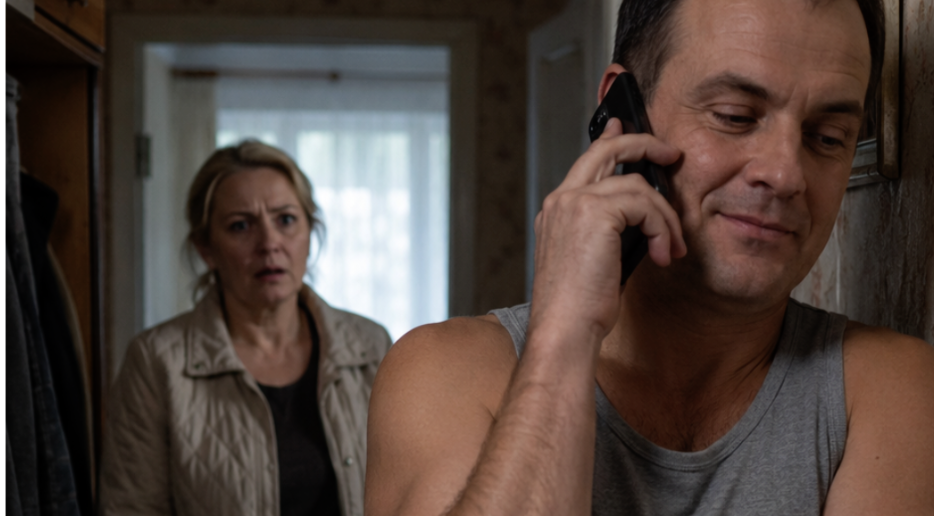
No, Seryoga, seriously, what’s she going to do? My wife is wooden. She doesn’t care about anything. Don’t worry, I’ve already found a buyer for her apartment.”
I froze in the hallway with shopping bags in both hands. The keys were still dangling in the lock — I hadn’t even managed to close the door behind me. In the bags were potatoes, onions, chicken legs, buckwheat on sale, and three yogurts for Kostik — only plain white ones, no sugar. In my head, I was already calculating whether I’d have time to defrost the meat or whether I’d have to throw it into the pan frozen again, so it would turn out steamed instead of fried.
Vadik was standing with his back to the entrance, pressing the phone to his ear with his shoulder and stirring something in a mug — his instant coffee with three spoonfuls of sugar. He never washed his dishes afterward.
“She won’t find out anything,” he continued, slurping from the mug. “I’ll tell her they’re documents for re-registration and she’ll sign. She trusts me. Wooden. No emotions, no character. A free housemaid.”
He laughed.
I recognized that laugh — the same way he roared with his friends in the garage while I washed the dishes after their get-togethers. The same laugh he had when Kostik fell off his bicycle as a child and I ran over with antiseptic, while Vadik just stood there and said, “Why are you fussing like a mother hen? Let him get up himself.”
A roaring filled my ears, like just before a spike in blood pressure. My fingers gripped the handles of the bags, the plastic cutting into my palms and leaving white lines. Slowly, I set the groceries down on the floor. I took out my phone. Turned on the voice recorder.
Mumbling drifted from the kitchen — Vadik was already discussing fishing hooks with Seryoga and tomorrow’s trip to the lake. That was always how he was: first he would spit out poison, then move on to nonsense. As if nothing had happened. As if I really were wooden.
I brought the phone to the crack of the half-open door and stood there until he said goodbye to Seryoga and promised to “celebrate the deal next week.”
Then Vadik hung up, grunted, and shuffled in his slippers toward the refrigerator. I turned off the recording, slipped the phone into my pocket, grabbed the bags, and silently slipped past the kitchen into the room. I closed the door and leaned my back against the frame.
A cold fire pressed beneath my ribs — I wanted either to scream or howl like a dog. Twenty-four years of marriage. Kostik, school, university, his loans, which I had paid off with my vacation money. His mother, whom I drove to the hospital three times a week until the very day she died. His socks, cutlets, the endless “Lyuba, where’s my blue shirt?” And now I was wooden. And there was already a buyer.
I sat down on the bed and stared at my hands. Buckwheat dust had rubbed into them. I looked at my wedding ring — thin, worn down. He had given it to me when we still lived in a dormitory and ate pasta with ketchup. I wanted to tear it off and throw it out the window.
But I didn’t.
I took a deep breath, just as my mother had taught me: “Lyubasha, if someone hurts you, count to ten first, and then decide what to do.”
I counted to twenty.
Then I got up, washed my face with ice-cold water, and took an old notebook out of the drawer. I found the number for the government service center — I had written it down when I was arranging disability paperwork for my mother.
Music played on the line for a long time. A woman’s voice explained that a ban on registration actions could be placed through the portal, but it would be better to come in person.
I said I would come.
Right now.
It was around three. Vadik was rattling around in the kitchen — probably frying eggs. I went out into the hallway and put on my coat.
“Where are you going?” he asked without turning around. The frying pan hissed.
“For bread. There isn’t a crumb for dinner.”
“Oh, right. Get me cigarettes too.”
I left.
In the elevator, I was shaking. Not from fear — from realizing what I was doing. For twenty-four years, I hadn’t done anything without his approval. Even the wallpaper color had been chosen together, and then he said, “Beige is boring. We should have picked green.” And I had stayed silent.
The government service center was empty. The girl at the window looked over the documents for a long time.
“Are you sure you want to place the restriction? Without your personal presence, no one — not even with power of attorney — will be able to sell, gift, or exchange the apartment.”
“I’m sure.”
She began tapping on the keyboard. Fifteen minutes later, I stepped outside with a piece of paper. I slipped it into the inner pocket of my coat, the same place where my phone with the recording lay.
I came home with a loaf of bread and a pack of his favorite cigarettes. Vadik was lying on the sofa, watching an action movie. I went into the kitchen and turned on the kettle. In the pan were the burnt remains of fried eggs.
I washed it.
Out of habit.
At around seven, the doorbell rang. Vadik jumped up and tugged down his T-shirt.
“Oh, that’s for me. Lyuba, put the kettle on. A good man is coming.”
I nodded.
A man of about fifty entered the hallway, wearing an expensive coat and carrying a briefcase. Vadik fussed around him, smiling broadly.
“Meet Oleg Borisovich, the realtor. We’re sorting out the apartment issue.”
I came out of the kitchen, wiping my hands on a towel. I looked at Vadik — at his smug face.
“Vadik, do you remember talking to Seryoga today?”
He froze. The smile slid off his face slowly, like badly glued wallpaper.
“What? Well… yes, I did. Why?”
“You called me a wooden wife. And said you had found a buyer for my apartment. And that I wouldn’t find out anything.”
A pause hung in the air. The realtor shifted from one foot to the other. Vadik first turned pale, then uneven red blotches spread across his cheeks.
“What are you talking about, Lyuba?” he began, but I raised my hand.
“Don’t. I heard everything. Here.”
I took out my phone and played the recording. His voice filled the room:
“My wife is wooden… I’ve already found a buyer for her apartment… she trusts me… a free housemaid…”
The realtor stepped back toward the door.
“Vadim, you didn’t say there were complications.”
Vadik looked at me as if I were a stranger.
“You recorded me? You were spying on me?” he hissed.
“I was standing behind the door with bags of groceries I bought with my own salary so that you, Kostik, and his girlfriend could eat dinner. And at that very moment, you were selling my home. Mine, Vadik. Not ours. My mother’s.”
He took a step toward me, but I continued calmly:
“And one more thing. Today I went to the government service center and placed a ban on any actions involving the apartment without my personal presence. So your buyer” — I nodded toward the realtor — “can go look for another option. This one is no longer for sale.”
The realtor backed away.
“I think I’ll go. Vadim, we’ll talk later. Excuse me.”
He slipped out the door.
We were left alone. Vadik stood in the middle of the room, gulping air like a fish on shore.
“What have you done? You ruined everything! We had plans!”
“You had plans. I had faith. And today you trampled it. You called me wooden. Well, you know what, Vadik? Wood burns. And I have burned.”
He sat down on the sofa and clutched his head in his hands.
“Lyuba, forgive me. It just slipped out. I didn’t mean it. Seryoga pushed me into it…”
“Seryoga,” I smirked. “Of course. It’s always someone else’s fault. Not you — the man who lived off me for twenty-four years, drank my tea, slept on my sheets, and considered me a piece of furniture.”
I took off my ring. Placed it on the coffee table.
“Tomorrow I’m filing for divorce. The apartment stays with me — it’s my mother’s inheritance, and you have no rights to it. You’ll pack your things within a week. I’ll explain everything to Kostik myself. He’s an adult.”
“Lyuba…”
“Don’t. You have no idea how light I feel right now. For the first time in many years, I’m not thinking about what to make for dinner. I’m thinking that I have a home. And that I have myself.”
I went into the bedroom and closed the door.
My phone beeped — a message from a friend:
“So, how was your day?”
I typed back:
“Excellent. I stopped being wooden.”
In the morning, I woke up at seven. Instead of rushing to put the kettle on for Vadik, I stretched, threw on my robe, and went to make coffee.
For myself.
Ground coffee, with cinnamon.
Vadik only drank instant coffee. But I had always loved coffee made from beans.
He came out of the room with a crumpled face and looked at the cezve in my hand.
“And me?”
“And you, Vadik, need to start looking for a new housemaid. Wooden women sometimes come back to life.”
I took a sip. The coffee was scalding hot. My hands were still trembling, and the cup knocked against my teeth. But it was the most delicious coffee of my life.
Because I had made it only for myself.
The doorbell rang. I set down the cup and went to open it. Oleg Borisovich, the realtor, stood on the threshold. No briefcase this time, in the same coat, but looking somewhat embarrassed.
“Sorry for coming so early. The thing is… your husband mentioned yesterday that the apartment was yours, but I didn’t know… In short, I would like to offer you my services. As the owner. If you ever decide to change something, sell, or buy — I can help. Honestly. No complications.”
I was taken aback. I stood there and looked at him. Vadik peered out of the kitchen with a twisted expression.
“What are you doing here?” he barked.
“Working,” Oleg Borisovich replied calmly. “I have a new client now.”
He held out his business card. I took it and turned it over in my hands. Then I looked at Vadik, at his helpless rage, and at the realtor with his professional smile.
“You know, Oleg Borisovich, I’ll think about it. But not today. Today I have plans — I’m buying a cat. And possibly a new frying pan.”
The realtor nodded, said goodbye, and left. Vadik muttered something and disappeared into the room.
I closed the door, leaned my back against it, and laughed.
Quietly, almost inaudibly.
For the first time in many years, I laughed in the morning in my own hallway.
I finished my coffee with a smile. And I thought that I would name the cat Marta. After the one we had when I was a child, before my father gave her away to the neighbors because there was “fur all over the apartment.”
Now I would have my own Marta.
And no one would say that fur was a problem.