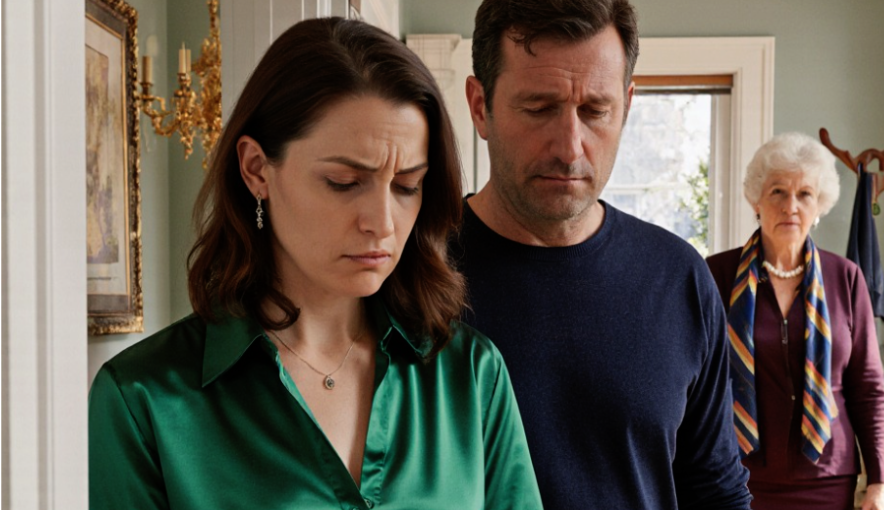
Have you completely lost your mind, Tamara Ilyinichna, or have you simply stopped being ashamed?” Oksana snapped, stopping on the stair landing with a wet umbrella in her hand.
Her mother-in-law slowly turned her head. A silk scarf was tied flawlessly around her head, as if she were not standing in the damp October chill, but sitting on the veranda of her own sanatorium somewhere in Kislovodsk. Misha clutched his dinosaur backpack to his chest and looked from his grandmother to his mother the way children look when they sense that the adults are no longer going to talk, but hurl words at each other like irons.
“Oksana,” Tamara Ilyinichna said coldly, pressing her lips together, “if you are going to eavesdrop, at least do it without such a dramatic face. Your raincoat is dripping all over the stairs. Maria Semyonovna downstairs will start screaming again that the entrance hall has turned into a swamp.”
“Let her scream,” Oksana cut her off, breathing heavily. “Right now I’m interested in something else. Why did my son just hear from you that his family is you, Andrey, and him, while I am, and I quote, ‘a temporarily residing woman’?”
Misha twitched his shoulder and muttered quietly:
“Mom, Grandma didn’t say it like that…”
“Misha,” Tamara Ilyinichna quickly interrupted, affectionately smoothing his hair, “the adults are going to talk now. Go into the apartment, take off your shoes, and wash your hands. And don’t stand there with your mouth open, or you’ll catch cold in your ears. Although some people in this family already have ears that work better than their brains.”
Oksana was silent for a second. Then she gave a short, bitter laugh.
Suddenly she understood with perfect clarity: that was it. She had not imagined it. She had not “reinterpreted things because she was tired.” She had not “worked herself up because it was the end of the quarter, deadlines, and hormones.” No. Everything was exactly as it seemed. In their beautiful, large, proper apartment on Frunzenskaya, a quiet war had been going on for a long time. And now, on the stair landing, it had officially been declared.
When they entered the apartment, the hallway smelled of meat, cinnamon, and expensive shoe cream. In their family, even ordinary household smells had pretensions of belonging in a magazine about beautiful living. Andrey came out of his study with a phone pressed to his ear, nodded to his wife, pointed at the screen as if to say “one minute,” and disappeared again. That was what Ivanov-style family support looked like: silent, in profile, and preferably without interfering with an important call.
“Take off the wet things,” Tamara Ilyinichna said dryly, hanging her coat on the hooks. “And don’t spread water everywhere. I only asked the housekeeper this morning to wipe everything down. Although, of course, why remember other people’s labor when you have your own little world: meetings, takeaway coffee, and eternal exhaustion.”
“I am going to talk to you now,” Oksana replied calmly, looking straight at her. “Not in the kitchen, not over dinner, not in whispers. Properly. Like human beings. So that later nobody can say I misunderstood something.”
“Like human beings?” her mother-in-law snorted. “You are going to lecture me about being human? You, who come home at nine in the evening and then lie with your phone for half an hour because you are tired of living?”
“And you,” Oksana stepped closer, “who pours garbage into my child’s head, are you going to play the holy martyr now too?”
“Oksana!” Andrey exclaimed, coming into the hallway and irritably removing his headset. “What now? Can we have at least one evening without a scandal?”
“We can,” Oksana answered instantly, without taking her eyes off her mother-in-law. “As soon as your mother stops explaining to our son that I am an outsider here.”
Andrey blinked, then tiredly rubbed the bridge of his nose.
“God… Here we go again. Mom, what did you say?”
“Nothing of the sort,” Tamara Ilyinichna replied with dignity, adjusting her cuff. “The child asked who our family was. I said family means the people who stand by one another. Apparently, not everyone here is ready for simple truths.”
“Don’t lie,” Oksana said quietly.
“Watch your language,” her mother-in-law snapped.
“And you watch your tongue when you talk to my son,” Oksana cut back. “He is not your project. Not your chance to replay motherhood. Not your final retirement soap opera.”
“Oh, look who finally found her voice,” Tamara Ilyinichna drawled with a smirk. “I was beginning to think all you could do was take offense and run off to work, as though they were going to hang your portrait on an honor board there.”
“Enough!” Andrey roared, raising his voice. “Misha is in his room! Do either of you even hear yourselves?”
“I hear myself,” Oksana replied and turned to him. “But you, it seems to me, stopped hearing yourself a long time ago. I’m asking you a simple question right now. Your mother told our child that I am a stranger to him. Do you consider that normal?”
Andrey hesitated for only a moment, but that was enough. Sometimes a person is betrayed not by the answer, but by the pause before it.
“I think,” he finally said in an even voice, “that you are too wound up right now. And that Mom most likely expressed herself poorly. That’s all. There’s no need to turn this into a federal-scale drama.”
“Expressed herself poorly?” Oksana gave a short laugh. “Excellent. Then let me express myself poorly too. Your mother is interfering in my family. Every day. With every word. And you are covering for her because it is convenient for you to be a good son and a spineless husband at the same time.”
“Don’t you dare speak to my son like that!” Tamara Ilyinichna flared up and stepped forward.
“And you don’t dare turn my child into an accomplice,” Oksana answered just as sharply.
Misha came out of his room, frightened, with a teddy bear under his arm.
“Mom… Grandma… please don’t…”
Oksana immediately softened and crouched down in front of him.
“Mish, go to your room for five minutes, all right? I’ll come to you. This is an adult conversation.”
“No,” Tamara Ilyinichna suddenly said firmly, pulling the boy toward herself. “Let him hear it. It will be useful for him to know what hysteria looks like in a person who does not know how to be part of a family.”
Oksana slowly stood up. Something inside her clicked so clearly, as if someone had flipped a switch in a dark room.
“Wonderful,” she said, now almost calmly. “Then, Andrey, you listen too. Tomorrow I am not going anywhere. I’ll take a day off. And you and I will talk without an audience. At length. In detail. In the meantime, keep your ideal family system under control before it collapses on your head.”
She went into the bedroom, closed the door, and for the first time in seven years of marriage, she did not cry. On the contrary, everything became dry and clear. Like in accounting after an inventory check: here is the income, here are the expenses, here is the shortage, and here is the person dragging home boxes that do not belong to them.
That night, Andrey lay down beside her, tossed and turned for a while, and began in his usual conciliatory tone:
“Oks, why did you have to do that? Mom really does go too far sometimes, but she helps. Misha is fed, supervised, the house is in order. You yourself said it would be difficult for us without her.”
“One thing is help,” Oksana replied quietly, staring at the ceiling. “Another is when a person is slowly squeezed out of her own home, and then everyone widens their eyes and says, ‘What are you talking about? You imagined it.’”
“Nobody is squeezing you out.”
“Then why have I been living for the second year as if I have to prove to everyone here that I have the right to sit on my own sofa?”
“You’re exaggerating again.”
“And you are hiding behind that word again because you’re afraid to touch the truth with your bare hands,” Oksana said, turning toward him. “Tell me honestly: have you ever once put your mother in her place when she humiliated me?”
Andrey frowned.
“Don’t start. She has a difficult character.”
“So what? I’m no sugar candy either. But I don’t explain to our child that his grandmother is ‘temporarily residing until circumstances are clarified.’”
He said nothing. Then he exhaled irritably.
“I’m tired. Let’s talk tomorrow.”
“Too late,” Oksana said. “Tomorrow it will no longer be ‘let’s talk tomorrow.’”
In the morning, she really did stay home. She waited until Andrey left and Tamara Ilyinichna took Misha to chess lessons. Then she went into her mother-in-law’s room. No dramatic music, no “oh, how low have I fallen.” She simply opened the drawer of the writing desk, then the second, then the third. Tamara Ilyinichna was a woman of the old school: if you built an intrigue, you absolutely had to collect an archive. Something to admire on long winter evenings.
The folder was found in the bottom drawer, under neatly folded magazines and receipts. Blue, with ties. Like in a bad TV series. Only this was not a series. It was her life, and that made it not funny at all.
Oksana untied the strings and sat right down on the carpet.
“Well, would you look at that,” she muttered, flipping through the pages. “Turns out I’m quite popular.”
There were printouts of her social media posts, photographs, bank statements, schedules of her work trips, and handwritten notes. On one sheet, in her mother-in-law’s neat handwriting, it said: “Came home after eight again. Found no time for the child. Priorities are obvious.” On another: “Gets irritated when Misha makes noise. Emotionally unstable.” On a third were the contacts of some psychologist, a meeting schedule, a draft complaint, and, like the cherry on this cake of family madness, a draft petition to determine the child’s place of residence with his father.
Oksana sat there, reading, and felt not hysteria, but icy rage. The kind that no longer makes you shake. On the contrary, it straightens your back.
At the bottom were powers of attorney bearing Andrey’s signature.
“Of course,” she said quietly. “How could it be without him?”
She photographed every page. Every note. Every sheet. Then she carefully put everything back, tied the strings, and returned the folder to its place.
An hour later, she was sitting at Lena’s, her old friend’s place, drinking coffee that had long gone cold.
“All right,” Lena said, scrolling through the photos on the phone and tapping the table with her fingernail. “The situation is lousy, but not fatal. In Russian courts, they still have to prove their wishes. A few papers from a pocket psychologist won’t be enough, especially if there are signs of manipulation. But the fact that they have a plan — that is interesting. Very interesting.”
“He signed them, Lena,” Oksana said dully. “Do you understand? He signed them. Not his mother, not some neighbor, not the hairdresser from the third floor. Him.”
“I understand,” Lena replied shortly. “As it turns out, your husband is not the head of the family, but a branch office of his mother’s will. But right now crying about that is a luxury. Right now you need to gather your own things. Where are your documents?”
“In the closet. In a folder.”
“Move them. The child’s birth certificate, your papers, the contract for the apartment you bought before marriage, everything. By the way, the apartment is yours, bought before the marriage?”
“Yes.”
“Then it is your personal property, not subject to division. That’s already good. You’ll have somewhere to go if the circus with horses begins. Now listen carefully.”
Lena leaned closer and lowered her voice:
“You need recordings. Not emotions, not retellings, not ‘I think.’ You need their own words. How your mother-in-law turns the child against you, what she says about you, how she discusses the plan. And ideally, Andrey should appear in there too. Without that, he’ll later pretend to be holy furniture: ‘I knew nothing, I was dragged into it.’”
“How?”
“A camera. A voice recorder. Patience. And a poker face.”
“I only have a poker face from morning until coffee.”
“Then you’ll walk around with a thermos,” Lena smirked. “And one more thing. Don’t drink anything they lovingly serve you. Especially tea. Ladies like that enjoy not only treating people morally.”
Oksana gave a humorless snort.
“Excellent. We’ve come to this. In my own home, like in a cheap detective production.”
“But with a good ending, if you don’t fall apart,” Lena cut in. “You’re not the first and, unfortunately, not the last. Family wars in this country are fought no worse than communal ones. Only instead of tanks, they use borscht, resentment, and a notary.”
Over the next few days, Oksana lived like an actress who had been given the role of a lifetime: “The Perfect Wife Who Does Not Suspect She Has Already Been Written Off into the Archive.” She smiled. Thanked them for the cutlets. Discussed winter tire prices with Andrey. Listened as Tamara Ilyinichna complained about the tasteless tomatoes at Azbuka Vkusa, as though that were the main tragedy of an entire generation.
And at night, locked in the bathroom, she listened to the recordings.
“Mishenka,” her mother-in-law’s voice sounded, honeyed and cloying, “our mom is a nervous person. Don’t upset her. When she gets angry, come to me. Grandma understands you.”
“Does Mom love me?” Misha asked quietly.
“In her own way, of course,” Tamara Ilyinichna sighed. “But some people have a strange kind of love. On the run. Between a meeting and a manicure.”
Oksana squeezed the phone so tightly that her fingers turned white.
On another recording, Tamara Ilyinichna was speaking on the phone:
“Yes, Arkady Borisovich, it has to be worded carefully… No, it’s too early for deprivation, I agree. Restricting contact would be more reasonable. The child is attached to me and his father, everyone can see that… Andrey? Andrey will sign. He’s my soft boy, as long as things are quiet at home.”
Oksana listened to that part three times. Not because she did not believe it. Because she wanted to memorize the intonation. That affectionate, calm tone of a person who takes apart someone else’s life like a wardrobe: throw this away, keep this, move this over there.
On Friday, Andrey announced at dinner:
“I’m going to Tula for the day on Saturday. A meeting with a client. It can’t be moved.”
“Of course,” Tamara Ilyinichna said with a smile. “We’ll manage here without you. I’ve wanted to invite Lidia Petrovna and Sofia Markovna for a long time. We’ll have a small family lunch.”
“Family?” Oksana repeated, taking a sip of water from her own bottle.
“Well, yes,” her mother-in-law replied innocently. “Although, as practice shows, not everyone understands the meaning of that word.”
Andrey pretended not to notice.
That night, Oksana barely slept. At dawn, she called Lena.
“Today,” she said.
“Excellent,” Lena understood at once. “Just don’t lose control too early.”
“I’ll try. But if I hear that ‘Oksanochka’ in her tone one more time, I may need a lawyer not for family law, but for criminal law.”
“Hands to yourself, words on record,” Lena replied dryly. “And don’t forget to send everything to me in the cloud immediately. In case a sudden technological miracle happens at home.”
Saturday morning was quiet and unpleasant, like all Moscow October mornings: a wet yard, gray slush underfoot, a neighbor’s drill, and an argument in the building chat about parking. Tamara Ilyinichna put on pearls. At nine in the morning. Because, apparently, intrigues simply did not work for her without pearls.
“Oksanochka,” she sang in the kitchen, “please slice the cheese. Only not as thick as you like it. We are not at a railway station.”
“Of course,” Oksana replied, putting down the knife. “And afterward, perhaps we can immediately discuss the moment you decided you had the right to rewrite my life by hand in a blue folder?”
Tamara Ilyinichna froze. Then very slowly set her cup down on the table.
“Excuse me?”
“Don’t pretend. It’s exhausting by now. The folder. The printouts. The psychologist. The powers of attorney. The plan to leave me without my child. I photographed all of it yesterday. Very informative reading. I especially liked ‘emotionally unstable.’ I suppose that diagnosis comes with a mortgage, quarterly reports, and dinner on schedule.”
Her mother-in-law turned pale, but quickly pulled herself together.
“Well then,” she said quietly. “So you went through my things. Dignified. Very dignified. Exactly your style.”
“And your style is digging through my life and teaching my son to fear his mother.”
“I am not teaching him to fear,” Tamara Ilyinichna hissed. “I am teaching him to see whom he can rely on.”
“On you?” Oksana smirked. “On a woman who collects a dossier on her daughter-in-law like a district police officer in the nineties?”
“On the person who is present,” her mother-in-law said with emphasis. “Not on the one who is always absent. You are always somewhere else. In your phone, in your work, in your complaints. Even when you come home, you arrive like someone on a business trip.”
“And you,” Oksana stepped toward her, “have crawled so deep into our marriage that you apparently now consider it your living space.”
“Because if I hadn’t crawled in, everything here would have fallen apart long ago!” Tamara Ilyinichna snapped for the first time. “Who is raising Misha? Who cooks? Who makes sure your home isn’t a mess? Who turns this apartment into a home instead of a hotel?”
“You are not making a home,” Oksana said harshly. “You are building yourself a throne room.”
“And what are you building?” her mother-in-law laughed contemptuously. “A career? Independence? Very funny. A woman over forty, with a child, without any real family support. Who needs you, apart from your presentations?”
“It is enough for me to be needed by myself and my son.”
“Your son?” Tamara Ilyinichna lifted her chin. “Don’t flatter yourself. Children are drawn to where it is calm. And you are a walking complaint with styled hair. Even when you smile, it looks as if you’re about to draw up a report.”
Oksana took out her phone, pressed a button, and played a recording.
Her mother-in-law’s voice sounded from the speaker:
“…Andrey will sign. He’s my soft boy, as long as things are quiet at home…”
Tamara Ilyinichna flinched as if she had been slapped.
“Turn that off immediately!”
“Why?” Oksana asked. “Isn’t this probably just me dramatizing again? Or this too?”
The second recording began:
“…Mishenka, when Mom gets nervous, it’s better to come to Grandma…”
Andrey was standing in the kitchen doorway. With his bag. Pale. Apparently, he had not gone to Tula after all. Or he had gone only as far as his own conscience and back.
“Mom…” he said hoarsely. “What is this?”
Tamara Ilyinichna instantly switched to a tragic tone.
“Andryusha, don’t look at me like that. I did everything for you. For you. For the child. You saw yourself what she had become. Constantly twitchy, always dissatisfied…”
“And the powers of attorney?” he interrupted, pulling papers from his pocket. “Was that for me too? You told me they were for a consultation about school registration and just in case. Just in case, Mom? Are you serious?”
“I wanted to protect you!” she raised her voice. “You are weak, Andrey. Too soft. You don’t know how to make difficult decisions. I have always made them for you, and what of it? You lived like a proper person!”
“Exactly,” he smiled bitterly. “Like a person. Only, apparently, not my own life.”
Oksana looked at them and suddenly felt a strange relief. Not joy. Not triumph. Simply that the words had finally come out of the kitchen into the light and stopped hissing in the corners.
“Andrey,” she said evenly, “the question is simple now. Did you know a lawsuit was being prepared?”
He lowered his eyes.
“I… I knew Mom had consulted someone. But I didn’t think it was all so…”
“Don’t lie, at least not now,” Oksana said quietly.
He pressed his lips together.
“I thought it was to shake you up. So you would spend more time at home. So that… so everything would get better.”
“Stunning,” Oksana smirked. “So a normal husband talks. And you decided I needed to be legally ‘shaken up.’ Very manly. You could print that on a mug.”
“Oksana, I made a mistake.”
“A mistake is when you buy the wrong cheese. This is called betrayal.”
Tamara Ilyinichna sharply pushed back her chair.
“Stop making yourself out to be the victim!” she shouted. “You came into an established family, an established way of life. You were given everything: an apartment, help, a child who was cared for while you played businesswoman. And what did we get in return? A sour face and endless complaints. Yes, I did not want Misha to grow up with a mother who is irritated by everything!”
“Don’t you dare!” Oksana shouted.
“Or what?” her mother-in-law stepped almost right up to her. “Will you hit me? Go on. Then everything will really become clear to everyone.”
Oksana sharply pushed her hands away when the woman poked a finger into her shoulder. She did not hit her. Just shoved her back. But that was enough for the tension to finally burst.
“Misha, go to your room!” Andrey shouted.
“No!” their son’s voice came from the hallway. “Don’t shout!”
Oksana came to her senses first. She ran to the child, crouched down, and hugged him.
“It’s all right, it’s all right. I’m here. Do you hear me? I’m here.”
The boy buried his face in her neck and whispered:
“Grandma said you might leave and abandon me… Is that not true?”
Oksana closed her eyes for a second. Then she pulled back and said firmly:
“It is not true. Do you hear me? I will not leave you. Not for anyone. Never.”
Tamara Ilyinichna snorted.
“Of course. Grand promises against the background of exposure.”
Oksana stood up, holding Misha by the hand.
“That’s it. This circus is over. Andrey, today I am leaving for my place in Khimki. With the child.”
“Wait,” he said, confused. “Let’s be calm. Let’s discuss this.”
“It was calm before, when you could have told your mother, ‘Don’t interfere.’ You didn’t. Now it will be through the law and lawyers. More reliable that way. For everyone, especially your mother with her creative approach to family relations.”
“You have no right to just take the child!” Tamara Ilyinichna shrieked.
“I have every right, as his mother, to take my son and leave a toxic environment,” Oksana cut her off. “And after that we will determine visitation arrangements in a civilized way. Without your domestic performances.”
“This is my apartment!” her mother-in-law shouted.
“No, Mom,” Andrey said hoarsely. “This is Oksana’s and my apartment. And it would be better for you now to go to Aunt Zina’s or to your dacha apartment. Just leave. And keep quiet.”
“You are throwing me out? Me? After everything?”
“After everything — yes.”
Tamara Ilyinichna looked at her son as if she wanted to burn a hole through him.
“Fine, then live. Without me, in a month you’ll be howling. He won’t be able to find his own socks, and you,” she jabbed a finger at Oksana, “you’ll remember how convenient it was to hate me while everything was done for you.”
“Possibly,” Oksana said calmly. “But at least it will be honest.”
Two hours later, she was driving along the wet Leningrad Highway, Misha asleep in the back seat hugging his teddy bear, while two suitcases, a box of documents, and a bag of children’s books lay in the trunk. Everything most valuable in life turned out not to take up so much space. Half of the old household, as it turned out, was not needed at all: crystal salad bowls, someone else’s curtains, silver frames, endless “family” dinner sets. Crisis is a strange thing. After it, you immediately see what in a home is yours and what is merely dust with ambitions.
A month passed. Then another.
The divorce proceeded painfully, but predictably. At first, Andrey tried to speak gently, then resentfully, then gently again. He suggested “not washing dirty linen in public,” as though his mother had not turned that very linen into an entire waste-sorting complex. Then he began to justify himself:
“I really didn’t think Mom would go that far.”
“You thought you could stand aside and not get touched by it,” Oksana replied. “That doesn’t happen.”
They agreed on a visitation schedule for the child. Without the grandmother’s presence. Oksana fought for that condition hard and without sentiment. Lena helped draw everything up properly, without unnecessary pretty wording, but in such a way that later nobody could claim “we misunderstood.”
One day, Andrey came to pick up Misha and, while their son was putting on his shoes, awkwardly said:
“You know… Mom now tells everyone that you turned me against her.”
“Too late,” Oksana replied, fastening the child’s jacket. “You are already a big boy. You should be able to keep secrets yourself and distinguish manipulation from love.”
He winced painfully. He understood where the quote came from. And nodded.
That evening, when Misha came back, they sat in the kitchen of the small Khrushchev-era apartment in Khimki, drinking tea with ring-shaped crackers, and her son suddenly said:
“Mom, it’s not as pretty here as it was there. But here it feels somehow… lighter.”
Oksana smiled.
“That’s because nobody here plays the Queen of England,” she said. “At most, I sometimes pretend to be an evil aunt when you throw your socks under the sofa.”
“And I pretend not to hear,” Misha nodded importantly.
“Very talented, by the way.”
He laughed. And that laughter was better than any victory in court.
Snow fell early that year. The yard beneath the windows turned white, the cars became equally unrecognizable, and the air was the kind that made you want to open the small window and finally breathe deeply. Oksana stood by the window with a mug of tea and thought about a simple, almost funny thing: how much strength a person spends not on living, but on enduring someone else’s idea of how they ought to live properly.
Misha’s voice came from the room:
“Mom! Come here! I built a house!”
She went in. On the carpet stood a Lego house: slightly crooked, multicolored, with a tower, a garage, and, for some reason, a helipad on the roof.
“Well?” he asked proudly.
“A very serious structure,” Oksana assessed. “You can immediately tell: an architect with character.”
“We will live here. And the robot. And maybe a cat.”
“A cat is already a claim to luxury.”
“And Grandma?”
Oksana was silent for a second. Then she sat down beside him.
“Grandma will have her own house,” she said calmly. “And we will have ours. That happens. The important thing is that where you live, nobody explains to you that you are extra.”
Misha thought for a moment, then nodded and said seriously:
“Then our house will be strong. Not because it’s made of blocks. But because there are no lies.”
Oksana looked at her son and suddenly smiled.
“You see,” she said. “And your grandmother thought only she knew how to raise men.”
Outside the window, snow fell quietly. In the kitchen, the kettle whistled. Mittens were drying in the bathroom. Her phone was blinking again with work messages. And in the hallway lay one child’s boot — the second, of course, had mysteriously disappeared as usual. Life had not become simpler, richer, or quieter. It simply no longer contained other people’s voices deciding for Oksana who she was in her own home.
And that, as it turned out, was not a dramatic ending.
It was a normal beginning.
The end.