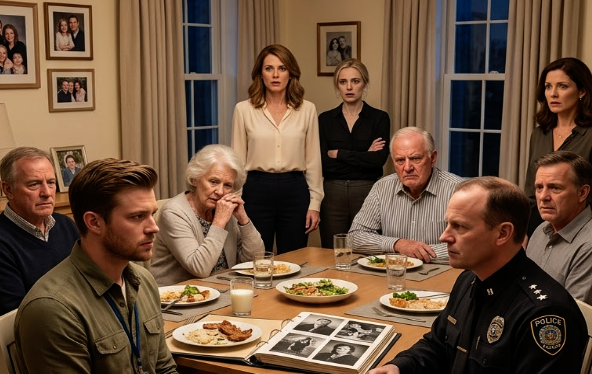
“You’re under arrest for impersonating a federal officer,” my brother announced to the silent room, his voice vibrating with a mixture of practiced authority and long-simmering malice.
The military badge hanging from my neck—a symbol of a life he could never fathom—seemed to glint mockingly under the harsh yellow light of our grandmother’s dining room chandelier. Alex stood there, chest puffed out, a man who had finally trapped his white whale. He thought he’d won. He had no idea that he had just pulled the pin on a grenade that would level his entire existence.
I am Cameron. I am thirty-seven years old. And on March 16, 2026, my own brother—the Chief of Police in our stagnant little town of Chesterville, Virginia—handcuffed me in front of our mother and grandmother. Before I detail the catastrophic moment his world imploded when my commanding officer breached that front door, I want to acknowledge those of you reading this. Whether you are in the bustling streets of Paris, the quiet hills of Italy, or anywhere else, thank you for witnessing this reckoning.
The dining room was a frozen tableau. The fork in my hand felt heavy, an anchor in a sea of rising tension. The only sound was the rhythmic tick-tock of the grandfather clock in the hallway and the sharp clack of my mother Eleanor’s knife hitting her fine china. Outside, the world was dark, but inside, the air was thick with the scent of roasted chicken and the metallic tang of impending disaster.
Alex’s police chief uniform was stretched tight across his shoulders, a garment that served more as armor for his ego than a symbol of public service. He looked at me not as a brother, but as a trophy. Around the table, the reactions were a study in family dysfunction. My mother’s face was a mask of “I told you so” disappointment. My cousins leaned in, hungry for the drama. Only my grandmother, Evelyn, remained still. Her eyes didn’t hold shock; they held a weary, ancient sadness, as if she had seen this play written decades ago.
“I have evidence,” Alex declared, slamming a manila folder onto the lace tablecloth. “A lie that ends tonight.”
He saw my silence as a confession. In reality, it was a tactical assessment. In my world—the world of the Office of Strategic Defense and Intelligence (OSDI)—silence is a weapon. I watched the silver handcuffs emerge from his belt. The click of the first cuff was a definitive punctuation mark. I didn’t resist. To resist is to give a bully the physical struggle they crave. I simply looked at him, letting him drown in his own triumph. To understand the poison in that room, we have to look at the foundations of the House of Caldwell. I hadn’t stepped foot in Chesterville for seven years. My life was a world of SCIFs (Sensitive Compartmented Information Facilities), encrypted satellite uplinks, and geopolitical chess. Chesterville was a memory I had intentionally allowed to gather dust.
The summons came not via a secure channel, but through a physical letter. My mother’s cursive—elegant, looping, and sharp as a razor—had found its way through three layers of military mail screening. It was a masterpiece of passive-aggressive manipulation. She spoke of Alex’s “heroic” rise to Chief of Police and the “duty” I owed to my aging grandmother. The subtext was clear: Come home so we can remind you that you are the secondary son.
I remember the last time I was here—our father’s funeral. I had arrived on a twenty-four-hour leave, my soul heavy with a grief I couldn’t share. But Alex had turned the funeral into a campaign rally for his own character. He was the one who stayed. I was the one who left. My mother had whispered to me that day, “At least one of you understood what legacy meant.”
I realized then that in her eyes, my career—a career that kept the very sky from falling—was merely a “selfish escape.” I left the next morning before the sun rose.
When I requested leave from General Delaney to attend this dinner, he had looked at me with those granite-gray eyes. “Family matters, Caldwell. Stay safe. Call if you need anything.” I had no idea that “anything” would involve a federal response team. The drive back to Chesterville was a descent into the past. I remembered being seventeen, sitting in my father’s Ford pickup. He had told me I had a “strategist’s mind”—that I saw the whole picture. He said Alex was a “rock,” someone who needed to be needed by a small community.
That distinction became a rift. My mother saw my ambition as a betrayal of the family unit. To her, the child who stays is the only one who truly loves. I enlisted in the Army to fly—to escape the gravitational pull of her expectations. Alex stayed to become the “king” of a ten-block radius. The dinner was never about a meal; it was a tribunal. Alex had spent weeks—and likely thousands of dollars in department resources—trying to “unmask” me. He sat at the head of the table, in our father’s chair, a seat he hadn’t earned but had simply occupied by default.
Throughout the meal, the conversation was a barrage of praise for Alex’s “new department equipment” and “charity drives.” I remained a blank wall. My training taught me that a narcissist cannot stand a lack of reaction. It starves them.
Then, I saw it through the window. A silhouette by an oak tree. A dark sedan with tinted windows parked two houses down. It was a perimeter. Alex hadn’t just invited me to dinner; he had staged a tactical operation. He was using the Chesterville Police Department to conduct a personal hit on a federal officer.
“You’re always so secretive, Cameron,” my mother lamented, her voice a practiced sigh. “What is it you do that’s so important?”
“It’s complicated, Mom,” I said, my eyes tracking the movement outside.
“It’s a fraud!” Alex roared, standing up and tapping his wine glass for silence. He opened the folder, tossing surveillance photos onto the table like playing cards. Photos of me entering my apartment, of equipment boxes labeled Restricted, of redacted OSDI documents he had illegally obtained via a private investigator named Markham.
Alex claimed the military had no record of a “Captain Cameron Caldwell” in any high-level unit. He was right, in a way. I wasn’t a Captain. I hadn’t been a Captain for nearly a decade. But in his small-minded arrogance, he assumed that if he couldn’t see the record, it didn’t exist. He called me a thief of “government property” and a practitioner of “stolen valor.” The moment the handcuffs clicked, I felt a strange, chilling clarity. Alex was behind me, his breath hot against my ear, his ego radiating off him in waves.
“Do you have anything to say for yourself?” he sneered.
“Are you sure you have the authority for this, Alex?” I asked quietly.
He scoffed, citing “federal crimes committed in his town.” I tried to warn him about the Uniform Code of Military Justice (UCMJ) and the Judge Advocate General’s (JAG) jurisdiction. I was offering him a lifeline, a chance to realize he was out of his lane. He spat on it.
As he hauled me toward the door, my right thumb found the hidden button on the seam of my belt—a discrete emergency beacon. I held it for three seconds. The vibration against my hip confirmed that a pincer movement was now being coordinated forty-seven miles away at Fort Claybornne.
The walk through the house was a gauntlet of silent judgment. My mother wouldn’t look at me; she was busy playing the role of the “long-suffering mother of a criminal.” My uncle Robert muttered about knowing I was “no good.” Only my grandmother met my eyes. In her gaze, I saw the truth: She had known this was coming. She had let it happen because she knew Alex’s poison had to be drawn out in the light, or it would kill us all. We were on the porch, Alex grandstanding for his two young deputies, when the world changed.
At exactly twelve minutes, the low, synchronized hum of high-output engines filled the street. Two blacked-out government SUVs executed a perfect pincer movement, blocking the street and pinning Alex’s cruiser in a blinding crossfire of headlights.
Men in tactical gear—not local cops, but federal agents with short-barreled rifles—poured out with the fluid lethality of a Tier 1 unit. Alex froze. “State police?” he stammered. “I didn’t call backup.”
Special Agent Rollins of the FBI stepped into the light. “This is a matter of national security. Step away from the vehicle.”
Alex tried to assert his “jurisdictional authority,” a pathetic attempt to use a plastic shield against a titanium wall. Rollins didn’t argue; he ordered his agents to secure the “subject”—Alex. Within seconds, the Chief of Police was disarmed and restrained.
Then, the rear door of the lead SUV opened.
General Marcus Delaney stepped out. Two stars glinted on each shoulder. His chest was a roadmap of American military history. He strode past the tactical teams, his boots clicking with the weight of absolute authority. He stopped in front of me and delivered a crisp, perfect salute.
“General Caldwell,” he said, his voice a thunderclap in the suburban night. “We received your signal. Are you secure?”
The silence that followed was absolute. The title—General—shattered the reality Alex had built. I wasn’t a captain. I wasn’t a fraud. I was a two-star General in the United States Army, and my brother had just kidnapped me. The legal fallout was a surgical strike. General Delaney didn’t just rescue me; he dismantled the infrastructure of Alex’s corruption.
“Chief Caldwell,” Delaney said, his voice a lethal whisper. “You have interfered with a national security asset and unlawfully detained a superior officer. You have disgraced your uniform and your father’s memory.”
As they loaded Alex into the back of the SUV, I saw it: genuine, unfiltered fear. The “King of Chesterville” was being taken to a world where his badge meant nothing.
Inside the house, the atmosphere was funereal. My mother, seeing Delaney—a man she knew from my father’s past—tried to plead for “misunderstanding.”
“Your son,” Delaney corrected her, “is a disgrace. There is nothing to misunderstand.”
My mother turned her venom on me. “Why didn’t you tell us? You’re a General? You let this happen!”
It was the final confirmation of her character. Even now, with the FBI in her dining room, she blamed the victim of the crime for not “managing” the criminal better. She blamed me for her “Golden Boy’s” fall.
“I didn’t tell you,” I said, looking her in the eyes, “because you never asked. You asked why I wasn’t home for Christmas. You asked why I wasn’t like Alex. You never once asked who I was.”
I left that house for the last time that night. I didn’t look back at the little blue house or the people inside it. I had come home for an ending, and I had found it. The following months were a masterclass in federal prosecution. Alex’s defense—that he was acting in “good faith”—was shredded when the prosecution revealed his history of illegal background checks and his obsession with my life. The private investigator, Markham, turned state’s evidence. He testified that he had warned Alex that the documents were “real intelligence” and to walk away. Alex had laughed and called him a coward.
Alex was sentenced to twelve years in a federal penitentiary. He was barred from ever holding office or owning a firearm. He lost his pension, his reputation, and his freedom. My mother refused to attend the sentencing. My grandmother sat in the back, silent and straight-backed, a single tear falling for the boy Alex could have been.
I spent time in therapy with Dr. Sharma, unpacking the “strategist’s mind” my father had praised. I realized that Alex’s jealousy wasn’t about my job; it was about a single sentence spoken in a garage thirty years ago. He had spent his life trying to prove my “strength” was a lie because he couldn’t find his own.\
Today, I stand in the Pentagon, looking out over the Potomac. My life is one of immense, quiet responsibility. I am no longer a ghost; I am the man who directs the ghosts.
I don’t think of Chesterville with anger anymore. I think of it as a scar. Sometimes, the people who share your blood are the ones most threatened by your light. They will try to define you by their own shadows. The hardest, most necessary thing you can do is refuse their definition.
My name is General Cameron Caldwell. I have served my country, I have survived my family, and I am finally, truly, home.