The silence of St. Andrews Chapel was not the peaceful kind; it was the heavy, suffocating silence of abandonment. It was a cold Tuesday in September, the kind of New York morning where the mist clings to the grey stone of 9th Avenue like a damp shroud. Inside, the vaulted ceilings seemed to swallow the meager notes of the organ.
I stood at the mahogany casket, my gloved hand resting on the polished wood. Inside was Nathan—the man who had spent six years teaching me that I didn’t have to apologize for existing.
I turned slightly to look at the pews. They were ghosts. The front three rows, reserved for the “inner circle,” were an expanse of empty red velvet. My mother, Patricia, wasn’t there. My father, Gerald, the pillar of the Ridgewood community, was absent. My sister, Chloe, the “delicate” one, was nowhere to be found.
I had called them. I remember the exact vibration of the phone against my ear at 6:00 AM the day Nathan’s heart simply stopped. My mother’s voice had been flat, inconvenienced. “Oh, Fay, that’s terrible. We’ll talk when you come home. Chloe has a fitting for her engagement dress this weekend—it’s been hectic.”
A husband’s death weighed less than a silk hemline.
There were 14 people in that 200-seat room. Three college roommates, six colleagues from the museum, a neighbor, a florist, and James Whitfield. James sat in the very last row, a sentinel in a charcoal suit. He didn’t cry. He watched. When the service ended, he approached me on the steps, the wind whipping my veil.
“Nathan loved you,” he said, his voice a low gravel. “He made sure of that. Come to my office Monday, Fay. Before you go to Ridgewood. It’s important.”
I nodded, not understanding that Nathan had been fighting for me from the shadows for years. Two days later, I drove the two-and-a-half hours to Ridgewood. As the Manhattan skyline shrank in the rearview mirror, replaced by the suffocatingly neat lawns of suburban New Jersey and then the rural stillness of upstate New York, I felt the old Fay—the “difficult” daughter, the “sturdy” one—trying to take over.
Ridgewood: Population 8,000. It was a town built on appearances. My father was the honorary treasurer of the Ridgewood Community Church, a title he wore like a crown.
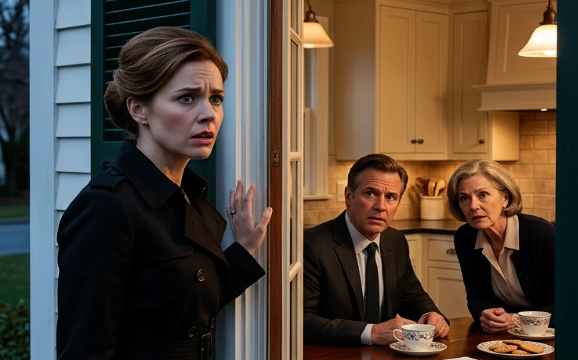
When I pulled into the gravel driveway of my childhood home, the white siding glowed with a predatory purity. I stepped onto the porch, my heels clicking softly, but stopped when I heard voices through the open kitchen window.
“She’s not thinking straight,” my mother’s voice sliced through the screen. It was her ‘committee voice’—organized, cold, and final. “She hasn’t been right since the wedding. Once Voss signs the papers, we file for the guardianship before she even knows what happened.”
My blood didn’t just run cold; it turned to slush.
“Tell Dad to make sure she doesn’t talk to that lawyer,” Chloe’s voice chirped over a speakerphone. “He gave me a weird vibe at the wedding. If we get her here for 72 hours, Voss says the evaluation holds. She’s grieving, she’s ‘unstable.’ No judge will question it. We manage the lofts, we manage the accounts. Simple.”
I stood frozen. A moth battered itself against the screen door, a frantic, mindless sound. They weren’t mourning Nathan. They were carving him up. $8.5 million. Six Manhattan lofts. They spoke of my life as if it were an estate sale they were managing after a minor fire.
I reached into my pocket. I remembered a compliance seminar at the museum: New York is a one-party consent state. I hit ‘Record.’ The red dot on my screen felt like a laser sight. I captured it all—the calculated greed, the dismissal of my humanity, the plan to erase my autonomy.
When I finally rang the bell, the transformation was instantaneous. My mother opened the door, her face melting into a mask of practiced tragedy. “My poor baby,” she sobbed into my shoulder. I smelled her lavender perfume and felt nothing but the urge to recoil. The next morning, the “trap” took the form of Dr. Raymond Voss. He sat in our den, wearing a cardigan designed to scream ‘trustworthy.’ He was an old friend of my father’s, a man whose medical license was apparently a tool for hire.
“Do you find it hard to make decisions, Fay?” he asked, his pen poised over a leather-bound notebook. “Do you hear Nathan’s voice?”
It was a performance. My mother sat on the loveseat like a chaperone, nodding at every leading question. I realized then that I wasn’t in a home; I was in an interrogation room. I answered every question with a chilling, flat clarity. I gave him nothing. No tears, no “instability,” no “confusion.”
The moment I could, I slipped away to “get water” and called James.
“Don’t sign anything,” James barked over the phone. “I have something for you. Meet me in Glendale.” In James’s cramped office, the air smelled of old paper and justice. He slid two folders across the desk.
“Nathan knew,” James said softly. “He came to me three years ago, right after your wedding. He said, ‘Fay’s family will come for her if I’m gone. They see her as a resource, not a daughter. Build a wall they can’t climb.'”
The wall was an Irrevocable Trust.
Every cent, every brick of the Manhattan lofts, was housed in a legal fortress. Even if a corrupt doctor and a greedy mother managed to get a guardianship, they couldn’t touch the principal. James was the co-trustee. It required his signature.
Then, James handed me a letter in blue ink. “Fay, I know your family… Don’t trust anyone who wasn’t at my funeral.”
The tears finally came. Not for the money, but for the fact that the only person who ever truly saw the predators in my living room was the man I had just buried.
But James wasn’t finished. He introduced me to Maggie Kesler, a forensic accountant with the eyes of a hawk. “Nathan suspected your father was skimming from the church,” James explained. “He documented Gerald’s desperate emails asking for ‘loans.’ Maggie has been digging into the church’s public filings.”
We had a plan. The annual Church Gala was in eight days. I just had to survive eight days in a house that wanted to pick my bones clean. Returning to Ridgewood was like entering a war zone. My car keys were “misplaced” by my mother. The Wi-Fi password was “reset” by my father. I was being isolated, the standard prelude to a takeover.
Patricia began a “PR campaign.” Every trip to the grocery store involved her whispering to neighbors. “Poor Fay. She’s so fragile. She won’t eat.” I watched from the window as Mrs. Carol and Mr. Dalton looked at our house with pity. They were being primed to be witnesses in a courtroom.
Then came the “Secret Ally.” My Aunt Helen.
Patricia’s older sister, Helen, had been “erased” from the family eight years ago. We met in a diner six miles away.
“She did it to our mother,” Helen told me, her voice trembling with a decade of suppressed rage. “Mom had a little memory slip, and Patricia pounced. She tried to get guardianship to sell the house. I stopped her, and she never spoke to me again. Fay, she’s using the same playbook on you.”
The pattern was complete. My mother was a serial predator of her own kin. The turning point came via a digital slip-up. Chloe, in her rush to plan her $48,000 wedding, accidentally forwarded an email to me instead of our mother.
Attached was a spreadsheet titled “Wedding Budget – F Accounts.” * Florist: $4,200 (F accounts)
Venue: $12,000 (F accounts)
Catering: $18,000 (F accounts)
‘F’ stood for Fay. They were spending my husband’s life insurance on centerpieces and silk veils before they even had the legal right to it. I screenshotted everything and sent it to James.
“Premeditation and financial motive,” James replied. “We have them.” The Ridgewood Community Church Gala was the social event of the year. 120 people sat under white streamers. My father, Gerald, stood at the podium in a crisp blue shirt, looking every bit the honest treasurer.
“This church is built on trust,” he began, his voice booming with false integrity. “Every dollar is accounted for.”
He finished to thunderous applause. Then, Reverend Harris—who James had briefed with Maggie’s findings—stood up.
“Thank you, Gerald. And now, for our routine transparency report, I’d like to introduce Margaret Kesler.”
The color drained from Gerald’s face so fast it was as if a plug had been pulled.
Maggie didn’t waste time. She projected the numbers onto a 10-foot screen. A $47,200 discrepancy. 47 transactions over 36 months, all routed to a personal account matching Gerald Hobbes’s information.
The room went deathly silent. Then I stood up.
My mother lunged for me in the aisle. “You did this! You’re unstable!”
“I have the recordings, Mom,” I said, my voice echoing in the hall. “I have the emails where you and Chloe planned to steal Nathan’s estate. And I have Helen.”
When Aunt Helen stood up from the back row, Patricia looked like she’d seen a ghost. The “Saint of Ridgewood” was unmasked.
The fallout was a domino effect. Ryan, Chloe’s fiancé, realized he was marrying into a nest of vipers. He took off his engagement ring, placed it on the dinner table, and walked out without a word. Chloe was left sobbing over a wedding that would never happen. Three months later, the dust has settled, but the landscape of my life is forever changed.
Gerald Hobbes pleaded guilty to a Class E felony. He now spends his Saturdays in a neon vest, picking up trash along the highway he used to drive as a “respected” citizen.
Dr. Raymond Voss had his license revoked. The “safe” cardigan couldn’t hide the rot of his ethics.
Patricia remains in that white house, but it is a prison of her own making. In a town of 8,000, “social death” is a life sentence. No one calls. No one visits.
Chloe is back in her childhood bedroom, buried in $32,000 of her own debt, with no “F Account” to save her.
I am back in Manhattan. I am the Associate Director of the museum now. On my desk sits a photo of my graduation—the one Patricia had pinned up with a rusty tack. Beside it is Nathan’s final letter.
He was right. I was the bravest person he knew, not because I had money, but because I had the courage to walk away from the only family I had to find the one I deserved.
I didn’t just inherit a fortune. I inherited my own life.