Money has a specific, rhythmic sound. For nine years, for me, that sound was the soft, digital ping of a bank notification on the first of every month. It was a sound that signaled “duty,” “sacrifice,” and “family.” But as I lay in a sterile hospital bed in March of 2026, the silence that followed my accident was far louder.
My name is Willow Bennett. I am 34 years old, a woman who built a career in data consulting by being meticulous, analytical, and forward-thinking. Yet, for nearly a decade, I allowed a glaring blind spot to consume my life. I was the silent engine of my family’s luxury, fueled by a narrative of guilt that had been carefully scripted by my mother, Charlotte.
Between the ages of 25 and 34, I sent exactly $4,200 every month to my parents. When you sit with that number, it feels substantial. When you multiply it by 108 months, it becomes a haunting figure: $453,600. That is nearly half a million dollars—the price of a beautiful home, a robust retirement, or a life of ease. Instead, it was the price I paid to keep a lie afloat.
The Genesis of the Grift
The manipulation began with a phone call that still rings in my nightmares. I was 25, vibrant, and newly employed. My mother’s voice had been a fragile glass ornament on the other end of the line, cracking with every word. My father had suffered a “stroke”—not a major one, she claimed, but enough to cripple their finances.
“We’re behind on the mortgage, Willow,” she had whispered, the sound of her tears a tactical weapon. “They’re talking about foreclosure. You’re the only one who can help this family. But don’t tell your father; his pride would never survive the shame.”
I agreed because that is what “good daughters” do. I set up the automatic transfer that night. I didn’t see it then, but that was the day I became an ATM rather than a daughter. My mother never thanked me. Instead, she framed my labor as a basic requirement for my existence in the family unit.
By the fifth year, the “emergencies” had become a standardized billing cycle. My sister, Olivia, was the primary beneficiary of my mother’s creative accounting. Olivia was “finding herself.” She was “an artist.” She was “an influencer in training.” Meanwhile, I was the one paying for the Louis Vuitton bags that appeared on her Instagram feed, disguised as gifts from our “struggling” parents.
My husband, Ethan Carter, was the first to see the rot beneath the floorboards. He was a man of logic and deep empathy, and he watched as I withered under the weight of my own generosity. One Thanksgiving, after watching my mother ignore my recent promotion to discuss Olivia’s TikTok followers for forty minutes, he asked the question I wasn’t ready to answer:
“Willow, have you noticed that your mother only treats you like a person when she needs the ‘ping’ of a transfer, but treats you like an inconvenience the rest of the year?”
I laughed it off then. I told him he didn’t understand the complexities of “Old World” family dynamics. I told myself another lie to keep the first one company.
Then, I got pregnant.
The two pink lines on the test should have been the happiest moment of my life, but all I could see were the numbers. $4,200. If I kept sending it, what would be left for my daughter, Lily? I called my mother, hoping for a shred of grandmotherly warmth. Instead, when I suggested reducing the payment to $3,000 to save for the baby, her voice turned into a shard of ice.
“After everything we’ve sacrificed for you? Do you know what your father’s heart medication costs? You’re being incredibly selfish, Willow. This is what you’re thinking about while your father struggles to breathe?”
I didn’t lower the amount. I just worked harder. I took on more consulting. I slept less. I grew a human being inside me while pouring my lifeblood into a bottomless pit of greed. October 17th, 2025. A Thursday. 9:47 p.m.
The rain was a thick, grey curtain over the streets of Seattle. I was 36 weeks pregnant, driving home from a late-night strategy meeting. I remember the green light at the intersection of Pine and 8th. I remember thinking about the crib we had just assembled.
Then, the world became a symphony of screaming metal and shattering glass. A pickup truck, ignoring the red light, t-boned my sedan. The impact was a physical erasure of my world. My ribs snapped like dry twigs. My lung punctured. But my only thought as the airbag deflated and the smell of gunpowder filled the cabin was: Lily.
I woke up fourteen hours later in a fog of morphine and fluorescent lights. I had an emergency C-section. My daughter was in the NICU, tiny and fighting. My husband, Ethan, had been 2,000 miles away in Seattle for work when the call came. He had frantically called the only person nearby who could have stood by my side or held our newborn daughter: my mother.
The Casino Call
Ethan told me the story later, his voice trembling with a rage he couldn’t contain. He had called Charlotte from the airport, begging her to go to the hospital.
“Willow’s in surgery. The baby is in the NICU. Please, Charlotte, you’re twenty minutes away.”
He heard it in the background—the bright, mocking trill of slot machines. The “cha-ching” of a casino floor.
“Tonight?” she had asked, as if he were asking her to check the mail. “Ethan, Olivia is on her cruise. I’m watching her cat. Whiskers gets so anxious.”
“Your daughter might die, Charlotte! Your granddaughter is alone!”
“Willow always has these emergencies,” she replied with a bored sigh. “She’s dramatic. It’s probably not as bad as the doctors say. Besides, you married her. She’s your responsibility now, not mine.”
She hung up to return to her blackjack game. When I finally regained consciousness and heard the nurse say that no family had arrived—not a single person—something in me died. The “good daughter” who had been groomed for a decade was buried right there in that ICU bed.
I reached for my phone with my one good hand. I opened my banking app. I saw the scheduled transfer for next month. With three taps, I did what I should have done nine years ago.
Cancel. Confirm. Done.
Three hours later, the door opened. It wasn’t my mother. It was my grandfather, Arthur Whitaker. At 78, he was a retired judge, a man who believed in the absolute weight of evidence. He carried a manila folder that looked like a case file.
“Willow,” he whispered, his eyes wet. “I’m here. And I’ve brought the truth.”
Arthur had been suspicious for years. He had noticed my parents’ lifestyle didn’t match their “struggling” narrative. He had been quietly collecting bank statements from my father, who had been too cowed by my mother’s dominance to speak up.
“Do you know what she tells the family, Willow?” Grandpa Arthur asked, opening the folder. “She tells them you’re the one who refused to help. She told me last Christmas that you were ‘too wealthy’ to care about your father’s health. She even tried to get me to remove you from my will, claiming you already had ‘too much’ while Olivia had ‘nothing.'”
The folder contained the receipts. The spa bookings. The luxury cruise confirmations. The transfers from my account directly into Olivia’s “influencer” fund. It was a roadmap of a decade-long heist. One month later, we held a small celebration for Lily. She was home, healthy, and a miracle of resilience. I had invited my mother, not out of forgiveness, but because I needed the finality of a courtroom. I needed everyone to see the mask slip.
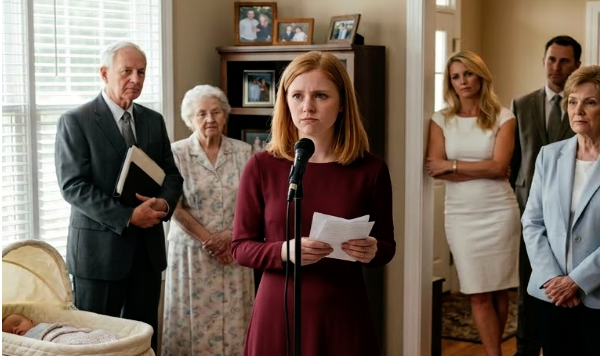
I had set up a wireless microphone for the speeches, connected to the large speakers in the living room. My mother arrived forty-five minutes late, Olivia in tow, looking like a woman who expected a coronation.
She cornered my grandfather near the window, unaware that the microphone on the side table was live. Her voice boomed through the house, silencing the twenty guests who were mid-conversation.
“Dad, you have to reconsider the will,” her voice echoed, sharp and predatory. “Willow has the house, the husband, the career. She doesn’t need your money. Olivia needs that inheritance. It’s only fair that you split it 90/10 in Olivia’s favor. Willow has already had enough.”
The room went deathly silent. My mother turned, seeing the shocked faces of my colleagues, my friends, and my father. She saw the glowing red light on the microphone.
I stood up. I didn’t feel the pain in my healing ribs. I only felt the clarity of the truth.
“For nine years, Mom,” I said, my voice steady as a heartbeat, “I sent you $4,200 a month. That is $453,600. Where did that money go? Did it go to Dad’s ‘medication’? Or did it go to the blackjack table at the Tulip Resort while I was in the ICU?”
“Willow, you’re taking this out of context—”
“There is no context for leaving a newborn alone in the NICU because you didn’t want to leave your slot machine,” I replied. “There is no context for calling your daughter ‘selfish’ while she pays your mortgage and your spa bills.”
The room erupted in whispers. My grandfather stepped forward, his “Judge” persona fully engaged.
“Charlotte,” he said, his voice a low thunder. “I am changing my will tomorrow. You will receive exactly ten percent, and only if you complete six months of psychiatric therapy. The rest goes to Willow and Lily. You have treated your daughter like a resource. Today, that resource is closed.”
My mother’s face transformed. The mask of the “concerned parent” shattered, revealing a woman possessed by a bitter, narcissistic rage.
“You ungrateful bitch!” she screamed, pointing a manicured finger at me. “I raised you! I gave you life! You owe me that money!”
“No, Mom,” I said, walking toward the door and opening it wide. “I paid that debt in full. And I’ve decided I don’t want to renew the contract. Please leave.” The aftermath was a slow, quiet reconstruction of my life. My father eventually left my mother, moving into a small apartment near us. He admitted he had been a coward, paralyzed by his own guilt and my mother’s volatile temper. I haven’t fully forgiven him, but I let him hold Lily. I let him try.
Olivia’s “career” vanished the moment the checks stopped. At 29, she took her first job in retail. She calls me sometimes, crying, realizing for the first time that the world doesn’t owe her a lifestyle funded by my labor. I sent her a list of therapists. It was the only “gift” I had left to give.
My grandfather became the father figure I never truly had. Every Sunday, he sits in our garden, reading to Lily, teaching her that family is a verb—something you do, not something you exploit.
I look at my bank account now, and I don’t see numbers anymore. I see Lily’s college fund. I see the vacations we will actually take. I see the security that was almost stolen from me by the woman who was supposed to be my protector.
The Final Lesson
If you are reading this, or listening to my story, know this: Boundaries are not an act of war; they are an act of self-preservation. You cannot set yourself on fire to keep people warm who only complain about the smoke.
For nine years, I was a prisoner of my own kindness. It took a car crash to wake me up, but I am finally awake. The “good daughter” is gone, and in her place is a woman who knows her worth, a mother who will never let her child feel like a debt to be repaid, and a human being who is finally, irrevocably free.
I lost $453,600. But I found my life. And that is a trade I would make a thousand times over.