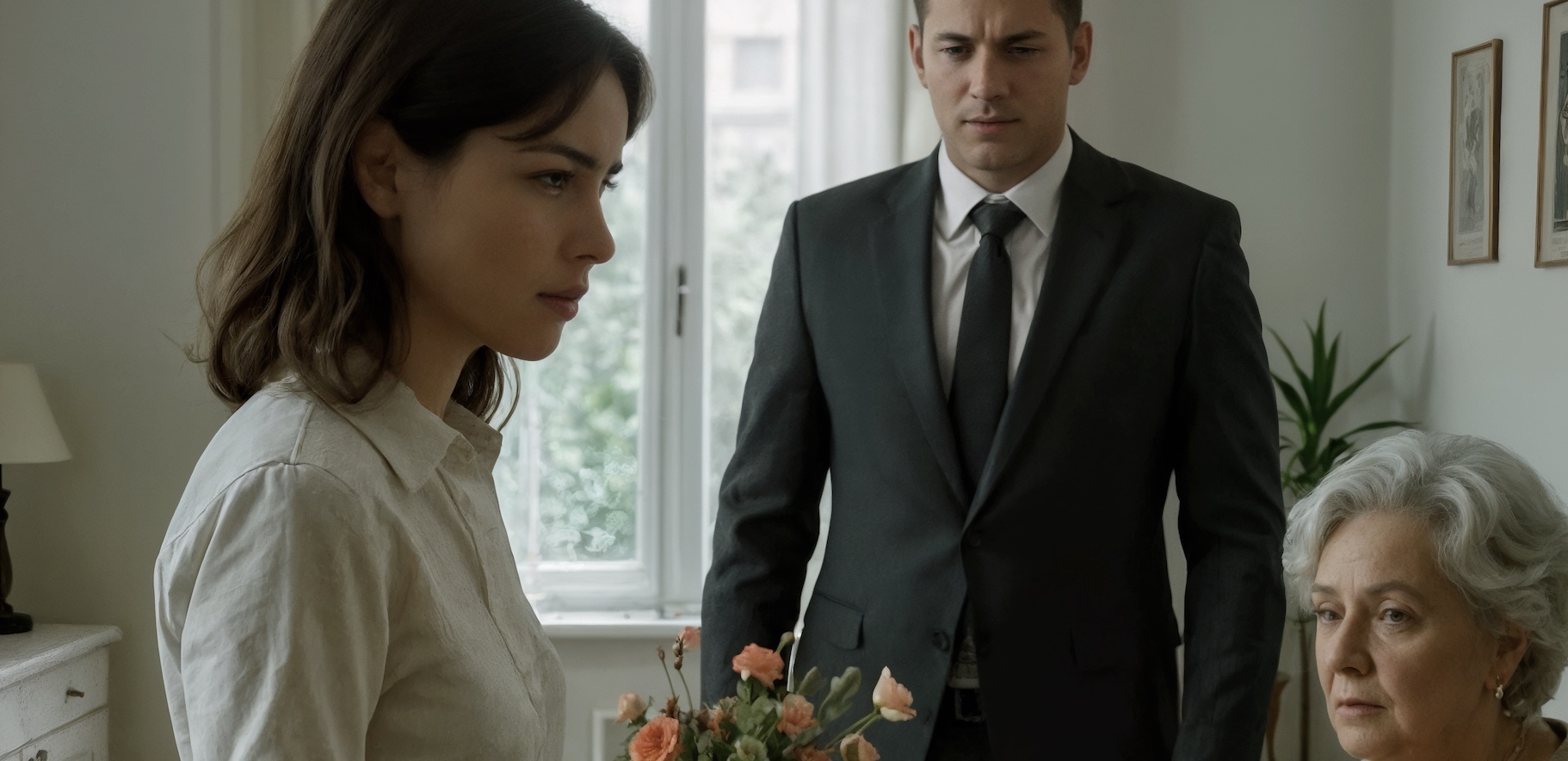
“No, I’m Not Giving Your Mother Any More Money! Enough! Let Her Deal With Her Debts Herself—I’m Done!”
23.01.2026admin
“So you honestly believe a vacation in Turkey matters more than helping my mother?” Igor’s voice vibrated like a wire stretched to breaking.
Alina turned from the window where she’d been watching the spring drizzle slap the glass like it had no shame. She was in an old home T-shirt with her hair in a messy bun, but her face was pure CEO-on-layoff-day.
“Yes, Igor. I do. Turkey matters more to me than your mother. Because I want a vacation. Because I worked nights for that bonus. And your mother… who is she to me?”
“Mom,” he breathed, as if she’d asked who Gagarin was.
“To me. Who. Is. She.” Alina fired the words like tennis balls. “Not to you—to me. Who is she? Did anyone help me when I ate plain buckwheat for three months so I could make an early mortgage payment? Or when I carried your whole family budget while you were ‘rethinking your life’ after getting fired?”
“Don’t be like that, Alya…” He reached for her, but she stepped back. She looked severe, even proud, though something burned and prickled in her chest—the familiar feeling of realizing you’ve reached the point of no return.
“And how should I be, Igor? Silent while I transfer money for her dog’s treatment because ‘Mom’s having a hard time, you understand,’ and I’m supposed to be endlessly understanding? Silent when she calls me a ‘career girl off the street’? Or when behind my back she labels me a ‘soft little nobody with no roots’?”
Igor stood with his shoulders pressed to the doorframe like a school kid outside the principal’s office. He looked lost, tired, and… strangely pathetic.
“Everything’s falling apart for her right now, Alya. They closed the café, but the loan’s still there. If we don’t help her, that’s it—she’ll go straight into a debt trap.”
Alina laughed—bitter, almost hysterical.
“And if I don’t go on vacation, I’ll fall into depression. Headfirst. And you’ll have to drag me out. Or will Mom help again? Show up with pies and tell me how in her youth they survived three winters with one coat?”
“You’re pushing it.” Igor yanked off his sweater like he’d suddenly gotten hot. “I just want you to understand: this is family. We’re family. And family helps each other.”
“Except in this family, I’m the punching bag, not a part of it.” Alina went quiet, as if the sound had been switched off. Then, calmly, she added, “I got a bonus. A big one. Half a million. I wanted to make you happy. Go somewhere together, change the scenery. Invest in myself—in us. But instead you’re saying it again: ‘Mom’s in trouble, save her.’ You know, Igor… I’m tired of being a life buoy for people who aren’t even mine.”
For three days he didn’t sleep at home. He texted, “I need to think.” And he did—at his mother’s. He came back Saturday morning with shadows under his eyes and a wrinkled shirt.
“Sorry,” he said right away. “I was wrong. It all just piled up. Mom, the creditors, and you with your Turkey…”
“Not Turkey.” Alina stood in the entryway in her coat, a bag on her shoulder. “My life, Igor. Mine. Not ‘ours.’ Mine. The bonus is mine. The job is mine. The stress is mine. And somehow your family’s problems are also mine. How does that happen?”
He said nothing. Just watched her zip her coat. Alina never slammed doors. Never threw scenes. Her calm was always worse than screaming.
“Where are you going?” he finally forced out.
“To a hotel. A couple of days. To get some air.” She smiled. “And you go deal with your mother. Figure out who’s family to whom—and who owes what.”
That evening she lay on crisp white sheets in a standard business hotel room, drinking wine from a plastic cup and scrolling through messages. An old chat with Igor used to be called “My Space and My Earthquake.” Funny. Now it was just “Igor.”
“You’re leaving me over money?” he texted. No period.
“I’m not leaving over money,” she replied. “I’m leaving because you always give it away to someone other than me. And I’m like I’m standing in line for your attention—always at the back.”
No answer.
She turned off her phone and, for the first time in weeks, felt like… herself.
In the morning—of course—a call. Who else calls at eight on a Saturday but Olga Petrovna?
“Alina, hello.” The voice was sticky, like jam spilled across a table. “Igor says you’re in a hotel. What a disgrace…”
“A disgrace is when you only ever call me when you need money.” Alina sat up and pulled the sheet around her. “What happened?”
“Nothing. I just thought… maybe you’d cooled off. Let’s talk like normal people. I’m not your enemy, dear Alinochka. Life is complicated…”
“Olga Petrovna,” Alina cut her off, “we’ll talk like normal people the day you call and instead of ‘help me,’ you say ‘how are you?’”
“Oh, but you’re so proud. So self-sufficient. So… cold.”
Alina gave a short, humorless smile.
“And you’re the same as always—wrapping an insult in lace. Goodbye.”
On the third day of her hotel break, Alina walked into a jewelry store. Not for a ring. Just because. Something for herself—something to remember. She bought small gold earrings, exactly the kind her mother-in-law would sneer at: “Cheap junk, like it’s from a market stall.”
She smiled at her reflection. No makeup. Bruises under her eyes, but real.
Freedom doesn’t always look glossy. Sometimes it looks like a morning with coffee from a vending machine—and a mother-in-law’s call you don’t pick up.
“You don’t understand, Alina—we’re not asking you forever!” Igor was tense, kneading a napkin in his hands like a first-grader at the dentist. “It’s just… a loan. A month. Two at most.”
They were sitting in a café by a shopping center. Too much glass, too many people, and not a hint of warmth. The table by the window he’d called her to wasn’t a date—it was an arbitration hearing. Only without lawyers and without cappuccinos.
Alina nodded slowly.
“I get it. Just a loan. Again, only promises. Again, no receipts. Like with your brother. Like with that coffee shop your mom opened ‘to start a new life’ and shut down eight months later.”
“Oh, here we go—Mom, Mom…” Igor leaned back and pressed his fingers to his temples. “She’s not going to live forever, you know. She’s already on pills. Blood pressure, nerves, doctors… what are you trying to do—give her a stroke?”
“And I can’t have one, right?” Alina cut in. “I guess I’m the one who can live without sleep, without rest, without support? Have you ever thought that if one person always has to ‘help,’ maybe others should at least learn not to make it worse?”
Igor went quiet. Outside the window, a gray woman in a white hat with a dog was rummaging at a trash can, looking for whatever people had thrown away. Alina suddenly thought: it’s true—people who always need something recognize each other instantly.
“I’m not against family, Igor. I’m against you sacrificing my interests on the altar of your debts every single time. Not even your debts. Your mother’s. Your brother’s. A sick dog’s kidney problem.”
“There you go again—mocking!” he snapped. “You joke, you sneer, everything has to be a punchline. And I’m trying, by the way… I’m doing something, at least!”
“What did you do?” She leaned closer. “What exactly have you done in the last year? You live at your mother’s, you work over there—temporarily. And who covers the mortgage payment? Who?”
He pressed his lips together, silent—and then suddenly blurted:
“Because you’re a careerist, Alya! It’s all wins, bonuses, bosses… You treat life like an Excel spreadsheet. And I’m a living person! I can’t live by a table like you do!”
Alina let out a quiet, tired huff.
“I don’t live in Excel. I live in reality. Where the electric bill isn’t paid with feelings—it’s paid with money. Where the mortgage is withdrawn from a card, not from hope. And if you’re such a ‘living person,’ then why don’t I feel alive next to you?”
She left first. He didn’t chase her. He just watched as she, in a gray coat—by the way, not even a new one—slid into a taxi without turning back, without calling, without looking for one last word. She didn’t even finish her cup. A single drop of coffee remained on the saucer—like a memory. Or like a spit mark.
Alina went home and immediately opened her laptop. She was the type who saved herself with tasks—the kind who, when angry, scrubbed the stove until it shone or sorted tax reports until midnight. Today it would be numbers.
But it didn’t work. The figures blurred, the thoughts jumped. She shut the laptop and sat down on the hallway floor—between the little cabinet and the shoe rack. She hugged her knees until her toes went cold.
“I don’t want to be their bank,” she whispered into the silence. “I don’t want to be their bank. I don’t want to be their bank…”
She repeated it like a mantra, but it didn’t get easier.
The next day she received a summons. Not a court one—worse. A family meeting. Officially: “Let’s just sit down and talk.” In reality: an interrogation with pressure and attacks.
Olga Petrovna was waiting by the building entrance, wearing a coat the color of wet clay and lipstick the color of quail eggs.
“Alinochka, finally,” she threw her hands up theatrically. “We thought you were offended for real…”
“I’m not offended. I just moved out.” Alina looked at her coolly. “You’ve got everything you need there: family walls, your dear son, your dear debts.”
Olga Petrovna faltered for half a second, then snapped:
“You know, I always thought you were smart. But apparently that has nothing to do with anything.”
“Exactly,” Alina nodded. “I’m smart. Which is why I’m going upstairs now, grabbing my things, and leaving. Because a smart woman doesn’t live with a man who puts her second after his mother.”
Upstairs: an old rug, the smell of valerian, and Igor’s voice—thin, like a dog that’s been kicked.
“Why are you doing this?” he rasped when she walked in. “Do you really think it’s that simple? That you can just… take off and leave?”
“No,” she answered. “I think we could’ve talked a hundred times, listened, understood. But you only heard your mother’s voice. And now it’s too late. Now—yes. It’s simple to leave.”
She took the suitcase. Packed in a hurry, but neatly. Alina always packed neatly— even when she was packing for nowhere.
“Do you still need me?” he asked, almost in a whisper. “Or have you decided everything?”
“I needed you back when I asked for something simple: ‘Understand me.’” She stepped closer and looked him straight in the eyes. “But every time, you checked with your mom first—whether it was allowed.”
“That’s low, Alya.”
“You know what’s low?” Alina paused in the doorway. “Telling a woman she’s ‘too smart’ and ‘too strong’ just because the man next to her turned out weaker than his mother.”
And she walked out.
No screaming. No scene. No “you’ll regret this.” Just one suitcase and gold earrings in her ears.
A week later she filed for divorce. Two weeks later her new status was official. And three weeks after that, a letter arrived. From a notary.
It read:
Property division. Apartment ownership. Clarification of joint debt.
Alina raised an eyebrow.
“So it begins.”
And it really was only the beginning…
She came to the notary’s office wearing gloves. It was chilly, and all morning she couldn’t decide—coat or trench. In the end she chose a strict dark-blue coat and heels. Divorce isn’t a reason to look like a victim, she told herself after one last glance in the mirror.
“Good afternoon. Alinochka, yes?” The notary—around fifty, with the face of an eternal shop-class teacher—looked over her glasses. “You’re here about the apartment? Come in, I’ll explain. But fair warning—my tea is terrible.”
Behind the glass partition sat Igor. A stretched-out gray hoodie, a grocery bag from a discount store, as if he’d come not to divide property but to pick up potatoes. His eyes looked like a hamster during a search—either he stole something himself, or he knows exactly who did.
“Hi,” he exhaled, like he couldn’t breathe.
“Hello,” Alina nodded evenly.
They sat opposite each other. Between them: the notary and a single protocol where it was spelled out in black and white—mortgage in both names, equal shares on paper, but payments made mostly by one party while the other lived in a state of… well… philosophical idleness.
“Alright, colleagues,” the notary began, tapping the paperwork with a pen stamped “Registry,” “you have an apartment acquired during marriage. But the mortgage payments were made mostly by Alina. That’s obvious from the statements. I have them right here. The loan is half paid off. And now the fun begins.”
Alina didn’t flinch. She already knew. Over the last few weeks she’d studied the civil code, the family code, and, just in case, property law too. At this point she was almost convinced she’d be reborn as a lawyer in her next life.
“So,” the notary went on, “Alina is claiming her share and wants the apartment sold, with the proceeds split. Correct?”
“Almost,” Alina said calmly. “I want it sold, and my husband’s portion calculated according to what he actually contributed. Which is twenty-seven thousand rubles. In two years.”
Igor flushed.
“That’s disgusting,” he hissed. “I lived there too! I put work into that place, repairs! I laid the kitchen tile myself, remember?”
“I remember. And I also remember the wiring you blew after that.” Alina smiled thinly. “I had to call an electrician and pay from my bonus. So—thanks, but no.”
“You turn everything into money,” he snapped. “What about love? Feelings? How we started?”
“We started with one suitcase, two backpacks, and big hopes.” Alina looked straight at him. “And we ended with your mother on my pillow and you doing nothing.”
“She only asked to stay, Alya. Why are you like this?”
“And I asked you to choose.” Alina leaned forward. “You chose to be a son. Not a husband.”
The notary cleared her throat.
“Alright. Feelings are feelings, but we’re dealing with the law. The apartment is sold. After the remaining mortgage is paid, the money is divided. Alina receives eighty-six percent. Igor gets the remainder.”
“Keep your pennies!” Igor suddenly sprang up. “Take it all! Live there! Just don’t paint me as a monster! I… I just wanted us to stay together!”
“And I wanted a family,” Alina said softly, “not a scheme where I’m constantly written off as an expense.” Her gaze didn’t waver. “We aren’t a couple, Igor. We’re an accountant and a failing project.”
Two days later she packed the boxes.
The apartment emptied quickly—because sometimes people have been living in different worlds for a long time before they finally admit it. Alina left Igor his old T-shirts, the photo album, and the coffee grinder he was always “fixing” and never fixed.
Something is always left behind, even when it feels like nothing is holding you.
She stood at the door with the keys in her hand. It felt strange—like the final act of a play when the audience is gone, but you’re still in costume and don’t know what to do with your last line.
The doorbell rang.
“Who is it?” she called, reluctantly walking over.
“It’s me,” Igor’s voice came through the door. “Can you… give me the keys?”
She opened up without a word. For a second they both felt awkward, like two former actors meeting on a stage where everything has already been performed.
“Here.” She held out the keyring.
“Where are you living now?” he asked, not meeting her eyes.
“Somewhere I’m valued. And where I’m not dragged into ‘family councils’ so they can peel off my last layer of skin.”
“I ruined everything, didn’t I?”
“No.” Alina smiled. “You just never tried to fix anything.”
She closed the door behind her. No slam. No drama. Just the click of the lock—and that was it.
Then she walked away. Slowly. Across the yard, past an old woman with newspapers, past the swings where she and Igor once kissed at three in the morning, laughing at some stupid series.
She walked—and with every step, she felt lighter.
“Alina!” his voice called from behind.
She turned. He stood by the entrance, still holding the keys.
“If anything… I still love you. I do.”
“And I love myself,” she answered quietly. “Finally.”
And she left.
Light-hearted, in heels, and with a clear intention never again to rent out her own interests—even “for a month, two at most.”