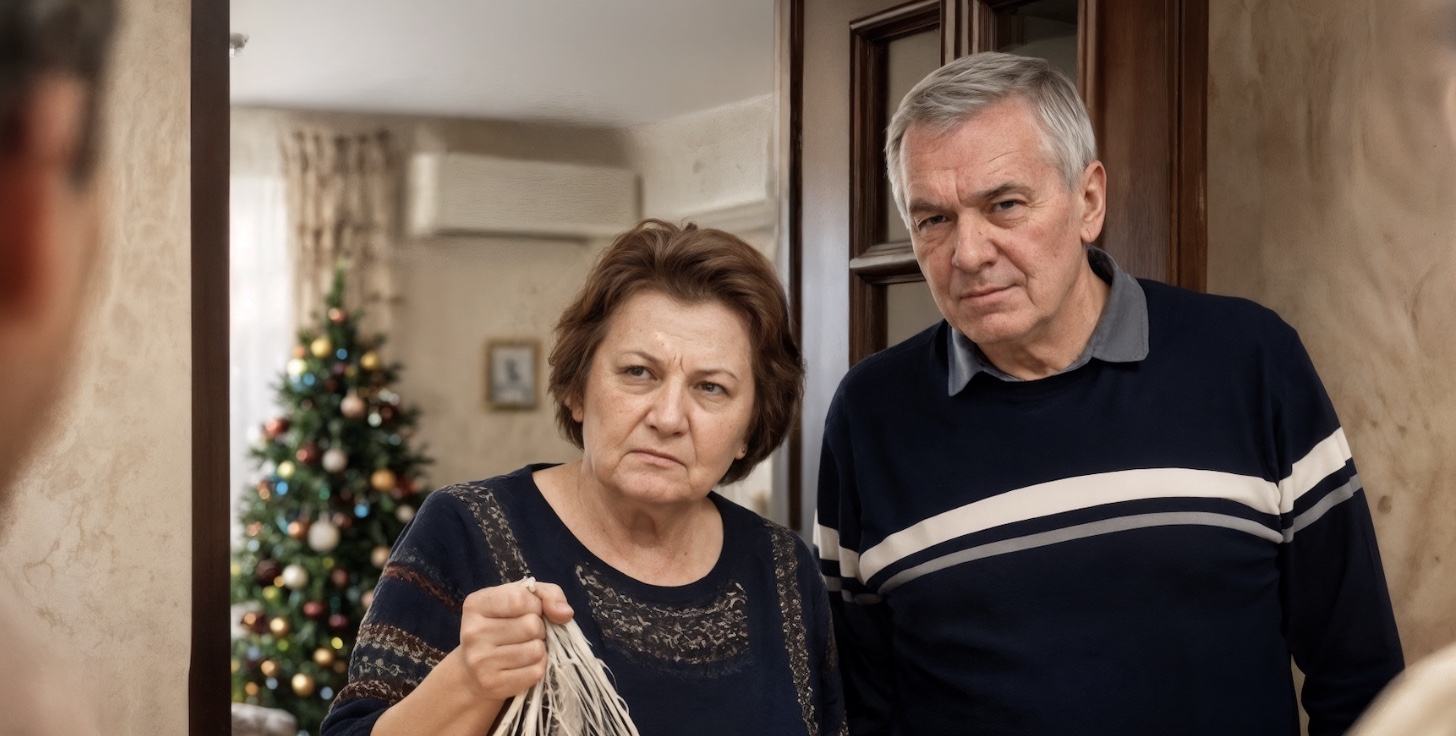
Marina had known for a long time there was no point hoping—they would come. They always did. For Gennady Petrovich and Zinaida Ivanovna, the New Year holidays worked like a magnet, pulling them toward their son’s city apartment with relentless force.
“Zhenya,” she called to her husband, who was dozing peacefully in front of the TV, “I think those are your parents.”
Evgeny didn’t even open his eyes.
“So what? They’re my parents. It’s the holidays.”
“The holidays,” Marina repeated, glancing at the refrigerator. Inside were groceries for exactly two people. For a week. She’d planned it all—counted, budgeted, shopped—because she wanted a calm break: books, movies, slow breakfasts. No hustle. No crowds of relatives.
The doorbell rang like a sentence being read aloud.
“Sonny! Marinochka!” Zinaida Ivanovna swept into the entryway with arms wide, smelling of cold air and that heavy “Red Moscow” perfume. “How could we spend these days without you?”
Gennady Petrovich squeezed in behind her, lugging a huge mesh bag.
“We brought potatoes—everything else is on you,” he announced brightly, plopping the bag right onto the floor Marina had just washed. “Hand-picked, by the way!”
Marina felt outrage rising like a wave. She stared at the bag—twenty kilos, at least—and for a moment couldn’t even speak. Potatoes. They brought potatoes.
“Come in, come in,” Evgeny fussed, helping his father take off his coat. “How was the trip?”
“Fine, but the commuter train was stuffy,” Zinaida Ivanovna said, already yanking off her boots. “At least it was quick.”
“And what are we having for dinner, Marinochka?” her mother-in-law asked, already marching into the kitchen and surveying the place like the rightful owner. “Oh my—your fridge is empty! Good thing we came. Gennady Petrovich, bring the potatoes in here. We’ll start peeling.”
“We literally just had lunch,” Marina tried. “Maybe a little later?”
“Oh sweetheart, we’re hungry from the road!” Zinaida waved it off. “And besides, we need to celebrate properly. Zhenya, do you have chicken? Or at least minced meat? We’ll do potatoes with meat, some kind of salad…”
Marina opened her mouth—then met her husband’s eyes. Evgeny gave the smallest shake of his head: don’t. Don’t start. Just endure it. They’re my parents.
“There’s chicken,” she gave in. “But it was for tomorrow…”
“Perfect!” Zinaida Ivanovna was already pulling containers out of the fridge, peeking into the freezer. “Oh, sausages too! And cheese! Gennady Petrovich, look—real doctor’s bologna! Can you believe you can still find decent one? We haven’t seen that in ages.”
“Because it’s expensive,” Marina thought.
By evening the table was, of course, full: fried potatoes with chicken, a bowl of Olivier salad (which used up all the bologna and half the mayonnaise), plus sliced cheese and vegetables.
Zinaida Ivanovna cooked while narrating everything like a TV host:
“See how wonderful it is when everyone’s together! Family should be together.”
Marina sliced bread and thought about how “together” somehow meant she washed dishes while her mother-in-law gave orders. How Marina’s groceries became “everyone’s dinner,” and the credit went to the sacred bag of potatoes.
“Marinochka, you didn’t make pickles this year?” Zinaida Ivanovna asked. “Such a shame. We would’ve brought ours, but jars are heavy. Gennady Petrovich, remember we planned to?”
“I remember,” her father-in-law nodded from the couch, already scrolling on his phone. “We just figured Marina would have some. You always used to.”
“Didn’t have time this year,” Marina cut in.
“Oh, I was counting on them,” Zinaida sighed dramatically. “Well, we’ll manage. The main thing is—we have potatoes.”
After dinner, once the parents settled into the living room (which was supposed to be Marina’s workspace, except now a foldout guest sofa took up half of it), she herded her husband into the kitchen.
“Zhenya, this isn’t what we agreed on.”
“Marish, what do you want from me?” he rubbed his face tiredly. “They’re my parents. It’s the holidays.”
“You’ve said that. But, Zhenya, they didn’t even call. They just showed up.”
“So they showed up—so what?”
“So what is: we had food for two people for a week. And they brought potatoes and now they’re eating everything else.”
“Marina, listen to how that sounds. It’s kind of ridiculous. Potatoes are a contribution too.”
“A contribution?” Her voice started to shake. “Zhenya, those potatoes cost, what, a hundred rubles? And they’ve already eaten three thousand rubles’ worth of food. And they’ll keep doing it for another week.”
“Don’t say ‘gorged.’ And anyway, they’re my parents. You want me to tell them no?”
Marina looked at him—soft, convenient, trained to dodge any conflict—and understood this conversation was going nowhere. He didn’t see a problem. To him it was normal: parents arrive, mother takes over the kitchen, father reads the news, and the wife provides food for everyone.
“Do you remember what I asked you to do?” she said quietly. “Talk to them. After last time.”
Last time was the May holidays. Gennady Petrovich and Zinaida Ivanovna had dropped by for the weekend and managed, in three days, not only to wipe out all their supplies, but also to “borrow” five thousand rubles (never returned, of course). And on the way out they’d taken three containers of leftovers “so it wouldn’t go to waste.”
“I did talk to them,” Evgeny mumbled.
“And what did you say?”
“I said if they want to visit, they need to contribute.”
“And they brought potatoes,” Marina finished. “Do you get it? They took you literally. They brought the damn potatoes!”
“Well, isn’t it good they listened?” he said, almost proudly.
Marina closed her eyes. Useless. Completely useless.
The next days confirmed her worst fears. Zinaida Ivanovna acted like the real owner of the apartment: slept in, ate for breakfast what Marina planned to cook for lunch, handed out cleaning advice (“Marinochka, you should wash those curtains—they’ve gone so gray”), and watched TV until midnight. Gennady Petrovich stared at his phone, napped, and periodically asked if there was “something to snack on.”
Marina cooked. Washed dishes. Went to the store for more food—because the groceries she’d bought for a week ran out by day three. Smiled. Endured.
On the fourth day, Zinaida Ivanovna announced:
“Marinochka, let’s do a proper holiday dinner! We’ll invite Tanya and Vova.”
Tanya and Vova were Evgeny’s younger sister and her husband. They lived nearby, worked two jobs, rented a tiny one-room place, and barely made ends meet. And yet they still managed to show up regularly at their brother’s—“to visit,” as they called it.
“Maybe we shouldn’t…” Marina tried. “We’re already low on food…”
“Oh, don’t be silly! Family should gather!” Zinaida chirped. “I already called—they’re coming tonight. We’ll make something simple. We still have half a sack of potatoes!”
Something dark and furious boiled inside Marina.
“Zina, those potatoes need peeling, boiling or frying. You need other food. Meat, for example.”
“Then go buy some,” her mother-in-law waved her off. “Or Zhenya can run out.”
“With what money?”
“With what money?” Zinaida Ivanovna stared at her, honestly surprised. “With yours. We brought the potatoes.”
And that was when Marina finally snapped.
“That’s it. Enough.” She stood up and looked her mother-in-law straight in the eyes. “Zinaida Ivanovna, you came without warning. You brought potatoes that cost almost nothing, and in four days you’ve eaten through ten thousand rubles’ worth of groceries. You order people around in my kitchen, watch my TV, sleep on my sofa. And now you’re inviting guests—into my apartment—and demanding that I feed them!”
“Marinochka, what are you talking about?” Zinaida Ivanovna went pale. “We’re family…”
“In a family people take care of each other. And what do we have?” Marina shot back. “You take care of yourselves—and I’m supposed to provide your comfort?”
“Zhenya!” the mother-in-law shouted toward the living room. “Zhenya, come here! Your wife has lost her mind!”
Evgeny rushed in, alarmed.
“What happened?”
“What happened is I’m tired!” Marina felt her voice cracking, but she couldn’t stop now. “I’m tired of being the help! Tired of cooking, washing dishes, buying groceries your relatives devour without even saying thank you! Tired of my apartment being used as a free restaurant and a free hotel!”
“Marinochka, how can you say that?” Zinaida Ivanovna threw her hands up. “We brought potatoes!”
“Potatoes!” Marina burst out laughing—sharp, bitter.
“Marina, calm down,” Evgeny tried to reach for her hand, but she jerked away.
“No, Zhenya. I won’t calm down. I want your parents to leave. Right now.”
“You can’t throw me out!” Zinaida Ivanovna flared up. “This is my son’s apartment!”
“An apartment we bought together,” Marina replied coldly. “With my money too, by the way. And I have every right to decide who is in it.”
“Zhenya!” his mother turned to him. “Do you hear how she’s talking to me?”
Evgeny stood between his mother and his wife, and Marina watched him waver—torn, unable to choose. And in that moment she realized she was exhausted not only by the relatives. She was exhausted by his weakness, by the endless “well, Mom,” “well, they’re my parents,” “well, it’s the holidays.”
“If they don’t leave,” she said quietly, “I will.”
A heavy silence fell.
“Marinochka, what’s gotten into you?” Gennady Petrovich appeared at the kitchen doorway. “Over potatoes? You’re fighting over potatoes…”
“This isn’t about potatoes!” Marina shouted. “It’s about entitlement! About you thinking it’s normal to show up without asking, eat someone else’s food, boss everyone around, and then act like a sack of potatoes is fair payment for a week of living here!”
“We thought you’d be happy,” Zinaida Ivanovna mumbled, suddenly unsure.
“Happy? Happy about what?” Marina snapped. “About my vacation plans being ruined? About spending my days at the stove instead of resting? About being used?”
“Marina, that’s enough,” Evgeny finally found his voice. “You’re crossing a line.”
“Me?” Marina looked at him for a long moment. “I’m crossing a line? And they aren’t, when they barge into our life? When they borrow money and don’t return it? When they pack up food from our fridge and carry it out?”
“All right. Enough,” Gennady Petrovich said, suddenly decisive. He headed for the hallway. “Zina, we’re leaving. We won’t stay where we’re not wanted.”
“Good,” Marina muttered.
“Marinochka…” Zinaida Ivanovna suddenly began to cry. “How can you? We’re relatives…”
“Relatives respect each other,” Marina answered, drained. “And you’re just taking advantage.”
Twenty minutes later Evgeny’s parents were gone—taking the same bag of potatoes with them (Marina carried it out to the entryway on purpose). The apartment fell into silence.
“You were too harsh,” Evgeny said at last.
“And you’re too soft,” Marina replied. “And that’s the problem.”
“What do you mean?”
“I mean I’m tired of being the only adult in this relationship. You can’t tell your parents ‘no.’ You can’t set boundaries. You just let everything slide, hoping it’ll fix itself.”
“They’re my family,” he insisted.
“And I’m your family too,” Marina said, feeling a crushing, animal exhaustion settle over her. “But for some reason their interests always matter more than mine.”
“That’s not true.”
“Then why didn’t you take my side?” she asked. “Why did you stay quiet while your mother ran my kitchen? Why did you agree when she invited Tanya and Vova without asking me?”
Evgeny said nothing.
“Exactly,” Marina nodded. “Because it’s easier for you. Easier to let me suffer than to tell your mother an uncomfortable truth.”
They sat in silence until evening. Marina washed every dish—meticulously, almost obsessively—as if she were trying to scrub away not just grease, but months of resentment. Evgeny sat in the living room, staring out the window.
Late at night he finally came to her.
“I’m sorry,” he said softly. “You’re right. I didn’t think. I just assumed that’s how it’s supposed to be.”
“It’s supposed to be different,” Marina said, drying her hands and looking at him. “We’re supposed to be a team.”
“I understand.” He hesitated. “What now?”
“Now you call your mother and explain the rules,” Marina said. “If they want to come, they warn us in advance. They bring real groceries or ready-made food—not symbolic potatoes. And they don’t command my kitchen.”
“She’ll be offended.”
“Let her be.”
Evgeny nodded and took out his phone. Marina watched him dial, watched him hesitate as he searched for words. And suddenly she wasn’t sure—wasn’t sure he could do it, wasn’t sure he had the strength to say what needed to be said.
“Mom?” Evgeny’s voice shook. “We need to talk.”
Marina stepped out onto the balcony. Below, the city glittered with lights. Somewhere music played, someone was still celebrating the New Year. But their holiday was different—this was a holiday of learning to say “no.”
Half an hour later Evgeny came out to her, pale and subdued.
“I said it,” he exhaled. “All of it. She cried. Said you’d turned me against them.”
“And?”
“And I told her it was my decision,” he said. “That I agree with you.”
Marina hugged him, and they stood there in the cold January air while someone down below shouted, “Happy New Year!”
“But what if they never come again?” Evgeny asked quietly.
“Then we’ll visit them,” Marina said. “With gifts and food we bring ourselves. Like grown-ups visiting grown-ups.”
“With potatoes?” Evgeny suddenly smirked.
They laughed—softly, tiredly, but for real.
“Oh, we’ve got plenty of potatoes,” Marina said.