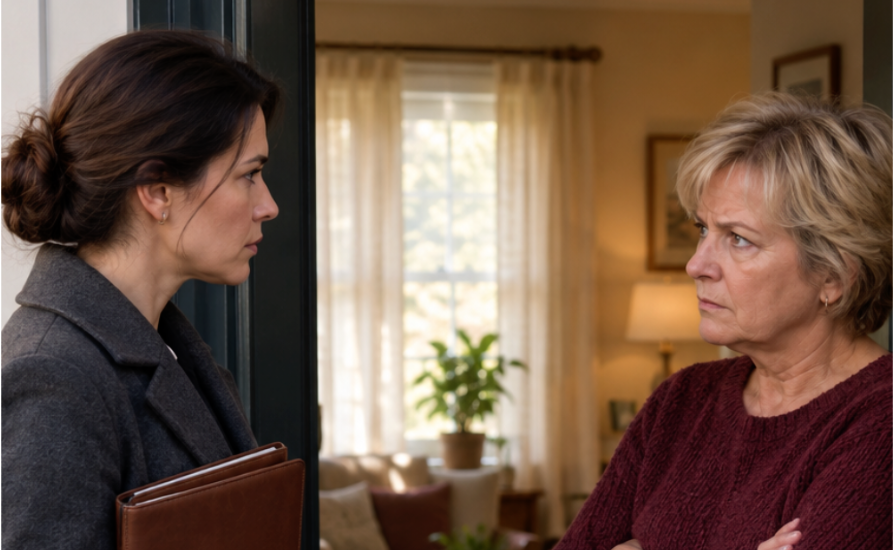
“There’s no one else to blame but you,” my mother-in-law said, having no idea that in an hour I’d be dealing with a matter of inheritance.
“Pack your things and make sure you’re gone by evening. You’re nobody in this house.”
Tamara Pavlovna said it calmly, as if asking to pass the salt at dinner. That calmness chilled me to the core. I stood in the kitchen, still holding the rag I’d just used to wipe the stove, staring at her, not sure if she was joking or dead serious.
Outside, a dull November day dragged on. The apartment smelled of fresh bread I’d baked that morning. Just a regular Saturday morning in our three-room flat on the outskirts of Tver. Eight-year-old Senya was playing with his toy cars in the bedroom, his soft “vroom-vroom” drifting in.
I worked as an accountant at a small trading firm. The pay wasn’t much, but it was honest, my own. My husband Kostya drove a truck, away on long hauls most of the time. We didn’t have much, but we were a team. At least, I thought so—until five minutes ago.
Everything changed three days ago when the money went missing.
Tamara Pavlovna kept her savings in an old biscuit tin. A hundred and twenty thousand rubles. She’d been saving for years to renovate her room. Then, on Wednesday, the tin was empty. She turned the whole house upside down, then handed down her verdict.
“There’s no one else to blame but you,” she said to me. “Kostya was away, Senya’s just a child. It must be you.”
I was left speechless by the injustice. I have never stolen anything in my life. I grew up in an orphanage, where every penny mattered, but stealing was never my way. On the contrary—I was raised to have pride and integrity.
“Tamara Pavlovna, I didn’t take your money,” I repeated softly now, nervously twisting the rag. “I swear.”
“Don’t swear,” she grimaced. “I can see right through you. You came here with nothing, and now you’re rummaging through my boxes.”
Every word stung. I remembered arriving in this family ten years ago with only one suitcase. Trying my best to please, getting up at five to cook, biting my tongue at every little criticism. I endured it all for Kostya. For the family I never had.
And now, this family was kicking me out.
Kostya came home that evening, exhausted, smelling of diesel fuel and long roads. I rushed to him, hoping he’d stand by me, figure things out—believe me.
“Kostya, your mother says I took the money,” my voice trembled. “You know that’s not true.”
Kostya slumped on a stool, pulling off his work jacket. His silence lasted a long time, his hands covered in scrapes.
“Vera, what am I supposed to say?” he finally managed. “Mom says one thing, you say another. The money’s gone, that’s a fact.”
I stared at the man I married, the one who used to carry me in his arms and promise to protect me. Where had he gone?
“You don’t believe me,” I whispered. It wasn’t a question.
“I don’t know who to believe,” he looked away. “Maybe you needed something urgent. You could have just said so. We’d understand.”
“We.” He already spoke as “we.” He had chosen his side.
Something inside me broke. Ten years. Ten years in this family, erased in three days, like a mistake in a notebook.
I couldn’t sleep that night. I stared at the dark ceiling, listening to my husband’s steady breathing. Yesterday that sound was comforting. Tonight—it felt distant and alien.
I thought of Senya. I thought about where we could go. All I had saved was a meager twenty thousand, put aside for my son’s future. Where can a mother and child go on that?
But alongside fear, something else grew deep inside me. Steely and cold. Dignity. The kind my orphanage caregiver Aunt Galya instilled in me: “Verachka, remember. Pride is the last thing anyone can take from you. Hold on to it when all else crumbles.”
In the morning, I got up before anyone else. Washed my face with cold water, looked in the mirror. My eyes were red, but my gaze was steady. I’d made my decision.
I wouldn’t beg. I wouldn’t grovel. If after ten years my own family didn’t trust me, then this family wasn’t worth keeping.
Tamara Pavlovna was already in the kitchen with her usual cup of tea.
“So, made up your mind to leave?” she squinted.
“I have,” I replied evenly. “But I’m taking Senya.”
“Take him,” she snorted. “Who needs an extra burden.”
That last comment about her own grandson made everything crystal clear. There was never a real family here—only a facade I clung to out of loneliness.
I started packing. Kostya stood in the bedroom doorway as I folded my son’s shirts into the bag.
“Vera, come on,” he muttered. “Where are you going in the middle of the night? Wait until morning. Don’t rush things.”
“I’m not rushing,” I said without looking back. “I’m leaving a place where I’m not called a thief.”
“The money will turn up,” he said, raising his voice. “Mom probably moved it and forgot. She’s old.”
“Let’s talk when it does,” I snapped. “For now—goodbye.”
I zipped the bag, taking only my own things and Senya’s. Nothing we’d bought as a family. Not a single item from this life.
Senya woke up, rubbing his eyes.
“Mom, where are we going?”
“We’re going to visit some good people, sweetheart,” I forced a smile. “Pack your things.”
He brightened up—visiting! He dressed quickly, tucked his favorite toy car into his pocket. Looking at my son, I realized he was my true family. He was why I had to stand tall.
We went to the hall. Tamara Pavlovna stood there, arms crossed, looking satisfied. Kostya shuffled by, eyes down.
“Leave the keys,” my mother-in-law snapped.
I quietly put the keys on the table, took Senya’s hand.
“Let’s go, son.”
We walked downstairs. A cold drizzle fell outside. I tucked Senya’s collar up, adjusted his hood. I had only fifteen hundred rubles cash—enough for a taxi to the station and something warm for my son.
I still didn’t know where to go. Maybe my old friend Lyuda, who’d once offered me a room in Klin. Or maybe find something cheap for now. My mind was clear, no panic. The fear was gone—only resolve remained.
We reached the bus stop. I pulled out my phone to order a taxi, and suddenly, it rang. An unfamiliar number.
“Hello?”
“Vera Sergeevna?” A pleasant, businesslike female voice.
“Yes, this is she.”
“My name is Olga, I’m calling from the notary office ‘Pravoved’. We’ve been looking for you all week. You need to come in regarding an inheritance matter.”
I stopped in the street. Rain drummed on my hood.
“What inheritance?” I asked, thinking there must be a mistake.
“No mistake,” Olga assured me. “Your cousin, Antonina Ivanovna Zhuravleva, passed away. You’re named in the will as her sole heir. It’s important—there’s significant property involved. Can you come today?”
I nodded mechanically, then caught myself.
“Yes, I can. Please give me the address.”
I jotted it down with a trembling hand. Antonina Ivanovna. I vaguely remembered her—my mom’s aunt, the one who sent care packages to my orphanage with candy and warm socks. The only relative who ever reached out. I wrote back, sent thank-you notes. Then the packages stopped, and I’d thought even that last thread was gone.
Turns out she remembered me, after all.
“Mom, are you crying?” Senya tugged on my sleeve.
“I’m not crying, honey,” I wiped my tears. “It’s just the rain. Let’s go, we’ve got important business.”
The taxi arrived quickly. As we drove, I gazed out at the wet streets and thought how strange life was. In the morning, I was nobody—a thief, an outcast. In an hour, someone was waiting for me with inheritance papers.
The notary office was in the city center, in an upscale building with glass doors. Olga was young and friendly. She sat me down at her desk, brought Senya some juice and cookies.
“Vera Sergeevna, I know this is all very sudden,” Olga began, sorting through the documents. “Antonina Ivanovna left you an apartment in downtown Tver, a summer house with land, and substantial savings in several accounts. The total inheritance is about eight million rubles.”
I stared at the papers, unable to comprehend. Eight million. An apartment. A house. This morning, I didn’t even know where my child and I would spend the night.
“But why me?” I asked quietly. “Didn’t she have other family?… Continued in the comments below.