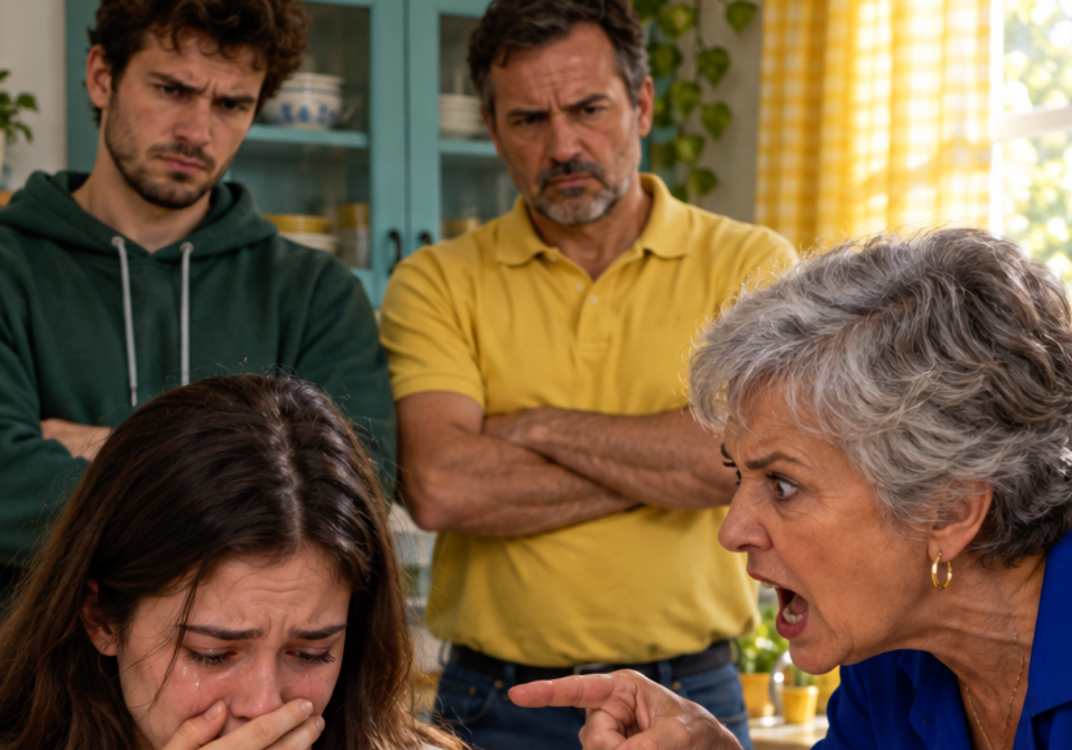
“Are you seriously telling me the house is in your name?” Lydia Petrovna’s voice went thin, like a fishing line about to snap. “Just yours?”
“Not in my name, but bequeathed to me,” Anya replied, clutching the folder of documents so tightly the corner dug into her palm. “The notary read it out. It’s all written here. The house, the land, the garage, and the bank account—they’re all mine.”
“The account, too?” The late man’s brother, Igor Mikhailovich, sat up straight on the old couch. “Unbelievable. So we all chipped in for the funeral, and he had a bank account?”
“Chipped in for the funeral?” Anya looked at him. “Sorry, who exactly chipped in? I paid for the service, the plot, the bus, the gathering, and even that sad little wreath from you—which you then photographed to show off like you wove it yourself out of spruce branches.”
“Watch your mouth, girl,” Lydia Petrovna raised a finger. “We’re not talking about wreaths right now.”
“Then what? About justice? Then let’s start with the wreaths. Everyday justice—very practical. I have the receipt, by the way.”
“Did you hear that?” Lydia turned to her son. “She’s already waving receipts at us. My brother’s barely cold in the ground and she’s got her accounting hat on.”
“Mom,” muttered Artyom, sitting by the window in his jacket even though the radiators were blazing like in a public clinic, “she’s not a total outsider. Uncle Sasha raised her.”
“Not an outsider?” Lydia laughed coldly and sharply. “Artyom, don’t embarrass yourself. She was brought in off the street. Well, not the street—the orphanage. Makes a difference to the notary maybe, but to blood family, it’s the same thing.”
“You always have precise definitions for ‘blood’,” Anya said. “Especially when ‘blood’ only matters for residence permits, inheritances, or family discounts.”
“Oh, so that’s how you talk now!” Igor stood up. “Sasha gave you a roof over your head, gave you his last name, helped you make something of yourself—now you’re lecturing us?”
“He gave me the house,” Anya replied evenly. “And his name. And he also taught me not to shout in the kitchen while someone hasn’t slept for three days straight after the funeral.”
“You haven’t been sleeping?” Lydia leaned forward. “Poor little orphan. Should we all start crying in the hallway now? Don’t forget, Anyanka, that we lost a brother too.”
“Lost him?” Anya slowly turned to her. “Where did you lose him, Lydia Petrovna? At your friend’s dacha in Tarusa? In the store, while looking for chicken discounts? Or on the phone, when he rang you in December and you said: ‘Sasha, later, I’ve got the plumber here’?”
“Don’t you dare!” Lydia shot up, the old chair beneath her—her grandmother’s—creaking. “I grew up with him!”
“And I lived with him,” Anya replied. “For twenty-two years. And these last three, I wasn’t growing up—I was practically rooted in his medications: blood pressure, tests, sugar, trips to the cardiologist in Balashikha, and waiting in those ultrasound queues where everyone looks like they’ve already been buried.”
“Here we go,” Igor waved his hand. “Saint caretaker. Next she’ll tell us all about her heroic pill organizing.”
“Let me explain,” Anya said. “Because clearly, you all seem to think that people die peacefully. You picture someone lying under a blanket, gazing out the window, sharing pearls of wisdom. But that’s not the reality. They forget if they’ve taken their pills. They get frustrated when they can’t button their shirt. In the middle of the night, they call out not for you, but for their mother—who’s been gone thirty years. They’re scared to go to the hospital because it reeks of bleach and loneliness. And someone has to hold their hand when the doctor says, ‘We’ll do everything we can,’ while already looking for the next file to deal with.”
“Enough with the performance,” Lidia’s tone softened, but her words stung even more. “You’re a good actress, I’ll give you that. Sasha was always too soft. He could be talked into anything.”
“Talked into what?”
“Into changing his will, obviously. Or are you going to tell me he came up with the idea to leave his house to some unrelated child all on his own, while he’s got a sister, a brother, a nephew? Artyom has a mortgage, by the way. Igor has a loan. My only income is my pension. And what do you have? A salary, youth, and absolutely no conscience.”
“I also have a cat with chronic cystitis,” Anya replied. “If we’re going to compete with sob stories, my cat could lay claim to the garage, too.”
“Are you joking?” Artyom looked up.
“Yes. A little,” Anya said. “Because otherwise, I’ll start breaking dishes. And those are dad’s plates.”
“Don’t call him dad,” Igor suddenly spoke. “Hear me? Don’t. He was your guardian. Your benefactor. But not your father.”
Anya stared at him for a long moment. The ‘Biryusa’ refrigerator hummed in the kitchen—Alexander Nikolaevich had wanted to replace it ten years ago, but kept saying, ‘It’s working, why bother.’ Outside, the wet asphalt gleamed in the gloomy May evening; someone near the entrance was arguing over parking. Just another regular evening after a funeral: the tea had gone cold, the herring was drying out, and in their black dresses, people were showing you could come not only to mourn, but to divide things up.
“Say it again,” Anya said.
“Say what again?”
“That he’s not my father. Say it all, with feeling. I want to remember exactly how my dad’s own brother stands in his living room, under his photo, and tells me who I am.”
“You’re not his blood,” Igor declared, pushing out his chin stubbornly. “And that’s that.”
“But you are his blood,” Anya answered. “And just a year before he died, you asked him for a hundred and fifty thousand ‘for a friend’s urgent surgery.’ If I recall correctly, that friend turned out to be a new engine for your Skoda.”
“You went through his paperwork?”
“I was paying his utility bills when he couldn’t even read the numbers anymore. I knew who he was sending money to. Lidia Petrovna, he sent you eighty thousand just last August. ‘For knee treatment.’ I guess your knee required Turkish medicine, since you were posting all those photos from Kemer.”
“How dare you,” Lidia turned pale. “He wanted to help his sister, that’s all.”
“Of course. He wanted to help everyone. Even when he was counting coins at the pharmacy because Eliquis kept getting more expensive. He helped you all, and now you show up saying I manipulated him.”
“What are we supposed to think?” Artyom’s voice was sharp, tired. “None of us even knew about the will. We just got told after the fact. Mom’s been crying for two days, dad won’t say a word, Uncle Igor is fuming. Do you get how this looks? Like you sat by his side, slipped him papers to sign while he was weak.”
“Artem,” Anna turned to him, “you visited him in January. Do you remember?”
“Yeah, I did.”
“You came by for forty minutes, took the old power drill because ‘Uncle Sasha’s just got it lying around anyway,’ and told him, ‘Hang in there, old man.’ After that, he was silent for two hours. I asked him what happened. He said, ‘Anna, to them, I’m just a cabinet in the garage now. They open it when they need something.’ Did I make that up too?”
Artem pressed his lips together.
“I didn’t know he felt that bad.”
“You didn’t know because you never asked.”
“I have my own problems!”
“Everyone has their own problems. But somehow, when someone is dying, their problems become too inconvenient for everyone else.”
“Anna,” Lidia sat back down and suddenly spoke softer, almost kindly—which somehow made it worse—”let’s not start blaming each other. We all have some fault. Someone didn’t come, someone didn’t call, that’s life. But a house isn’t just walls. This is our family home. Our mother lived here, we ran around as kids here, our father built the shed here. You came later.”
“I came when I was seven,” Anna replied. “In a red coat that was too short for me, carrying a bag with three t-shirts, a plastic bunny, and my vaccination record. The hallway smelled like cabbage soup and floor paint. Your brother squatted down in front of me and said, ‘I don’t know how to be a dad, but I’ll try.’ I remember that better than the multiplication table. So yes, I came later. But not yesterday.”
“You sure know how to tell a story,” Igor sneered. “All ready for a TV talk show.”
“You’d look great on one,” Anna shot back. “Especially with a Škoda engine.”
“Oh, screw you!”
“Igor!” Lidia hissed sharply. “Not in front of the kid.”
“I’m thirty,” said Artem. “What kid?”
“The heir to the mortgage,” Anna said quietly.
“Look,” Artem stood up. “You can get sarcastic all you want, but the issue isn’t going away. The house is worth twelve, maybe fifteen million. The land is good, the train line is nearby, Moscow is close. You get it all. That’s not fair.”
“Is fairness when one person does the caretaking, and the others just split things up?” Anna asked. “Or is it when someone decides during their lifetime who gets what, and the rest respect that decision?”
“He could have been wrong.”
“He could,” Anna said. “Just like you could be wrong, deciding today’s the perfect day to push me for a piece of these walls.”
“We don’t want just a piece of the wall,” Lidia said dryly. “We want our share. Our legal share.”
“By the will, it’s not legal.”
“We’ll contest it.”
“Go ahead, contest it.”
“Are you really that confident?”
“No,” Anna admitted honestly. “I’m not sure of anything. There’s a pot of buckwheat in my sink for the third day because I just can’t bring myself to wash it. Dad’s pajamas are drying on the balcony—I washed them the day he was taken away. His slippers are in the closet, and every time I see them, I jump. I’m not even sure I’ll be able to go to work tomorrow without breaking down on the bus. But I’m sure of one thing: Dad knew what he was doing.”
“Dad, dad,” Lidia said with a bitter smile. “You keep repeating it like some kind of spell.”
“Because it’s my word.”
“It’s not yours!” Lidia burst out. “It’s not! Don’t you get it? After Marina died, he was never the same. My daughter-in-law passed away, they never had a child, he walked around empty, like a pot with no bottom. He needed a therapist, not an orphan girl who looked like a beaten stray. He pitied you. Pitied! And pity makes a terrible notary.”
continued in the comments
“Lidia Petrovna,” Anya replied quietly, “you really try to hurt me. And it’s working. But your words don’t make this house yours.”
“You little—”
“Mom, that’s enough,” Artyom said, resting a hand on her shoulder. “You’re going too far.”
“Too far?” Lidia turned to him. “Too far is when an outsider takes our family’s house. I’m just telling the truth.”
“The truth?” Anya opened the folder and pulled out a few sheets of paper. “Then let’s be thorough. Dad left more than just a will. He left a letter.”
The room went silent. Even Igor stopped sniffling.
“What letter?” Lidia asked.
“A regular one. In an envelope. The notary gave it to me separately. I didn’t want to read it in front of you. I thought it was private. But you’ve marched into my business so boldly there’s no point closing the door.”
“Go ahead, read it,” Igor said. “Let’s hear your touching speech you probably wrote yourself.”
“No,” Anya replied. “I won’t read it all. There are things in it that aren’t for your consumption. But here’s a part I think matters.”
She unfolded the paper. Alexander Nikolaevich’s handwriting was shaky and large—after his stroke his hand obeyed poorly, and the letters sprawled like fraying stitches.
“‘Anya, if Lida, Igor, or anyone else starts talking to you about blood, don’t argue. Blood is for medicine. Family is for every day. They might not understand that. To them, this house will just seem like bricks, but to me it’s the place where you stopped flinching at footsteps in the hallway. That’s why the house is yours. Not because you cared for me. Not as a payment. But because you are my daughter.’”
Lidia turned to face the window.
“Go on,” Igor said hoarsely. “Is there something in there about us?”
“There is,” Anya answered. “But you won’t like it.”
“Read it.”
“‘I helped Lida as much as I could. Igor too. I can’t and don’t want to do more. They can’t have the house. They’ll sell it, and the money will be gone in a year. Then all that’ll remain is an empty place and mutual resentment. Anya doesn’t see the house as a prize, but as a root. She’s lived without roots long enough.’”
“Wonderful,” Lidia slowly clapped her palm against her knee. “So we’re just moths, and you’re the tree.”
“Those aren’t my words.”
“Of course. It’s easy to hide behind the dead.”
“And it’s easy for you to attack the living.”
“Anya,” Artyom said, his tone different now, softer than before, “did he really write that?”
“Do you want to see it for yourself?”
“I do.”
She handed him the letter. Artyom took it carefully, as if the paper might burn him. He read it for a long time, mouthing the words as he went, then passed it to his mother.
“Mom, that’s his handwriting.”
“I know his handwriting,” Lidia snapped. “Don’t act like you need to teach me.”
“Then read it.”
“I don’t have to.”
“You do if you’re going to sue and yell that nobody loved her.”
Lidia snatched the page, skimmed it, and her face became tight and stony.
“This changes nothing,” she said. “Old people get sentimental, especially when someone makes themselves convenient.”
— Convenient? — Anya smirked. — I was anything but convenient. At seven, I hid bread under my pillow because I thought they wouldn’t give me any tomorrow. At nine, I broke a neighbor’s window because a boy called me a foster home rat. At fourteen, I ran away by train to Kursky station, because I figured: if Dad raised his voice, he’d send me back. He searched for me until night, found me by the coffee machine, bought me a belyash, and said, “Ready to go home?” Not “I’ll punish you,” not “You’re ungrateful,” just “home.” Oh yes, I was just so convenient. Like a gift with a thirty-page manual.
Igor sat down heavily.
— Okay. Let’s say he loved you. No one’s arguing.
— You just were.
— Yeah, we argued, — he said irritably. — People say all kinds of things when they’re emotional. But the money is real. I have bailiffs breathing down my neck. Lida’s pension is a joke. Artyom’s got a mortgage at nine percent, the bank is like family — just calls more often. Can you do anything human about this?
— So first I’m a stray and a swindler, and now I’m expected to do things humanely?
— Anya, — Artyom cut in, — let’s not squabble. We really need to figure out what comes next. We’re not just leaving, you know that too. Court is a mess: stress, experts, neighbors, gossip. Do you really want that?
— Do you?
— Neither do we.
— Then be straight with me. What do you want?
— Compensation, — Igor said. — Real compensation. Not just a token.
— How much?
Lidia looked up.
— Three million.
Anya laughed. It wasn’t a happy laugh—more like a short hiccup.
— Sure. Why not five? Modesty is only good for classifieds on Avito.
— The house is worth a lot, — Lidia said. — Three million is less than a third.
— I don’t have three million.
— Sell the house.
— No.
— Take out a loan.
— To buy your absence? That’s expensive.
— Enough sarcasm! — Igor slammed his fist on the armrest. — You think we want to be sitting here?
— No idea. You all look pretty lively.
— I have eight hundred thousand in debt, — Igor blurted out. — I’m not proud. It just happened. Work dried up, my wife got sick, I had to fix the car, then the interest piled up. Sasha promised to help. He said, ‘We’ll sort it after the holidays.’ We didn’t. He died. And now you sit here like the notarial queen.
— He never promised you eight hundred, — Anya said. — He told me what you were asking for. And he said, ‘I won’t give him any more. That’s enough.’ He was scared you’d just burn through it again.
— Burn through what? — Igor jumped up. — What do you know about my life?
— Only that Dad gave you over four hundred thousand in the last five years. No paperwork. And every time, you came back for more.
— He’s my brother!
— And brother just means commission-free ATM?
— You really are a piece of work, — Igor muttered.
— Maybe so. But I’m not the one pretending love is measured by a share of the inheritance.
Artyom rubbed his face with his hands.
— Guys, we’ll be here till midnight at this rate. Anya, can you suggest an actual amount? Not three million, okay, but something reasonable. So Mom doesn’t have to go to court, Uncle Igor stops shouting, you can stop sleeping with valerian, and we all act like civilized people—even if that’s debatable.
continued in the comments
“I have seven hundred thousand,” Anya said. “That’s it. All my savings. It’s for the roof repair, by the way, because the bedroom leaks near the pipe—you probably noticed the stain on the ceiling. Then again, you only paid attention to the square footage, didn’t you?”
“Seven hundred for all of us?” Lydia made a face. “That’s a joke.”
“No funnier than your three million.”
“So, are we supposed to split this between the three of us? Just over two hundred each? For our family home?”
“This isn’t the price of the house. It’s an attempt to settle this dispute.”
“Choke on your attempt,” Igor snapped.
“Fine,” Anya closed her folder. “Then we’ll go to court.”
“You’ll regret this,” Lydia said almost calmly. “I’ll find doctors, neighbors, whoever I need. I’ll prove Sasha wasn’t in his right mind. After that stroke, he mixed up the days, forgot about the kettle. Even notaries can make mistakes—they’re only human.”
“He was evaluated by a psychiatrist before making the will. The report is in the case file.”
“You thought of everything, huh?”
“He did. Because he knew you guys better than I’d have liked.”
“Oh, I see. So he was scared of us?”
“No. He was afraid you’d eat me alive. And honestly, he underestimated your appetite.”
Lydia stood up abruptly.
“Enough. Let’s go. Talking to her is pointless.”
“Mom, wait,” Artyom said. “Don’t get worked up. Seven hundred is better than two years in court.”
“Are you taking her side now?”
“I’m on the side of common sense. I have to work tomorrow, there’s a staff meeting at nine, my kid has a fever, and I really don’t want to spend the next two years listening to you curse Anya, Uncle Igor, the notary, the district court, and dead Uncle Sasha all at once.”
“Thanks for your honesty,” Anya said.
“Don’t get too happy,” Artyom looked at her tiredly. “I still think you should’ve told us sooner.”
“Told you what? ‘Hello, family, dad’s still alive but already wrote the house isn’t yours’? Great topic for the family chat.”
“You could have handled this like a human being.”
“Handling it like a human being would’ve meant coming by while he was still alive.”
Artyom kept quiet. That comment settled over everyone like a wet coat on their shoulders.
Suddenly, the lock clicked in the hallway.
Everyone turned around.
“Who is that?” Lydia whispered, as if the deceased had come back to check on the inheritance squabble.
The door opened, and a short woman in a gray raincoat appeared on the threshold, holding a wet umbrella and a bag from Pyaterochka.
“Oh,” she said, seeing the packed room. “Guess I picked the wrong time.”
“Tamara Sergeyevna?” Anya stood up. “Why do you have keys?”
“Sasha gave them to me. Your cat was sitting on my landing again, so I brought him home. I thought you were alone—I’d put the kettle on. But looks like… Wow, quite a shareholders’ meeting you’ve got here.”
The cat really did dart between everyone’s legs, meowed indignantly, and disappeared under the cabinet.
“A neighbor?” Lydia gave the woman a once-over. “We’re not worried about the cat right now.”
“Well, I care about people,” Tamara Sergeyevna replied calmly. “But you know, cats are sometimes more grateful.”
“Tamara Sergeyevna,” Anya said wearily, “we’re in the middle of a family discussion.”
“I hear you. The whole building hears you. Especially about the ‘foundling.’ That’s a nice word, so warm. Reminds me of cabbage pies.”
Lydia turned crimson.
“You really shouldn’t get involved.”
— I’m not getting involved. I just came to hang up my umbrella. But since everyone’s here—Anya, Sasha asked me to give you something after I saw the notary. I was waiting for things to calm down. But as I can see, things are only heating up.
Anya froze in place.
— What do you need to give me?
Tamara Sergeyevna set a bag on the floor, then pulled a small envelope out of her coat’s inner pocket. It was sealed with tape.
— He brought it to me a couple of weeks before he went into the hospital. He said, ‘If my relatives start fighting, give this to Anya. If they don’t, burn it.’ I even joked, ‘Sasha, you’re an optimist.’ He told me, ‘No, Tamara, I’m a realist now.’
— What’s in there? — Igor stepped closer.
— Not for you, — the neighbor said sharply. — It’s for Anya.
— So now every neighbor is a notary in this house? — Lidia snapped. — What kind of circus is this?
— The real circus is when grown adults count each other’s power outlets after a funeral, — Tamara Sergeyevna replied. — This is just an envelope.
Anya opened it. Inside was a flash drive and a note: ‘Play it if they won’t listen to the letter.’
— Where’s your laptop? — Artyom asked.
— In the kitchen.
— There’s no need, — Lidia said sharply. — This is getting disgusting. We are not obliged to watch any posthumous performances.
— Well, I want to see it, — Igor said. — If my brother prepared something, let’s watch.
— Of course, — Lidia shot him an angry look. — You’re probably hoping there’s money drawn inside.
— Lida, that’s enough.
They moved into the kitchen—a tight space with a peeling window frame, a lemon-patterned tablecloth, and stools everyone had used in the summer, sitting and eating okroshka from a big pot. Anya put her laptop on the table. Her hands shook so much she couldn’t get the flash drive in on the first try.
There was only one file on the screen. A video. Alexander Nikolaevich sat in this same kitchen, wearing a gray sweater, thin, his cheeks sunken, but his gaze was clear and stubborn.
— Hello, vultures, — he said from the screen.
Tamara Sergeyevna gave a quiet laugh.
Lidia gasped:
— Sasha…
— If you’re watching this, it means I was right, and that’s unpleasant even after death, — he went on. — Lida, don’t interrupt the video. Igor, sit down. Artyom, don’t pretend this has nothing to do with you. Anya, my daughter, forgive me. I hoped you wouldn’t have to watch this.
No one in the kitchen was breathing.
— I left the house to Anya. Not out of pity. Not as a thank-you for taking care of me. And not because she deceived me. For your information, I’m not an idiot, though some people tried very hard to treat me like one. The house goes to her because that’s what I decided. But there’s something else you don’t know.
Lidia gripped the edge of the table.
— Marina, my wife, — said Alexander Nikolaevich, — begged me, even on her deathbed, to take in a child. Not just any child. Specifically Anya. She knew her mother. At the time, Anya was very little and couldn’t remember anything. Her mother, Olga, was Marina’s cousin. The family kept it quiet, because Olga had a child without a husband, drank, disappeared, and everyone was ashamed. They weren’t ashamed that the child was left alone, but that the neighbors might find out. When Olga died, the girl was sent to an orphanage. Marina didn’t have time to file for guardianship. She passed away three months later from cancer. Afterward, I did what I promised her. I took Anya in.
Anya sat without moving. The words seemed to pass through her with a delay, like cold water seeping through a crack in the wall.
“What?” she whispered. “What did he say?”
Lydia recoiled from the table.
“No. No, that’s not true.”
It was as if Alexander Nikolaevich on the screen could hear her.
“Lida, you knew. You can clutch your heart now, but you knew. Marina told you. You said back then, ‘We don’t need someone else’s disgrace.’ I remember that. I remember it very well.”
“Mom?” Artyom turned to her. “You knew?”
“It was a long time ago,” Lydia managed to say barely audibly. “It was… complicated.”
“Complicated?” Anna slowly lifted her eyes. “You knew I was related to Marina? That Dad didn’t take me in for no reason?”
“A cousin isn’t really family,” Lydia said mechanically, but then stopped herself.
“Of course,” Anna let out a soft laugh. “Family ties only matter to you when it comes to property.”
The video continued playing.
“Anna has more connection to this house than those who only ever showed up here to borrow money. Marina wanted the girl to live with family. I didn’t manage right away. I was angry, empty inside, lost. But Anna became my daughter not by paper, but by life itself. Lida, if you have anything human left in you, leave her alone. Igor, stay out of this. Artyom, think for yourself, not with your mother’s grudges. That’s it. I’m tired. Tamara, turn it off already, or I’ll end up adding another will just for my swearing.”
The screen went dark.
Outside, the rain grew heavier, drumming against the window sill as if someone was firing tiny pellets at the old metal.
“Mom,” Artyom said dully, “did you really know?”
Lydia stood pale, her lips thin.
“All I knew was that Marina wanted to take in some girl. I didn’t know any details.”
“He said you knew.”
“The dead can make mistakes too.”
“Mom.”
“Don’t look at me like that!” Lydia burst out. “I was twenty-eight back then, had my own little child, my mother recovering from a stroke, no money, Marina was dying, Sasha walked around like a ghost. And then there was that whole business with Olga that the whole family was trying to forget. Yes, I said we shouldn’t carry other people’s problems. I said it! So what, should you hang me from the chandelier now?”
“No,” Anna replied. “The chandelier is too old, it wouldn’t hold up.”
Tamara Sergeevna covered her mouth with her hand, but her eyes were wet.
“You always joke,” Lydia turned to Anna. “It’s easy for you. You won.”
“Won?” Anna stood up. “I just found out half my life was cut away from me and swept under the rug. That the woman whose photos we had in our room wasn’t just Dad’s wife, but someone who wanted to save me. That you knew and kept it quiet. And still, today you called me a stranger. Yes, Lidia Petrovna, give me my prize. Preferably a saucepan to the head.”
“I didn’t owe you anything.”
“Of course. You don’t owe anybody anything. Yet for some reason, the house owes you.”
Igor sat down on a stool, head in hands.
“Wow, Sasha really stirred things up… Anna, I… Look, I honestly didn’t know. Lida, did you really stay silent all these years?”
“And what would you have done?” she snapped. “Run up to hug? You, the same person who hid child support from your own daughter?”
“Don’t change the subject.”
“What was I supposed to do? Sasha made his own decision. He took her in, raised her. So let him raise her. I thought, why dig all this up? Who would have felt better if I had?”
“Me,” Anya said. “It would have made things easier for me. Maybe I wouldn’t have spent twenty years feeling like people just pitied me. Maybe I wouldn’t have woken up at fifteen thinking that if I got an F, they’d send me back. Maybe I wouldn’t try so hard to be convenient that I still apologize to the delivery guy when he brings a cold pizza.”
Artyom sat down next to her.
“Anya, I honestly had no idea. And I’m ashamed of the things I said.”
“You said less than everyone else.”
“But I was thinking the same way. That you were lucky. That Uncle Sasha saved you, and now you’ve gotten everything. But really…” he paused, searching for words. “Really, he just did what any adult should have done. And everyone else pretended not to notice.”
Lidiya suddenly headed for the door.
“I’m not going to listen to this.”
“Mom, wait.”
“No. That’s it. I’m tired. My blood pressure is up.”
“Your blood pressure always goes up whenever you have to answer a question,” Artyom said.
She stopped at the kitchen doorway.
“Watch your mouth.”
“I already have. You spent the whole ride telling me that family is blood. But now it turns out blood was inconvenient for you, when she was in the orphanage in a short coat.”
Lidiya seemed to age ten years in a moment. She sat down on a stool by the wall, her fingers locked on her purse.
“You all think I’m a monster,” she said quietly. “But I was just scared. Marina was dying, Sasha was losing his mind, Mom would scream at night after her stroke, we had no money, my husband was drinking. I thought: one more child and we’ll all drown. I said something terrible. Yes. Then Sasha took you in. I came after a month, you were sitting under the table eating a crust of bread. I wanted to say… I don’t know what. I didn’t say anything. Then it was too late. Then you grew up. By then it seemed: if we’ve kept quiet this long, silence is just easier.”
“Easier for who?” Anya asked.
“For me,” Lidiya said after a pause. “It’s easier for me. Is that what you wanted to hear?”
“No.”
“Me neither.”
Igor cleared his throat.
“Listen. Maybe now isn’t the best time, but… I’m taking back what I said about the court. I’m not going. If Sasha said it, then that’s that. And I don’t need the money.”
“How noble,” Anya said.
“It’s not noble. It’s shame. Those are different things.”
“Igor,” Lidiya lifted her head, “are you out of your mind?”
“Lida, I’ve got a lot going on, but I’m not out of my mind. I said some awful things today. The least I can do is not make things worse. The house is hers. That’s it.”
“And the debts?”
“My debts are mine. Shocking, huh? Even I’m surprised.”
Tamara Sergeyevna took a loaf of bread from a bag and placed it on the table.
“I brought you some bread, Anechka. And milk. You only have a lemon, three eggs, and medicine for the cat in your fridge. Some heiress you are. Millionaire with expired kefir.”
Suddenly, Anya covered her face with her hands. She didn’t break down in loud sobs, didn’t cry prettily—she just bent over, like someone who’s been carrying a heavy wardrobe on their back for too long, and now they’ve finally been told they can put it down.
“Anya,” Artyom gently touched her shoulder, “are you okay?”
“Not really. I don’t even know who I am right now.”
“You’re Anya,” said Tamara Sergeyevna. “The rest you’ll figure out later. People love digging into genealogy, as if there are washing machine instructions hidden there. But no one reads the instructions anyway.”
Lidiya was silent for a long time. Then she took a handkerchief out of her bag and crumpled it in her hands.
“I’m not going to apologize,” she said quietly. “Because it would just feel cheap. After everything I said, ‘sorry’ is like a band-aid on a broken bone. But I won’t go to court. And I won’t let Artyom go, either. And if you ever want… if you ever need Marina’s photos, I have an album. Where she’s young. And I think there’s even a picture of Olga too. Your mother.”
continued in the comments
Anya lifted her head.
“You’ve kept her photos all this time?”
“I never throw out photographs,” Lidia tried to smile, but it didn’t quite work. “I even have a picture of the fridge from ’89. It was brand new, Polish-made. The whole family stood in front of it, like it was the Mausoleum.”
“I want the album,” Anya said. “But not today.”
“I understand.”
“And I’m not giving you any money today.”
“You don’t have to,” Igor said.
“It’s not out of principle. It’s just the roof is leaking. And, you know, I decided that for the first time in ages, I’m going to spend money not on someone else’s debts, but so I don’t have to have a bucket in my bedroom catching drips.”
“That’s the right thing to do,” said Artyom. “I can find a crew for you. A good one. Not like the guys who put the glass in Mom’s balcony and then a pigeon ended up living between the panes for two days.”
“It wasn’t a pigeon, it was a starling,” Lidia said automatically.
“Mom, that doesn’t make the story any better.”
Suddenly, Anya started to laugh. At first quietly, then harder. Her laughter was nervous, salty, and tired, almost teetering on hysteria—but it was alive.
“Dad would say right now, ‘Well, the family council was a success. Nobody killed anyone, that’s practically a holiday.'”
“He would have put on the kettle, too,” said Tamara Sergeevna. “And brought out his crunchy sushki that are impossible to chew without risking your teeth.”
“They’re in the cupboard,” said Anya.
“Of course they are. He always bought them as a strategic end-of-the-world supply.”
Lidia got up.
“We should get going. It’s late.”
“Yeah,” Anya said. “Probably should.”
They lingered by the door. Igor shifted awkwardly from foot to foot.
“Anya, I… If you need help with the garage, Sasha’s workbench is heavy. I can come over. No talk about shares, I promise.”
“We’ll see,” she replied. “I’m not ready yet.”
“Got it.”
Artyom was the last one left standing.
“Should I call you tomorrow? Not about the inheritance. Just about the roof and the album.”
“Call me the day after tomorrow. Tomorrow I’ll be washing the buckwheat pot and hating humanity.”
“Fair enough.”
Lidia had already stepped out into the hallway, but suddenly turned back.
“Anya.”
“What?”
“Marina really wanted a child. Back then, I thought she was clinging to a silly idea because she was dying. But now…” she paused. “Now I think maybe we, the ones left living, were actually the sillier ones.”
Anya didn’t say anything. She just nodded.
The door closed. The apartment was quiet, but not empty. It was a different kind of silence—not the kind that presses down after a funeral, but the kind where you finally hear the drip of water in the bathroom, the cat rustling in a plastic bag, the neighbor’s TV through the wall—even when it’s too loud.
Tamara Sergeevna put the kettle on.
“So, heir with roots, want some tea?”
“I do,” Anya replied. “Just not with sushki. I’ve chewed through enough hard things for today.”
“And keep the video in three places,” the neighbor said matter-of-factly. “On a flash drive, in the cloud, and send it to Artyom. Family is like mold: you think you’ve gotten rid of it, but as soon as things get damp, it comes back.”
— You’re really comforting, you know.
— I’m a realist, like your father. By the way, it’s a shame he didn’t let me finish at the end. I’m sure the swearing would’ve been top-notch.
Anya glanced at her laptop screen, where the kitchen reflected as a dark rectangle: the tablecloth, cups, loaf of bread, the neighbor in a wet raincoat, and herself—pale, red-eyed, but no longer so lost.
— Tamara Sergeyevna,—she said quietly,—did you know about Marina and Olga?
— Not everything. Sasha once said, “Anya didn’t come to us by accident.” I didn’t pry. You don’t wipe your boots on someone else’s pain.
— Why didn’t he tell me?
— He was afraid. People often stay silent not because they don’t love, but because they’re scared. Good people get scared too. Your father was good, but he wasn’t a saint. They say saints don’t rant about utility bills, but Sasha did—so much that the radiators turned red.
Anya smiled through her tears.
— I’m angry at him.
— And you should be. Love doesn’t cancel out anger. Only in cheap TV dramas does a person die and all the complaints vanish with a violin soundtrack. In real life, when someone dies, their socks are still there, their secrets stay, the hurt remains, and you still get the gas bill.
— Now I need to find Olga’s grave.
— You’ll find it. Not today. Today: tea, medicine for the cat, and sleep. Tomorrow, the cooking pot. The day after, the roof. Genealogy can wait—they’ve been sitting for years, they won’t spoil in a couple more days.
Anya picked up her cup. The tea was strong, a little bitter, without sugar—just the way her father liked it.
There were footprints from strange shoes left in the hallway, an open folder lay on the table, a paused video on the screen, and in her mind—words that didn’t change the past, no, the past was standing there like an old house with cracks, but they changed her place within it.
She thought she’d spent the evening defending her inheritance: the bricks, the land, the rusty garage, the apple tree behind the bathhouse that bore fruit one year and threw a tantrum the next. But it turned out she was defending something else—the right not to be an accident. Not to be someone’s mistake, someone’s whim, or a pity after the death of a wife.
And the strangest thing: when Lidia called herself a coward, Anya saw for the first time not just an enemy with a bag and a venomous tongue, but a woman who had once been scared too and had chosen the comfort of cruelty. It didn’t forgive anything. But it did make the world feel a bit less flat.
— Tamara Sergeyevna,—Anya said after a long silence,—could you stop by tomorrow? Just to sit for a while.
— I can. But you’ll need to clean the floor. Your relatives left a mess, like they were dividing potatoes in the basement.
— I’ll clean it.
— And pull the cat out from under the cabinet. Poor thing probably thought you were discussing his share too.
Anya got up, walked over to the cabinet and crouched down.
— Barsik, come out. The house is ours. But your cystitis—don’t get excited about that.
The cat meowed suspiciously.
Outside, the rain was slowly letting up. Somewhere in the yard, a car door slammed, someone laughed, someone swore, and life, paying no respect, just kept on moving. And suddenly, Anya realized her father hadn’t left her a house instead of a family, like people shouted today. He left her a house where family was no longer just a pretty word, but what it had always been: a difficult, crooked, uncomfortable truth that you either endure or sell off piece by piece.
She will endure. Not out of nobility, but simply because she no longer wanted to live as if she could be sent back at any moment.