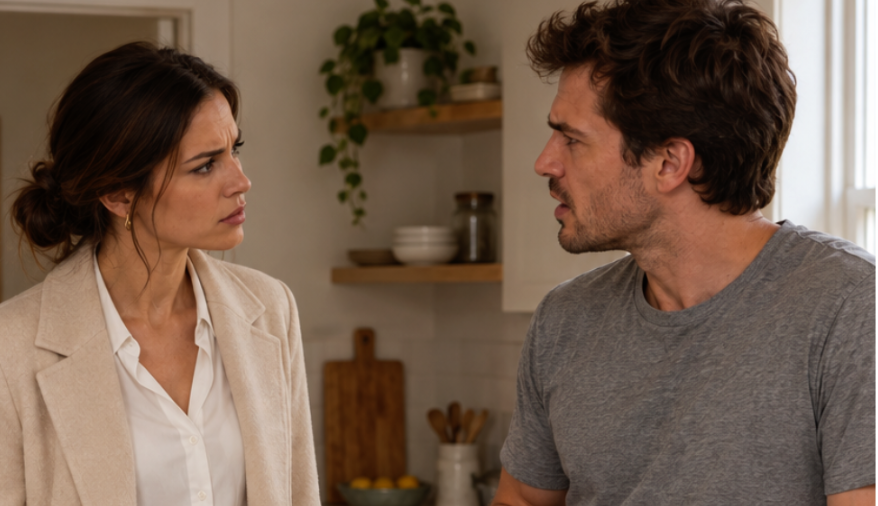
“Svet, I don’t get it,” Ruslan paused in the middle of the kitchen holding a plate. “Are you really flying alone?”
Svetlana was fastening her watch by the window. Outside, March was slowly brightening up in Yaroslavl: a janitor was pushing gray slush toward the curb, and their neighbor on the bench was feeding the neighborhood cat pieces of boiled chicken. Just a typical morning, nothing special — except for Svetlana, it felt like one last test before a major change in her life.
“Yes, really. Just one ticket. My reservation is for one person.”
Ruslan set the plate on the table with that same expression he always wore when the world refused to fit itself around his needs.
“You said we’d go together.”
“I said you had to contribute your part. Not the whole trip. Just your share. You had three months.”
He smirked.
“My part… You talk like an accountant even at home. You know work’s complicated for me right now.”
“It’s not just ‘right now.’ It’s almost always something. The warehouse — because the boss nitpicked. The delivery service — because you had to wake up early. The logistics company — because you didn’t like the team. Even the job my friend got you didn’t suit you.”
“Oh great, now you’re going to bring all that up?”
“I’m not bringing up the past. I’m summing things up.”
Her words hung in the air between them. Ruslan stepped closer and tried to put his hands on her shoulders — a gesture he used to erase any uncomfortable conversation. Svetlana stepped back a little. Not sharply, without drama, but clear enough.
“Svet, what are you doing? I’m your husband.”
“Exactly. That’s why I’m tired of explaining things to a grown man that any adult should already understand.”
Her phone buzzed. Lyubov Anatolyevna. Svetlana hit decline and walked out of the apartment, not even shutting the door loudly. Ruslan stared at the closed door for a few more seconds, waiting for her to come back, kiss his cheek, or say she just snapped. In the past, she always softened by the evening. He’d gotten used to it, like the central heating in their apartment: it’s there, simply because it always is.
At the meat processing plant, Svetlana worked as the head accountant — respected and a little feared. She could argue with suppliers who tried to sneak extra items into the paperwork, and never held back telling the director if a decision would cause losses. But at home, she lived by a different logic: she didn’t check or compare promises with reality, wanting to believe that love didn’t need such blunt tools.
She’d met Ruslan at a colleague’s anniversary party. She was thirty-two, he was thirty-one. He joked, helped carry plates, always seemed to be nearby. After six months, he was calling her apartment “our home” so naturally she didn’t argue. In her neat, overly grown-up life, he was the one who could suggest a countryside trip for pie in the middle of the week or buy a silly mug just because it “looks like you when you’re mad.”
She didn’t notice the little warning signs. Ruslan might forget to pay the utility bills, but he always remembered which new coffee shop had opened nearby. He could kiss the top of her head and say, “You’re strong, you’ll handle it,” especially when his expired credit card, hidden from her for nearly a month, was involved. His relatives slowly made their way into their lives: Lyubov Anatolyevna arrived with homemade lecho and big sighs about a proper daughter-in-law; father-in-law Pavel Yefimovich, with his stories of a tough retirement and requests for help with his tires; sister Tamara, who first came to “chat,” then “just until Friday,” and then simply sent her card number with a “Svet, help me out?”.
Svetlana helped—not because she was naive, but because she had joined the family late and was afraid of seeming stingy, distant, or not good enough. Only with time did she realize: warmth was expected of her… and so was the money.
That evening, she opened the door and found the table set, a bouquet of chrysanthemums, and Ruslan in a clean shirt. The kitchen smelled of fried garlic and burnt butter. Once, this scene would have touched her. Now, she saw it as a hastily arranged stage set, not genuine care.
“Let’s not fight,” he said softly.
“Okay. Talk.”
Ruslan poured her some fruit drink from a decanter, even though he usually just poured it straight from the carton.
“I see you’re tired. Maybe I did drag things out with my job search. But you know I can’t just take any work. I need to be sure it won’t be humiliating.”
“And what about me—is it fine if I get humiliated?” Svetlana asked.
He fell silent.
“When your sister sends me her card number without even a ‘hello’—that’s humiliating. When your mother talks about tiles like I’ve already agreed to pay for them—that’s humiliating. When your father jokes in front of everyone that with a daughter-in-law like me he doesn’t have to worry about old age—that’s humiliating, too. And when you hear all this and act like it’s normal, I realize exactly what role I’ve been given here.”
Ruslan pushed his plate away.
“You helped on your own. No one forced you to.”
“Yes, I did. And that’s why I’m the one stopping now.”
He stood up, paced the kitchen, and came to a stop by the window. It was getting dark in the yard. The curtains reflected in the glass—curtains Svetlana had chosen, just like the rest of the apartment, furnished at her expense.
“You’re making a scene over my trip?”
“No. The trip just happened to fall on the right date.”
She pulled a few sheets from a folder and set them on the table. Ruslan took the top one: lists of amounts, dates, and money transfers. Tamara’s payment plan, Pavel Yefimovich’s insurance, Lyubov Anatolyevna’s medication, his credit card, his phone, his debt to an acquaintance who once came by and asked to ‘settle things man to man.’
“Did you make a report about me?”
“For myself. So I could see facts instead of just feelings.”
“You’re checking up on the supplier now?”
“At least suppliers sign contracts.”
He slammed his palm on the table—not hard enough to break anything, but the fruit drink in her glass trembled. Svetlana looked at his hand, then his face. She wasn’t scared. The sadness was in the predictability: when tenderness didn’t work, it was time to bring on the pressure.
“You’re packing your things and leaving today,” she said. “I’m flying out tomorrow.”
“This is my home.”
“This is my apartment, bought before we married. You’re not registered here.”
“So you planned this from the start.”
“This time—yes, I did.”
He walked out of the kitchen and returned, his jaw clenched tightly.
“I’m not going anywhere. If you want to call someone, go ahead.”
Svetlana had been expecting this. She picked up her phone and placed it on the table, screen facing him.
“I don’t want any scenes at the front door. But if you stay, I’ll go to my parents, change the locks, and handle it officially. There won’t be a quiet way out of this.”
He looked at the phone. With the old Svetlana, you could argue endlessly until you were both exhausted, then make up. This one said little, but every word came with a decision already made.
At that moment, Lyubov Anatolyevna called. Svetlana put her on speaker.
“Svetochka, why aren’t you answering Tamara? She needs to make a payment today. And about the bathroom, I wanted to check—you should get the tiles now, they’ll just get more expensive later.”
“Lyubov Anatolyevna, I won’t pay for your expenses anymore. Tamara’s installment plans, the bathroom renovation, Pavel Yefimovich’s car. Nothing.”
“Sveta, you must be tired. We’re not strangers.”
“Strangers ask for a lot less.”
“We accepted you as one of our own! I brought you preserves, watched after Ruslan…”
“Cans of lecho aren’t the same as a bathroom renovation.”
“Stop going on about the renovation!” her mother-in-law snapped. “A good wife supports her husband, doesn’t count every penny. And you should think about who’ll want you with that attitude.”
Svetlana glanced at Ruslan. He stood beside her—a grown man who that morning had insisted she pay for his trip—and silently listened while his mother told her where she belonged.
“Your son will be coming to your place today. With his things.”
“To our place?” her mother-in-law faltered. “What do you mean?”
“Exactly what I said.”
Lyubov Anatolyevna started talking quickly, the authority gone from her voice. There’s not much room. Pavel doesn’t sleep well. Boxes everywhere. Tamara brings the kids. Svetlana listened as excuse after excuse tumbled out and realized: as long as her son was on her couch, he had to be protected. But as soon as that couch had to become his parents’ problem, there was no space for him at all.
“These are your family matters. You handle them.”
She hung up the call.
Ruslan sat down on a chair. He was still angry, but now confusion had joined the mix. He had just heard how the mother who’d spent all day demanding her son be defended was suddenly searching for reasons not to take him in.
“Happy now?” he asked her.
“No.”
He left for the bedroom, took out a gym bag, and began tossing clothes in—roughly at first, then more slowly. He picked up a sweater Svetlana had given him last winter, held it for a moment, then folded it carefully and placed it on top. Svetlana stood in the doorway, not rushing him.
“I really did want to get things together,” he said, without turning around.
“When? After your vacation? After the car? After your mother’s bathroom gets fixed?”
He zipped the bag shut with a sharp motion.
“You really know how to hurt with words.”
“No. I’ve spent too long softening them.”
In the hallway, he put his keys on the table. Next to them was a photo from a photobooth: they were both laughing, faces close together, Svetlana wearing his scarf. Ruslan picked up the photo with two fingers, looked at it, then set it back down.
“Leave it. I don’t need it anymore either.”
He left. The door closed quietly, almost like any other day.
Svetlana spent her first day in the Turkish hotel barely leaving her room. She sat on the balcony, trying to make sense of why she didn’t feel any lighter. She had done everything right—she freed herself from someone else’s debts, from their expectations. But with that, she had to admit: for three years, she’d been feeding an illusion. Not with money, but with hope—just a little longer and he’ll get things together; just a little longer and he’ll understand; just a little longer and they’ll become a real family.
On the second day, she went down for breakfast and, for the first time in a long while, didn’t count in her head how much she’d save by picking a cheaper hotel. On the third, she bought herself a light dress from a small shop by the waterfront. The saleswoman laughed, showed her how the fabric draped over her shoulders, and Svetlana felt, not like a wallet or a convenient solution to someone else’s problems, but simply like a person—someone who could buy a dress without having to explain herself.
She filed for divorce right from the hotel, using an online portal. Before submitting, she stared at the screen for a long time—not because she hesitated, but because a few clicks were all it took to end something that had started with walks along the river, hot tea in paper cups, and his hand resting on her shoulder. She clicked the button, closed her laptop, and walked to the sea. The waves rolled onto the sand calmly, unaffected by human stories.
Ruslan was living at his parents’ place. At first, Lyubov Anatolyevna felt sorry for her son, scolded Svetlana, and said that she’d regret it one day. But after three days, she asked Ruslan to go buy potatoes; after four, to pay some bills; after a week, not to stay up with the TV all night because Pavel Yefimovich couldn’t sleep. The father-in-law, who once loved talking about manly dignity, quickly turned to practical matters.
“Are you planning to look for a job?” he asked one morning. “Or have you just moved in to be supported?”
Tamara stopped calling once she realized her brother wouldn’t pass on her requests, and that he wouldn’t give her any money himself. The big, close-knit family soon became just an ordinary family, squeezed into a small apartment with a list of unpaid chores and bills, once the generosity of outsiders was gone.
When Svetlana came back to Yaroslavl, the locks on the door had already been changed. Her father met her at the airport, silently took her suitcase, and then, only in the car, asked:
“Are you holding up?”
“I am.”
He nodded and didn’t ask anything else. There was a time she used to get angry about his distrust of Ruslan, about the car being in his name, about his advice to keep their accounts separate. Now she understood: he never wanted to control her life. He just saw what she refused to see.
A month later, Ruslan came to her building. He stood outside, shifting from foot to foot, holding a bag. She went out—not out of pity, but to close one more door without any unfinished words.
“I found your things.” He held out the bag: an old book, a scarf, a charger she’d stopped looking for.
“Thank you.”
The confidence seemed to have left him. Just an ordinary jacket, stubbled chin, tired eyes. He still tried for his old smile, but it didn’t work—not even on himself.
“I got a job. Doing deliveries. The pay is decent. I just wanted you to know.”
“Okay.”
“Maybe if you hadn’t been so abrupt back then…”
Svetlana looked at him, and he didn’t finish the sentence.
“Don’t put the blame for what you called a ‘rough patch’ for years on how abrupt I was.”
He lowered his eyes.
“You’ve changed completely.”
— No. I’m just finally on my own side now.
A neighbor walked by with a carton of milk, glancing at Ruslan. He adjusted his collar and took a step back.
— I’ll sign the divorce with no arguments.
Svetlana nodded. There wasn’t any celebration—just a calmness, without any bitterness or sense of victory.
The divorce was processed quickly. Lyubov Anatolyevna kept sending messages: first blaming, then reminding her about jars of lecho, then asking her to help Tamara ‘one last time.’ Svetlana didn’t reply. One evening, she deleted all the messages, put her phone face down, and sat for a long time with her coffee.
The apartment felt different now. No more stray socks under the armchair, no empty promises in the mornings, no annoyed sighs from the couch when she came home with groceries. Svetlana bought a coffee machine she used to say she’d get ‘later,’ and new bedding—the old sheets remembered too well their reconciliations after fights.
One day her father came over to attach a shelf in the bathroom, even though it was fine as it was. He fiddled with the drill, complained about the crooked wall, then drank tea while gazing at the kitchen.
— It’s quieter here now, he said.
— Empty?
— No. Just quieter.
Six months later, she saw Ruslan near the supermarket, loading bags into Pavel Efimovich’s old car—he still hadn’t gotten his own. A woman in a puffy jacket stood nearby, tapping her phone irritably. Ruslan noticed Svetlana, straightened up, and tried that same smile—the one he’d first entered her life with. Svetlana nodded and walked on. The smile didn’t touch her. Not at all.
At home, she opened her planner and wrote for the next Saturday: ‘Buy a ticket to Kazan.’ One ticket. As she finished, she realized she hadn’t paired that word with ‘alone’ for ages—she was just going wherever she wanted.