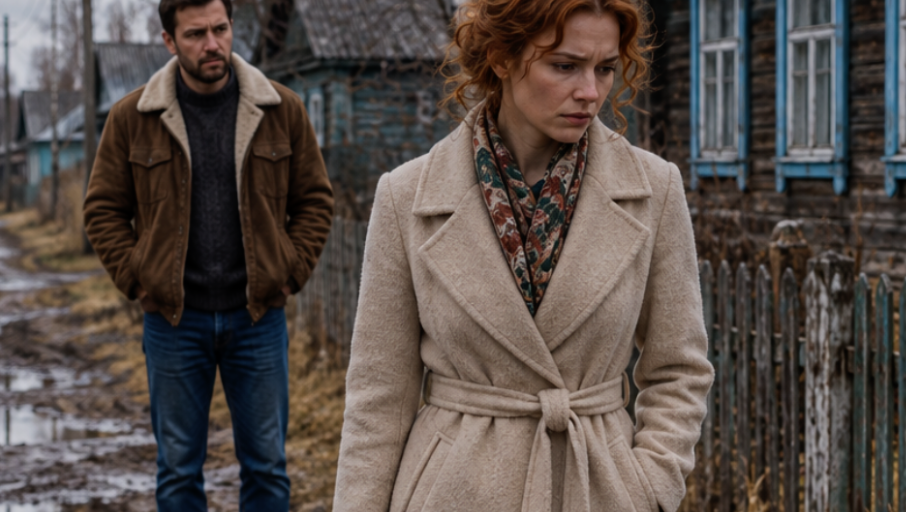
They married young—Sergey was twenty-three, Tatyana twenty-one. That’s tradition in the village: after your army service, it’s time to start a family. Sergey already had a sturdy house, inherited from his parents, built on a tall foundation with beautifully carved window frames. He worked at the sawmill and earned good money. Tatyana got a job at the village administration office, shuffling papers and filling out forms. Life was harmonious, never any fighting. In the evenings, they’d sit on the porch, watching the sunset behind the river and dreaming about the future. Their biggest dream? Kids. Two at least, three if they could—maybe a boy and a girl, or two boys and a girl. When Sergey had a bit to drink during the holidays, he’d always say, “A family without kids isn’t a family. It’s like a house without windows—who needs it?”
Tatyana would listen and smile. She wanted it too—a little one, warm and soft, with rosy feet. She’d already picked out names: Egorka or Alenka. In the stores, she’d look at baby blankets and onesies and tiny cribs.
But time passed, and nothing was happening.
At first, they didn’t worry—it doesn’t always happen right away. Then, anxiety crept in. Then Tatyana traveled to the republic’s capital to see the doctors. She was checked every way imaginable—blood tests, ultrasounds, more procedures. Finally, a middle-aged woman doctor with glasses told her calmly, as if commenting on the weather:
“Tatyana, unfortunately, you have infertility. Primary. It’s a congenital condition. There’s nothing we can do.”
Tatyana remembered sitting in the hospital corridor, staring at one spot. The wall was painted with green oil paint, peeling at the edges. She kept thinking, ‘Any second now, that paint will crack and everything will collapse.’ The wall held up. But her world fell apart.
She came home in a daze. Sergey met her at the door, searching her face:
“Well? What did they say?”
She told him everything. He sat down on a stool, silent for a long time. Then he stood up and went outside. He smoked one cigarette after another. When he came back, his face was stony.
“Here’s what we’ll do,” he said. “We’ll get treatment. I’ll find the money. We’ll find other doctors.”
And they tried. They visited old village healers, drank all sorts of herbal teas, went to churches and lit candles. Tatyana prayed earnestly, until her knees ached. Nothing worked.
A year later, Sergey had changed. He became withdrawn, irritable. He ate dinner staring into his plate. He answered her questions with one word. At night, he tossed and turned and couldn’t sleep. One morning, he sat across from her and said,
“Tanya, I can’t do this anymore.”
“Can’t do what?”
“This. Without kids. You have to understand—I need a family line. A name to pass on. Someone to leave the house to. Otherwise, what’s it all for? Why am I working at the sawmill so hard?”
She looked at him and stayed silent. There was a lump in her throat, but she didn’t cry.
“This isn’t your fault,” he said, eyes averted. “I get it. It’s an illness. But I can’t stay. I’m sorry.”
“You want a divorce?” she asked quietly.
He nodded. Silent. Staring at the floor.
And she left.
She packed a bag in half an hour. Quietly—no tears, no accusations. She put in her dresses, shoes, her mother’s jewelry box: earrings, a ring, a brooch. Sergey stood by the window, not turning around. Only when she was at the door did he say,
“Please—don’t hold it against me. I really can’t do it any other way.”
She didn’t reply.
She caught a bus to the district center, then hopped on a train heading to the republic’s capital. Gazing out the window, she watched forests slip by, spotted the occasional village, and saw the gray sky stretch overhead. Inside, she felt nothing. Not pain—just emptiness, like a house stripped bare after the furniture’s been taken away.
There was no one waiting for her in the capital. But she made it work—first staying at a dorm, then renting a room from an old woman. She found a job. First as an orderly at a hospital. Then as a nanny at an orphanage. After a while, she studied remotely to become a teacher and ended up staying there for good.
The orphanage was an old, Soviet-era building, but it felt homey. The kids were all different: some abandoned, some orphaned, some taken from troubled families. Some were quiet and timid, others wild and mischievous. But all of them wanted the same thing—to be loved. And Tatyana did love them. She gave them everything she had: staying up all night with the sick ones, deep heart-to-heart talks, baking pies on Sundays, singing lullabies at bedtime. She never had children of her own, but now she had many. More than she’d ever dreamed.
She knew every child’s name. Remembered their birthdays. She knew who liked what food, who was scared of thunderstorms, who cried at night. She mended their collars, wiped noses, broke up fights, and sat through twenty parent meetings a year—her own version of parenthood. She became a mother to those who didn’t have one. And never, not once, did she regret it.
As for Sergey, he got married again just six months after the divorce.
Her name was Valentina. Young, strong, cheerful—the complete opposite of quiet, thoughtful Tatyana. She came to the village from a neighboring district and worked as a shop assistant. They met at a dance in the village club. Two months later, they had a wedding, and a year after that—their first child. A boy. Andrey.
Sergey was happy. He carried his son in his arms, bathed him in a zinc tub, and strolled up and down the village street with the stroller, proud and important as a goose. The neighbors would smile and say, “Well, Sergey, you finally made it! Now everything’s just as it should be!” He’d nod and smile back.
Three years later, a daughter was born. Nastya. Now Sergey walked around with two children—a boy and a girl, just like he’d always wanted. The house overflowed with noise, laughter, cries, diapers, and toys. He built them swings in the yard, took them sledding in winter, and taught them how to fish in the river.
He didn’t think about Tatyana anymore. Or rather—almost never. Occasionally, very rarely, a thought would flash by: “I wonder how she’s doing?” But he quickly brushed it aside. He had a new life now. A real one. A full one.
Years passed. The kids grew up. Andrey finished school and moved to the republic’s capital to go to university. Nastya followed three years later. Both graduated, found good jobs. Andrey became a manager at some company. Nastya—a bookkeeper. They got married and started families of their own.
Sergey stayed behind in the village. By then, Valentina had left him—she couldn’t handle village life and moved to her sister’s in a southern city. So he ended up alone. In a big house with carved window frames. He waited for his kids to visit. To call. To come by.
But the kids didn’t visit. And they didn’t call.
At first, he didn’t understand. He thought maybe they were just busy with work and their own families. But then months passed. The phone stayed silent. Whenever he called, Andrey would cut the call or give a short reply: “Dad, I’m busy. I’ll call you back.” But he never did. Nastya answered more often, but their talks were empty—just about the weather, about health, the usual “How are you? — Fine.” He could feel it: something was off. Something was gone. Some thread had snapped.
One day he couldn’t stand it anymore and decided to visit Andrey in person. Without warning. He spent a long time shaking on the bus and then a minibus. He found the building — a new high-rise in a fresh neighborhood. He climbed up. Rang the doorbell.
His daughter-in-law opened the door. She looked at him with surprise, maybe even fear.
“Oh, Sergey Petrovich… Andrey didn’t say you were coming.”
“I’m just passing by. Thought I’d drop in.”
She led him to the kitchen. The grandkids—a boy and a girl—were sitting with their tablets, barely glancing up. Andrey came out half an hour later. Greeted him coldly. Sat down across from him.
“How are you, Dad?”
“I’m fine. Just came to see you all.”
“You shouldn’t have. You should’ve called first. We have plans.”
Sergey sat in someone else’s kitchen, drinking tea from a stranger’s cup, feeling out of place. An outsider. He was tolerated, not expected. That same evening, he left. On the bus ride back, he stared out the window in silence. Inside, something was breaking—slowly, with a painful snap, like an old rope giving way.
Later, there was another conversation—over the phone. He called Andrey to wish him a happy birthday. Andrey replied curtly. Then said:
“Dad, sorry, but please don’t call us too much. We have our own lives. You have your own problems… handle them yourself. Don’t take it personally.”
Sergey wasn’t offended. He hung up and sat a long time in silence. Autumn. Rain outside the window. The house, empty. The stove, cold. On the wall—photos of the kids: in school, fishing, with balloons. Familiar faces. Now strangers.
He sat and thought: “Andrey. Nastya. My children. My blood. I did everything for them. Everything. Worked two jobs, gave the best to the home, spent the last penny on their education, their weddings, their apartments. And now…”
He looked around the empty house. Dirty dishes in the kitchen. Dust in the rooms. No one would come. No one would call. No one needed him.
And then he remembered Tatyana.
He didn’t remember her well. It was vague. Quiet, kind, gray-eyed, gentle hands. How she left—with just one suitcase. How she never said a word of reproach. How he said: “Don’t hold a grudge,” thinking he was doing the right thing.
Now suddenly he was curious: how was she? Where was she? What had become of her? He knew nothing. Thirty years—no word. Someone from the village had mentioned seeing her in the capital, said she worked with children. Nothing more.
He started searching. Asked around with old acquaintances. One guy, someone he used to work with at the sawmill, gave him a number—said his wife’s sister had crossed paths with Tatyana at work. Sergey scribbled the number on a scrap of newspaper. He stared at the digits for a long time. Couldn’t bring himself to call.
But then he dialed.
Ring. Another. Third. Fourth. He was about to hang up—and suddenly:
“Hello?”
It was the same voice. Just the same—soft, calm. Thirty years had passed, but the voice hadn’t changed.
“Tanya,” he said, hesitating. “It’s Sergey.”
There was a pause on the line. A long one.
“Hello, Seryozha,” she said. There was no hurt or joy in her voice—just recognition. As if they’d only parted ways yesterday.
“How are you?” he asked. “I just… I was thinking… after all these years…”
“I’m well,” she replied. “I work. Everything is fine with me.”
And in that moment, he heard it—in the background. Children’s laughter. Children’s voices. Someone shouted: “Tatyana Nikolaevna, can we play a bit longer?” And another tiny voice: “Will you read us a story?”
He felt short of breath.
“Where… where are you?” he asked.
“At the orphanage,” she said. “I work here as a caregiver. It’s been over twenty years now.”
“And… the children?”
“Children,” she confirmed. Then she added quietly, “I have a lot of them, Seryozha. So many.”
He stood there, holding the phone, a lump forming in his throat. He wanted to say something—something important, something that would explain everything: his life, his mistakes, his loneliness. But no words came.
“Tanya,” he finally managed to say. “Are you… are you happy?”
She was silent for a moment.
“You know, Seryozha,” she said, “I once thought God didn’t give me children as punishment. But then I realized—He did give them to me. Just not in the usual way. In a different way. I have Vanyushka—he’s five, abandoned, his parents are alcoholics. He calls me Mom. And Lenochka—she’s three, left in a shoebox. I’ve been raising her since that very day. And Seryozha, your namesake—he’s fourteen, a troubled teen, he’s been through three orphanages, no one could handle him. But I managed. Now he’s enrolled in vocational school. He comes to visit me every weekend.”
As she spoke, her voice grew warmer. He could hear how much she loves. How much she is needed. How full her life is.
“I’m happy, Seryozha,” she said. “Very happy. And you?”
He stayed silent. Because there was nothing to say. He had a home. He had children. He had grandchildren. And yet, he had none of it. She had given all her unspent love to children who weren’t hers—and became a mother to dozens. He had demanded his own—and ended up with nothing.
“Forgive me, Tanya,” he said softly. “For everything. For leaving. For not understanding back then. I was a fool.”
“God will forgive you,” she said. “And I forgave you long ago.”
She spoke calmly, without a quiver in her voice. And he understood: she truly had forgiven him. Long ago. Not because he deserved it. But because she no longer needed to carry the hurt. She had so much love, there was simply no room left for resentment.
“You know what?” she suddenly said. “You should come visit. We could use some help around here. The fence is falling down, the swings are broken. The kids need a man’s hands. Will you come?”
His eyes stung with tears.
“I will come,” he said. “I absolutely will.”
He arrived a week later.
The orphanage stood on the edge of the city—it was an old two-story building painted yellow. On the steps, two small children froze as they saw him. Tatyana came out the door.
He recognized her right away—and yet he didn’t. She was the same, and yet different. Silver streaked her hair, and tiny wrinkles fanned from her eyes. But her face held a certain radiance. That special inner light that people have when they live not for themselves.
“Hello, Seryozha,” she said.
“Hello, Tanya.”
They stood facing each other—two people no longer young, who parted ways thirty years ago. One had lost everything he built. The other had found everything she never dreamed of.
Peeking out from behind her were children. A little boy of about five, with flaxen hair and a serious look. A girl around three in a calico dress, her hair tied with a bow. And a teenager, tall and a bit gangly in a baggy jacket.
“These are ours,” Tatiana said. “Meet them.”
The little boy walked up and held out his hand—just like an adult would.
“Vanya,” he said.
“Sergey,” Sergey replied, shaking the small hand.
Then, out of the blue, the little girl ran up and hugged his leg. She just wrapped her arms around him—trusting and childlike, not at all afraid of this stranger. He froze, unsure what to do with his hands. Then he leaned down and gently stroked her head.
“What’s your name?” he asked in a hoarse voice.
“Lena,” she said, lifting her gaze to him. Her eyes were the bluest blue. Like the sky. Like hope.
And that’s when Sergey started to cry. He hadn’t cried since he was a kid, after he scraped his knee and his father told him, “Men don’t cry.” And yet, here he was—crying. Not out of sadness, not out of self-pity. For something else entirely. For suddenly realizing: here it is. Right here. The love he’d searched for and never found. The children he demanded from life and never received. The purpose he’d lost.
They had always been here. He simply hadn’t seen them.
Now Sergey visits the orphanage every weekend.
He fixed the fence. He repaired the swings. Built benches, made a sandbox, hung up a basketball hoop. The kids call him Uncle Sergey and run to meet him as soon as his car turns toward the gates. He brings candies, fruit, and books. Tells them bedtime stories. Teaches the boys how to whittle, hammer nails, and light a campfire.
Tatiana watches him and smiles. There’s nothing romantic between them anymore—nor will there ever be. Too much water under the bridge. But there is something else—deeper than love, stronger than marriage. They are two halves of the same broken cup. And each has been filled in their own way.
Sergey doesn’t call Andrey and Nastya anymore. Not out of hurt feelings. He’s simply let go. He’s learned: you can’t demand love. You can only give it. And then, sometimes, it comes back to you—from places you never expected at all.
Sometimes, as Sergey walks down the orphanage hallway, Lenochka catches up to him and grabs his hand. And she asks:
“Uncle Sergey, are you coming tomorrow?”
“I’ll come,” he answers.
“Really, truly?”
“Really, truly.”
She nods—serious, like a grown-up. And runs off.
And he stands there, watching her go. And he thinks: this is what was worth living for. Right here. Simple. Real. The things you can’t buy, demand, or earn. The things you’re given freely—if you’re ready to give as well.
Tatiana comes out onto the porch. They stand together, watching the children play in the sandbox.
“You know, Sergey,” she says, “I don’t regret anything. If things had turned out differently back then, I would’ve had my own children. Two, maybe three. But this way—I have twenty. And now, so do you.”
“Even more,” he says. “We have twenty. Together.”
She looks at him. In her eyes, there is that same quiet, calm wisdom as thirty years ago. The same kindness. And he realizes: she has always been stronger than him. Always. He just never saw it. It took losing everything for him to finally see.
In the sandbox, little Lena is shaping sand pies and humming to herself. Clouds drift above the orphanage. Somewhere, a dog barks. The old swing creaks as Vanyushka soars towards the sky. And it feels like, at last, everything is right where it belongs.