“Here you go, dear. This is for you.”
My mother-in-law placed a glossy brochure on the table and slid it toward me with two fingers, just like a teacher sliding a bad report card over. The cover read: “Medical College. Correspondence Department. Junior Medical Staff.” A girl in a blue cap smiled from the cover.
“I did my research,” Angelina Eduardovna smoothed the tablecloth as if my presence had left creases. “Fifty-two thousand a year, you can pay in installments. Forty-six is not too late. At least you’ll have some education; otherwise, it’s embarrassing in front of people.”
Gleb stopped chewing mid-bite. I looked at the clock: it was twenty to three. I had to be on duty by five.
For four years, I’ve been hearing this “no education” speech. Almost fifty Sunday lunches in this kitchen that smells of bay leaves and “Red Moscow” perfume, with a Pushkin bust from former students on the windowsill—where the hostess, a school principal for seventeen years, still speaks as if conducting a staff meeting.
It all started one evening. In the fall of 2022, Gleb brought me over right after a long shift to meet everyone. I was still in my jacket, my hair unwashed, and my hands smelled of antiseptic. My mother-in-law asked where I worked.
“At the regional hospital. In thoracic surgery. I’m just coming off a shift, sorry.”
“Oh, dear, only night guards and orderlies work those shifts around here,” she smiled. And then, just like in a classroom, she asked: “And who wrote ‘Night, street, lamp, pharmacy’?”
I hadn’t slept for twenty-six hours. I couldn’t remember. The way she adjusted her glasses on their chain made it clear: my fate was decided.
I tried to explain. Right there at the same table I said, “I’m a doctor. A surgeon.” She laughed: “Doctors, dear, know Blok.” Gleb spoke up: “Mom, she really is a surgeon.” I remember her reply word for word: “Gleb, you’re in love. You’d believe she’s an astronaut.” That same night I sent her a message—calm, naming my department. An hour later she replied: “Lilya, don’t make things up. Gleb can choose who to love, but don’t lie to me.”
And I decided I wasn’t going to prove myself anymore. I’d spent my whole life doing that: in the village school, at university—where people told me there was no place for women in thoracic surgery—and then for twenty years, to department heads and professors. Two hundred and sixty surgeries last year. At home, I just wanted to be a wife. I told Gleb, ‘Don’t fight her. I don’t need anyone to love me just for my title.’
But my mother-in-law filled in the story herself. I had the apartment, so obviously, it must’ve been left from my first husband. Of course, the car was bought on credit by Gleb. As for my son, Arseny, I supposedly ‘raised him all by myself, so where was there time to study?’ Everything made sense—as long as she wanted it to make sense.
‘Glebushka,’ she turned to her son, ‘help her with the paperwork. The application needs to be written properly, she won’t figure it out on her own.’
Under the table, I clenched and unclenched my fingers one at a time, just like I do before putting on gloves. My fingertips tingled. My mouth went dry, even though I’d just had some compote. How much longer could I just sit there, nodding, as if they weren’t talking about me?
I picked up the brochure and slid it back across the same tablecloth, with the same two fingers.
‘Thank you, Angelina Eduardovna. I get plenty of learning. Every single day.’
‘Every day, she learns,’ my mother-in-law pursed her lips. ‘I wonder what exactly she’s learning.’
‘All sorts of things. And I write my own applications.’ I stood up. ‘I have to be at my shift by five.’
‘A shift,’ she drawled. ‘What is that, cleaning floors?’
‘Yeah. Floors.’
I grabbed my jacket from the back of the chair and left before dessert. In four years, I’d never left before dessert. Already in the hallway, I heard her tell Gleb, ‘You see? No manners, no sense of decorum.’ And for the first time, Gleb said nothing—he just followed after me.
The car smelled of wet leaves, the windshield wipers squeaked on the glass. Gleb was silent until the first traffic light, then he said:
‘Lilya, just show her your diploma. Just once.’
I opened my phone, found the conversation from October twenty-second, and turned my screen so he could see.
‘I have shown her. She doesn’t read, Gleb. She’s just checking up. And I’ve already been checked.’
He snorted, took my hand as we rounded the corner, and for a moment, things felt warm. I even thought maybe we’d keep going like this: a family dinner once a month, a new brochure once a month, and I’d survive. Then my phone buzzed in my palm.
‘Lilya, I have a key after all. I’ll drop by on Wednesday, tidy up the place since you clearly don’t have time.’
***
On Thursday, I came home after a 24-hour shift, just before ten. A fine, cold rain was falling, the apartment building smelled of wet umbrellas and someone’s pancakes. I opened the door, took off my shoes, and didn’t immediately realize what was wrong.
The shelf in the hallway was empty. Wiped spotless, smelling of chlorine, and completely bare.
On the side table was a note, written in large, teacherly handwriting with a heavy hand: ‘Cleared out the rubbish, just a bunch of dust collectors. Wiped down everything. Don’t thank me. A. E.’
Fourteen books. I could recognize them by their spines as well as faces. Two volumes on operative surgery, reference books, my notes from my internship in a cardboard folder, the atlas my mentor Pavel Andreevich gave me when I performed my first solo surgery. On the flyleaf, in his handwriting: ‘To Lilia—best hands in the class.’
I went down to the dumpsters in my lounge pants, not even bothering to throw on a jacket. The box was off to the side, soggy, already slumped over. Rain was trickling down my neck, the stench of rotten cabbage coming from the container, and somewhere behind the building, a garbage truck was rumbling. I pulled the books out one by one, laying them on the lid of the bin, shielding them with my body. Nine survived. Five had swollen up like sponges, the pages glued together in a gray mush. The atlas was one of them.
I opened it right then and there. The inscription had blurred into blue stains, and of the words ‘best wishes,’ all that was left was ‘best.’
And then it hit me. The spines said ‘Surgery’ in big golden letters. My mother-in-law couldn’t have missed that. She saw it, for sure. And for her, it was just more proof: the surgery nurse dragging home someone else’s textbooks, just to seem smarter. Any truth about me became a point against me in her eyes.
My fingers were so cold they could barely move. But I held the books steady, the way you handle something you absolutely can’t drop. Inside, there was no pain. Inside, it felt quiet and crystal clear, like the operating room in the minute before the first cut.
I took the books back home, laid them out on the radiator, and without changing clothes, I headed to my mother-in-law’s place.
She opened the door in an apron, the air full of vanilla and something slightly burnt.
“Lilya? Aren’t you supposed to be sleeping after your cleaning shift? I cleared out so much dust at your place—you should have seen it.”
I held out my hand.
“The key, please.”
She looked confused. Adjusted her glasses on their chain, glanced at my hand, then at me.
“What key? Gleb gave it to me.”
“But the apartment is mine. The key, Angelina Eduardovna.”
“I keep your place tidy, and now you—”
“You threw out my books. Fourteen of them. Five are beyond saving now.”
“Just scrap paper!” my mother-in-law threw up her hands. “My dear, I’ve worked with books for forty years. I know the difference between a real book and trash.”
I didn’t lower my hand. I just stood there, waiting like I wait for the anesthesiologist to say “go ahead.” Maybe twenty seconds. She pressed her lips together until they turned white, went to the other room, and put the key in my palm. She didn’t just put it—she pressed it into my hand, forceful, as if she were handing out a failing grade.
Right then, her phone rang from her apron pocket. She turned away and her voice switched instantly to honey-sweet:
“Emil, darling! So how’s Mark? Did he bounce back after the hospital stay? In spring, it was such a close call!”
I left without saying goodbye. In the elevator, the key felt icy in my hand. I squeezed it and slowly exhaled through my nose, staring into the cloudy mirror. For the first time in four years, I’d taken something back from her—instead of giving something up.
At home, I was drying the pages with a hairdryer, sheet by sheet. It smelled like hot paper and a bit of glue. In the evening, Gleb came in, saw the books on the radiator, and understood everything without a word. He brought towels, sat next to me, and we spent until midnight pressing the atlas through cloth. Not once did he say ‘but that’s just my mom.’ That helped more than any words.
Then he got a message. He read it and showed me: “Your wife has thrown me out of your home. I won’t forget this.”
I lay down, but I couldn’t fall asleep. ‘Mark. After the regional hospital. Spring.’ In April, on the night of the fifteenth, a man over seventy was brought in by ambulance. I operated for almost five hours. At four in the morning, I walked out into the hallway and saw a tall, stooped woman sitting with a thermos on her lap. She only asked one thing: ‘Is he going to live?’ His name was Mark.
Who knows how many people there are in the city of Markov, I told myself. Still, I lay awake for a long time, staring at the dark window.
***
For ten days, my mother-in-law didn’t call. But on October third, she called Gleb and, for the first time in my memory, actually said ‘please’: the girls were coming over for Teacher’s Day, the trays were heavy, so could Lilia help out?
“She really said ‘please’,” Gleb looked at me, embarrassed but hopeful at the same time. “Maybe this is her way of making peace?”
I went for his sake. And I told myself: if it happens again, this will be the last time.
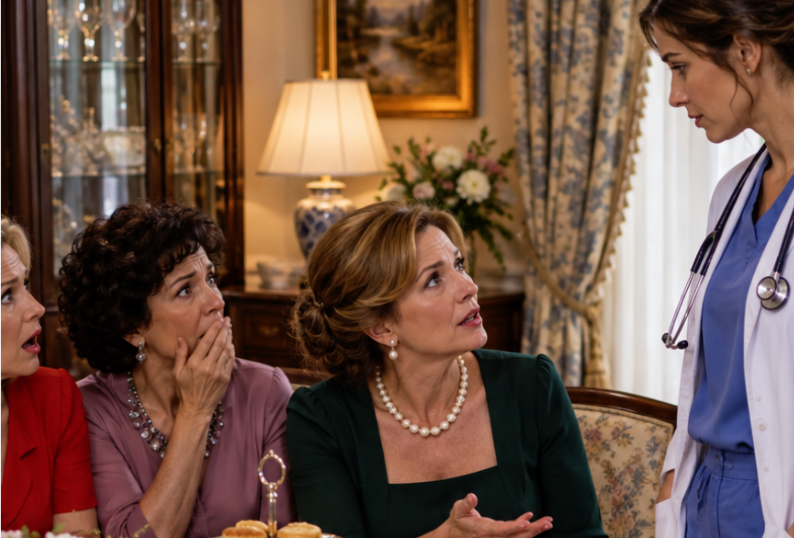
On the evening of the fifth, Angelina Eduardovna’s living room smelled of bergamot and Napoleon cake. The round table was adorned with asters in a crystal vase and her blue-and-white lattice china set, the one reserved for guests. Three of her former colleagues came: two elementary school teachers I didn’t know, and Emilia, tall, stooped, and with a loud voice that could probably still command a classroom. She had taught chemistry for forty years.
My mother-in-law handed me a frilly apron.
I carried the teapot, pastries, sugar bowl, and gathered up saucers. Spoons jingled, the clock on the sideboard ticked, and they chatted about pensions, grandchildren, and some Zoya Pavlovna who had ‘really gone downhill’. Emilia glanced at me several times and then looked away, as if trying to remember something.
“Lilia, bring more hot water,” my mother-in-law smoothed the tablecloth with her hand, then turned to her friends and sighed: “Our daughter-in-law didn’t get an education. But she’s got golden hands, carries trays, never dropped one yet.”
“Well, Angelina, that’s alright,” one of the teachers nodded sympathetically. “Not everyone can do everything.”
Emilia put down her cup, not quietly, but with a sharp clink against the saucer.
“Wait a second. What trays?” she stared straight at me. “This is Liliana Sergeyevna. You operated on my Mark in April.”
It got so quiet I could hear the trolleybus rustling by outside the window.
“Emilia, you must be mistaken,” my mother-in-law laughed in a thin, unnatural voice. “She’s just an orderly.”
“I’m not mistaken. I’ve kept records for forty years, I remember faces. I waited for her in the corridor until four in the morning. She came out in a blue suit, took off her cap, and said, ‘He’ll live.’ Orderlies don’t walk out to relatives at four a.m. with those words. And later I brought her a ‘Bird’s Milk’ cake to the staff room.”
“I remember,” I said. “You even taped a note to the box.”
The teachers exchanged glances. My mother-in-law adjusted her glasses on their chain, once, then again.
“Well, lots of people wear lab coats there,” she muttered. “Maybe she was assisting. Handing something over.”
That’s when it hit me. Even now. Even with a living witness. Heat rushed from my neck to my cheeks, my ears thudded, and my fingers started stretching out, one by one, like before an operation. And from this familiar movement, my mind cleared, cold and sharp.
I set the tray on the sideboard. Untied my apron, folded it neatly, and hung it over the back of an empty chair. Then I sat at the table, poured myself tea into a guest cup with the blue lattice pattern, and took a sip. The tea was strong and already a little cool.
“Emilia, how is Mark? Does he come in for check-ups?”
“He does!” she beamed. “He tinkers in the garden, picked two buckets of apples.”
“Alright. I won’t say anything else in front of everyone and I won’t share anything about my patients.” I turned to my mother-in-law. “Angelina Eduardovna, I’m a thoracic surgeon with twenty years of experience. I told you this four years ago at your table. I even wrote it down. You replied that I was making it up.”
My mother-in-law opened her mouth, then closed it. Her hand rested motionless on the tablecloth. Three pairs of eyes were fixed on her, not on me.
The guests started to leave after about fifteen minutes, awkwardly and in a rush, praising the pastries as they went. In the hallway, Emilia grabbed my hand—firmly, almost like a man.
“Thank you. For Mark. Back then, I didn’t have any hope.”
My mother-in-law was washing the cups, her back turned to me. She didn’t look around when I left.
Outside, the air smelled of fallen leaves and someone’s distant bonfire from the dachas. I got into the car with Gleb and suddenly burst out laughing, tears streaming down my face as I buried my forehead in his shoulder. He didn’t ask anything. He just waited for my laughter to fade.
And then, the next day, something happened that hadn’t occurred in four years. My mother-in-law called me herself—not Gleb.
“Lilya,” she said, her voice unusually quiet. “I think I overreacted. Come over on Sunday. I’ll bake an apple pie.”
I hung up and sat in the kitchen for a long time. Could it really be? Was a single tea party all it took? Gleb was whistling as he walked around the apartment.
Back then, I had no idea that by Sunday, my mother-in-law would have an entirely different story ready—and she wouldn’t start telling it to me.
***
On Thursday, I walked out of the operating room just before four o’clock. Nearly five hours on my feet, my back aching, the smell of antiseptic on my hands so strong it stung my nose. A fluorescent lamp buzzed in the hallway. The head nurse, Galina, approached me with an apologetic look.
“Liliana Sergeevna, someone’s asking for you again. From your mother-in-law. Third time this week.”
The first two times, the calls came to the nurses’ station. A woman wanted a ‘consultation about an x-ray,’ and a man was asking when I could admit his mother-in-law without waiting in line. Turns out, Angelina Eduardovna had personally given both of them the department’s number.
At the end of the corridor, near the visitors’ lounge, an elderly woman in her seventies wearing a beret was sitting with a stack of test results on her lap. She’d come to visit her sister in her neighboring room and decided to make good use of the trip.
“Liliana! I’m Nonna Karlovna, I went to school with Angelina for twenty years. She said you’d take a look at me and admit me right away.” She leaned closer and lowered her voice. “She says you owe her. She put up with you for four years, always so secretive. You and Emilia set her up to be shamed in front of the girls—everyone knows about it now.”
I glanced at the clock: fifteen past twelve. My hands hadn’t trembled once in five hours. But now they’d gone cold, as if I was standing in the rain by the trash cans again. So that was the kind of pie she was baking. In three days, I’d gone from a ‘brainless daughter-in-law’ to a ‘liar for hire,’ someone you could treat as your own private resource.
“Nonna Karlovna,” I said, “I can’t see you without a referral. Please see your general practitioner, get a referral, and make an appointment. It takes about two weeks. That’s how everyone gets in. Your sister did it that way too.”
“Angelina said you were kind,” she replied, obviously hurt.
That evening, I sat in the kitchen, massaging each finger one by one. So. What do I have? The rumor started at her table, among her friends. That’s where it must end—not at the department, not over the phone, not through Gleb. I need to handle this myself.
“I’m with you,” Gleb said when I explained. “And this time, I’m not staying silent.”
On Sunday, my mother-in-law turned seventy-four. An apple pie sat in the middle of the table, filling the room with the scent of cinnamon and baked dough. The same crowd was there: the two teachers, Emilia, Nonna Karlovna. Angelina Eduardovna greeted us in the hallway, beaming, with a cameo pinned to her collar.
“Here’s our surgeon!”
She raised her glass as soon as everyone had taken their seats.
“To my daughter-in-law! Four years of being modest, hiding everything from me, making me look foolish. But it’s fine, I don’t hold grudges. Now our family has its own doctor, and none of us will ever have to wait in line again!”
The teachers smiled. Nonna Karlovna gave me a sideways glance. I stood up, leaving my glass on the table.
“Happy birthday, Angelina Eduardovna. I have two things to say. In front of everyone, because you talk about me in front of everyone.”
I pulled out my phone, found the chat, and read out loud the message I sent on October 11th, 2022, with the name of the department and my position. And her reply: ‘Lilia, don’t make things up. Gleb knows best who to love, but don’t lie to me.’ Then I placed my phone in front of Emilia, screen up, so she could see the date.
“I didn’t hide anything. I told you the very first evening. Then I wrote to you. You replied that I was making it all up.”
“And I told you too, Mom,” Gleb said, not raising his voice or looking away. “You said I’d believe it if she claimed to be an astronaut.”
“And the second thing. No one’s getting to me without waiting their turn. Not your friends, not even you, if it comes to that. Not because I’m cruel. Because everyone in that line has their own Mark, and his wife brings him a thermos too.”
“She’s right,” Emilia said loudly. “My Mark was brought in by ambulance, no special favors. And they saved him.”
Nonna Karlovna stared down at her plate. The teachers now looked at the mother-in-law. Angelina Eduardovna’s hand rested on the tablecloth, pausing without smoothing out a wrinkle.
“I just… I meant well,” she murmured, at a loss for words. A school principal who, for seventeen years, never failed to have the last word at any faculty meeting.
I reached for the gift in my bag—a small, hardback volume—and set it next to her plate. The title: Blok. On page twenty-three, ‘Night, Street, Lamp, Pharmacy.’ I checked to make sure.
We stayed until tea. The pie was delicious, and I honestly ate a slice. Emilia and I left together, and in the elevator, she looked down at me and said, “I graded for forty years too, Liliana Sergeyevna. And not once without looking in the notebook.”
***
A month passed. Nonna Karlovna didn’t call the nurses’ station anymore, and her sister was discharged on time. My mother-in-law’s friends now only show up for her Thursday gatherings every other week; Emilia skips the most. But in November, she came to my department with Mark, with a proper referral, at the right time and date. She brought a box of ‘Ptichye Moloko’ and a note taped to it.
Angelina Eduardovna calls me herself every couple of weeks. The conversations are brief, just about the weather and blood pressure, and there’s no ‘dearie.’ At Gleb’s cousin’s anniversary, she apparently announced at the table: ‘Liliana Sergeevna is our surgeon.’ Not ‘daughter-in-law,’ not ‘Lily.’ We don’t hug or drink tea late into the night together. The key to my apartment stays in my dresser drawer, and she never asks for it back.
At the last Sunday lunch, I realized I hadn’t checked the time even once. I just sat there, enjoying her pie, not waiting for a chance to leave.
The atlas sits on the hallway shelf. Its pages are wavy, and Pavel Andreevich’s inscription is still unfinished: ‘To Lilia – the be…’ But I remember exactly how it was supposed to end.
I found the college brochure in the glove compartment. Back in September, Gleb absent-mindedly scooped it up from the table. Just last week, I gave it to Vika, our orderly. She’s twenty-four, studies anatomy on her phone after night shifts, and saves a bit from every paycheck.
‘Fifty-two thousand a year, you can pay in installments,’ I told her. ‘And it’s definitely not too late.’
‘How do you know that?’ Vika asked, surprised.
I told her, ‘A school principal once told me.’