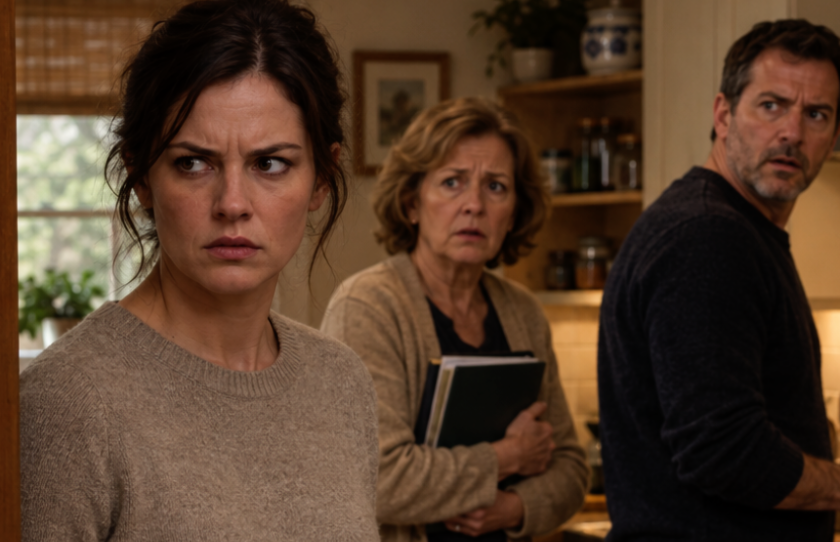
“Who are you?” I stood frozen in my own entryway, unable to move.
A woman about fifty-five, heavyset, wearing my thick robe embroidered with daisies, stepped out of the kitchen holding a ladle. She looked at me like I was the one who’d wandered into her apartment by mistake.
“So, you must be Ninochka? Lyosha told me about you. Come in, the borscht is almost ready.”
I stayed right where I was, standing in the doorway with my travel bag slung over my shoulder, trying to figure out if I’d messed up the floor number. No, the doormat is mine. The lock is mine. But the scent of unfamiliar perfume in the hallway definitely isn’t.
“Lyosha!” I shouted.
My husband appeared from the other room. Barefoot, in his lounge pants, looking like he’d just gotten caught stealing jam.
“Nin, you weren’t supposed to get back until tomorrow.”
“I came home today. Who is this woman?”
He rubbed the back of his head. It was a habit I’d known for twelve years—he always did that right before he was about to lie.
“This is Aunt Zina. My mom’s cousin. From Bezhetsk.”
Aunt Zina smiled at me from the kitchen and waved her ladle.
“I’ll stay with you for a bit and tidy up! Poor Lyosha was just wilting here all alone without you.”
I wanted to sit down right there on the floor.
I worked as a manager at a logistics company, with business trips that often lasted three or four days. I’d gone to Veliky Novgorod to meet a supplier and came back a day early. And this is what I walked into.
The apartment smelled like borscht, bleach, and something floral. Someone else’s coat was hanging on the rack. In the bathroom—where I peeked in a minute later—there was someone else’s toothbrush in my cup, someone else’s face cream on my shelf, and someone else’s towel on my hook.
And on the washing machine, there was a neat stack of someone else’s laundry.
“Lyosha, can I talk to you for a moment?”
We shut ourselves in the bedroom. He immediately put his hands up, as if surrendering.
“Nin, she got here three days ago. She called my mom, my mom called me. Said Aunt Zina had nowhere to go—she’d been kicked out of her rented room, her pension’s too small. Asked if she could stay for a couple of weeks.”
“A couple of weeks?”
“Well, a month at most.”
“Lyosha, you let a complete stranger into my apartment while I was gone—and you didn’t even bother to call me?”
He rubbed the back of his head again.
“I wanted to, but I thought you’d come home tomorrow and I could explain everything calmly then.”
I sat down on the bed. The apartment was mine. Not ours. Mine. I inherited it from my grandmother and registered it to myself before we ever married. Lyosha had known this since day one. His mom knew too.
But somehow that never stopped anyone.
My mother-in-law, Galina Petrovna, lived in Tver in her own two-bedroom and managed everyone’s lives over the phone. Every family argument of ours would end up going through her. Lyosha called her after every disagreement, and she’d then call me to explain how I should behave with her son.
I put up with it. I’d put up with it for twelve years.
Because Lyosha wasn’t a bad person. He was just weak. He never could say “no” to his mom. Couldn’t make decisions for himself. And I kept thinking that if I were just patient enough, maybe he’d grow up.
But now, in my own apartment, a stranger was living in my bathrobe. And making borscht with my groceries.
“Fine,” I said. “A couple of days. Until she finds a place to stay. But that’s it.”
Lyosha nodded in relief.
A week passed.
Aunt Zina wasn’t looking for a new place to stay. She woke up at six every morning, made a racket with the pots and pans in the kitchen, blasted the TV at full volume, washed all my curtains without asking, and rearranged the furniture in the living room.
“It’s cozier this way, Ninochka. You’ll get used to it.”
But I never got used to it. I would come home from work and the apartment no longer felt like mine. Aunt Zina had claimed the living room sofa, spread out her own blanket, lined the windowsill with her bottles, and hung a small icon over the couch.
In the second week, I talked to Lyosha again.
“She has to leave.”
“Where, Nin? She has no one else.”
“That’s not my problem.”
“She helped mom’s sister when she was sick. Mom thinks we owe her.”
“We don’t owe her anything. And this is my apartment.”
He went silent. Then he said quietly:
“Mom asked me not to kick her out.”
Just like that. Not “I ask you.” Not “I feel bad.” Just “Mom asked.”
In the third week, Aunt Zina invited a friend over. The two women sat in my kitchen, drank tea from my set, and chatted about grocery prices. When I got home, her friend looked me up and down and said:
“Nice apartment, cozy. Zina, you’re lucky to have such relatives.”
I calmly put down my bag.
“Zinaida Vasilievna, can we talk?”
She came into the hallway, wiping her hands on my apron.
“Do you plan on looking for your own place?”
“Why should I? Lyoshenka said I can stay.”
“Lyoshenka isn’t the owner of this apartment.”
She smiled. Softly, almost like family.
“Ninochka, you wouldn’t throw an elderly woman out on the street, would you? What would people say?”
People. The never-ending argument.
That evening I called my mother-in-law.
“Galina Petrovna, your aunt needs to move out.”
“Nina, don’t be so harsh. Zina is lonely, she’s sick, and she has nowhere to go. You live in a three-bedroom, there’s plenty of space.”
“We live in a two-bedroom.”
“Well then, the sofa in the living room is free.”
“It was free. Now your aunt is on it.”
“Just be patient. It’s family, after all.”
Family. Another argument that would usually silence me.
But this time something changed. Maybe because at work I was in the middle of negotiations with a supplier who had been lying to us about delivery dates for three months. I’d gotten good at recognizing when someone says one thing and does another.
And I started noticing odd things.
Aunt Zina, who supposedly lived on a tiny pension, wore nice clothes. Her coat wasn’t cheap. Leather purse—not from the market. Brand new phone—not a basic one.
One day I happened to see her paying at the local store. Card, contactless payment. For someone supposedly without money or a place to live, she seemed awfully confident.
And then I heard a conversation.
I came back from lunch earlier than usual. Aunt Zina was on the phone in the kitchen and didn’t hear me come in.
“Galya, everything’s going well. I’m making myself at home. The girl is nervous but putting up with it. Lyoshka is on my side. Give me another month, they’ll get used to it, and then we’ll handle the registration.”
I froze in the hallway.
Registration.
“Well, you said yourself: once you get registered, they can’t get you out even with a crowbar. The apartment’s good, the area is nice. It’ll do for me.”
I could hardly breathe.
“Yeah, yeah, we’ll tell Lyoshka it’s for the doctors, for the clinic. He’ll sign, he’s obedient.”
Aunt Zina burst out laughing.
I quietly left the apartment. Walked down one flight of stairs and sat on the step.
My hands were shaking. Not from fear. From anger.
Registration. That’s what it was from the very beginning. Not just ‘stay for a couple of weeks.’ Not ‘help a lonely woman.’ It was a plan. A calm, well-thought-out plan where my mother-in-law and her aunt were working together.
To register a stranger in my apartment. And then what? Demand a share? Force a sale through court?
I remembered how six months ago my mother-in-law casually asked, ‘If something happens to you, Nina, will the apartment go to Lesha?’ I brushed it off back then. Thought it was just casual talk.
Now it all made sense.
The next day, I took a day off and went to see a lawyer. A young woman named Alyona listened to me carefully.
‘Is the apartment yours, bought before the marriage?’ she asked.
‘Yes. I inherited it from my grandmother.’
‘Is your husband’s aunt already registered at your place?’
‘No. Not yet.’
‘That’s good. While there’s no official registration, she’s just a guest. You have every right to ask her to leave. If she refuses, that’s illegal residence.’
‘And what if my husband is against it?’ I asked.
‘Your husband isn’t the owner. His opinion has no legal weight.’
Alyona helped me draft a written demand for vacating the apartment. Official, with date and signature.
‘Give it to her and have her sign for it. If she doesn’t leave by the deadline, call the police.’
That evening I came home. Aunt Zina was watching a drama in the living room. Lesha was sitting in the kitchen.
I sat next to him and set my phone on the table. On the screen was a recording—not of my aunt, but of my conversation with the lawyer. I recorded the consultation on purpose, so Lesha could hear every word.
He listened in silence. Then he turned pale.
‘Nina, are you serious?’
‘I’m serious. And now, listen to this.’
I played a second recording. That same one. Aunt Zina’s voice: ‘The girl is nervous but holding out. Lesha’s on my side. Give me one more month, and we’ll get the registration done.’
Lesha listened. His lips turned white.
‘Is that Mom? Was she talking to Mom?’
‘With Galya. That’s what she called her.’
He covered his face with his hands.
‘I didn’t know, Nina, I swear I didn’t know.’
‘Maybe. But you didn’t ask. You didn’t call me when you let her in. You didn’t take my side once in three weeks. You just said, “Mom asked,” and that was enough for you.’
He stayed silent.
I stood up, walked into the living room, and turned off the TV. Aunt Zina looked up at me.
‘Zinaida Vasilievna, here is a formal request to vacate the apartment. You have three days.’
She took the paper, read it, and for the first time in three weeks, her smile vanished.
‘Is this a joke?’
‘No. And there won’t be any registration. Not in a month, not in a year. Never.’
She opened her mouth, closed it. Then shouted:
‘Lesha!’
Lesha stood in the doorway. He didn’t come into the room, didn’t stand beside her.
‘Aunt Zina, you’d better leave.’
Her face grew longer.
‘What? But Galya arranged everything!’
‘Galya arranged things with you. Not with me.’
Aunt Zina called my mother-in-law right in front of me. Put her on speaker, like she always does. Galina Petrovna yelled so loud, I’m sure the neighbors heard every word.
‘Nina’s completely out of line! Lesha, are you a man or a doormat? Put your wife in her place!’
Lesha took the phone from Aunt Zina’s hands.
“Mom, this is Nina’s apartment. I have nothing to put in its place. And you had no right to put on this show behind my back.”
Silence fell.
“Lesha, have you lost your mind?”
“No, I’ve come to my senses. For the first time in a long while.”
He set the phone down on the table, screen facing down.
Aunt Zina left two days later—not three, as she’d initially demanded. She packed her things, grabbed her bottles from the windowsill, took down her icon, and called a taxi. When she said goodbye, she looked at me with hurt in her eyes.
“I really did clean up, you know. And cooked borscht.”
“Thank you for the borscht,” I replied. “Please close the door behind you.”
After she left, I washed the daisy-print robe again. It still smelled like someone else’s perfume after the first wash, so I soaked it in a basin of vinegar and washed it once more.
Lesha and I talked for a long time that evening. We didn’t raise our voices. We just talked.
“Do you realize your mom tried to plant someone in my apartment so she could later claim a stake in it?”
“I do.”
“And do you get that if I hadn’t come home early, if I hadn’t heard that conversation, things could have ended very differently?”
“I understand.”
“Lesha, I need to know one thing. Are you with me or with your mother?”
He was silent for a long moment. Then finally said:
“I’m with you. But I need time to learn how to say ‘no’ to her—not just in this moment, but always.”
“You can have the time. But I don’t have any patience left.”
He nodded. For the first time in twelve years, he seemed to realize my words weren’t empty threats.
A day later, I changed the locks. Not because I was afraid of Aunt Zina, but because my mother-in-law still had a key to my apartment. She’d had it since the first year of our marriage, “just in case.” For twelve years, I told myself this was normal.
Galina Petrovna called when she found out her key didn’t work. She showed up unannounced, as always.
“Nina, my key isn’t working.”
“I changed the lock.”
“Will you give me a new one?”
“No.”
Pause.
“What do you mean, ‘no’?”
“Just no, Galina Petrovna. If you want to come over, call ahead.”
She hung up. Then she called Lesha. Lesha said:
“Mom, Nina’s right.”
It was a strange feeling. For the first time in twelve years, my husband told his mother I was right. Not, “Just bear with it,” not, “I’ll talk to her,” not, “she’s just tired.” Simply: right.
A small word. But it suddenly felt easier to breathe.
Six months passed. Aunt Zina found a room in Bezhetsk and started working as a cloakroom attendant at the clinic. She’s not homeless or destitute. She just saw an opportunity to get registered in a nice apartment and decided to give it a shot.
My mother-in-law still calls. Less often now, quieter, more cautiously. She never apologized. But she stopped giving orders. She feels the boundary, even if she won’t admit it out loud.
And sometimes I stand in the kitchen, making borscht, and think: it’s strange how long you can put up with discomfort, convincing yourself it’s normal. Someone else in your robe, someone else’s things on your shelves, someone else making decisions in your life.
All this time, I thought keeping the peace was more important than keeping myself. That family, relatives, “that’s how it’s done,” “just bear with it,” and “what will people say” mattered more than my own right to lock my own door.
They don’t.
My robe with daisies is hanging in the bathroom. It’s clean, mine, and smells like my laundry detergent. The apartment keys are in the drawer. There are two sets: mine and Lyosha’s.
No one else’s.
Sometimes just a forgotten piece of paper, a single call, or something overheard can change everything. Follow along—there are plenty more stories like this ahead.