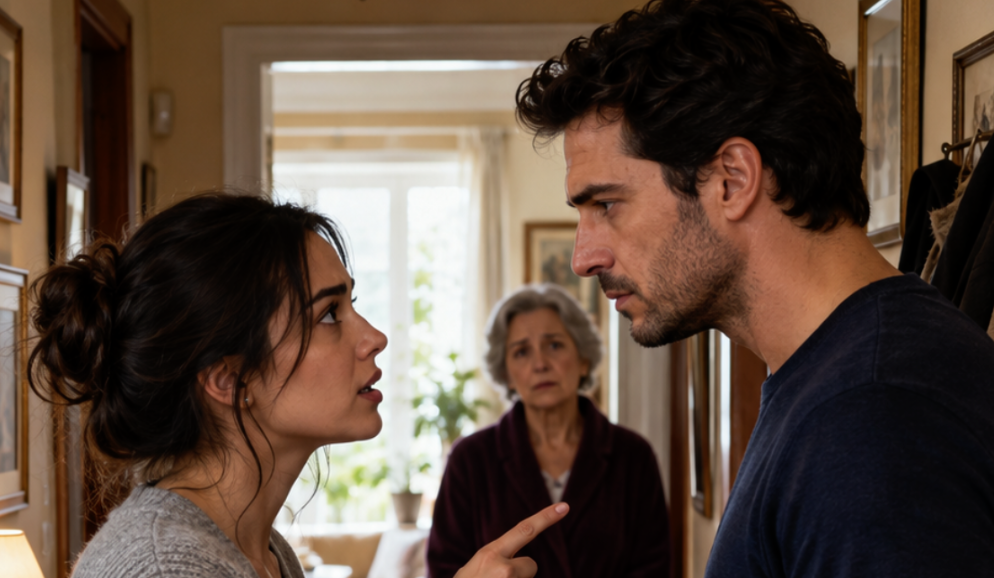
— This is my apartment, and I want your mother to leave it immediately! Otherwise, you’ll be the one looking for a new home!
“Alinochka, you should pour the salt into a different salt shaker. This plastic one absorbs moisture, so the salt gets all clumpy. I had one just like it at home and threw it away immediately,” Lydia Semyonovna’s voice, soft and enveloping like warm jelly, filled the entire kitchen.
Alina slowly turned her head. She was standing at the stove, stirring vegetables in a frying pan, and for a moment she froze, looking at her mother-in-law. The woman was sitting at the table that, only a week ago, had belonged entirely to Alina, examining the kitchen utensils with the air of an expert.
It was already the seventh morning of their living together. Or, as Lydia Semyonovna called it, her “guest visit.”
“I’m comfortable with this one, Lydia Semyonovna,” Alina replied evenly, returning to what she was doing. The smile she forced onto her face came out tight and unnatural.
“Well, suit yourself, little homemaker,” her mother-in-law sighed, and there was so much universal sorrow in that sigh over improperly stored salt that one could have written a tragedy about it. “I only want what’s best. My Romochka has been taught to keep things tidy since childhood. He likes everything to be in its proper place, everything done sensibly.”
Alina tightened her grip on the frying pan handle.
Romochka.
Her husband, a thirty-two-year-old man and department head at a large company, had turned back into “Romochka” over the past seven days.
He fixed his mother’s laptop because it was “acting up,” ran to the pharmacy for drops because her “blood pressure was jumping,” and spent half an hour explaining how to use a new weather forecast app.
He did all of it with the cheerful obedience of a devoted son, completely failing to notice how the air was slowly disappearing from the life he shared with Alina.
Their apartment, which Alina had purchased before their marriage, had suddenly stopped being their fortress.
It had become an extension of Lydia Semyonovna’s home.
The spices on the shelf had been rearranged into a “more logical order.” The towels in the bathroom were now folded in thirds instead of halves because it looked “neater.” The television remote no longer lay on the coffee table but on the armrest because “it was easier to see there.”
Every morning began with an inspection and unsolicited advice. Every evening ended with a detailed report about how Romochka’s day had gone and complaints about Lydia Semyonovna’s health that demanded her son’s immediate attention.
“Mom, what are you starting again?” Roman said as he entered the kitchen, kissing his mother on the top of her head before putting an arm around Alina’s shoulders. “Alina is a wonderful homemaker all by herself. Right, sweetheart?”
He winked at her, trying to ease the tension, but Alina only felt irritated.
He didn’t see it.
Or pretended not to.
He treated everything as harmless family eccentricities, failing to understand that this was a systematic, methodical invasion of her territory and her life.
He didn’t notice how his mother, like an experienced military commander, was conquering centimeter after centimeter, gradually turning Alina into a guest in her own home.
“Romochka, sweetheart, are you there?” came a voice from the room an hour later, when they had finally tried to watch a movie together on the sofa. “Come here for a minute. I can’t figure out how to turn the volume down on this tablet.”
Roman sighed heavily, but immediately got up.
“Coming, Mom. One second.”
That “one second” stretched into twenty minutes.
Alina sat in front of the dark television screen, listening to their muffled voices.
She no longer felt angry.
Instead, a cold, calm sense of detachment was growing inside her.
She looked at her hands resting on her knees and realized that she could no longer remain in this one-person theater where her husband had been assigned the role of obedient stage property and she had been given the role of silent spectator.
At that moment, something clicked inside her head.
Not loudly, but quietly, almost soundlessly, like a key turning in a well-oiled lock and setting into motion the cold, clean mechanism of a decision as sharp as a shard of ice.
The heavy grocery bags pulled painfully at their hands, their thin plastic handles cutting into their palms.
They walked almost the entire way home from the store in silence.
Gray sky. Gray pavement. And the same gray, faded atmosphere between them.
Alina stared straight ahead at the backs of occasional pedestrians and the passing cars, but all she could see was the interior of her apartment occupied by someone else’s will.
Roman, however, seemed to notice nothing.
He was lost in his thoughts, which, as it turned out, revolved once again around the same center of gravity.
“Mom asked me to take a look at why the iron isn’t heating properly,” he broke the silence when there were less than a hundred meters left to their building. “She says it’s switched on, but it doesn’t smooth the fabric. And I need to sort out the printer too. She wanted to print some recipes, but it chewed up the paper. I’ll have to look at it tonight. Maybe it’s the cartridge…”
Alina stopped.
She simply stood in the middle of the sidewalk and let the grocery bags fall from her hands.
They hit the pavement with a dull thud.
Several oranges rolled lazily out of a torn net bag toward the curb.
Roman walked another couple of steps before turning around.
“What’s wrong? Are you tired? Give them to me.”
She wasn’t looking at the bags.
She was looking at him.
There was no emotion in her gaze.
No anger.
No hurt.
No accusation.
Only cold, crystal-clear detachment, and it suddenly made him uncomfortable.
She looked at him as though he were a complete stranger she was seeing from the outside for the first time.
“This is my apartment, and I want your mother to leave it immediately! Otherwise, you’ll be the one looking for a new home! Because I’m tired of living in a place where people come and go as they please!”
Her voice was even and calm, completely free of hysteria, which made her words sound even heavier, like hammer blows against an anvil.
Roman blinked.
Once.
Then again.
He was certain he had misheard her, that this was some kind of cruel, unsuccessful joke.
“Alina, what are you even talking about? What happened? We were just walking normally.”
“We weren’t walking normally, Roma. You were,” she corrected him, and something resembling a bitter smile flickered at the corners of her lips. “You were walking along planning how you were going to keep serving your mother. And I was walking along realizing that I can’t stay in the same room with both of you anymore.”
Understanding slowly began to dawn on him, with difficulty, like someone suddenly pulled out of a warm sleep and plunged into icy water.
“Listen, she’s my mother. She’s visiting us. Just put up with it a little longer. She’ll leave soon. You can’t just…”
“I’m not going to put up with anything in my own home anymore,” Alina cut him off, emphasizing the last two words. “I put up with it for a week. I watched her rearrange my things, comment on my cooking, and turn you into an errand boy. I waited for you to notice something yourself. You didn’t. So now you’re going to notice this.”
She bent down and picked up one of the bags.
Her movements were precise and controlled.
There was no fuss.
“You have a choice. Either by the time we get home, you explain to your mother that her visit is over and put her on the next train, or the two of you go to the station together, except you’ll be taking your belongings with you. Choose, Roman. Right now.”
He stared at her calm, unreadable face and, for the first time in their entire life together, understood that his usual persuasion, softness, and attempts to smooth everything over would not work.
The woman standing in front of him was no longer his accommodating, understanding Alina.
She was the owner of the home, and she had just presented him with the bill.
There was only one way to pay it.
The elevator ride passed in thick, viscous silence.
It was so dense that it seemed to press against their eardrums more strongly than the change in altitude.
Roman did not look at Alina.
He stared at the glowing floor numbers as though they contained the coded answer to an impossible problem.
Alina, on the other hand, did not take her eyes off him.
She studied his profile, the tense line of his jaw, the Adam’s apple twitching in his throat.
She did not try to guess what he was thinking.
She already knew everything.
She was simply recording the moment in her memory, memorizing this man who, only half an hour earlier, had still been her husband and had now become the defendant in her own private trial.
The click of the door lock sounded deafening.
The first thing that hit them was the smell of roasted chicken and vanilla.
Lydia Semyonovna was clearly baking something for tea.
She was sitting in their favorite armchair in the living room, enthusiastically folding Roman’s freshly ironed shirts into a neat pile.
When she saw them, her face lit up.
“There are my dears! I’ve been tidying things up here. I ironed Romochka’s shirts because he didn’t have a single fresh one left for tomorrow. And there’s a pie rising in the oven. Apple—your favorite.”
Alina silently walked into the kitchen.
Without a single unnecessary movement, she began methodically unpacking the groceries.
A can of peas into the cupboard.
Milk into the refrigerator.
Bread into the breadbox.
Every movement