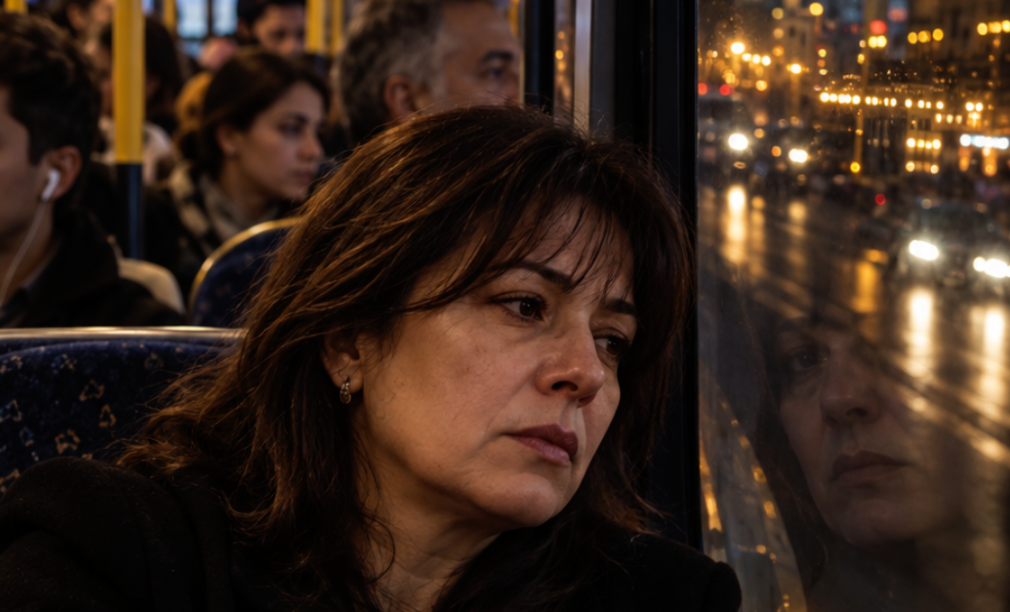
A Mother Learned the Truth About Her Daughter and Took a Night Bus to the City. Her Daughter Never Tells Anyone What Happened Next
Lida found out by accident.
Her daughter’s friend Natasha came to the village for the weekend to visit her parents. She stopped by Lida’s house as a neighbor, just to have some tea. They sat in the kitchen, chatting about this and that. Then, just as Natasha was about to leave, she hesitated in the doorway.
“Aunt Lida,” she said, looking at the floor. “You should go see Alina. In the city. Right now.”
“What happened?” Lida turned pale. “Is she sick?”
“No. She isn’t sick.” Natasha bit her lip. “Just… go. Please.”
And she left, almost running out of the house.
Lida did not sleep all night. In the morning, she took two days off from her job at the post office, packed a bag, and got on a bus.
Alina had left for the capital three years earlier, immediately after graduating from school. She had enrolled in university to study economics. Lida was proud of her: her daughter was the first person in their family to receive a higher education.
Lida herself had spent most of her life working as a cleaner at the village administration, and before that, as a milkmaid. Her husband, Igor, had died many years ago, when Alina was six. Lida had raised her daughter alone.
Alina used to call once a week. She would talk about her studies, the dormitory, her friends. Her voice was cheerful and energetic.
Only during the last year, something had changed.
She called less often and kept the conversations shorter. Whenever Lida asked questions, Alina answered evasively.
“Everything’s fine, Mom. I’m studying. I have a part-time job.”
“Where are you working?” Lida would ask.
“Oh… just at a café. As a waitress.”
But something about her voice did not sound right.
Lida could feel it, but she pushed the anxiety away. Her daughter was young and beautiful. What was there to worry about? She would manage somehow.
Now Lida sat on the bus, watching fields drift past the window, while her heart tightened with a terrible sense of foreboding.
What could Natasha possibly have discovered that Alina’s own mother did not know?
Lida reached the capital by evening.
She had not been there for five years, since the time she had brought Alina to preparatory courses.
The city overwhelmed her with its noise, lights, and crowds.
Lida stood at the bus station, confused, holding a bag in one hand and a piece of paper with an address written on it in the other.
It was not the address of Alina’s dormitory.
Natasha had written down another one.
Lida took a taxi for the first time in her life. The driver, a young man, talked about something the entire way, but Lida did not listen.
She stared out the window.
They arrived.
A tall apartment building stood in a new neighborhood, surrounded by glass, concrete, and a guarded entrance.
Lida got out and stood there for a moment, looking upward.
It could not be.
Alina had told her that she still lived in a dormitory, sharing a room with three other girls, under modest conditions.
Lida dialed her daughter’s number.
“Hello, Mom?” Alina sounded surprised. “Did something happen?”
“I’m here,” Lida said. “In the city. Outside your building.”
There was a pause.
A long one.
So long that Lida thought the connection had been lost.
“What building?” Alina asked quietly.
“This one.”
Lida gave her the address.
Silence filled the phone.
Not simply a pause, but a dead, ringing silence.
Lida could hear her daughter’s breathing become uneven.
“I’m coming downstairs,” Alina said. “Stay there.”
She came out of the building about ten minutes later.
Lida barely recognized her daughter.
It was not that Alina had changed dramatically. She still had the same figure, the same light brown hair, the same eyes.
But something about her was different.
Her clothes were expensive, nothing like what an ordinary student would wear.
Her coat was the kind Lida had never even seen in the stores back home. A leather handbag with a shiny clasp hung from her shoulder.
Her face was carefully made up and well cared for, but dark shadows lay beneath her eyes.
And her expression was frightened.
“Mom…” Alina stopped a few steps away. “Why did you come?”
“What do you think?”
They stood facing each other, two women.
One was tired, wearing an old winter jacket, with hardworking hands and gray beginning to show at her temples.
The other was young, beautiful, expensively dressed, but with eyes filled with fear.
“Come on,” Alina said. “Just not here.”
They went into a café across the street.
It was expensive, with live music and waiters in white shirts.
Lida felt uncomfortable. She sat stiffly in her chair, unsure what to do with her hands.
Alina ordered coffee confidently and naturally, like someone accustomed to places like this.
“Mom,” she said after the waiter walked away. “What do you know?”
“Nothing,” Lida replied. “Natasha said, ‘Go see Alina.’ She said something had happened. So I came.”
Alina covered her face with her hands.
She sat like that for a long time.
Then she lowered her hands, and Lida saw that her daughter was crying.
Silently.
Tears ran down her cheeks, smearing her mascara.
“Mom,” she whispered. “Mommy…”
Then she fell silent.
Because saying the truth meant destroying everything.
And not saying it was no longer possible.
They stayed in the café for an hour.
Maybe longer.
Alina spoke in fragments, stumbling over her words, as though she were both trying to explain herself and confess at the same time.
Lida listened without interrupting.
Her face looked like stone.
The story was simple and terrifying.
During Alina’s second year at university, she ran out of money.
Her scholarship was tiny. Her mother sent her as much as she could, but it was not enough even for food.
A girl from the dormitory introduced her to some “good people.”
At first, Alina only accompanied men to dinners.
Then it became more.
Alina said she had wanted to stop, but she needed the money and could not find another job.
Eventually, she became accustomed to it.
Or rather, she never truly became accustomed to it.
She simply accepted it.
There was money.
Clothes.
An apartment.
Restaurants.
And a constant, unending feeling of shame.
“I didn’t know how to tell you,” Alina whispered. “I was afraid. You wouldn’t have survived it.”
Lida remained silent.
She sat staring at her daughter: at the expensive coat, the carefully manicured hands, the tear-streaked face.
And she remembered Alina at six years old, coming home from school with a failing grade in math and crying because she was afraid her mother would be disappointed.
She remembered how they had hung wallpaper together in their new apartment.
She remembered Alina standing on the school steps in her graduation dress, thin and happy, holding a bouquet of peonies.
Where had all of that gone?
“Come on,” Lida finally said. “Let’s go to your place.”
Alina looked up in alarm.
“Mom, it’s… messy.”
“I don’t care. Let’s go.”
The apartment was not simply clean.
It was luxurious.
Two rooms. Expensive furniture. A television covering almost an entire wall.
There was a coffee machine and dishwasher in the kitchen.
A Jacuzzi stood in the bathroom.
Lida walked around the apartment, touching things and shaking her head.
It felt like a museum.
Except this was not a museum.
It was a cage.
A beautiful and expensive cage, but still a cage.
“So this is how you live,” Lida said. “And I thought you were some poor, hungry student. I kept sending you pickles and homemade jam whenever someone was traveling to the city. And you were here…”
“Mom, please don’t,” Alina begged.
“Don’t what?” Lida spun around sharply. “What exactly shouldn’t I do, sweetheart? Shouldn’t I tell the truth? Shouldn’t I see how you’re living? Shouldn’t I know where the money for all this came from?”
Alina sank onto the sofa and began to cry.
Not silently this time.
She sobbed loudly and helplessly, like a child.
“I’ll quit,” she said through her tears. “I’ll leave everything. I’ve wanted to quit for so long, Mom. I can’t do it anymore. I’m scared. I’m ashamed. Every morning, I hate looking at myself in the mirror…”
Lida stood in the middle of the room.
Her arms hung by her sides.
Her face had turned gray.
And then suddenly, she walked toward her daughter, sat beside her, and wrapped her arms around her tightly.
Just like when Alina had been a little girl who scraped her knee and ran to her mother for comfort.
“Shh,” Lida said. “Shh, my girl. That’s enough. It’s over.”
They sat like that for a very long time.
Outside, darkness fell.
The room was silent except for the ticking of the clock on the wall and Alina’s quiet sobbing.
“Here’s what we’re going to do,” Lida said. “Pack your things.”
“What things?” Alina lifted her tear-streaked face.
“Only what you need. Leave the rest. Whose apartment is this?”
“It’s rented. It’s paid for a month in advance.”
“Good. Leave the keys for the landlord. You’re going home.”
“Mom…”
“I said home.” Lida spoke calmly, but there was steel in her voice. “To the village. With me. You’ll rest and recover. Then we’ll decide what comes next.”
Alina said nothing.
“Do you hear me?” Lida asked.
“I hear you.” Alina’s voice was quiet and broken. “But university… I still have another year.”
“You can transfer to distance learning. Or take academic leave. That can all be solved.” Lida stroked her daughter’s hair. “Everything can be solved except one thing. What you’re doing to yourself.”
Alina began crying again.
But this time the tears felt different.
Lighter.
As though they were washing something dark, sticky, and shameful out of her.
They packed until midnight.
Alina filled one suitcase with only the essentials: clothes, documents, her laptop, and several books.
She did not even look at the expensive electronics, the wardrobe full of dresses, or any of the beautiful, alien wealth around her.
It was as if everything in the apartment were nothing more than props from someone else’s movie in which she had accidentally appeared.
Later, they sat in the kitchen drinking tea.
Lida brewed the tea she had brought from the village, with mint and blackcurrant leaves that she always carried with her in a little packet.
Alina drank it and smiled through her tears.
“Mom, this is that tea… from our garden.”
“From our garden,” Lida nodded. “The mint grows beside the porch, and the currants near the fence. You planted them when you were little. Remember?”
“I remember.”
They fell silent.
And that silence contained more words than all the conversations they had had during the previous three years.
In the morning, they left.
Alina gave the keys to the concierge.
She did not call anyone.
She said goodbye to no one.
She simply cut everything off like a thread and left with her mother on the bus.
She wore the same old winter jacket she had once worn when leaving home to enroll at university.
The expensive coat remained hanging in the closet.
On the bus, they sat together.
Alina rested her head on her mother’s shoulder and fell asleep.
For the first time in many months, she slept peacefully and deeply, without dreams.
Lida stared through the window and thought about how much she had not known.
How much she had failed to notice.
How much they still had to repair.
But she knew one thing for certain.
As long as she was alive, her daughter would not be lost.
She would pull her out.
She would wash away the dirt.
She would warm her again.
No matter how shameful it was.
No matter how painful.
Because she was her mother.
And that said everything.
Back in the village, another life began.
The first few weeks were difficult.
Alina almost never left the house.
She slept until noon and then sat by the window, staring outside.
Lida did not bother her.
She did not question her.
She did not reproach her.
She was simply there.
She cooked, did the laundry, heated the bathhouse, and brought cucumbers and tomatoes in from the garden.
In the evenings, they drank tea with pies and sat together in silence.
Of course, the villagers gossiped.
Why had Alina returned?
Why had she come back in the middle of the academic year?
What had happened?
But Lida cut off every question with the same short answer.
“Her health suffered. The doctor prescribed fresh village air.”
And not another word.
After a month, Alina began going outside.
At first, she only went into the yard to feed the chickens.
Then she started going to the store, holding her mother’s hand.
Later, she visited their neighbor, Aunt Tamara, who knew nothing and asked nothing.
She was simply happy that the girl had come home.
By winter, Alina found a job at the village administration as an assistant accountant.
The salary was tiny.
But the money was not the point.
She needed something to occupy her hands and her mind.
And she needed something, however small, that she could do herself.
Earn money herself.
Live herself.
Manage things herself.
She transferred to the university’s distance-learning program.
She caught up on the classes she had fallen behind in, studying online late at night.
Sometimes Lida would look into her room.
The desk lamp would be glowing, and Alina would be bent over her textbooks, her lips moving quietly as she memorized the material.
And warmth would spread through her mother’s heart.
She was alive.
She would make it.
Six months passed.
One evening, while a February snowstorm raged outside, the two of them sat together in the kitchen.
Alina stirred her tea with a spoon and suddenly said:
“Mom, are you never going to ask?”
“Ask about what?”
“About that. About what happened.”
Lida was silent for a moment.
Then she said:
“Why should I? You’ll tell me yourself when you want to. Or you won’t tell me at all. That’s your right.”
“And if I never want to?”
“Then never.” Lida shrugged. “What happened before isn’t the most important thing. What matters is what’s happening now. And what comes next.”
Alina stared at her mother for a long time.
Then she stood up, walked over, and embraced her tightly and desperately, just as she had done that night in the city.
“Thank you,” she whispered. “Thank you, Mommy.”
“For what?”
“For coming. For not turning away from me. For…” She hesitated. “For loving me.”
“You silly girl,” Lida said. “How could I not love you? You’re my daughter. My own flesh and blood. Whatever you’ve done, whatever happens, you are my daughter. Forever.”
Outside, the snowstorm howled and struck against the windows.
But the kitchen was warm.
The light was on.
And two women sat holding each other and crying.
But these were good tears.
Cleansing tears.
Like a spring thunderstorm.
Alina never tells anyone what happened that evening when her mother came to the city.
Not because she is ashamed, although the shame, of course, remains.
And perhaps it always will.
She does not tell anyone because it belongs only to her.
What happened between her and her mother in that strange, luxurious apartment.
What was said.
What remained unsaid.
What they understood without words.
There are some things you do not share with anyone.
Not even with the people closest to you.
Not even with those who love you more than anyone else in the world.
Some things remain only between a mother and her daughter.
Forever.