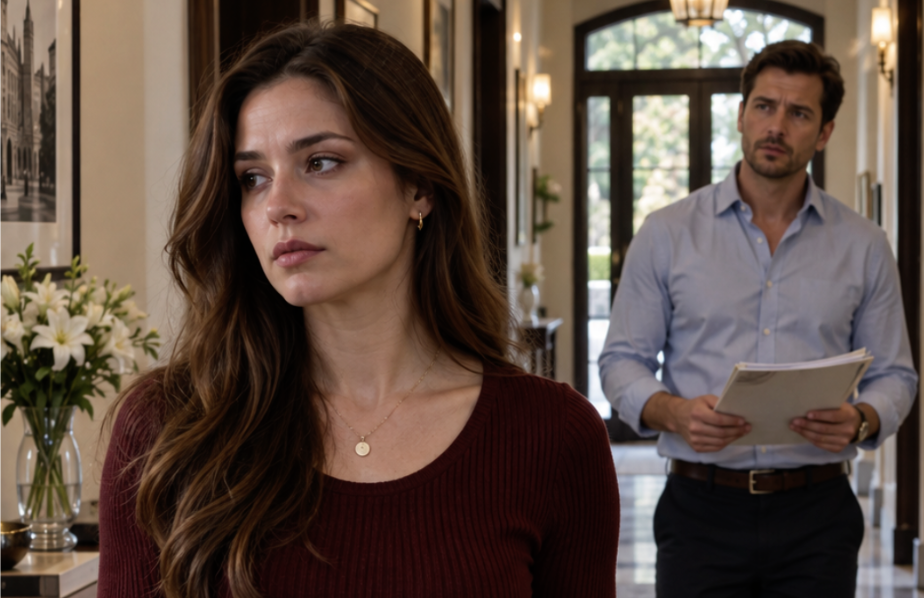
“This is my apartment, and I’m not giving it to your greedy family!” Olga slammed the door, leaving her husband standing there with the mortgage papers.
“Where is she?” Nina Stepanovna barged into the apartment as if she were storming Berlin in 1945. “I spent fifty minutes on a minibus! No air conditioning, and people have no conscience!”
“Mom, I told you it would’ve been better to take a taxi,” Viktor said with restraint, correcting his mother, whose lips were already twisting into an indignant grimace.
“So now I’m supposed to pay for taxis with her money too?” Nina Stepanovna pursed her lips and nodded toward the kitchen. “Where is she?”
Olga was standing by the window, brewing chamomile. Not tea—chamomile. Her stomach had started twisting after her husband called her a greedy egoist two days earlier. All because of the apartment. More precisely, because of the apartment her grandmother had left her. In the city center. A two-room apartment. Clean, furnished, renovated. The renovation was old, but her grandmother had been one of those people who believed, “It may not be fashionable, but it’s clean and it isn’t falling apart.”
Olga had adored her grandmother. And the apartment. Especially now.
“Hello, Nina Stepanovna,” Olga said, turning around with the cup held in both hands. “Come in. You like sitting in the armchair, after all.”
“That isn’t an armchair, it’s a wreck!” her mother-in-law snapped immediately, dropping herself into the old but sturdy chair. “I would’ve thrown it out back in 1990. Where are the proper sofas? Where’s a TV with a normal-sized screen instead of one the size of a passport?”
Olga took a sip and said nothing.
“Listen,” Viktor stepped closer and positioned himself between his mother and his wife as though preparing for a duel. “Why are you being so stubborn? We’re a family. Now you have an apartment. We could sell it and buy a three-bedroom place so there’s enough room for everyone. Or at least pay off our mortgage. We’re in this together!”
“Sure, together,” Olga smirked. “Except when Grandma was ill, both of you suddenly decided you needed to go ‘to a health resort.’ And now we’re ‘together.’”
“Don’t start,” Viktor said, his voice dropping into a threatening tone. “This isn’t humane. I took out that mortgage because of you, by the way. Don’t forget—I have debts. And Mom…”
“Exactly!” Nina Stepanovna cut in. “I’ve had surgery, by the way! My knees hurt! I’ll break my legs in that Khrushchev-era apartment of yours!”
“You never even lived there, Nina Stepanovna,” Olga snapped. “And anyway, Grandma left the apartment to me. Period. To me. Not to us. Not to Viktor. Not to you. To me.”
“Do you seriously think you’re going to keep everything for yourself?” Viktor no longer tried to hide his irritation. “You just want to profit from this. From your grandmother. From us.”
“And you don’t?” Olga placed her cup on the windowsill and, for the first time, looked at her husband not as the man she had once loved but as an opponent in a courtroom.
So that’s how they see me. Like a sack of money.
“I just need clarity,” Viktor’s voice softened, but there was more poison in that softness than in his mother’s remarks. “What do you want? To keep the apartment and live there alone? What about our son? What about me? What about us?”
“Our son is grown up. He joined the army. He told me himself that he’s perfectly fine in the barracks. And you, Vit? What were you expecting? That I’d hand you the keys and walk out?”
“But we’re husband and wife!” he shouted. “It’s marital property!”
“Not when it’s inherited property,” Olga said calmly. “Article 36 of the Russian Family Code. Inherited property isn’t divided. Not even in a divorce. Even if you’ve suddenly forgotten how to read.”
“How dare you!” Nina Stepanovna jumped to her feet. “My son got you out of that factory! He took you to doctors when, God forgive me, you were completely broken after the miscarriage! He treated you like you were made of glass! And now you’re throwing him out?”
“He should’ve carried me in his arms too, but his legs were too short. He didn’t make it,” Olga shot back.
“That’s it. To hell with you,” Viktor waved his hand. “Do whatever you want. I’ll show you later who ends up getting nothing.”
He slammed the door so hard that Olga’s fingers trembled.
Nina Stepanovna stood there like a monument. She remained silent for a second, then leaned closer and hissed:
“You think this is just going to end here? Viktor put up with you. I put up with you. Now just wait.”
“Wait for what? A court summons?” Olga smirked. “I told you, greed runs in your family. No need for a DNA test. You can see it in your eyes.”
Her mother-in-law headed toward the exit without saying goodbye. But at the door, she turned around anyway.
“I feel sorry for your grandmother. She was a good woman. Just a fool. She left everything to you. She should’ve left it to normal people.”
“Of course. Otherwise someone might pawn everything, sell Grandma’s porcelain online, and rent the rest out on credit,” Olga replied sarcastically before shutting the door.
Two days later, she received a notification.
Viktor had filed for division of marital property, trying to drag the apartment into the case by arguing that it was tied to the family’s shared financial situation.
Olga wasn’t surprised.
On the third day, his lawyer called.
On the fourth, Nina Stepanovna’s lawyer called.
Are you people auditioning for some game show or what? Spin the wheel and wait for the apartment to drop into your lap?
Olga was pouring herself tea when the intercom suddenly rang.
“Who is it?” she asked into the receiver.
“It’s Lyuda, your neighbor from the landing. Your mother-in-law is sitting outside your door with her things. She says she’s going to live with you. You don’t mind, do you?”
Olga put down the receiver.
Then she sat on the floor.
And for the first time in a week, she laughed loudly and silently at the same time, until her face hurt.
Nina Stepanovna barged into the apartment carrying two bags and one curse. Neighbor Lyuda stood in her doorway watching with pursed lips.
“Thanks, Lyudochka,” Olga said through clenched teeth and slammed the door. “And what exactly are you doing here?”
“It’s temporary. Until you and Vitya sort things out,” her mother-in-law replied matter-of-factly as she kicked off her sneakers. “You don’t mind, do you?”
“Of course not. Come in. There’s still a free corner beside the trash can. I can make you a bed there.”
“Don’t be sarcastic, Olya,” the woman said as she headed into the room. “I’m not a stranger, you know. I’m your husband’s mother. Or is he already your ex-husband?”
“You haven’t heard? He threatened to sue me and take everything away. Somehow I didn’t feel much family warmth after that.”
“You’re provoking everyone!” Nina Stepanovna placed a jar of pickles on the table as if it were some new kind of currency. “You started all of this yourself. You turned everyone against each other.”
Olga exhaled heavily.
“I simply inherited an apartment. Grandma decided to leave it to me. Me. Not ‘the family.’ Not Vitya. Not you. Me. What exactly is wrong with that?”
“Everything is wrong!” her mother-in-law threw her bag onto the sofa. “You young people have nothing but selfishness in your heads! My husband, may he rest in peace, and I had one wardrobe between us! One blanket! And nothing happened! We lived! And now you want to live alone like some princess?”
“I just want to live peacefully. Without scandals. Without pressure. Without blackmail.”
“And what am I doing? Am I bothering you?” her mother-in-law challenged her. “I was always on your side! Always! Even when you cried at night and Vitya was drinking. Who supported you? I did!”
“You told me to have a baby and ‘everything would work itself out.’ I was twenty-two. Vitya was already going on drinking binges.”
“That happens to everyone!” Nina threw up her hands. “A man is a man! You just don’t know how to live properly!”
“You mean endure everything? Keep quiet? Share Grandma’s apartment until you’ve carried all the furniture away?”
“Oh, don’t be ridiculous!” her mother-in-law said, already opening the pickles. “I won’t be here long. I’ll just stay here while you and Vitya sort things out. You’re alone anyway. And my legs hurt. Where else am I supposed to go?”
Olga fell silent.
Her face turned to stone.
“You want me to evict you, don’t you? So later you can go to court and tell everyone your daughter-in-law threw her elderly mother-in-law out?”
Nina flinched but quickly regained her composure.
“Who said anything like that? I just… I just want to stay for a little while. Until everything is settled…”
“Until it’s settled who’s in charge?”
“Until it’s settled who gets to stay in this apartment!” her mother-in-law blurted out.
Then she froze, realizing what she had said.
Silence hung between them like mold on a ceiling—disgusting, sticky, impossible to scrape away.
“Well,” Olga whispered, looking out the window. “So you did decide. You’re fighting for the apartment.”
“Not for the apartment!” Nina shouted. “For Vitya! For my son! For the family!”
“For the family that never existed? Where were you when he screamed at me while drunk? When he smashed glasses against the walls? When our child hid in the bathroom because Daddy was ‘playing tanks’ until four in the morning?”
Nina lowered her eyes.
A second later, she looked straight at Olga again.
“I thought you’d work it out. Nobody reported anything to me. And you—you kept quiet!”
“I kept quiet because I was ashamed. Because I believed things would get better. And now you come here and… and what?”
“And I’m trying to save something!”
“What? Grandma’s apartment?”
“No! The family!”
“A family isn’t you holding a lawsuit in one hand and a jar of pickles in the other!”
“You’re ungrateful!” Nina screamed. “We did everything for you! Everything!”
“Sure. Everything. Even my apartment.”
They stood a meter apart.
Two women.
Two fronts.
Two generations.
One battle.
And silence.
Sharp, metallic silence.
Then Nina quietly walked into the room, taking the jar with her.
Olga slowly sat down on a stool.
So this is how it happens, she thought.
A war can start while everyone is wearing slippers.
Three days later, her mother-in-law “just hung a few things” in the wardrobe.
A week later, she began “taking care of the house,” wiping floors and loudly complaining that there was no bath mat in the bathroom.
Ten days later, she brought over a friend “to show her how my daughter-in-law lives—the one with a heart made of ice.”
Viktor kept sending messages:
“You’re destroying everything yourself.”
“We could have settled this peacefully.”
“You’re acting like a stranger.”
Then one evening, when Olga came home from work, the apartment smelled of meat patties.
Nina was standing in the kitchen wearing an apron. Napkins, bread, tea—everything had been arranged as if they were expecting the governor.
“Are you going to eat?” she asked without turning around.
“Are you cooking with my money, or are you finally supporting yourself?”
“I bought the minced meat with my own money,” Nina said with restraint. “I wasn’t the one desperate to come here. Vitya told me, ‘Mom, she won’t give in. We need to occupy the territory.’ So here I am. Consider me the landing party.”
“Right. A landing party in a cooking apron. With blackmail for dessert.”
“I just want you to understand that we aren’t enemies. We’re family.”
“Too late,” Olga said. “Far too late.”
That night she couldn’t sleep.
She lay staring at the ceiling.
What if she doesn’t leave? What if there’s a trial? Vitya isn’t going to stop this. He’s only pushing her forward.
Olga got up earlier than usual the next morning.
And filed a police report.
For moving into private property without the owner’s consent.
The law isn’t always kind, but in situations like this, it can be very useful.
Two days later, the apartment door was opened by the local police officer.
“Good morning. A complaint has been filed. I’m going to ask you to gather your belongings. Legally, you have no right to live in this apartment without the owner’s consent.”
“Well, would you look at that,” Nina whispered, pale as the wall. “Are you serious?”
“Surprising, isn’t it?” Olga nodded. “I used to think family values were something real too. Turns out they’re just an excuse for an occupation.”
Nina silently walked into the room.
“You’ll regret this!” she hissed at the doorway. “You have no idea what Viktor is capable of.”
“He doesn’t know what I’m capable of now either,” Olga replied calmly.
When the door slammed shut, Olga sat down on the floor and wrapped her arms around her knees.
No triumph.
No relief.
Only exhaustion.
Family. Love. Loyalty.
All of it sounds wonderful until someone else’s meat patties start smelling in your apartment.
The court hearing was scheduled for 9:30 in the morning.
Olga arrived at nine, with dark circles beneath her eyes but her back straight.
Vitya arrived at 9:35 wearing wrinkled trousers and an expression full of reproach, as though she were the one who had been late for all eight years of their marriage.
“Well, hello,” he muttered without looking at her.
“You won’t be surprised if I don’t answer,” she replied dryly, checking her papers.
“It’s impossible to deal with you like a normal person…” he began, but before he could finish, the courtroom door swung open and they were called inside.
The room was as gray as December in Tula.
The judge had the face of a retired Soviet youth-group leader, while the clerk clicked her fingers over the keyboard as if tapping on bones.
Everything was exactly as it should be.
Olga placed her divorce petition on the table, along with a copy of the ownership certificate for the apartment and a list of what remained after Vitya’s “peaceful” attempt to settle things as a family.
The list was brief:
“Toothbrush. Fear. Silence.”
“Plaintiff, do you confirm that you wish to dissolve the marriage?” the judge asked, looking over her glasses.
“I confirm,” Olga nodded calmly. “On every point. I don’t just want to end the marriage. I want to end the farce. The illusion. The trap disguised as love.”
“Do you support the claim?” the judge asked Viktor.
He shifted in his chair.
“Well, I don’t know… Maybe there’s still something we can save…”
“Viktor,” Olga interrupted him. “Enough. You can only save someone who wants to live. You want to possess. And not me.”
“I just wanted us to do everything together!”
“Really?” she narrowed her eyes sarcastically. “What exactly did we do together? You drank, I cleaned. You slept, I worked. You lied, I covered for you. Wonderful cooperation. A masterpiece of partnership.”
The court clerk nearly choked while trying not to cough.
“Wait,” Vitya cut in. “What about the apartment? She got it while we were married. So theoretically, it’s jointly acquired property.”
Olga turned toward him slowly, like something out of a Tarantino movie—only without blood. So far.
“Listen carefully. Grandma left the apartment to me in her will. Legally, it belongs only to me. By the time I accepted the inheritance, I was already living separately from you. And you were already putting on drunken performances at the Fazenda bar. So don’t get your hopes up.”
The judge raised her eyebrows.
“All supporting documents have been submitted. The apartment is indeed not subject to division.”
“All right,” Vitya continued stubbornly. “But can I at least claim compensation for emotional damages?”
“Of course you can,” Olga smirked. “But first, pay back all the emotional debts you owe me. The amount keeps changing, though. Your conscience has a worse exchange rate than the dollar.”
“You really are a bitch,” Vitya muttered through clenched teeth.
“But an honest one. And one with documents,” Olga turned back toward the judge. “I’ve said everything.”
After the hearing, they stepped into the hallway.
Viktor followed her.
“Listen, yes, I was wrong. But you’re no angel either. We could… well… at least stay on normal terms somehow. Not as enemies.”
“Vitya, you’re confused. You’re the one who ended up without the apartment. I didn’t end up without a brain. We aren’t enemies. We’re strangers.”
“But I… I tried…”
“You tried to take the last things I had. First, my grandmother’s memory. Then my peace. Then my freedom. First with a smile, then through your mother, then through court. So don’t be offended that I didn’t want to participate in that circus.”
He stood there with his hands hanging at his sides.
“I did love you.”
“Maybe you did. Once. But then you wanted me to feed you, clean up after you, tolerate everything, and share Grandma’s sofa. And now I want to live. Simply live. Without you.”
Two weeks passed.
Olga sat in the kitchen.
The silence was so loud that it almost seemed possible to hear the old kettle contemplating the meaning of life.
She reached for her phone.
Not a single new message.
Not from Vitya.
Not from Nina.
Not from the universe.
Perfect.
She turned on some music.
The same music that had once played on her grandmother’s old tape recorder in the countryside, while they pitted cherries together and talked about life.
“You have to live, Olechka, as if you were at war. Only without bullets. With a warm blanket and all your documents in order.”
Grandma had known what she was doing.
She had arranged the apartment paperwork correctly.
And apparently, she had chosen a granddaughter with character.
The delivery man called.
He brought her order—a new reinforced security door.
“Are you afraid someone might come?” the young man smiled.
“I’m not afraid. I know they’ll come. Now they shouldn’t even bother trying.”
Late that evening, the doorbell rang.
Olga looked through the peephole.
Nina Stepanovna was standing on the landing.
Olga opened the door slightly.
Without the chain.
“Olga… I’m not here for what you think.”
“I’m not thinking anything. I’ve already done all the thinking I need. Speak.”
“I wanted to say… I’m sorry. I was wrong. My son isn’t exactly a gift. And I had no right to stick my nose where I wasn’t invited.”
Olga said nothing.
She simply watched her carefully.
“I just… I’m alone now.”
“So am I.”
“You’re strong.”
“No. I’m just tired of being weak.”
“Maybe we could have some tea?”
“I have a new door now. And new rules.”
But tea…
Tea was possible.
Once.
No pickles.
No blackmail.
Just tea.
Later, while they sat in the kitchen and a light June rain drizzled outside, Olga suddenly smiled.
“You know… I finally understand now that family isn’t about where you’re registered. It isn’t a surname. It isn’t a ring. And it isn’t even an apartment.”
“Then what is it?” Nina asked quietly.
“It’s a choice. Every day. To stand beside someone—or pull everything toward yourself. To love—or possess. To help—or control. I choose differently now.”
Nina lowered her eyes.
“Forgive me.”
Olga nodded.
“Drink your tea. And then, please, leave. I’m not throwing you out. I’m… letting you go.”
She closed the door behind her.
Turned the new lock.
Sat down on the sofa.
And for the first time in many years, she simply exhaled.
Quietly.
Peacefully.
Inside the apartment that was no longer a battlefield.
It was her home.