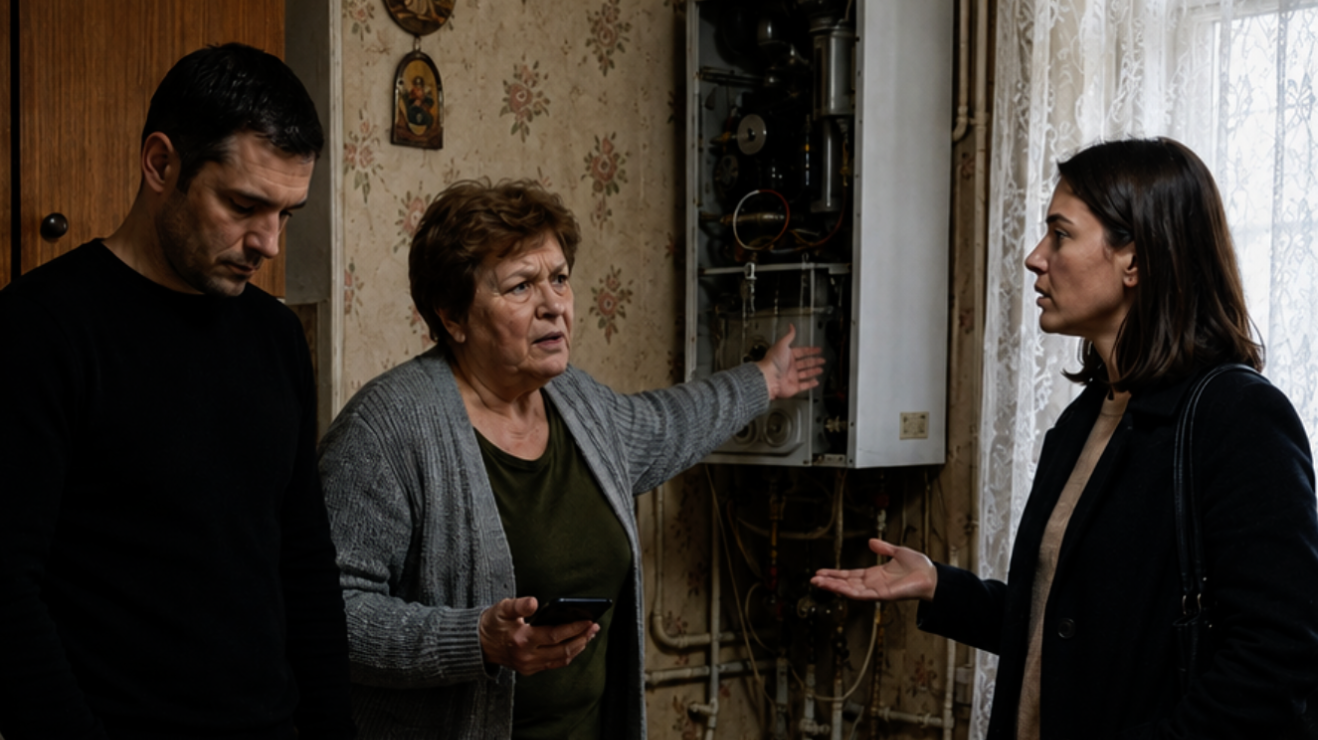
Mom Transferred the House to My Brother. A Week Later She Called: “The Boiler Broke. Will You Buy a New One?” I Didn’t Hold Back
I was standing in the kitchen, chopping onions, when my phone vibrated right beside me. The screen said “Mom.” I wiped my hand on a towel, picked up, and already knew she was going to ask for something.
“Irochka, we have a disaster,” she began without even saying hello. “The boiler is leaking. Oleg says it needs to be replaced, but we don’t have the money.”
Seven years ago, the two-story house where I had grown up became entirely my brother’s property. Mom had called me back then and said simply: she was transferring the house to Oleg because he had a family to support, while I already had an apartment of my own. I didn’t argue. A month later, I simply went to a notary, obtained a copy of the property record, and took it home, placing it in a folder with my documents. Ever since, that piece of paper had been lying there like evidence in a case that had never been opened.
I remembered every brick of that house. The veranda where Mom dried apples for winter. The fourth step from the top that creaked and that everyone stumbled over in the dark. The upstairs room Oleg and I had shared as children—he slept on a folding bed by the window, while I had my narrow bed against the wall, and both beds squeaked equally loudly at night.
With one phone call, all of that became someone else’s property, even though I had been born in that house and lived there for eighteen years, right up until I got married.
Over those seven years, I had already paid twice.
The first time was for the shed, which collapsed after a storm. Fifty-one thousand rubles. I transferred the money to Oleg’s card that very evening after Mom called me. Back then, I didn’t even ask why I was paying instead of the owner of the house. I simply opened my banking app and sent the money because Mom had asked, and I still hadn’t learned how to say no.
The second time was for the fence, which had been knocked down by heavy snow. Forty-five thousand rubles. Once again, the money went to Oleg’s card. Once again, Mom’s voice came through the phone:
“You can afford it. Your husband earns good money.”
I never asked why Oleg wasn’t finding the money himself. I simply paid and hung up.
Every time, I told myself the same thing: this would be the last time. They wouldn’t ask again.
And every time, I was wrong.
Two years passed between the shed and the fence, and another five between the fence and the boiler. Long enough for me to almost forget my habit of obediently opening my banking app whenever Mom called.
I still remembered that phone call seven years ago in every detail.
I had been washing dishes. My phone was lying on the table on speaker, and Mom began without any introduction, as if she were reading from a prepared script: they had decided to transfer the house to Oleg. She would feel more secure that way. His family was growing, while I already had my life arranged—a husband, an apartment. There was nothing for me to be offended about.
I asked only one question.
“Did it ever occur to you to ask me?”
Mom replied that the matter had already been decided and that there was no point creating drama over nothing.
I finished washing the plate I was holding and said nothing else.
A month later, I went to a notary and got a copy of the property record—not because I planned to challenge anything, but simply because I wanted to have something in writing.
And I had lived with that piece of paper for seven years.
I didn’t argue.
But I didn’t forget either.
“How much does the boiler cost?” I asked now, staring at the half-chopped onion on the cutting board.
“Oleg sent me the price. Hold on… forty-six thousand, including installation.”
I remained silent for about ten seconds.
Outside the window, a neighbor was starting his car. The sound of the engine reached me faintly through the double glazing.
When Mom didn’t get an answer, she tried another approach.
“You have to understand, winter is almost here. How are they supposed to live without heating? Besides, the house used to belong to all of us. You grew up there too.”
There it was again.
“The house used to belong to all of us.”
This was the third time in seven years she had said that phrase—every single time when money was needed, never when square meters were being discussed.
I immediately remembered what she had said on the day the house was transferred: the house belonged to Oleg; I had my own life.
Apparently, the house became “ours” only when there was a bill to pay.
“Mom, I’ll think about it,” I said, and for the first time I hung up before she did.
The onion had dried slightly on top while we were talking.
I finished chopping it in silence, put a frying pan on the stove, and let my hands work while my mind did the arithmetic.
Fifty-one thousand plus forty-five thousand.
Ninety-six thousand rubles over seven years.
And not once had anyone asked whether I even wanted to participate financially in the fate of that house.
Twenty minutes later, Oleg sent me a voice message, which was unusual in itself. He almost never contacted me directly. Everything normally went through Mom.
“Ira, hi. Mom said you’re thinking about it. This is genuinely an emergency. The kids are freezing. It’s already three degrees in the bedroom. You’re not going to refuse, right? This is how we’ve always done things.”
That phrase bothered me more than anything else.
“This is how we’ve always done things.”
The arrangement had been created by Mom, without my participation, seven years earlier, in a single phone call.
Now they were trying to present it as some kind of family tradition, as though I had personally suggested it.
I listened to the voice message three times, stopping mentally at the same phrase each time.
“This is how we’ve always done things.”
Who exactly was “we”?
The people who had made every decision without me?
Had anyone asked for my permission when this arrangement was created?
The house had been transferred without consulting me.
The decision that I would pay for repairs had also been made without me. They simply presented me with the bill.
And now the phrase “this is how we do things” made it sound as if I had once volunteered for this arrangement and signed up for it indefinitely.
I sent Oleg a short message: I’d reply later, I was busy.
Then I put my phone on the charger.
The screen showed four percent battery, and for a moment I thought that even my phone was handling this day about as well as I was.
I turned the stove down low and walked over to the window.
It was getting dark quickly, early as it does in autumn. The courtyard lights had already come on even though it was only a little after six.
Sergey came home later than usual. He hung up his jacket, looked at my face, and asked only one question.
“The house again?”
“The boiler,” I answered. “Forty-six thousand.”
He didn’t say whether I should or shouldn’t pay.
He simply nodded and went to wash his hands.
He had never interfered in my relationship with my relatives—not with advice, not with criticism—and that evening I appreciated it more than ever.
We ate dinner quietly.
Our son talked about an algebra test. He’d gotten a B even though he had studied the whole evening before.
I listened only half-heartedly.
In my head, I kept replaying the conversation with Mom word for word.
“The house used to belong to all of us.”
Three words that for seven years had served as a key to my wallet, but never as a key to the front door of that house.
I wasn’t even much of a guest there anymore.
Once a year I stopped by for Mom’s birthday, sat on the veranda for an hour, drank tea, and went home.
The house welcomed me like a neighbor rather than a daughter of the family.
But whenever there were bills to pay, they came to me as though I were somehow responsible for the entire place and simply happened to live elsewhere for technical reasons.
After dinner, I took out the folder containing my documents.
The property record was exactly where it had always been, between the car insurance papers and old receipts from car repairs.
I unfolded the sheet and reread the line containing the address and the owner’s name.
One owner.
Oleg Viktorovich.
Not a single word about me.
As if I had never existed in the history of that family home.
I put the document back.
And suddenly I understood that if I called Mom myself, the conversation would be different.
No more “I’ll think about it.”
There would be a specific answer.
Yes or no.
And there would be conditions.
I barely slept that night, going over all the possibilities.
I could simply pay.
Forty-six thousand rubles wouldn’t bankrupt Sergey and me, and it certainly wasn’t worth losing sleep over.
But then I caught myself thinking the same thing again.
It wasn’t about the amount anymore.
It was about the fact that every phone call began the same way—with a request instead of a conversation.
Mom never asked how I was doing.
She never asked how her grandson was doing at school or whether I was healthy.
It was always the same thing:
We need money.
You can afford it.
By morning, I had made my decision.
I wasn’t going to wait for the next call. I was going to call her myself and say what I had postponed saying for seven years.
But Mom beat me to it.
She called around lunchtime the next day.
This time, her voice sounded more demanding.
“So? Have you decided? The technician is available tomorrow. We need to make a decision now instead of dragging this out.”
“Mom, I have a question for you,” I said, and felt my back straighten almost automatically. “Remember the shed? Fifty-one thousand. The fence—forty-five thousand. That’s already ninety-six thousand rubles spent on a house where I don’t own a single square meter. And now you’re asking for another forty-six thousand.”
I didn’t shout.
I spoke almost casually, as though I were reading out an estimate at work, where I was more accustomed to dealing with numbers than emotions.
But behind that calm tone were seven years of silence.
And I think Mom understood that for the first time.
“What does any of that have to do with this? I don’t understand what you’re talking about,” she said, her voice rising half a tone.
“It has everything to do with it. The house is always ‘ours’ when you need money, and it’s Oleg’s alone when we’re talking about the paperwork.”
I kept my voice even, although everything inside me tightened as though I had crossed a line I would never be able to step back over.
There was silence.
I heard a spoon clink against a cup on the other end. Mom was apparently drinking something and had hit the cup in surprise.
“Are you saying I’m supposed to transfer the house again? At my age?” Her voice had become quieter but sharper.
“I’m saying one thing,” I replied slowly, separating each word. “Transfer the house to both of us, the way it should have been from the beginning, and I’ll pay for the boiler that same day. If you don’t, then deal with it without me. I’m not paying for someone else’s house anymore.”
Mom was silent for a long time.
During that silence, I could almost picture her sitting in her kitchen—the same kitchen where I had done my homework as a child at a table covered with a floral oilcloth—having no idea what to say because we had never had a conversation like this in all seven years.
“How can you speak to me like that? I’m your mother,” she finally said quietly, sounding genuinely shocked.
“The same way you spoke to me over the phone seven years ago when you decided everything in ten minutes.”
And suddenly I noticed that the hand holding the phone had stopped trembling.
For the first time during the entire conversation.
Mom didn’t give me a definite answer.
She simply said, “Fine, I’ll think about it,” in the tone people use to end a conversation forever, and hung up first.
That was unusual.
Normally, I was the one who did that.
Still, after seven years, this was the first conversation in which she hadn’t had the last word.
The kitchen suddenly became very quiet.
I put my phone face down on the table and stood there for about thirty seconds, staring through the window at the empty courtyard.
My shoulders, which had been raised almost to my ears throughout the conversation, relaxed on their own.
The kettle on the stove had gone cold. I had put it on before the call and completely forgotten about it.
That evening, Sergey and I sat on the balcony.
He brought two glasses of tea even though I hadn’t asked.
“So?” he asked.
“I told her if she transfers the house to both of us, I’ll pay. If she doesn’t, they can handle it themselves.”
I took a sip of tea. It was still hot enough to burn my lips.
“Harsh,” he said.
There was no judgment in his voice. He was simply stating a fact.
“Maybe,” I agreed. “But I’ve been silent for seven years.”
We sat there quietly, listening to someone in the courtyard calling a child home.
Our son finished his homework and joined us on the balcony. He sat down beside us without asking anything.
For a while, it almost felt cozy—just enough for me to forget for an hour that the conversation with Mom wasn’t really over yet.
Then my son asked why Grandma hadn’t invited us to the country house in such a long time.
And I immediately realized that even he, at thirteen years old, had noticed the strange distance long before that day’s phone call.
I gave him a vague answer—something about adults being busy—and changed the subject to algebra.
That night, I lay awake for a long time.
But not because I was anxious.
Instead, I felt strangely light, as if I had finally put down something heavy that I had been carrying for far too long.
For seven years, I had believed I was somehow obligated to keep paying without asking questions simply because I had failed to challenge the original decision about the house.
Now that obligation suddenly didn’t feel like an obligation anymore.
Sergey was already asleep beside me.
I listened to his breathing and tried to figure out whether I regretted what I had said.
I didn’t.
Even the numbers I had finally said out loud to Mom no longer felt like something I needed to apologize for.
Two weeks passed.
Mom never called back to agree to my condition.
In the end, she bought the boiler herself through a store, paying for it in twelve monthly installments.
I didn’t hear that from her.
I found out from Oleg, who sent me another voice message, this one short and dry:
“We sorted it out. Don’t worry.”
The house remained solely in his name, exactly as before.
Through Aunt Valya, an acquaintance who spoke to Mom more often than I did, I heard that Mom was telling everyone I had “sold my own mother out for a few square meters” and that I had “grown up greedy, even though that wasn’t how I had been raised.”
From that same Aunt Valya, I learned that the previous weekend they had celebrated my nephew’s birthday at the country house.
The whole family had gathered.
I wasn’t invited.
Oleg stopped contacting me entirely.
Not once in those two weeks.
It was as though the boiler price quote had been the last reason he would ever have to write to me.
I kept waiting for Mom to call herself—if only to discuss my condition, argue about it, or suggest some alternative.
But the phone remained silent for the second week in a row.
And I understood immediately:
Silence was an answer too.
Just one without words.
Once, I almost called her myself.
My finger hovered over her number for about three seconds.
Then I put the phone back in my pocket.
Because if I called, it would mean that once again I was the one taking the first step.
I had already stated my condition once.
I wasn’t going to repeat it twice.
And I sleep peacefully now.
For the first time in seven years, I no longer lie awake calculating how much more money I’ll transfer without asking questions.