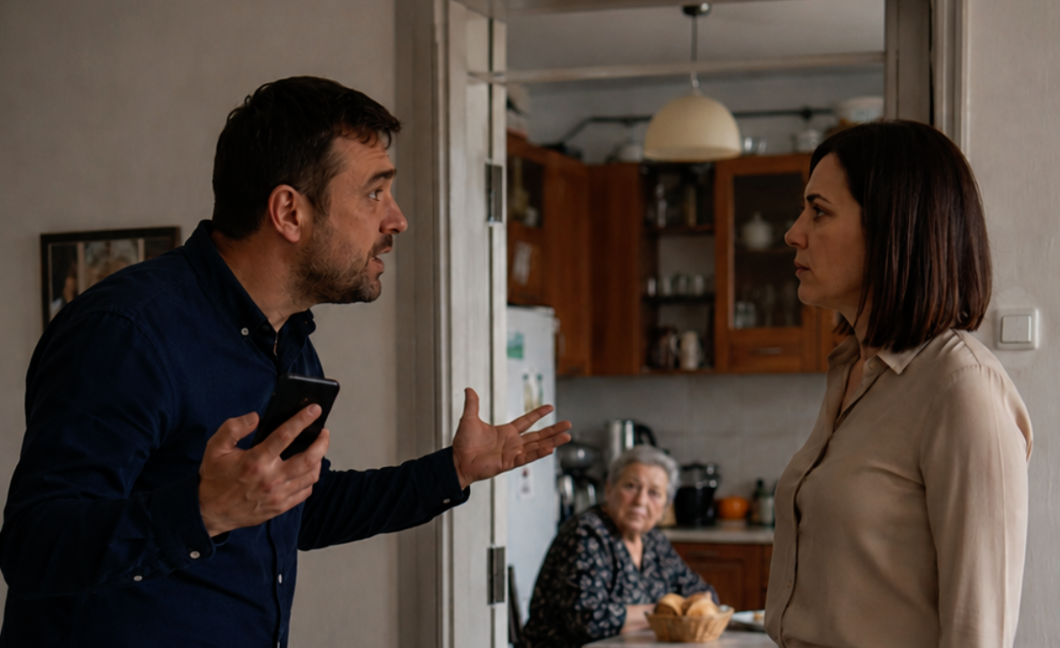
— Where the hell are you? My mother is sitting here hungry! — her husband shrieked into the phone. Sveta’s answer left him speechless.
The stove had gone cold as early as seven in the morning, but the smell of yesterday’s fried potatoes still lingered in the kitchen, soaked into the curtains, the oilcloth, even into Sveta herself. She stood at the sink scrubbing a scorched saucepan—the same chipped enamel one Nina Petrovna used to cook her oatmeal in and always left “to soak,” though somehow it was always Sveta who ended up doing the soaking and scrubbing.
The television droned on behind the wall. It was one of those talk shows where strangers divided up apartments and screamed at one another as if the property were the last thing they had left in the world. Nina Petrovna watched programs like that from morning until night, commenting, gasping, and during the commercial breaks calling out:
“Sveta, dear! Are you going to be much longer? I’d like some tea.”
“Coming, Nina Petrovna.”
Sveta put the kettle on. Her hands did everything automatically: take out the cup with the blue rim—her mother-in-law drank only from that one—add two spoonfuls of sugar, a slice of lemon if there was any. There hadn’t been any lemon for three days, and somehow that would be held against her too.
She carried the tea in. Nina Petrovna was sitting in an armchair wrapped in an Orenburg shawl, even though it was a warm May outside and the heating had long since been turned off. The remote lay on her lap. On the side table beside her were an opened pack of valerian tablets, her glasses, and a saucer covered in cookie crumbs.
“There’s still no lemon,” Sveta said as she set down the cup. “I’ll buy some tomorrow.”
“Oh, don’t trouble yourself,” her mother-in-law said, pursing her lips. “In my day, a daughter-in-law would never leave her husband without lemon for his tea. But you… Andryusha will come home from work hungry, and all you’ve got is yesterday’s potatoes.”
Sveta said nothing. Silence was what she had learned to do best—to remain quiet without letting anything inside her tremble. She had learned it over the two years Nina Petrovna had been living with them. At first it had been “just for a week, while they replace the pipes in my apartment.” Then the pipes were replaced, but the weeks kept coming and piling into months, and now it had already been two years since a woman who was, in truth, an outsider had begun running the home in which Sveta herself had grown up.
Because the apartment belonged to Sveta.
Somehow everyone in the apartment had simply forgotten that.
The two-room apartment in Uralmash had been left to Sveta by her grandmother Vera. Properly, legally, through a will, a year and a half before Sveta ever met Andrei. Her grandmother died in February. Sveta accepted the inheritance, registered everything in her own name, hung new curtains—the very curtains that now smelled of fried potatoes—and lived there quietly by herself, working as an accountant for a small company that sold heating boilers.
Sveta had known that apartment by heart since childhood. In that kitchen, her grandmother had taught her how to make pelmeni and told her stories about how she had received the apartment through the factory, how she had waited in line for eight years, how happy she had been when the housing order finally came through.
On the windowsill in the large room, her grandmother’s geranium still stood. Sveta watered it carefully, never letting it dry out, as if some invisible thread connecting her to the past still lived inside that flower.
Every crack in the ceiling, every creaking floorboard in the hallway was familiar and dear to her.
It wasn’t simply an apartment.
It was her ground. Her place in the world.
She met Andrei a year later. He came to repair her laptop after she found his ad. He stayed for tea, then for dinner, and then, eventually, he simply stayed.
There was barely even a wedding. They registered their marriage, sat in a café with his coworkers and two of her friends, and Andrei moved his things into her apartment.
There weren’t many things. A bag of clothes, a box of tools, and an old computer tower that ended up sitting unused in a corner.
The first year had been good.
Sveta still didn’t allow herself to think about it for too long. It made her ashamed of herself somehow—ashamed that she had been so happy and so blind.
Andrei used to laugh. On Saturdays he brought her éclairs from the bakery downstairs. He fixed anything that broke. He said the apartment was cozy, that her grandmother had furnished it nicely, that the two of them were happy there.
He never once said, “your apartment.”
It was always “ours,” “our place,” “home.”
And Sveta had liked that.
She had thought that was what family meant: when “mine” quietly became “ours.”
With her own hands, she had given away her “mine.” She registered her husband at the address, gave him half the wardrobe, half the kitchen, half the bed—and all of herself.
It had never occurred to her that one day someone would turn that word “ours” against her.
And then Nina Petrovna “had trouble with the pipes.”
It all began innocently enough.
Her mother-in-law arrived with one bag and an apologetic expression. The plumbing risers in her apartment were being replaced, there was no water, it was impossible to live there, she would stay only for a week, she wouldn’t get in anyone’s way.
For the first week, she really did keep quiet.
Then she began to “help.”
She rearranged the dishes in the kitchen because “this way is more convenient.” She threw away Grandmother Vera’s old grater because “it was rusty anyway.” She rehung the towels.
Little things.
Sveta said nothing. It felt awkward to complain. Nina Petrovna was an older woman. A guest.
Within a month, the guest had become the mistress of the house.
Nina Petrovna was already saying things like, “In our family we don’t do that,” “That’s not how we raised Andryusha,” and “In my house…”
My house.
Sveta caught that phrase once and nearly choked on her tea, but she stayed silent.
She stayed silent the next time too.
And the time after that.
Eventually, silence became a habit, slowly gathering layers of resentment like shells building up on a rock, until there was nowhere left to put any more of it.
Andrei changed slowly, almost imperceptibly.
At first, whenever tension arose between his wife and his mother, he tried gently to smooth things over.
Then he started keeping quiet.
Then he began taking his mother’s side. Always. Over everything. As though it were safer and easier that way.
“Sveta, she’s old.”
“Sveta, just give in. Is it really that hard?”
“Sveta, don’t start.”
And Sveta gave in.
And gave in.
And gave in.
Until she had given away herself.
There was one evening she remembered especially clearly.
Guests had come over—Nina Petrovna’s cousin and her husband. Sveta had spent the entire day cooking and setting the table. During dinner, when the cousin praised the kholodets, Nina Petrovna waved dismissively.
“Oh, I made that. Sveta is hopeless in the kitchen.”
Sveta had been standing in the doorway holding the kettle.
She heard it.
Andrei heard it too.
He sat there eating the very kholodets his wife had stayed up half the night preparing, and he said nothing.
He didn’t even look at her.
That was when something inside her seemed to crack—not loudly, but quietly, like thinning ice underfoot. It was still holding her weight, but it was no longer the same.
By that May, Sveta could no longer remember the last time she had made a decision in her own apartment.
The kettle boiled for the second time.
Sveta made tea for herself—not in the cup with the blue rim, but in an ordinary one—and sat down on a stool by the window.
In the courtyard, some boys were kicking a ball around. The janitor was sweeping the path. A neighbor from the fifth floor was walking her dachshund.
Ordinary life.
A life in which people had homes of their own and nobody sat in someone else’s armchair wrapped in a shawl in the middle of May.
Her phone rang.
Andrei.
“Where are you?” His voice sounded even, but Sveta had already learned to hear the irritation beneath that calmness, like a current running under still water.
“At home. Why?”
“Mom says you didn’t buy her any lemon again.”
“I didn’t. I’ll buy some tomorrow.”
“Sveta.” He sighed as if she were a child who had spilled her juice for the hundredth time. “Is it really that difficult? She’s elderly. She needs attention.”
“Andrei, I work. I left at eight this morning, came home at six, cooked dinner, cleaned up…”
“All right, all right, don’t start. That’s not why I’m calling. Mom and I were thinking—we should register Kostya here.”
Sveta froze with the cup near her lips.
“What Kostya?”
“Kostya. My cousin. He needs to get a job, and without local registration in the city, it’s impossible. We’ll register him temporarily, just for six months or so. Mom says it’s not like we’re short on space.”
“Not short on space,” Sveta repeated quietly.
“Yeah. What’s wrong?”
“Nothing. We’ll talk when you get home.”
She ended the call and sat for a long time staring into her cooling tea.
Kostya.
His cousin.
In her apartment.
Mom says there’s plenty of room.
Mom says.
That evening, there was a scandal.
Not shouting—this family rarely lowered itself to outright yelling. They worked differently here: sighs, pursed lips, wounded expressions that somehow left Sveta herself feeling guilty without even knowing what crime she had committed.
Andrei came home and ate dinner in silence.
Afterward, Nina Petrovna began casually, as though the subject were hardly important:
“Now, Svetochka, don’t worry. Kostik is a quiet boy. And really, what difference does it make to you? The apartment is big.”
“It’s a two-room apartment,” Sveta said. “There are already three of us living here.”
“Four will fit. People live in much tighter conditions. Tamara’s son-in-law lives with his mother-in-law…”
“Nina Petrovna.”
Sveta herself was surprised that her voice didn’t tremble.
“This is my apartment. My grandmother’s apartment. I do not want to register a stranger here.”
The room fell silent.
Andrei looked up from his phone…
Continued just below in the first comment.
The stove had gone cold at seven, but the stifling aroma of yesterday’s fried potatoes stubbornly clung to the kitchen, seeping into the vinyl tablecloth and into Sveta herself. She stood at the sink, mechanically scrubbing a chipped enamel saucepan. It was the same vessel in which her mother-in-law, Nina Petrovna, prepared her daily oatmeal, invariably leaving it to soak. Naturally, the scrubbing always fell to Sveta. Beyond the thin wall, the television droned with the synthetic outrage of daytime talk shows. Nina Petrovna consumed these spectacles voraciously, her dramatic gasps punctuating the commercial breaks.
“Sveta, dear! Are you going to be much longer? I’d like some tea.”
Sveta dutifully prepared the tea, her hands moving with numb precision. The blue-rimmed cup, two sugars. No lemon today, a transgression she knew would be weaponized. She carried it to the living room, where Nina sat swathed in an Orenburg shawl despite the mild May weather.
“No lemon again,” the older woman sighed, pursing her lips. “In my day, a wife would never neglect her husband so. Andryusha will return hungry, and you have nothing but old potatoes.”
Sveta offered no reply. Silence had become her sanctuary, a hardened shell cultivated over two agonizing years.
Initially, the arrangement was framed as a fleeting inconvenience. Nina was supposed to stay just for a week while the plumbing in her own apartment was replaced. The pipes were fixed, but weeks bled into months. An interloper had gradually seized control of the home where Sveta had grown up, an apartment she had legally inherited from her beloved Grandmother Vera. The transition of power was insidious and suffocating. Andrei, whom she had originally loved for his easy laughter and Saturday éclairs, subtly shifted his allegiances. The “ours” they had once built dissolved into “Mom says.” Whenever friction arose, Andrei retreated into passive complicity, murmuring, “Sveta, she’s old. Just give in.”
And she did. She surrendered the arrangement of the kitchen, the choice of towels, and eventually, her own dignity. By that fateful May, Sveta was no longer a homeowner; she was a servant in the very rooms where her grandmother had once taught her to make dumplings. The geranium on the windowsill stood as the last surviving tether to her past.
The final erosion of her boundaries began with a phone call. Andrei’s voice carried a familiar irritation. “Mom and I were thinking… we should register Kostya here,” he announced, referring to his cousin. “Just temporarily. Mom says it’s not like we’re short on space.”
When Sveta flatly refused to register a stranger, Andrei and his mother deployed their customary theatrical sighs and wounded accusations. But the true ambush came days later over dinner.
“We’re a family,” Andrei began. “But the apartment is entirely in your name. I’m nobody here. Let’s put half the apartment in my name. Sign over a deed of gift. Mom says that’s what normal married people do.”
Nina echoed the sentiment from her chair, decrying Andrei’s supposed status as a dependent living on charity. As Sveta looked at them, the heavy, suffocating silence inside her began to fracture. She realized with chilling clarity that this was the endgame. First a shared deed, then a divorce, and finally, expulsion from her own life.
“I’ll think about it,” she whispered.
The following day, Sveta bypassed the cafeteria and sought out a legal consultation. She sat across from Olga Sergeyevna, a lawyer with tired but deeply observant eyes, and poured out the fractured reality of her marriage.
“Sveta, let us be unequivocally clear,” the lawyer stated, lowering her glasses. “Property received through inheritance is your separate, individual property. Article 36 of the Family Code protects you entirely. Your husband has absolutely no legal claim to this apartment. No half, no quarter. If you sign a deed of gift, you are voluntarily surrendering what he could never legally take from you. My advice? Sign nothing. He is simply a person you once allowed to live in your home. You possess the absolute right to revoke that permission.”
Stepping back into the May sunshine, Sveta felt an unfamiliar lightness. The paralyzing fog of guilt had evaporated, replaced by the unyielding clarity of the law. She was not a tenant in her own life. She was the sole owner.
Saturday morning arrived. Instead of catering to the household’s endless demands, Sveta visited her grandmother’s grave. Kneeling by the headstone, she murmured apologies for treating the hard-won home like a transient hotel. Fortified by a quiet, unshakable resolve, she returned to the lawyer to draft the divorce papers.
She was waiting at the bus stop when her phone vibrated.
“Where the hell are you?” Andrei shrieked, dispensing with any pretense of affection. “My mother is sitting here starving! It’s three in the afternoon! Do you have no conscience at all?”
Watching the gentle rhythm of the street, Sveta listened to his synthetic outrage.
“Andrei,” her voice was steady, a flat expanse of ice. “I’m not coming back right now. I went to a lawyer today. The apartment is mine. Inherited property is not divided in a divorce. There will be no deed of gift. I have packed your belongings. There are two bags by the door. Leave your keys in the mailbox.”
A profound silence swallowed the line. The bluster vanished, replaced by the sputtering confusion of a man whose carefully constructed illusion of power had shattered. “Sveta, wait… let’s talk at home like normal people.”
“I haven’t been home in two years,” she replied. “It’s over. Leave the keys.”
Following her lawyer’s counsel to avoid unnecessary theater, Sveta spent two days at her friend Lenka’s apartment. Nina’s texts fluctuated frantically between vicious insults and pathetic pleas, while Andrei’s phone calls went unanswered. Sveta observed the barrage with a profound sense of detachment, drinking tea and watching the city lights flicker outside.
When she finally pushed open the door to her apartment, the cloying atmosphere had lifted. The bags were gone. The armchair was empty, save for a forgotten saucer of crumbs and a packet of valerian. Andrei’s keys, attached to a small kitten keychain she had given him years ago, lay discarded in the mailbox.
Sveta moved slowly through the rooms, the silence ringing beautifully in her ears. She paused by the living room windowsill, touching the dry soil of her grandmother’s geranium, and carefully watered it. Then, she unhooked the potato-scented curtains and thrust open the windows. The cool spring wind rushed in, rustling the printed property register extract on the table that boldly declared her the sole owner of the estate.
Her phone chimed. It was a message from Andrei begging for a conversation, promising that he finally understood everything and wanted to start over.
Sveta stared at the glowing screen as the sun dipped below the horizon, casting a warm golden hue over her spotless, quiet kitchen. She remembered her grandmother’s words: a home is the one place in the world where no one can throw you out. You cannot endlessly carve away pieces of yourself out of misplaced pity, lest you wake up to find nothing left.
She placed the phone face down on the table, permanently silencing the past. There was no need to hurry. For the first time in two years, the space belonged entirely to her. She lifted the blue-rimmed cup to her lips and took a long, peaceful sip of tea.