My Mother-in-Law Wiped Her Hands on My Sweater in Front of the Guests: “You’re Nobody!” But That Night, Her Son Was Left Without a Car
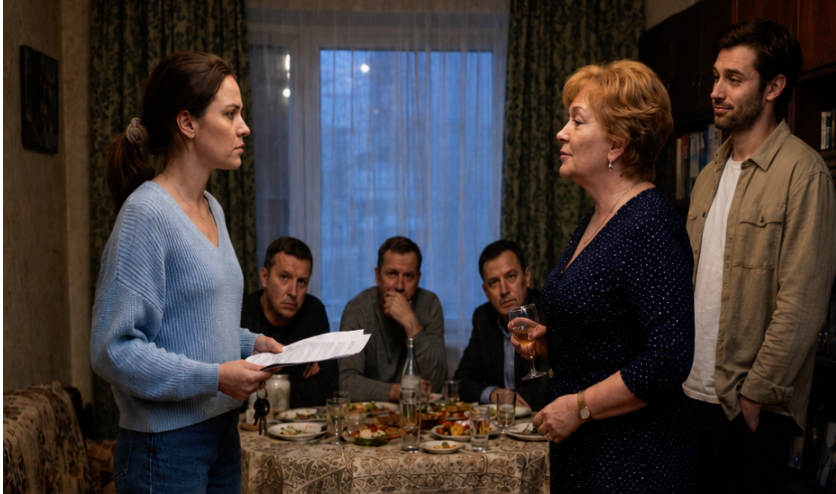
“Oh, nothing’s going to happen to that rag of yours!” Nadezhda Petrovna’s sharp voice, colored by her distinctive rural accent, cut through the silence that had suddenly fallen over the dinner table.
The mother-in-law leaned heavily back in her chair without even considering reaching for a napkin. Her large, reddened fingers, which had just been tearing apart a roasted bird, left two distinct greasy prints on her daughter-in-law’s light-colored sweater. She wiped her hands on Marina as naturally as though Marina were not a person, not the hostess of the apartment, but a towel conveniently draped over the back of a chair for her use.
There were six people sitting at the table: Igor’s aunt, who had come in from the region, a couple of his friends with their wives, and Igor himself. No one made a sound. The only thing that could be heard was the ticking of the wall clock in the hallway.
Marina slowly raised her eyes to her mother-in-law. Nadezhda Petrovna stared back at her with triumphant defiance. Her watery eyes were filled with open, undisguised malice, strengthened by alcohol-induced courage.
“You are nobody in this house,” the woman declared loudly, enunciating every word as she swept her gaze over the frozen guests. “You live off my little Igor! A spoiled city princess. You can’t cook properly, you can’t satisfy your husband. All you know how to do is buy yourself those pale-colored clothes while he breaks his back working two jobs!”
Marina looked at her husband.
Igor was sitting at the head of the table—the table Marina had bought with her own bonus, in the apartment Marina had inherited from her grandmother. He held a rounded shot glass in one hand. His face was slightly flushed from drinking.
At that moment, while his mother publicly humiliated his wife both physically and emotionally, he should have done something.
Stopped her.
Put her in her place.
Thrown her out.
Igor snorted.
Then his lips twisted into a crooked smile, and suddenly he gave a short, muffled laugh.
“Mom, you’re unbelievable,” he said, pouring more cognac into his neighbor’s glass. “Marina, why are you just standing there? Go change. Mom’s just joking around. Relax—it’s a celebration.”
He had not merely failed to defend her.
He had legitimized the humiliation.
Inside Marina, there were no hysterics and no tears. There were no tears left at all—they had dried up somewhere during the second year of their marriage.
Instead, there was a quiet, almost physically perceptible click inside her chest.
It was as though someone had walked over to an electrical panel and, with one motion, switched off the light in the room of her soul where she had stored hope, patience, and all her attempts to “save the family.”
What followed was absolute, ringing clarity.
She said nothing.
She did not make a scene, nor did she grab a glass from the table to throw its contents into her mother-in-law’s smug face.
Marina simply pushed her chair back, stood up, and walked out of the living room with her back perfectly straight.
“That’s right, go cry into your pillow!” Nadezhda Petrovna’s triumphant croaking followed her.
Then came a relieved murmur of voices. The guests realized there would be no storm after all, so they could go back to attacking the salads.
Marina went into the bedroom and quietly closed the door behind her. The thick oak door cut off the sounds of the party.
She walked over to the mirror.
A twenty-nine-year-old woman with a pale face stared back at her. Her light-brown hair was gathered into a severe bun, and there was an ugly greasy stain across her chest.
An accountant at a large property-management company.
A person who reconciled multimillion-ruble balances every day, searched for financial discrepancies, and managed budgets.
And somehow, that same person had decided she could “balance the books” in a relationship with an infantile man and his domineering mother who hated the entire world.
Marina pulled the ruined cashmere sweater over her head and, without even trying to clean it, casually tossed it into the trash bin beneath the dressing table.
She put on a simple black turtleneck.
The fabric wrapped comfortably around her body like armor.
“You live off my little Igor.”
The sentence echoed in her temples.
Igor worked as a delivery driver.
Or rather, that was what he called himself.
In reality, he delivered small shipments for online stores, earning an unstable salary, half of which he concealed while complaining about fines from his employer.
But it was not about how much he earned.
It was about his ambitions, which had absolutely nothing to do with reality.
Igor wanted to appear successful.
He loved expensive sneakers, the newest smartphone models, and going to bars with his friends, where he always paid for everyone with an extravagant gesture.
And when he ran out of money, he did what all cowardly people who wanted to appear more important than they really were tended to do.
He took out microloans.
Marina remembered the night exactly one month earlier.
She had been asleep when the front door slammed so violently that the walls shook.
Igor stumbled into the bedroom, pale as chalk, his hands trembling, smelling of alcohol mixed with raw animal fear.
He dropped to his knees beside the bed and began sobbing loudly, burying his face in the blanket.
That night, the truth came out.
His flashy lifestyle had long been financed by loans carrying insane interest rates.
The calls from unfamiliar numbers—the calls he never answered unless he went into another room—had been from debt collectors.
His debt had grown to two hundred thousand rubles.
And the previous day, while he was loading goods, two strong-looking men had approached him and, very politely but extremely clearly, explained what would happen to his knees if the money was not repaid within a week.
Marina had that money.
Two hundred thousand rubles—her personal savings, accumulated from bonuses and vacation pay.
She had planned to glaze and insulate the balcony and create a small relaxation area there.
She could have told him to get lost.
She could have thrown him out.
But a month ago, that foolish feminine pity was still alive inside her.
She had not seen an adult man standing before her.
She had seen a terrified little boy.
And she agreed to help.
But Marina was a professional accountant.
She did not simply hand money over because she knew the value of every kopeck she earned.
That very night, at three in the morning, she placed a sheet of paper in front of him at the kitchen table.
It was a purchase-and-sale agreement with collateral conditions.
Igor’s only valuable possession was his car—a relatively new crossover he had bought before their marriage. He worshiped it, polished it every weekend, and affectionately called it “my little swallow.”
According to the documents, Marina was buying the car from him for those same two hundred thousand rubles.
The vehicle would become her property.
But an additional agreement was attached to the contract: if Igor repaid his debt within six months, Marina would transfer the car back to him.
If he did not—or if he refused to pay—the vehicle would remain hers permanently and irrevocably, and she would have the right to dispose of it however she wished.
Igor had signed everything without even reading it.
His hands had been trembling.
He kissed her fingers and swore he would find extra work, that he would never touch another credit card again, and that she was his savior.
The next day, they formalized everything through Gosuslugi, the Russian government services portal.
Officially.
Igor calmed down quickly.
The debt collectors were paid off.
But a debt to his wife…
Was that really a debt?
A wife would not come and break his knees.
A wife would forgive.
A wife would forget.
Marina walked over to the wardrobe, where a small metal safe disguised as a shoebox stood on the top shelf.
She quickly entered the combination.
The door creaked softly.
Inside were their passports, some cash, and a thick plastic folder.
She took it out.
The vehicle registration certificate.
The vehicle title.
The signed purchase-and-sale agreement.
Everything was in her name.
And beside them, in a small compartment, lay the spare smart key to the crossover.
Igor himself had given it to her in a burst of remorse as a guarantee.
Marina picked up the key.
It was cold and heavy.
An explosion of laughter came from behind the wall.
Nadezhda Petrovna was cackling again.
“…and that’s exactly what I told her!” came her mother-in-law’s muffled voice. “And she went quiet like a little mouse and crawled away! City people—they’re all cowards. No backbone at all!”
Marina put the documents and the key into her leather shoulder bag.
Then she slipped on a dark trench coat and put on her sneakers.
She did not even need to pass through the living room. The apartment’s layout allowed her to leave the bedroom and enter the hallway without crossing the room where the guests were feasting.
She quietly turned the lock.
The door closed almost silently behind her.
The apartment building smelled of dampness and the old garbage chute, but to Marina, the air felt like the purest oxygen imaginable.
She went down the stairs without waiting for the elevator.
There was an absolutely clear, cold plan inside her head.
No emotions.
Only debit and credit.
And now it was time to close this toxic balance.
She stepped outside.
The autumn evening had already taken over the city, lighting the yellow streetlamps.
Near the entrance stood Igor’s crossover, proudly gleaming with freshly polished sides.
He had parked it so that it occupied one and a half parking spaces—his eternal habit as the self-proclaimed “master of life.”
Marina approached the driver’s door.
She pressed the button on the smart key.
The vehicle greeted her with blinking indicators and a quiet click of the locks.
She sat in the driver’s seat.
The interior smelled of cheap vanilla air freshener and tobacco.
The seat was pushed far back to accommodate Igor’s height.
Marina did not bother adjusting it. She simply stretched her legs toward the pedals.
She pressed the start button.
The engine purred evenly and powerfully.
“You’re nobody in this house,” flashed through her mind.
She shifted into gear and smoothly drove out of the courtyard.
The city was half empty on this Sunday evening.
Traffic lights turned green, letting her pass.
Marina drove confidently without exceeding the speed limit.
She knew the city like the back of her hand.
The journey took about half an hour.
She reached an industrial district on the opposite side of town, where a large guarded parking lot stood among warehouses and tire shops.
It was run by a former military man who had once worked with Marina’s father.
It was the sort of place where no one could retrieve a vehicle without the registered owner appearing in person, signing the logbook, and presenting a passport.
The heavy metal gates slowly slid aside.
Marina parked the crossover in the farthest corner, directly beneath a surveillance camera beside a concrete fence.
She switched off the engine.
Silence filled the cabin.
Marina placed her hands on the steering wheel and closed her eyes.
Her heart was beating steadily.
No fear.
No regret.
Only a growing sense of freedom spreading through her chest, pushing out the suffocating atmosphere of years spent in this marriage.
She stepped out of the vehicle, locked the doors, and walked toward the guard booth.
“Good evening, Mikhalych,” she greeted the elderly man in a camouflage jacket.
“Oh, Marina! Hello! Haven’t seen your father in ages. What, decided to leave your little beauty with us?”
“Yes, Mikhalych. Here are the documents. I’m the owner. I’m leaving it here for a month, and here’s the payment.”
She handed him several banknotes.
“And most importantly, if anyone else comes here—with any keys, shouting whatever they want—do not give them the car. Call the police immediately. I am the only person allowed to pick it up personally. Understood?”
The guard looked carefully at her hard, focused face, then at the documents, then back at her.
He asked no questions.
In his profession, unnecessary questions served no purpose.
“We’ll take care of it properly. Not even a mouse will get through. Don’t worry.”
Marina nodded, turned around, and walked toward the parking lot exit.
She returned home partly on foot and then by night bus.
It took almost an hour and a half.
The nighttime cold penetrated her trench coat, but she felt hot.
She stared through the bus window at the lights of shopfronts passing by, the occasional pedestrians, the billboards, and realized that this evening was a dividing line.
The point of no return.
Tomorrow, her life would be completely different.
And she would build that “tomorrow” herself.
When Marina’s key turned in the lock of her apartment, it was already shortly after ten in the evening.
She stepped into the hallway.
The party had quieted down.
The guests were just getting dressed to leave.
Igor’s aunt was pulling on her boots, grunting as she leaned against the wall for support.
Her husband’s friends were smoking on the landing, loudly discussing some football match.
The apartment smelled of dirty dishes and alcohol.
“Oh, look, the lady of the house is back!” one of Igor’s friends said with a drunken grin as he came in from the landing. “We were just leaving. Igor said you’d gone to lie down because you had a headache.”
Marina calmly hung her trench coat on a hook.
“Yes. My headache is gone. Goodbye.”
Sensing the cold radiating from her, the guests quickly said their goodbyes and spilled out through the door.
The lock clicked.
Only three people remained in the apartment.
Igor came out of the kitchen.
He was already wearing sweatpants and a wrinkled T-shirt.
In his hand was a half-finished bottle of beer, which he had apparently decided to use to “polish off” the cognac.
His face looked puffy, and his eyes were slightly cloudy.
“Where the hell have you been?” he asked irritably, taking a sip. “Mom’s in there washing the dishes for you. You could at least have cleaned up after the guests if you weren’t going to come back to the table. Making a whole circus over some stupid sweater.”
Nadezhda Petrovna floated out of the kitchen.
She was wearing an apron, her hands were wet, and her face bore the expression of a martyr.
“Leave her alone, son. I’m used to being both a guest and a servant in this house. What can people like us expect compared with delicate city ladies? So what if I accidentally got a little grease on her? What a tragedy.”
Marina walked into the kitchen.
The table was covered in dirty plates, leftover goose, and crumpled napkins.
Without saying a word, she pulled out a chair, disdainfully brushed a piece of bread onto the floor, and sat down.
She opened her bag.
Then she took out the plastic folder and placed it on the table.
“Igor. Nadezhda Petrovna. Sit down.”
Marina’s voice was quiet, but there was so much steel in it that Igor involuntarily took a step backward.
“Why are you suddenly giving orders?” her mother-in-law scoffed, wiping her hands on a towel—at least this time it was actually a towel. “Go to bed. You have work tomorrow.”
“Sit down,” Marina repeated.
Sensing that something was wrong, Igor lowered himself onto the stool opposite her.
Nadezhda Petrovna stood next to her son with her lips pursed in displeasure and her arms crossed over her chest.
“Marina, what are you starting now?” Igor’s voice had lost its confidence.
He looked at the folder.
“What’s that?”
Marina opened the folder.
She took out the purchase-and-sale agreement with the collateral clause and placed it where Igor could see it.
“Do you remember what this is, Igor?” she asked.
He blinked.
The alcoholic fog inside his head slowly began to clear, giving way to primitive fear.
He recognized his scribbled signature at the bottom of the page.
“That’s… well, just a piece of paper. We had an agreement. I’m paying you back little by little. Why are you bringing this out in front of Mom?”
“You’re not paying me anything,” Marina stated calmly. “In an entire month, you haven’t transferred a single ruble to me. But you did buy yourself a new smartwatch, and today you treated your buddies to cognac that costs five thousand rubles a bottle.”
“I’ll pay you back from my salary! Why are you counting my money?!” he snapped, slamming his fist on the table.
“I’m counting my money, Igor. Because those were my two hundred thousand rubles. Now listen to me very carefully.”
Marina leaned forward, resting her elbows on the table.
Her eyes looked directly into her husband’s soul, and suddenly he realized that the person sitting opposite him was a complete stranger.
“Your car is no longer parked outside.”
The sentence hung in the air like the sound of a snapped string.
Igor froze for a second.
His alcohol-soaked brain struggled to process the information.
“What do you mean… it’s gone?” he asked with a foolish smile. “Was it stolen? Did you call the police?”
“I moved it,” Marina replied. “To a guarded parking lot. I have the documents. I have the vehicle title. Legally, the car belongs to me.”
“What the hell are you talking about?!” Igor roared, jumping up from the stool.
He rushed into the hallway.
A second later came the sound of the balcony door opening.
Marina could hear him racing around on the balcony, leaning over the railing and staring desperately into the darkness of the courtyard.
“Where is it?!” His shout from the balcony was filled with genuine horror. “Where’s my car, you bitch?!”
Nadezhda Petrovna finally understood what was happening.
Her face became blotchy and distorted with rage.
“What have you done, you piece of filth?!” she shrieked, lunging toward the table. “You stole my son’s car?! I’ll take you to court right now! You’ll go to prison, you thief!”
Marina did not even flinch.
She slowly turned her gaze toward the raging woman.
“Read it, Nadezhda Petrovna.”
She tapped one fingernail against the lines of the contract.
“It’s right there in black and white. I am the owner. Your son sold the vehicle to me for two hundred thousand rubles. The very same two hundred thousand rubles I handed over to thugs so they wouldn’t break your precious son’s legs over his microloan debts. You didn’t know that, did you? Your little Igor didn’t tell you he was up to his neck in debt?”
Her mother-in-law abruptly fell silent.
Her mouth dropped open as her frantic gaze moved from the papers to Igor, who had rushed back from the balcony.
He was white as a sheet.
“Igor… is that true? What thugs? What debts?” his mother asked, her voice trembling.
“Mom, don’t listen to her!” he shouted, rushing toward the table and trying to grab the documents.
With one quick motion, Marina swept the folder onto her lap.
“Don’t touch them,” she said through clenched teeth in an icy voice. “These are the originals, but copies are already stored somewhere safe.”
She stood up.
Now she towered over both of them.
“Here’s how it’s going to be. The terms have changed. Before, you had six months. Now you have exactly one week. Seven days. If two hundred thousand rubles are not in my bank account by next Sunday, the car goes up for sale. I’ll sell it to resellers for next to nothing—I don’t care. I’ll get my money back. And you’ll be left without a car and without a job, because you won’t be delivering your boxes on foot.”
Igor breathed heavily, clenching his fists.
His eyes filled with tears of helpless rage.
He was accustomed to problems somehow resolving themselves.
He was used to shouting, sulking, slamming a door, and waiting until Marina came to make peace with him.
But now there was a wall standing in front of him.
“You… you have no right,” he croaked. “That’s my car. I bought it myself. Before I even met you!”
“You sold it, Igor. You signed your name. And now get out.”
“What?!” mother and son exclaimed simultaneously.
Marina raised her hand and pointed a long finger toward the hallway.
“Your son is going home with you, Nadezhda Petrovna. Tonight. Right now. Neither of you has any business being in my apartment.”
“Have you lost your mind?!” Her mother-in-law looked as though she might have a heart attack.
She clutched her chest.
“It’s nighttime! Where are we supposed to go?! This is my son’s home! He’s registered here!”
“He isn’t registered here. I never gave permission for that,” Marina replied calmly, as though reading out figures at a business meeting. “This apartment belonged to my grandmother. And in here, you are nobody. You have ten minutes to pack enough of his belongings for the immediate future. If you are not out the door in ten minutes, I am calling the police. I will tell them that two drunk people forced their way into my apartment and threatened me with physical violence. The neighbors will confirm that you were shouting.”
“I’m not going anywhere!” Igor tried to assume a threatening posture as he advanced toward his wife. “Give me the keys, you bitch, and then you can start giving orders!”
Marina did not retreat a single step.
She pulled the phone out of her trench coat pocket and dialed 112.
She turned on the speakerphone.
Long ringing tones sounded through the silent kitchen.
“Hello, police?” Marina said loudly and clearly. “15 Stroiteley Street, Apartment 42. My drunk husband and his mother are threatening me with physical violence. They refuse to leave my property. Yes, I am the owner. Yes, I’ll wait for the officers.”
She ended the call, bluffing that the dispatcher had answered that quickly, but it was enough.
Igor’s nerve broke.
All his artificial bravado vanished in a single instant.
He rushed into the bedroom.
The sounds of wardrobes being opened, hangers crashing to the floor, and a stream of vicious swearing came from inside.
Nadezhda Petrovna stood in the middle of the kitchen, breathing heavily.
Her face had turned an ashen gray.
She no longer looked like the domineering woman who controlled the situation.
She was simply an old, frightened woman whose imaginary world had just collapsed.
“May you be damned,” she hissed, staring at Marina with hatred that would once have frightened her. “You snake. We took you to our bosom.”
“Goodbye, Nadezhda Petrovna,” Marina replied without looking away. “And don’t forget your scarf in the hallway.”
Fifteen minutes later, the apartment door slammed shut with a heavy thud.
Igor disappeared behind it, dragging an enormous sports bag with shirt sleeves sticking out of the top, followed by his mother, who continued cursing everyone and everything around her.
Marina was alone.
She stood in the hallway and listened as their footsteps faded down the staircase.
Then she walked over to the door, turned the lock twice, and put on the security chain.
Returning to the kitchen, she looked at the devastated table.
The dirty plates.
The remains of the greasy goose.
In the past, she would immediately have started cleaning everything, scrubbing the apartment until it shone so she could wake up to a clean home in the morning.
But now she simply took a large garbage bag and, with one sweeping motion, pushed everything into it—the plates, scraps of food, napkins, and unfinished bottles.
The dull sound of breaking dishes seemed like the most beautiful music she had ever heard.
Tomorrow she would buy new plates.
Beautiful ones.
Just for herself.
Then Marina opened the banking app on her phone.
She went to the Automatic Payments section.
“Loan payment (Tinkoff) — disable.”
“Loan payment (MigCredit) — disable.”
“Ivi subscription (Igor’s profile) — disable.”
She cleared all the notifications, locked the screen, and placed the phone on the clean table.
The next morning, at exactly nine o’clock, the locksmith arrived.
For three thousand rubles and twenty minutes of work, he replaced the cylinder in the front-door lock and handed Marina three brand-new, gleaming keys.
The old keys Igor possessed had become useless pieces of metal.
Marina stood by the window holding a cup of strong coffee.
Down in the courtyard, where the crossover had stood proudly only yesterday, there was now an empty space.
The parking spot had been occupied by someone’s unremarkable little compact car.
The phone on the table vibrated.
The screen displayed:
Mother-in-law.
Then:
Igor.
Then messages began pouring in.
Dozens of them.
Threats turned into pleas.
Curses became promises that everything would change.
Marina took a sip of coffee, opened the settings, and with a single tap sent both numbers to the blacklist.
She looked at the clock.
It was time to get ready for work.
For the first time in a very long while, she did not need to think about what to cook for dinner, how to justify buying herself a sweater, or where to find money for another one of her husband’s secret payments.
She walked over to the wardrobe and chose a new light-colored sweater—soft, fluffy, unbelievably cozy.
She put it on and smiled at her reflection in the mirror.
Yes, her mother-in-law had been right.
Yesterday, she had wiped her hands on Marina’s sweater.
But that night, her son was left without a car.
And Marina, at last, was left with herself.
And that was the best deal she had ever made.