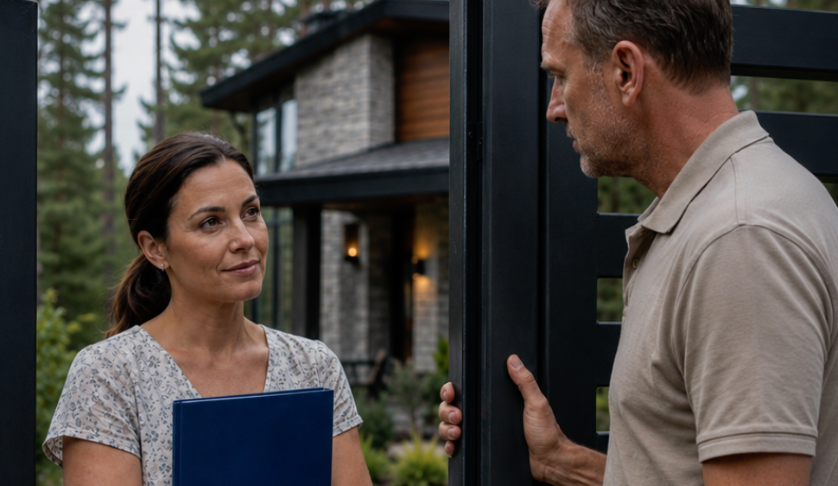
“Give us the keys—we’ve come here to relax!” my husband’s relatives said. I handed them a list of rules and the price of accommodation.
“Give me the keys, Natasha. People have been traveling, and here you are with your paperwork again,” Kirill said, stretching his hand through the gate.
His entire family was standing behind him.
Larisa Ivanovna was holding two striped bags and was already looking past me toward the door of the house. Oksana, Kirill’s sister, had placed a box filled with pots, bags, and a roll of disposable tablecloth beside the fence. Roman was unloading a barbecue grill and charcoal from the trunk. Dmitry silently took out a portable cooler and fishing equipment.
They had come for a vacation.
To my place. To my house. For an entire week. Without an invitation.
I stood on the inside of the gate holding a folder.
Not the keys.
The first page was titled:
“Accommodation Rules. Cost. Responsible Tenant.”
Kirill read the heading, pulled his hand away from the gate, and looked at me as though I had ruined not merely his morning, but his entire carefully prepared plan.
“Are you serious?” he asked.
“Yes.”
Larisa Ivanovna placed her bags directly in the tire tracks beside the road without checking whether they were blocking traffic.
“That isn’t how things are done in my family,” she said. “You don’t leave relatives standing at the door.”
“In my house, no one stays without the owner’s permission,” I replied.
My voice was calm. Not because I didn’t care.
It was simply because, over the previous twenty-four hours, I had realized that the moment I began trying to justify myself, they would walk inside.
They would enter with their bags, boxes, folding beds, habits, and complete certainty that someone else’s house could be claimed simply by speaking loudly enough.
Kirill glanced at Oksana. Apparently, he expected his sister to turn the situation into a joke and push through the decision he had made for both of us.
Oksana merely raised her eyebrows.
“Natasha, we aren’t strangers. You could be a little more accommodating.”
I opened the folder and turned the first page toward them.
“The rules are here. The accommodation price is here. The payment details are here. If you want to stay in the house for seven nights, we sign a rental agreement under the name of one adult, you pay the fee and security deposit, and after that I give you one set of keys.”
Roman stopped unloading the charcoal.
“What agreement? We’re visiting you.”
“Guests arrive after being invited. You came because Kirill promised you the house, and Kirill is not the owner.”
Kirill fell silent for a moment after I said the word “owner.”
His family didn’t like that word when it was spoken by a woman.
A house, a car, a salary, a refrigerator, and weekends quickly became “ours” when someone wanted to use them.
But they instantly became “yours” whenever someone had to pay for them.
I had received the house in the Sosnovy Bereg gardening community from my aunt through a deed of gift dated August 10, 2021.
Kirill and I had not registered our marriage until May 21, 2022.
I knew the sequence not from memory, but from the documents inside the blue folder.
My aunt had said to me at the time:
“Register the house in your own name. And don’t hand out the keys.”
I had smiled. I thought she was simply being overly cautious.
Back then, Kirill was attentive, calm, and even considerate. He asked whether he could pick an apple from a tree, let alone bring people there for an entire week.
Later, it turned out that I had been closing my eyes to things for far too long.
First, he brought his mother there “for a couple of days to get some fresh air.”
Then Oksana came “just to sunbathe,” but left four days later after leaving behind an empty gas cylinder, sticky refrigerator shelves, and a candle-wax stain on the wooden table.
Then Larisa Ivanovna decided that my veranda was the perfect place to dry carpets.
Then Roman brought his friends over “for a barbecue,” and I spent two hours collecting plastic forks from around the lilac bushes.
Every time, Kirill said the same thing:
“We’re family.”
He used the phrase like an entry permit.
Once he said it, I was expected not to ask questions, not to calculate expenses, not to look at the damaged belongings, and not to remind anyone that the house was actually mine.
The preparations for this “vacation” had not begun the previous day.
On July 5, 2026, Kirill had written in his family group chat:
“The house is free. Natasha will complain for a while and then get used to it.”
I had never been added to that chat.
But on the evening of July 12, he left his laptop open on the kitchen table while he washed a mug, and the screen had not gone dark.
I wasn’t searching through someone else’s messages.
I simply saw my own name.
Oksana had written:
“We’re leaving tomorrow around eleven. Mom gets a separate room, Roman and I will stay upstairs, and Dimka will sleep downstairs. Tell Natasha not to be stingy with the bedding. We’re staying for a week.”
Kirill’s replies were short and confident:
“I’ll take the keys in the morning.”
“The house is empty anyway.”
“The main thing is making sure she doesn’t start talking about ownership again. Mom finds that upsetting.”
I photographed the screen.
Then I opened the cabinet in the hallway and saw that one set of house keys had already been removed from its hook.
Kirill had prepared it in advance.
That night, I didn’t wake him up or start an argument.
He would have said that I had misunderstood everything.
That they “just wanted to relax.”
That I shouldn’t be so petty.
That his mother would be offended.
I already knew how that conversation went.
So I sat down at the kitchen table, opened my laptop, and prepared a document.
The first page was titled “Accommodation Rules.”
It contained simple conditions: no smoking inside the house or on the veranda, no moving furniture, no taking tools from the shed, and no heating the bathhouse without my permission.
I also included separate prohibitions against bringing additional guests, leaving rubbish on the property, touching documents, using my aunt’s dishes, or going through my belongings in the locked cabinet.
The person named in the agreement would be responsible for any damage.
The second page was titled “Cost.”
Seven nights in the house: 42,000 rubles.
Final cleaning: 3,500 rubles.
Firewood, water, septic system, and bathhouse use: 4,000 rubles.
Refundable security deposit: 15,000 rubles.
Total due before receiving the keys: 64,500 rubles.
I did not offer them a special “family price.”
It was precisely the “family” members who had left me with a broken handle in the bathhouse, an emptied well after endless watering, and a ketchup stain on my aunt’s linen table runner the previous time.
At least with strangers, no one feels embarrassed about sending an invoice.
With my husband’s relatives, for some reason, I had once felt embarrassed even asking them to wipe the table after themselves.
By morning, that embarrassment was gone.
At 8:40 a.m. on July 13, 2026, I printed the documents.
At 10:20 a.m., a handyman from the neighboring village replaced the lock cylinders on the gate and the front door.
The old keys no longer turned in either lock.
I put the two new sets into my pocket.
Kirill arrived at the house before everyone else.
He got out of the car, walked quickly toward the gate, and inserted the old key into the lock.
It went in, but it wouldn’t turn.
He tried again.
Then he looked at me.
“Natasha, open the gate. Don’t make a scene.”
“The gate is locked, Kirill. We can talk through it. The house will be opened after we reach an agreement.”
He glanced quickly toward the road.
Roman’s car was already turning onto it.
Folding chairs were tied to the roof, and Larisa Ivanovna could be seen inside wearing a light-colored hat.
They were arriving with the satisfied expressions of people who were not coming to ask for anything, but to take possession of it.
Kirill leaned toward me across the gate.
“Don’t humiliate me.”
“You put yourself in this position.”
“Everyone lives like this. You’re just showing off.”
“Then go stay with someone who lives that way.”
The car stopped beside the fence.
Larisa Ivanovna climbed out first. Oksana opened the trunk. Roman reached for the bags, and Dmitry placed the portable cooler beside my gate as though a place had already been assigned to it.
“Well, why are we standing around?” Larisa Ivanovna said cheerfully. “Open up, Natasha. I’ve been traveling all morning, and my legs are aching.”
I held the papers through the gate toward Kirill, but he refused to take them.
So I turned the folder toward Larisa Ivanovna.
“Before checking in, you need to choose the responsible tenant. I need their passport details, the length of the stay, payment, and a deposit. The rules are on the first page.”
Larisa Ivanovna stared at the paper as though I had handed her not a document, but a personal insult.
“You’re showing me a price? Me? Your husband’s mother?”
“I’m showing it to everyone who arrived to stay in my house without an invitation.”
Oksana smirked and looked at Kirill.
“Wow. You don’t discipline your wife at all, do you?”
Kirill grimaced but remained silent.
He had already realized that the usual performance was not going according to plan.
Previously, he had pressured me when we were alone: in the kitchen, in the car, before bed, when I became too tired to argue.
But now his mother, his sister, Roman, Dmitry, the neighboring road, the new lock, and my folder were all there.
“Natasha, enough,” he said. “Open the house. We’ll talk later.”
“No. First we reach an agreement. Then you get the keys.”
“What kind of agreement do you need with family?”
“A normal one. Who is staying, how long they’re staying, who is paying, and who is responsible for any damage.”
Larisa Ivanovna laughed briefly.
There was nothing cheerful about it. It sounded angry.
“Ungrateful woman. I accepted you into this family.”
I looked at her bags, the folding beds, and the boxes already leaning against my fence.
In the past, I would have begun listing how many times I had driven her around, bought her medicine, prepared meals, and listened to comments about my “city habits.”
Now none of that had anything to do with the keys.
“Kirill accepted me into the family. I never invited anyone into the house.”
Roman put the grill back into the trunk but didn’t close it.
He was waiting for instructions from Oksana or Larisa Ivanovna.
Oksana snatched the pages from Kirill and began reading them aloud, skipping the words she didn’t like.
“‘Do not move the furniture. Do not take the tools. Do not heat the bathhouse.’ Natasha, what kind of people do you think we are?”
I remembered August 2025, when Roman had taken the electric trimmer from the shed and returned it with a damaged power cord.
Oksana had said the equipment was old and had only itself to blame.
Kirill had asked me not to make a big deal out of it.
“I consider you adults. That’s why everything is in writing.”
Dmitry joined the conversation for the first time.
“And where did you get the figure of 64,500 rubles?”
“From the expenses. The house, water, septic system, firewood, cleaning, and wear and tear. Seven nights of accommodation. The refundable deposit is listed separately.”
Roman snorted.
“We could stay at a holiday resort for less.”
“Then the resort is a better choice for you.”
Larisa Ivanovna immediately turned toward him.
“Be quiet, Roma.”
Then she looked at me again.
“You’re destroying relationships over money.”
A greenhouse door slammed on a neighboring property.
Somewhere beyond the apple trees, a lawn mower started humming.
An ordinary summer morning continued around us while a group of people stood beside my gate treating my refusal as though it were a childish whim.
“The person destroying the relationship is the one who promises someone else’s house without the owner’s permission.”
Kirill finally took the papers.
He read the first page, then the second, and looked up.
“Do you honestly think my mother is going to pay you for a bed?”
“I think your mother is not going to stay in my house for free just because you promised her she could.”
“We’re family.”
“Being family does not give you the right to hand out my keys.”
He crumpled the edge of the page.
Not much, but I noticed.
“You’re deliberately humiliating me in front of my relatives.”
“No. I’m correcting what you did behind my back.”
Oksana looked at Kirill more carefully.
“So you never actually discussed this with her?”
After that question, it became clear to everyone that they had not come to visit us.
They had come because of Kirill’s promise.
And that promise had been based entirely on his certainty that I would surrender once there were witnesses.
I took an extract from the Unified State Register of Real Estate out of the folder.
I had ordered it earlier for the roof repairs.
Without emotion, family loyalty, or resentment, it stated my name.
“Here is the document. I am the owner. The deed of gift is in my name. Kirill is not registered at the house, and he owns no share of it.”
Kirill stepped closer to the gate.
“Put that away.”
“Why? You wrote that the house was empty anyway.”
He realized that I had seen the messages.
Not immediately, but he understood.
His face became angry and closed off.
“You went through my group chat?”
“Your group chat was open on our kitchen table. Thank you for writing everything so honestly.”
Oksana lowered her eyes to her phone.
Larisa Ivanovna tightened her grip on the bag handles.
Roman pretended to inspect a wheel.
Only Dmitry continued looking directly at Kirill, and there was simple irritation in his gaze.
They had been placed in an embarrassing situation, yet everyone was trying to blame me for it.
At 12:15 p.m., Nikolai Petrovich, the chairman of the gardening community, approached the gate.
He was carrying a management folder and a mesh bag filled with zucchini.
In a small gardening community, arguments beside someone’s gate rarely go unnoticed.
“Good afternoon. Natalia, is everything all right?”
Larisa Ivanovna immediately became animated.
“You’re an older, respected man, so tell us. How can she refuse to let her husband’s relatives into the house? We came for a week with all our belongings, and she presented us with a price list.”
Nikolai Petrovich looked at me, then at Kirill, and then at the bags.
“Is the house Natalia’s?”
“It’s mine.”
“Then Natalia decides who is allowed inside.”
Larisa Ivanovna opened her mouth but could not immediately think of a response.
“But she’s married,” Oksana said.
“Congratulations,” Nikolai Petrovich replied. “That doesn’t change the owner.”
Kirill turned sharply toward him.
“Nikolai Petrovich, we’ll handle this ourselves.”
“Then handle it. But move the bags off the road. And don’t leave the grill beside the fence. The road is shared.”
He spoke calmly, without caring who was whose mother, sister, husband, or son-in-law.
That made his words sound especially firm.
I turned toward Oksana.
“If you want to stay, choose the responsible tenant, transfer 64,500 rubles, and sign the agreement. Otherwise, take your belongings. I am not opening the house based on Kirill’s verbal promises.”
Oksana shoved the pages back through the gap in the gate.
“You can choke on your precious house.”
Roman closed the trunk wearily.
“Let’s go. There’s no point.”
Larisa Ivanovna did not move.
She stared at Kirill, demanding the impossible: that he somehow become the master of a house that did not belong to him.
“Son, say something to her.”
Kirill inserted the old key into the lock once again.
The lock did not turn.
The soft metallic click inside it sounded more convincing than any argument.
At 1:10 p.m., they began loading everything back into the car.
There was none of their earlier enthusiasm.
Roman put away the grill. Dmitry picked up the cooler. Oksana slammed the car door so violently that Nikolai Petrovich looked at her over the top of his glasses.
Larisa Ivanovna sat in the front passenger seat and did not look at me again.
Kirill remained beside the gate after everyone else had gotten inside.
“Do you understand that things will never be normal after this?”
I closed the folder.
“Things weren’t normal before. You just called it family.”
He got into the car with his relatives and drove away with them.
Two tire tracks and an abandoned package of disposable cups remained on the road.
I picked up the package with two fingers and threw it into the rubbish bin beside the shed.
Nikolai Petrovich remained by the gate for a moment.
“If they come back and start causing trouble, call the police station. And call me. I’m nearby.”
“Thank you.”
“You’re welcome. It’s a good house. Take care of it.”
After he left, I opened the gate with my own key.
The new one.
The path to the porch was empty.
Only my chair, my aunt’s round table, and the watering can I had forgotten to put away that morning stood on the veranda.
The house did not look “empty.”
It simply did not contain strangers.
I went inside and placed the folder on the kitchen table.
My phone began coming to life ten minutes later.
Oksana wrote first.
Her message was long, full of mistakes and accusations.
Then Larisa Ivanovna sent me a voice message that I did not listen to.
Then Kirill wrote:
“Mom is sitting on a bench outside a shop. Is this what you wanted?”
I did not reply immediately.
First, I opened my banking app and checked whether there had been any suspicious transactions on our shared card.
Then I opened my email, attached screenshots of the conversation, a photograph of the old key, the property extract, and my rules to a message addressed to the lawyer I had consulted during the winter about the roof repairs.
The subject line read:
“Consultation Regarding the Use of Personal Property and a Family Conflict.”
Only then did I write back to Kirill:
“What I wanted was to prevent people from moving into my house without my permission.”
He replied almost immediately:
“You threw my mother out onto the street.”
I looked at the screen and typed:
“Your mother came for a vacation without an invitation. She has a car, adult relatives, and a choice of hotels. That is not my fault.”
Then I silenced the phone.
On the evening of July 14, 2026, Kirill returned to the apartment alone.
I heard him fumbling with the lock for a long time.
Apparently, he was gathering his thoughts outside the door.
When he entered, the confidence with which he had demanded access to the house that morning was gone.
All that remained was the anger of a man who had been forced to explain his own lie to his mother, his sister, and his sister’s husband.
“They rented a room near the highway,” he said from the doorway.
“So they found accommodation.”
“It was expensive.”
“My offer was cheaper if you calculate the cost for the entire house.”
He threw his car keys onto the entryway cabinet.
“Are you mocking me?”
“I’m calculating.”
Everything had been prepared in the kitchen.
The blue folder was lying on the table.
Beside it was the old set of keys he had tried to use at the gate.
Next to those was a sheet of paper containing three points:
The house in the Sosnovy Bereg gardening community is Natalia’s personal property.
All guests may visit only with Natalia’s consent.
The transfer of keys to third parties without Natalia’s consent must stop.
Kirill read it and smirked.
“So now you’re giving me rules for our marriage?”
“I’m establishing rules concerning my property.”
He sat across from me but did not remove his jacket.
“My mother is going to tell everyone that you charged her money for air.”
“A house, water, electricity, a septic system, firewood, cleaning, and responsibility for someone else’s behavior are not air.”
“It’s petty.”
“What was petty was promising my house to someone and expecting me to remain silent in front of your relatives.”
He looked away.
For a moment, I did not see my husband.
I saw an adult man who had hidden behind his mother and the word “family” for far too long.
In the past, I would have begun feeling sorry for him during moments like this.
I would have softened my explanation, chosen gentler words, and postponed my decisions until later.
This time, my pity remained somewhere far away.
“I wanted what was best,” he said.
“For whom?”
Kirill did not answer.
It was the most honest answer he had given all day.
I pushed the old keys toward him.
“You took these from the hook without asking. Don’t do it again.”
“What if I’m your husband?”
“A husband is not a second property certificate.”
He stood up abruptly.
“You’ve become a stranger.”
I looked at the old keys on the cabinet.
Only yesterday, he had intended to give them to his relatives as though I did not exist in the situation at all.
“No, Kirill. I simply stopped being an accessory to your family.”
He walked into the bedroom, took out a sports bag, and began packing his things: T-shirts, a charger, a razor, and documents from the top drawer.
I did not interfere.
I did not ask him to stay, and I did not ask where he was going.
The answer was already there between us.
He was going somewhere where my rules could be called betrayal.
He stopped at the door.
“I’ll spend the night at Mom’s.”
“All right.”
He waited for a different reaction.
Perhaps he expected me to ask him to talk again tomorrow.
Perhaps he expected the familiar gesture in which I would be the first to smooth over the conflict so that Kirill’s family would not think I was a bad wife.
But I stood beside the cabinet holding the new set of house keys.
“Natasha, are you really prepared to destroy everything over a summer house?”
“It’s a home. And the house isn’t what destroyed anything.”
Kirill looked at the old keys on the cabinet, picked up his bag, and left.
On the morning of July 15, 2026, I drove to the gardening community alone.
On the way, I bought a small sign reading “Private Property” and two new hooks for the keys.
The house was peaceful.
Not cheerful, not sad, not empty.
Simply peaceful, the way a place feels when other people’s bags are no longer standing at the door.
I screwed the sign onto the gate, checked the lock, walked along the path to the porch, and opened the door.
The accommodation rules were still lying on the kitchen table.
I did not put them back into the folder.
I left them on top, beside a pen.
Then I took Kirill’s old key out of my pocket.
The useless one.
I hung it on a separate nail inside the shed, beside some rusty nuts and a broken latch.
The new key remained with me.
I locked the house, walked toward the gate, and looked across the property: at the apple tree, the veranda, and the empty space beside the fence where other people’s bags had been standing the previous day.
No one was standing there anymore.
And that was the proper ending to their vacation in my house.