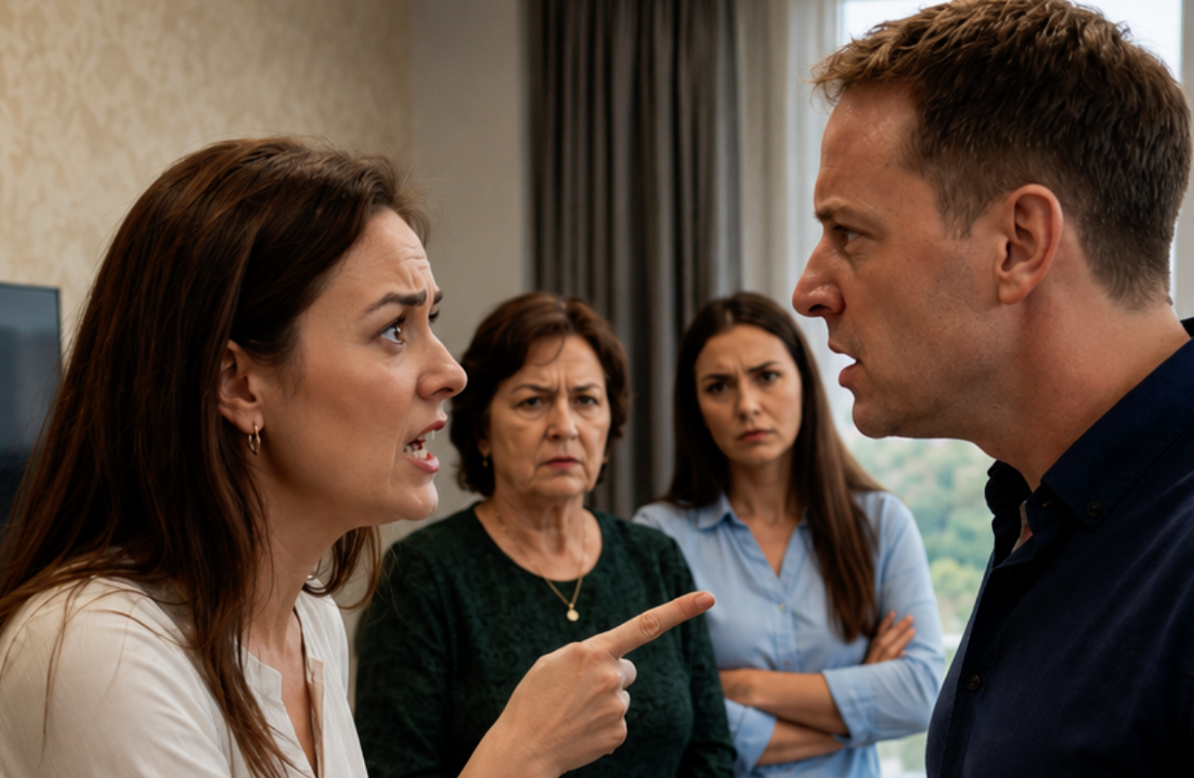
“I’m Filing for Divorce, and You’re Moving in with Your Mother Today.” — My Husband and Mother-in-Law Decided I Would Support Their Entire Family
“What have you done to tie him down over there? My own son hasn’t visited his mother for three weeks!” Lyubov Ivanovna’s voice clanged through the phone so loudly that I had to pull it away from my ear. “Or have you hung some enormous padlock on your door?”
I exhaled slowly, staring through the window at the gray blocks of Yekaterinburg apartment buildings. Sunday morning had only just begun, and my nervous system had already suffered its first breach.
“Good morning, Lyubov Ivanovna. Kirill is asleep. He was finishing a project for work until midnight yesterday. We don’t have any locks. We simply have adult responsibilities and exhaustion.”
“Exhaustion, she says!” my mother-in-law scoffed. “Before he got married, he wasn’t too tired to help his mother at the country house every weekend! But the moment he put a ring on his finger, he suddenly lost all his strength. Zhannochka is raising a child alone, she still has a car loan on that old vehicle, and I’m lying here with high blood pressure. Wake him up immediately. We need to take the old sofa to the dump.”
Without saying anything, I ended the call and placed the phone on the countertop.
I work as a senior logistics coordinator at a large warehouse. Years of experience have ingrained in me the habit of calculating everything, planning my time, and protecting resources. I physically cannot stand chaos or pointless waste.
It was a shame that my own marriage was now skidding into a ditch with all the grace of a fully loaded truck on an icy highway.
Kirill appeared in the kitchen doorway. He ruffled his hair and squinted against the pale Ural sunlight.
“Was that Mom?” he asked hoarsely, sitting down at the table. “What happened this time?”
I walked over to the coffee machine and placed a cup of strong espresso in front of him.
“An emergency evacuation of an old sofa. Your immediate presence is required. Otherwise, and I quote, ‘her blood pressure is acting up, and Zhannochka has to manage everything alone.’”
Kirill looked away guiltily, wrapping both hands around the hot cup.
The usual stage of denying the obvious had begun.
“Sveta, you have to understand. She’s getting older. Zhanna’s husband doesn’t pay child support, and she still has that car loan. They’re struggling. I’ll drive over quickly, help carry the junk out, and be back by lunchtime. We wanted to go to the movies tonight, remember? I’ll book the tickets now. Don’t turn this into a tragedy. Rise above these petty female grievances.”
He was skillfully shifting responsibility.
In his version of reality, I wasn’t an exhausted wife enjoying her only day off after a six-day workweek. I was a capricious obstacle standing in the way of his sacred duty as a son.
“All right,” I said without raising my voice.
It was the rule of a finished discussion: no hysterics, only facts.
“But if you leave now, you’re using up our shared time. And I want to remind you that three weeks ago, you ruined the entire weekend in exactly the same way by digging potatoes over there.”
“I’ll be there and back before you know it!” he declared cheerfully, draining his coffee in one gulp. “You’re my wise wife. You understand everything.”
He left at ten in the morning.
He returned at ten thirty that night.
Kirill reeked of glue, solvent, and sour sweat. He dropped heavily onto the bench in the entryway and pulled off his filthy sneakers.
I came out of the bedroom into the open-plan kitchen and living room. The apartment’s layout made hiding impossible. From the hallway, the entire space was visible.
“Sorry,” my husband muttered, avoiding my eyes. “It turned out there was more than just the sofa. We carried it out, and Mom immediately said that since I was already there, I should install some shelves in the bathroom. Then Zhanna caught me and dragged me halfway across the city to replace the linoleum in her hallway. You know Mom. It’s impossible to refuse her. She immediately starts clutching her chest.”
I walked to the wardrobe, took his work jacket, and hung it on a hanger.
“I tried to reach an agreement with you this morning, Kirill. You promised to return by lunchtime. You ignored our plans to renovate your sister’s apartment. That isn’t helping your mother. It’s unpaid exploitation.”
“There you go again!” he shouted, trying to convince me that I was the unreasonable one. “Was I out chasing women? I was helping my family! They don’t have a man in the house! You twist everything around. You’re always trying to make me look guilty!”
He went into the bathroom and slammed the door.
I remained in the hallway, listening to the sound of running water.
I had no intention of simply tolerating this, but I also saw no point in starting a scandal in the middle of the night. At work, I had learned one simple rule long ago: tantrums do not restore missed deadlines. Problems are solved only with a clear, cool head.
For the next three days, Kirill switched into his “offended innocent” mode.
He spoke to me in short, clipped phrases, demonstrating how deeply I had wounded his feelings as a devoted son.
It was a cheap, overused tactic.
On Wednesday, the seasonal workload at the warehouse broke every record. I was standing at unloading dock number four, preparing a rejection report.
The freight driver, a sweaty man in a greasy cap, was trying to appeal to my sympathy. He begged me to accept several damaged pallets of expensive equipment.
“Svetlana Yuryevna, please try to understand!” he whined, peering at my tablet. “They’ll hit me with an enormous fine. I have three children and a mortgage! I didn’t drop them on purpose!”
I calmly stamped REJECTED on his delivery note and slid the document across the desk toward him.
“Valera, as a person, I feel sorry for you. But I’m not going to pay out of my own pocket because you transported fragile cargo as though it were firewood. I also have a mortgage and plans for my money.”
That same evening, after my shift, I opened the banking app on our tablet at home.
The savings account was in Kirill’s name, but we both contributed to it. Every month, each of us transferred a fixed amount from our salaries.
We hadn’t opened it under his name out of foolishness.
Shortly before we took out the mortgage, the bailiffs had mistakenly assigned someone else’s debts to me. There was a debtor with exactly the same name, and suddenly both my accounts and my car were frozen.
It took almost a year to prove that I was not that person: applications, court proceedings, bank statements.
While that mess dragged on, it was unsafe to keep our shared money in my accounts, so we opened a savings account under Kirill’s clean record. Afterward, we simply left it that way.
I looked at the screen, and a cold vacuum formed in my chest.
Exactly two hundred thousand rubles were missing from the account.
The transaction had been made late the previous evening. It was an instant transfer using a phone number.
Recipient: Lyubov Ivanovna S.
I locked the tablet, picked up my phone, and called my husband.
He didn’t answer immediately. I could hear the noise of a building supply store and the clatter of shopping carts in the background.
“Svetochka, I’m a little busy. Let’s talk tonight,” he began hurriedly.
There was no wounded resentment in his voice now, only the nervous haste of someone who had been caught red-handed.
“Where did the two hundred thousand rubles from the savings account go?” I asked in a flat voice.
A thick silence followed.
I could hear a cart loaded with metal products rolling past Kirill.
“Sveta, here’s the thing. Mom urgently needs to replace the roof at the country house. The beams are rotten, and everything is leaking. I couldn’t refuse her. Her pension is tiny. And Zhanna was laid off, while my nephew needs to spend the summer out in the fresh air. I lent them some of our money. We weren’t planning to make an extra mortgage payment this month anyway. I’ll return everything when I get my bonus, I swear!”
“You took our shared money without telling me. Half of that money came from my quarterly bonus for working night shifts.”
“Why are you acting like some accountant?” Aggressive irritation crept into his voice. “The family is in trouble, and you’re counting every kopeck! If the house starts falling apart, mold will spread, and it’ll become nothing but a ruin. We’ll inherit it someday anyway, so we had to invest in it. Stop counting pennies. Think about the future and focus on something positive. All right, this is awkward. I’m standing at the register.”
He ended the call.
I slowly placed my phone on the table.
My husband had secretly emptied our shared savings while hiding behind the sacred excuse of filial duty.
At work, stealing like that would get someone fired and blacklisted.
In marriage, apparently, the wife was expected to understand and endure.
His mother had pushed him into it. That much was obvious.
And for a long time, we had no longer lived like a family. We were two strangers tied together by a mortgage.
There was no conversation that evening.
Kirill returned after midnight, claiming he had been unloading lumber.
We spent all of Thursday trapped in heavy silence. He avoided me, leaving for work earlier than usual and returning late, communicating only with brief nods.
On Friday, he stayed overnight at his mother’s country house.
He sent me a short message:
“Too tired to drive back to the city. The builders messed things up, so I’ll supervise them until Sunday. Don’t be angry.”
I began Saturday morning with a visit to a lawyer.
The consultation lasted forty minutes.
When I returned home, I took my husband’s suitcase out of the wardrobe. I didn’t cry or tear his clothes apart. I neatly folded his sweaters, jeans, and T-shirts, zipped the suitcase, and placed it in the corner of the hallway.
Then I sat down at the kitchen table.
I took out a notebook, a calculator, and our bank statements from the previous three years.
Methodically, I balanced the debits and credits of our married life.
The picture that emerged was perfectly clear: I had been the principal sponsor of his fantasy of being the perfect son.
For a moment, the numbers blurred.
I noticed that the hand holding my pencil was trembling slightly.
I put it down, covered my face with my palms, and sat like that for a minute, listening to the kitchen clock ticking.
Then I wiped my eyes with the back of my hand and returned to the statements.
I didn’t have time to cry over a calculator.
The final confrontation came on Sunday afternoon.
I was wiping down the stove when the doorbell rang briefly.
I didn’t even have time to reach the hallway before a key turned in the lock—the same key Kirill had once given his mother “just in case.”
The door opened.
Lyubov Ivanovna stood on the threshold, and behind her, panting, my sister-in-law Zhanna squeezed through the doorway.
They had not come to visit me.
They needed a storage facility.
“Sveta, we’ll be quick!” Zhanna boomed, pulling off her muddy boots directly on my clean doormat. “Kirill has been stuck on that roof all day. We came to get his work clothes and the rotary hammer. He said they’re on the balcony.”
They walked through my kitchen as though they owned the place.
Zhanna threw her oversized bag over the back of my chair without asking permission.
They smelled of smoke, dampness, and the undisguised triumph of people who had just received someone else’s resources for free.
“Well, hello, daughter-in-law,” my mother-in-law drawled, pulling out a chair and seating herself at the table without invitation. “Svetochka, you’re always such a welcoming hostess. Will you make us some tea after the journey? We’re starving. Why are you staring at us as though we’ve reached into your pocket?”
I calmly washed my hands and dried them with a towel.
I poured water into the electric kettle and switched it on.
“How is the construction work progressing with my two hundred thousand rubles, Lyubov Ivanovna?” I asked, leaning against the windowsill.
My mother-in-law pursed her lips, and her small eyes narrowed.
“Our shared money!” she snapped. “You’re a family! Kirill is a man, and he decides how the household budget is spent. What a wonderful son I have!”
She looked at me triumphantly and adjusted the collar of her jacket.
“Unlike certain people who only know how to hide money away while their husband’s mother sits under a leaking roof.”
Zhanna had already returned from the balcony, dragging a heavy plastic case containing the rotary hammer.
She dropped it onto the laminate flooring with a crash and wiped her dusty hands on her jeans.
“Mom, just tell her already. Why keep putting it off?” my sister-in-law interrupted. “Sveta, we actually came here for a reason. The two hundred thousand Kirill gave us only covered the materials. Lumber is expensive these days, and we still need to insulate the terrace. We don’t have any money left to pay the workers.”
“And what does paying your workers have to do with me?” I asked, folding my arms and observing this theater of absurdity.
“Everything!” Lyubov Ivanovna shouted, leaning forward. “Kirill promised yesterday that he would go to the bank on Monday and take out a consumer loan for five hundred thousand rubles. In his own name. That will be enough to finish the country house and pay off Zhannochka’s old car debt.”
She delivered this order in the tone of a division commander.
“You can handle your mortgage by yourself for now. You earn a good salary at the warehouse,” Zhanna said dismissively. “It won’t kill you. The interest on my loan is outrageous, and it needs to be paid off first, or I’ll drown completely. You can live modestly for six months and eat pasta. At least Mom’s house will look like something from a magazine. You’ll go there yourselves later, relax in comfort, and grill meat on the new terrace.”
I stared at them in genuine disbelief.
To them, I was nothing but a draft animal expected to serve the needs of their clan while depriving myself of everything.
“You came here to inform me that my husband is taking on half a million rubles of debt to renovate your country house and pay off Zhanna’s loans, while I’m supposed to support our apartment alone?” I clarified, remaining perfectly calm.
“Yes! Because he’s my son, and he owes me for the rest of his life!” my mother-in-law shrieked, slamming her palm against the countertop. “You knew who you were marrying! Look at this little princess, hoarding all the money for herself. You’ll endure it. That’s a woman’s lot—to endure and help her husband’s family.”
The electric kettle clicked off, releasing a small cloud of steam.
I did not pour the water.
I walked over to the cabinet, took out a stack of documents, and placed them on the table directly in front of my mother-in-law.
“What’s that?” Zhanna asked suspiciously, taking a step away from the table.
“That, Zhanna, is a sobering dose of reality,” I said evenly. “I spoke to a lawyer yesterday. He explained that if a loan is not taken out for the needs of our household but is used to renovate your country house, there are grounds to prove in court that it is Kirill’s personal debt. Your renovations will not be paid for at my expense.”
“Oh, are you trying to frighten us with divorce?” my mother-in-law scoffed with a crooked smile. “He’ll still repay the loan from your shared income! Where are you going to go when you have a mortgage?”
“I’m leaving,” I said, looking directly into her eyes.
My gaze was heavy and unreadable.
“I’m filing for divorce tomorrow. Now listen carefully so there won’t be any surprises later.”
I turned one of the pages.
“Yes, the apartment is under a mortgage. That’s true. But I paid the initial deposit of one and a half million rubles from my personal account, using money from the sale of a studio apartment I owned before the marriage. In court, I will demand that my premarital contribution, confirmed by bank statements, be taken into account. Only the remaining amount will be divided according to the law. Your son’s share may turn out to be much less than half.”
The kitchen fell silent.
Only the still-hot kettle crackled softly as it cooled.
Zhanna choked on air. Her confidence burst with an almost audible snap.
“And I will also ask the court to consider the two hundred thousand rubles he secretly transferred to you for lumber as misuse of the marital budget during the division of property,” I finished.
Lyubov Ivanovna turned pale.
Her arrogance began to crumble, revealing ordinary fear underneath.
Their entire financial pyramid, built on my shoulders, was collapsing in real time.
“You… you would throw your own husband into the street over a piece of metal on a roof?” she croaked, clutching her collar.
“Over betrayal, Lyubov Ivanovna,” I corrected her. “The outcome is logical. We sell the apartment. I recover what I invested. Your son receives the minimum share he is entitled to by law, along with the consumer loan, provided he manages to take it out tomorrow. Then all of you can live together at the country house.”
Zhanna swallowed nervously and quickly grabbed her bag from the chair.
“Mom, let’s get out of here. She’s insane. She’ll really leave him with nothing,” my sister-in-law hissed, backing into the hallway.
“I simply refuse to solve your problems at my expense any longer,” I said, stepping aside to clear their path. “My patience has run out.”
My mother-in-law rose heavily, leaning on the edge of the table.
There was no remorse in her eyes, only wild fury that her usual manipulation scheme had shattered against the facts.
“You’ll regret this, you calculating snake,” she hissed from the doorway.
“Leave the keys on the cabinet,” I said, pointing to the shoe rack in the hallway.
Lyubov Ivanovna threw the key ring down with hatred.
The metal struck the wood with a sharp clang.
The front door slammed so hard that the light in the hallway flickered.
Kirill arrived an hour and a half later.
His mother had apparently called him from the road, and he must have broken every speed limit getting home.
He burst into the apartment with a red, bewildered face and began rushing around the hallway, unable to decide whether to take off his muddy shoes. He fidgeted and avoided my eyes.
“Sveta! What did you say to Mom? What divorce? You’ve decided to destroy our family over some old grievances?” he shouted, waving his arms. “We’re a team! Fine, maybe I acted too quickly with the money, but she’s my mother!”
I sat on the sofa and calmly looked at the man with whom I had planned to spend my life.
All I saw was a cowardly little boy trying to balance between two sides at my expense.
“You destroyed the family, Kirill, when you stole our money. I’m merely freeing myself from something that is dragging me to the bottom.”
I stood and walked over to the window.
“Your things are packed in the suitcase by the entrance,” I said in an icy voice. “You are moving in with your beloved mother today. This is not open for discussion. And if the two hundred thousand rubles have not been returned to the savings account by tomorrow evening, I will proceed with the divorce, the division of property, and a request for those two hundred thousand to be included in the financial settlement.”
He tried begging.
Then he switched from aggression to self-pity.
He tried to make me feel guilty and shouted that I was “destroying his life over pieces of paper.”
Then he abruptly changed his tone and tried to convince me that I was exaggerating. He swore he would cancel the loan and never visit the country house again without my permission.
His excuses were bursting at the seams like a cheap Chinese down jacket.
He understood that his mother had placed him in serious financial danger, but he was not ready to admit it.
I refused to listen.
I went into the bathroom and locked the door.
The sound of running water drowned out his pathetic voice.
When I came out forty minutes later, the apartment was empty.
The suitcase was gone from the hallway.
The air no longer smelled of dust, construction materials, or other people’s problems.
There was only perfect, ringing silence.
I had no intention of forgiving him.
For me, the marriage had ended the moment those two hundred thousand rubles were spent on someone else’s lumber.
The ultimatum about returning the money was not an opportunity for reconciliation. It was a test.
I already knew he would never find that much money within a day.
He would only find new excuses.
What came next was what I did best: calmly, through official documents, without hysterics.
Tomorrow, I would file for divorce.
Then would come the property division, my premarital contribution, and those two hundred thousand rubles recorded as misuse of the marital budget.
I would recover everything legally owed to me, down to the last kopeck, and walk out of this story with a clear head instead of a broken heart.
I had already made one serious miscalculation over the years: I had carried another family on my shoulders and called it a marriage.
I would not make the same mistake twice.