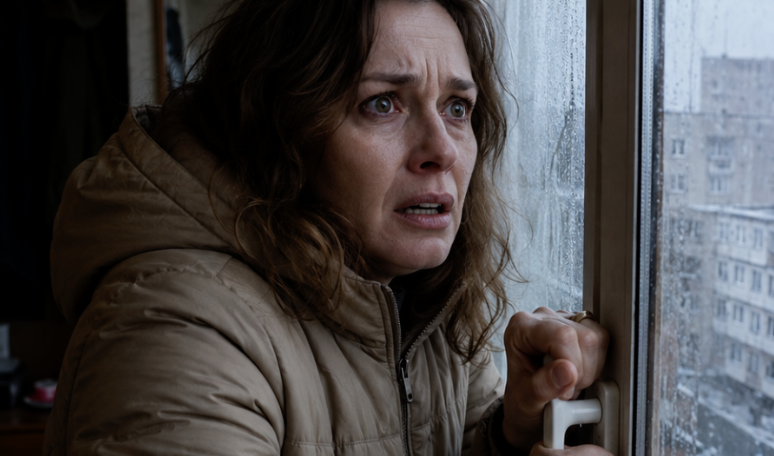
“Toma! Artyom, look at me! Why are you out on the balcony in just a T-shirt?!” Kira’s voice cracked into a hoarse rasp as she yanked hard on the stiff plastic handle of the balcony door.
The door would not budge. Behind the fogged double glass, sitting on an overturned enamel bucket, was her twelve-year-old son.
His lips had taken on a clear bluish shade, and his thin shoulders were shaking violently from heavy tremors.
A November draft swept across the unglazed balcony of the old Brezhnev-era apartment block, blowing icy flakes of snow straight onto the boy’s feet, which were shoved into worn-out summer flip-flops.
In his hands, Artyom was clutching the heavy metal chuck from an ancient Soviet drill.
Kira began pounding on the glass with her fists as hard as she could, ignoring the pain.
“Denis! Denis, damn you, come here right now!” she screamed.
Her husband came out of the corridor slowly, wiping his hands on a waffle towel.
Behind him, shuffling in felt slippers, appeared his father, Valery Stepanovich — a heavyset man with a crimson face and his usual cigarette stuck to his lower lip.
The air was thick with the smell of boiled cabbage, raw meat, garlic, and stale tobacco smoke.
“What are you yelling about the second you walk in?” her father-in-law boomed, squinting through the bluish smoke. “Take your shoes off first. You’ve tracked dirt everywhere, and Marina just washed the floors.”
“Open the balcony!” Kira grabbed her husband by the collar of his flannel shirt and shoved him toward the window. “Are you blind?! The child is turning blue!”
Denis fussed with the latch. The door flew open, letting a blast of icy wind into the stuffy kitchen. Kira rushed onto the balcony without taking off her boots, tore off her down jacket, and wrapped it around her trembling son.
“Mom… I didn’t mean to,” Artyom whispered, his teeth chattering.
The metal drill chuck slipped from his numb fingers with a loud clatter and rolled across the peeling concrete floor.
“I just wanted to tighten a little screw, and it fell off the table…”
“Quiet, sweetheart, quiet,” Kira said, rubbing his frozen hands and feeling a primal rage begin to boil inside her. “Go to the room. Now.”
She led her son into the warm room. Denis tried to take the boy from her, but Kira slapped his hand away with such force that her husband recoiled.
“Kira, why are you throwing yourself at me?” Denis muttered conciliatorily, with a guilty little smile. “Dad was just carrying out a lesson in discipline. The boy got into Grandpa’s tools without permission. Broke something. He has to understand responsibility. So what, he stood there for ten minutes…”
“Ten minutes?!” Kira spun around sharply. “It’s minus eight outside! He’s in a T-shirt! Have you all completely lost your minds with these ‘manly’ rules of yours?!”
Her sister-in-law Marina drifted in from the living room, holding a bowl of sticky dough. Her face, shiny with cheap cream, was twisted with disgusted annoyance.
“Oh, here comes the drama,” she snorted, dropping the bowl onto the flour-covered table. “You’d think someone beat him. It’s normal male upbringing. If we listened to you, we’d have to raise the boy like some delicate little lady. Your Artyom doesn’t know any limits at all. Yesterday he misplaced Dad’s Phillips screwdriver, today he smashed the drill. An IE-1035, by the way! Soviet-made! It was an eternal thing until your clumsy kid got his hands on it.”
Kira felt her breath catch. They had been living in this three-room apartment for three months already — waiting for the floor screed in their mortgaged new-build apartment to dry and for the rough renovation work to be finished.
For three months, Kira had silently swallowed their nitpicking, washed dishes after everyone, bought groceries for six people, and endured Valery Stepanovich’s endless lectures about how “people used to live and never whined.”
“Tyomochka, go to the bathroom, turn on the hot water, and warm your feet,” Kira ordered quietly, but in a tone of steel. “And lock the door from the inside.”
The boy, sobbing and wrapped in his mother’s huge down jacket, slipped down the corridor. The lock clicked.
Kira slowly unbuttoned the collar of her sweater. It seemed to her that the air in the kitchen had become as thick as jelly.
“Here’s how it’s going to be,” she said, leaning against the table and sweeping a pinch of flour onto the floor. “I tolerated your rules. I tolerated it when you, Valery Stepanovich, puff away in the toilet so badly that smoke stands like a column through the whole apartment. I tolerated it when you, Marina, take my shampoo that costs two thousand and wash your cat with it. But for what you just did to my son, I am going to destroy you.”
“Well, look at that, we’ve got ourselves a little commander!” her father-in-law barked, leaning heavily on the countertop with both fists.
Ash from his cigarette fell straight into the bowl of minced meat.
“Whose house do you think you’re in, you little runt?! I got this apartment from the factory. I worked myself to the bone for it! And you live here with everything handed to you, then you ruin my property! That drill is older than you. It cut through concrete like butter!”
“That drill of yours is a dangerous piece of scrap metal!” Kira did not step back even an inch. “Its cord is wrapped with electrical tape in three places. It’s terrifying to even plug it in!”
“Kira, please shut up,” Denis hissed, glancing at the front door as if the neighbors could hear them through reinforced concrete. “Dad is right. You can’t take tools without permission. I’ll buy him a new drill myself, whatever he wants… Dad, tell me which one you need. Makita? Bosch? We’ll buy it from my advance. The incident is over.”
Kira looked at her husband with such icy contempt that Denis fell silent and lowered his eyes.
Standing before her was not a forty-year-old design engineer, but a frightened little boy who was still afraid of being whipped for getting a bad grade in shop class.
“The incident is over?” Kira’s voice dropped to a frightening whisper. “So you think it’s normal that your own father put your child out in the freezing cold? And you sat here…” She pointed at the wooden board where freshly made dumplings lay in neat rows. “Sat here making this… and watched your son turn blue behind the glass?!”
“I wasn’t watching… I was listening to the TV… And anyway, it wasn’t even that cold out there!” her husband tried to justify himself, nervously fiddling with the button on his shirt.
“There are gaps out there as wide as a finger!”
“Oh, what a tragedy!” Marina cut in again, planting her hands on her hips. “Denis and I got worse than that when we were children. But we grew up into normal people and respect our elders. You modern mothers turn boys into mush. What your Artyom needs is a good belt, that’s what I’ll say.”
“What you need, Marina, is a decent man, not deadbeats from dating sites,” Kira shot back, and her sister-in-law instantly broke out in red blotches. “But this isn’t about you.”
Kira turned and strode quickly into the corridor.
“Hey! Where are you going? I’m not finished with you!” Valery Stepanovich roared, stomping heavily after her. “Look me in the eye when I’m talking to you!”
Instead of answering, Kira went to the old Soviet wall unit called Sputnik, which took up half the narrow corridor. She opened the lower door where, as she knew, her father-in-law kept his “especially important” documents, screwdrivers, rusty bolts, and receipts.
“What are you rummaging around in there for?! Get away from there!” the old man bellowed, trying to shove his daughter-in-law aside.
But Kira, with a strength surprising for her build, pushed him off with her elbow and pulled out a thick plastic envelope folder.
She returned to the kitchen and threw the folder onto the table with full force, straight onto the flour and dumplings. The folder burst open, and papers scattered out like a fan. Yellow receipts, white printouts, forms with red stamps.
“What is this?” Denis frowned, shaking flour off one of the sheets.
“Read it, Denisochka,” Kira said, her voice ringing with tension. “Read it out loud. Since we’re having an evening of honesty and respect for elders.”
Denis uncertainly lifted the sheet to his eyes.
“Court order… Justice of the peace, district number four… To recover from… To recover from Valery Stepanovich a debt on a microloan from the microfinance company Quick Money… Sixty-eight thousand rubles…”
“What?!” Marina snatched the sheet from her brother. “Dad, what is this?”
“None of your business!” the old man growled, trying to rake the papers off the table with his thick hands, spotted with age marks. His face went from crimson to ashen gray. “It’s a mistake! Scammers took out a loan in my name!”
“Really?” Kira pulled another sheet from the pile. “And this? A notice from the bailiffs. Accounts frozen, and a utility debt for this very apartment. You haven’t paid for electricity or water in four years, Valery Stepanovich.”
Dead silence hung over the kitchen. All that could be heard was the steady dripping of water from the untightened tap in the sink and the shower running in the bathroom, where Artyom was warming up.
Denis stared in shock from the papers to his father.
“Dad… you said your pension was going into… into a savings deposit. That you were saving up for a new car…”
“I don’t owe you any explanations!” her father-in-law snapped, but his voice betrayed him with a tremor. “It’s my business! I’ll manage!”
Kira gave a bitter smirk, crossing her arms over her chest.
“You’ve already managed. You take out microloans at insane interest rates to buy junk from Avito. Rusty boat motors, broken Soviet drills, chainsaws that don’t work! You’ve stuffed the garage, balcony, and pantry with that trash! You play the great homeowner and jack-of-all-trades, but in reality, you’re just an old, irresponsible hoarder who has dragged his family into a debt pit!”
“Shut your mouth!” the old man raised his hand, but suddenly stopped, swaying.
He leaned heavily on the table, gasping for air.
“Dad!” Marina rushed to him, supporting him by the elbow. “Get him water, Denis! Can’t you see he’s feeling sick?! You drove him to this, you snake!”
Denis darted to the sink and grabbed a glass.
“I don’t need water!” Valery Stepanovich shoved the glass away. “Get out of my house! You and your clumsy brat! I don’t want your spirit here!”
Kira did not even flinch. She stood upright, staring into the old man’s shifty eyes.
“With pleasure. But before we leave, Denis needs to learn the most interesting part.”
“Kira, enough, please,” her husband groaned, covering his face with flour-stained hands. “I can’t listen to this anymore.”
“No, you will listen!” Kira stepped toward her husband and forcibly pulled his hands away from his face. “Do you know why the collectors still haven’t knocked down this flimsy front door? Do you know why they haven’t cut off the electricity in this almshouse?”
Denis blinked in confusion.
“Because for the last six months, I have been secretly paying off these damned debts behind your back, Denis! From my own salary!”
“What?..” Denis recoiled. “You… you were giving our money to him? Why didn’t you tell me?”
She shifted her contemptuous gaze to her father-in-law.
“He begged me with tears in his eyes. And today this great educator, this model of masculine behavior, almost froze my child over a piece of Soviet plastic. That’s it. I’m done.”
Kira turned and headed down the corridor.
“Toma!” she shouted, knocking on the bathroom door. “Get out. Dry yourself, put on the warmest clothes you have. We’re leaving.”
Artyom came out of the bathroom. His hair was wet, his cheeks burned with an unnatural blush, but his lips had returned to a normal color. He was wearing a thick fleece jacket.
“Where are we going, Mom?” he asked quietly, sniffling. “To our place? But the floors are bare there…”
“It’s better to sleep on bare concrete in a sleeping bag than on featherbeds with relatives like these,” Kira cut him off, pulling a huge sports bag from the closet. “Pack your schoolbooks.”
She began frantically yanking jackets off hangers and shaking their shoes out of the entryway cabinet.
Denis slowly came out of the kitchen. He stopped in the doorway, watching his wife furiously stuff things into the bag. His face had frozen in an expression of deep, almost childlike shock.
“Kira… where are we going at this hour? Tomorrow is Sunday…”
“We’re going to our apartment. And you, Denis, can stay. Tomorrow is Sunday. Perfect time to go to the flea market with your father and buy another non-working carburetor. Borrow a couple thousand from a microloan place — that should be just enough.”
Marina rushed out of the kitchen.
“Denis, say something to her! She’ll leave now and file for divorce! She’ll start dividing your apartment!”
Denis looked at his sister, then shifted his gaze to his father, who was breathing heavily while sitting on a chair at the back of the kitchen, surrounded by trampled flour. The old man no longer looked like a fearsome master of the house. He seemed simply tired, sick, and very angry — a man tangled in his own lies.
Then Denis looked at Artyom. The boy stood in the corner of the corridor, clutching his backpack of schoolbooks to his chest, staring at his father with huge, frightened eyes. And in those eyes Denis suddenly saw himself — thirty years earlier, when his father had locked him in a dark pantry for three hours because he had lost one ruble outside.
Denis silently walked to the coat rack and took down his winter jacket.
“Denis? Where do you think you’re going?” his father’s voice did not sound threatening now, but somehow pitiful. “Who’s going to finish making the dumplings? Your late mother started that tradition… Tomorrow is Sunday.”
Denis zipped his jacket all the way up to his chin.
“The traditions are over, Dad,” he said quietly but with complete firmness. “And so is my money. Deal with the bailiffs yourself.”
He took the heavy sports bag from Kira’s hands and slung it over his shoulder.
“Toma, put your hat on. It’s cold outside.”
The three of them left the apartment without saying goodbye. When the heavy metal door slammed shut behind them with a clang, cutting off the smell of garlic and stale tobacco, Kira exhaled loudly for the first time that evening.
Six months passed.
In their new apartment on the nineteenth floor of a high-rise, it smelled of fresh paint, wood shavings, and new laminate flooring. The renovation was not finished yet: wires stuck out of some of the walls, there was a cheap table from a hardware store in the kitchen instead of a fitted set, and an air mattress lay in the bedroom.
Artyom sat on the floor in his room, surrounded by instructions and tiny parts. He was intently assembling a programmable robot from the kit his father had given him for his birthday.
“Mom, Dad! Come here!” he shouted happily. “It moved! Look!”
Kira came out of the bathroom, drying her hands with a towel. Denis looked up from assembling a bookcase and came over to his son. The plastic robot, buzzing with its little motors, awkwardly climbed over a wire lying on the floor.
“Well done, engineer,” Denis said, ruffling his son’s hair. “Your hands grow from the right place.”
Kira stepped up to her husband and leaned against his shoulder. Denis wrapped an arm around her waist and pulled her close.
“He called today,” Denis suddenly said quietly, watching the robot’s blinking LEDs.
Kira tensed, but said nothing.
“He asked me to help move things to the dacha. Said the bailiffs seized the TV and washing machine to cover the debt. Marina had a huge fight with him and moved into a rented apartment. She couldn’t handle living in strict austerity.”
“And what did you say?” Kira asked evenly.
“I said I didn’t have time. That I was assembling a bookcase for my son,” Denis shrugged. “I sent him five thousand for groceries. That’s all. I’m not solving his problems anymore.”
Kira gently kissed her husband’s stubbly cheek. She knew how difficult that decision had been for him. Uprooting the fear of his father from inside himself had turned out to be harder than leveling the walls in that apartment.
“You know,” Kira said, looking out the window at the glittering lights of the night city. “Sometimes I think — what if Artyom hadn’t dropped that damned drill back then? Would we have kept putting up with it?”
“No,” Denis shook his head. “The abscess would have burst anyway. It’s just… sometimes you need a severe cold to wake up and realize you’re freezing alive.”
He bent down, picked up the plastic robot from the floor, and handed it to his son.
“Hold it carefully, Toma. If you break it, it’s all right. We’ll fix it together. We’ll print a new part on the printer we’re going to buy.”
Artyom smiled and buried himself in the diagrams again.
Their home did not have expensive dinner sets, perfect order, or traditional Sunday lunches with dumplings. But there was no fear there. And no one ever froze on a balcony again, paying for someone else’s ambitions and mistakes.