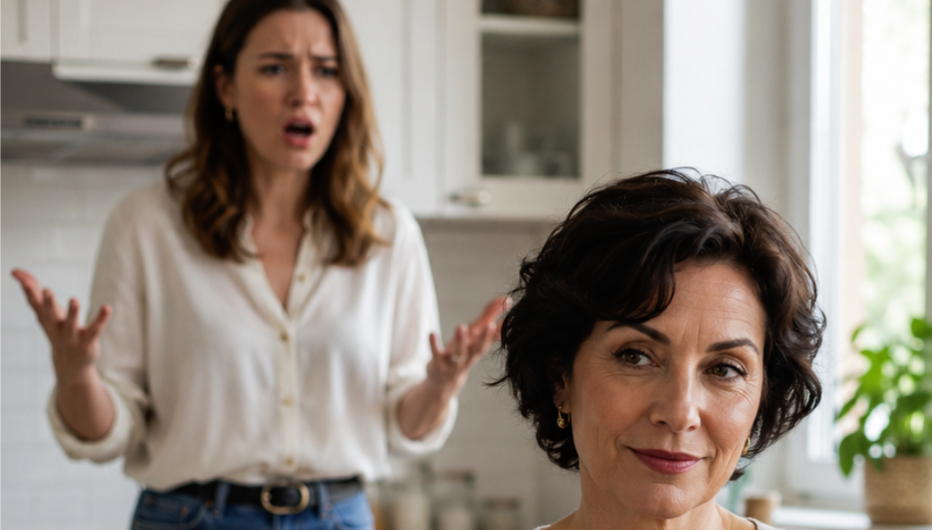
“Sell the studio apartment,” Regina said, as casually as if she were asking me to pass the salt.
I didn’t even understand at first. I was standing there with a plate in my hands, hot steam from the borscht rising toward my face. And she sat across from me, examining her long nails — raspberry-colored polish, fresh, probably done yesterday.
“What studio?” I asked.
“Yours. The one-room apartment on Lenin Street. It’s just sitting empty anyway.”
It wasn’t sitting empty. I rented it out. Eighteen thousand a month. I had saved for eight years to buy it. Denied myself everything — no vacations, no fur coat, no proper dental work. I only got my teeth fixed last year, by the way.
But there was no point explaining that to Regina. She always counted other people’s money more easily than her own.
“Why do you need to sell my apartment?” I set the plate down. Carefully. Though I wanted to do it not carefully at all.
“We have a debt. Valery took out loans. More than three million.”
She said “we,” but what she meant was, “you have to help.” I had heard that seven times in five years. Seven times she had come over, sat just like that, examined her nails, and asked for money.
The first time — fifty thousand for something “urgent.” The second — one hundred twenty thousand, “just to tide us over until payday.” The third — one hundred fifty thousand. Then more, and more, and more. I wrote it all down. I have a notebook, blue, squared paper. Every amount is there. Every date. Every promise of “I’ll pay it back in a month.”
She paid back — zero. Not a single ruble in five years. Eight hundred forty thousand. I counted.
I remember every time. I remember how she sat on that same chair and said, “Nelli, you understand, we’re not strangers.” I remember opening my banking app and transferring the money. How she immediately checked her phone to see if the money had arrived — and smiled. Wide, with raspberry lips matching her nails.
And then she disappeared. For a month, two months. Until the next request.
Once I tried to remind her. Carefully, over the phone: “Regina, you promised to return the one hundred twenty thousand.” She laughed and said, “Nelli, you’re an accountant, you have professional deformation. Family isn’t debit and credit.” And she hung up.
Family isn’t debit and credit. But eight hundred forty thousand is almost three of my monthly salaries combined. Just like that.
“Regina, I am not selling the studio apartment.”
She raised her eyes. Slowly. As if she hadn’t understood.
“This is for the family, Nelli. Artyom is my brother. You’re his wife. We are one family.”
One family. I had been in this family for twenty-four years. And for twenty-four years Regina appeared whenever she needed something. For a birthday — without a gift, but with a request. For New Year’s — with a debt note in her pocket. Not hers, of course. Mine.
“No,” I said.
Regina stood up. The chair scraped across the tile. She grabbed her bag — large, leather, new, by the way — and headed for the door.
“Artyom knows about this,” she threw over her shoulder from the hallway.
He knew. Of course he knew. He always knew. And he always stayed silent.
The door slammed. I stood alone in the kitchen. The borscht was getting cold. My hands gripped the edge of the table — my fingers white. I didn’t unclench them right away.
Then I sat down. Pushed the plate away. I didn’t want to eat. I had spent three hours making that borscht — roasting the beets, simmering the broth over low heat. For whom? For Regina, who hadn’t even tasted it.
I opened the notebook. Flipped to the last entry. “February 14 — 150,000 rubles. ‘For one month, Nelli, I swear.’” Three months had passed. Silence.
That evening Artyom came home from work. Quiet. He ate the soup in silence. I waited. He couldn’t hold out past the second bowl.
“Regina called.”
“I know. She was here.”
“Nelli, maybe you could think about it? They really have problems. Valery didn’t do it on purpose, the business just didn’t work out.”
Business. In twelve years Valery had opened four “businesses.” Shawarma, a car wash, flower delivery, and something with cryptocurrency. Every time Regina came and explained, “This time it will definitely take off.” Every time I gave money. Every time — a hole.
“Artyom, I bought the studio with my own money. I saved for eight years. Do you remember?”
He remembered. He looked away.
“Well, maybe at least part of it?”
“Part of what? Part of my apartment? Or part of my life that I spent earning it?”
He didn’t answer. I stood up and cleared the plates. The conversation was over. But I knew: for Regina, it wasn’t.
Three weeks later, the dacha happened.
I arrived on Saturday morning to plant seedlings. It was April, the soil had already warmed up. I opened the gate and froze.
In the yard — three cars. On the veranda — people. Eight of them. Regina, Valery, their daughter Kristina with her husband, and some others — unfamiliar faces.
The grill was smoking. My grill. My skewers. And my dacha.
I had bought that plot eleven years ago. Six hundred square meters, a little falling-apart house that I rebuilt. I found the work crew myself, made the plan myself. Foundation, walls, roof, bathhouse, fence — almost two million over the years. I remember every board. Every can of paint. Every evening after work when I came here with a tape measure and a notebook instead of resting.
Regina saw me and waved. Cheerful. Her raspberry nails glittered in the sun.
“Nelli! Come in! We’re making shashlik!”
I walked over. Looked at the fence. Three sections of the plastic picket fence were broken. Valery’s car, apparently, hadn’t made the turn. He had parked right on my garden beds. The very ones where I had been growing strawberries for three years. A special variety, “Queen Elizabeth.” Four seasons of care.
The wheels stood directly on the bushes. I could see the red berries — crushed, in the dirt, pressed into the tire tread.
“Valery, you drove over the beds,” I said.
He didn’t even turn around. He was rotating the skewers.
“Ah, well, sorry. There was nowhere to park.”
Nowhere. Six hundred square meters, and a three-meter-wide entrance to the house. And he “couldn’t find a place.” Three years of strawberries — under the wheels.
Regina rushed over.
“Nelli, don’t start. We’re family. So what, garden beds. You’ll plant new ones.”
I silently walked around the plot. The fence — at least forty-five thousand to repair. The beds — three years of work, seedlings, fertilizer, covering material. About thirty thousand. Not counting my time.
I went into the house. On the veranda — dirty boots. Someone’s, unfamiliar. Tracks all the way to the bedroom. In the kitchen — a mountain of unwashed dishes. My dishes. Plates with dried ketchup, glasses with fingerprints. In the sink — grease, streaks. Someone had fried eggs in my frying pan and hadn’t washed it.
In the bathhouse — wet towels on the floor. Three of them. New ones, I had bought them in March. Crumpled, trampled.
I went back outside. Counted the bottles by the grill. Nine empty beer bottles, two wine bottles. Trash was lying right on the ground — bags, napkins, disposable cups.
“Regina, who is going to pay for the fence?”
She laughed. Loudly, across the whole yard.
“Oh, Nelli. You know our situation. What fence? We have three million in debt!”
Three million in debt, but a new bag. Three million in debt, but shashlik for eight people — the meat wasn’t cheap, I saw the packaging, Miratorg. Three million in debt, but a manicure every two weeks.
I took out my phone. Photographed the fence. The beds. The wheels on the strawberries. The dishes in the sink. The towels on the bathhouse floor.
“What are you doing?” Regina frowned.
“Calculating the damage.”
She came closer. Lowered her voice so the guests wouldn’t hear.
“Are you serious? Over a fence? Nelli, we’ve been coming here for ten years. Ten years! This is our dacha too.”
Yours. You’ve been coming here for ten years. And for ten years I’ve paid for the electricity, repaired it, painted it, carried out your trash. It’s yours when you’ve invested even one ruble. But there hadn’t been a ruble. Not one.
“This is my dacha, Regina. Mine only.”
She stepped back. Something flashed in her eyes — not hurt, no. Anger. Pure, brief.
That evening I sent Artyom the photos and the amount: seventy-five thousand. Fence plus beds.
He called an hour later.
“Nelli, why would you do that? She’ll be upset.”
She’ll be upset. Not me, whose three years of work had been crushed. Her.
“Artyom, let her pay.”
“All right, I’ll talk to her.”
He talked. Regina didn’t pay. Of course.
But it wasn’t about the money. It was about the way Artyom said, “She’ll be upset.” In all these years, he had never once asked: what about you?
I sat in the kitchen. The notebook lay in front of me, blue, squared. Eight hundred forty thousand in loans. Seventy-five thousand in damages. Total — nine hundred fifteen. Not counting ten years of free use of the dacha.
Ten years. Every summer, every long weekend, every May holiday — Regina and her family at my dacha. I paid for the electricity. I repaired the roof after their visits. I bought bed linen that Kristina spilled wine on. I painted the walls that Valery scraped while dragging his fishing rods through the doorway.
Ten years. Not a kopeck. Not a thank-you. Only “we’re family.”
Family lunch at my mother-in-law’s was every first Sunday of the month. A tradition.
Zinaida Pavlovna, Artyom’s mother, set the table for eight. Cabbage pie, aspic, cutlets. I brought a salad. Regina came empty-handed. Always.
That day everything went as usual. Zinaida Pavlovna talked about her blood pressure. Valery was silent. Kristina looked at her phone. Artyom ate a cutlet.
And then Regina put down her fork. Quietly. Demonstratively.
“Mom, do you know Nelli refused to help us?”
Zinaida Pavlovna stopped chewing.
“Help with what?”
“We have a debt. A serious one. We asked Nelli to sell the studio apartment. She refused.”
I felt blood pound in my temples. The studio. My studio. She said it as if we were talking about some useless stool in a storage closet.
Zinaida Pavlovna looked at me.
“Nelli, is that true?”
I wanted to stay silent. For twenty-four years I had stayed silent at these lunches. When Regina criticized my borscht. When she said I was “too economical” — that was what she called greed. When she hinted that Artyom could have “found someone better.”
But that day — I couldn’t.
“It’s true,” I said. “Regina asked me to sell my studio apartment. The apartment I spent eight years buying. With my own money. Without Artyom’s help, without anyone’s help. So I could pay off Valery’s debts, which he took on for his business projects. Four in twelve years. Not one worked.”
Silence. Zinaida Pavlovna’s fork clinked against her plate.
Regina turned red.
“You’re twisting everything! It’s not like we were asking for nothing! We would have paid it back!”
“Paid it back?” I looked her in the eye. “In five years you borrowed eight hundred forty thousand from me. Seven times. Not one ruble returned.”
Artyom jerked.
“Nelli, not here.”
Not here. Not now. Not in front of Mom. I had heard that all these years. Except Regina had calmly declared right here that I had to sell my apartment. She was allowed to. But I wasn’t allowed to answer?
“Exactly here,” I said. Quietly. Without shouting. “Because this is exactly where Regina decided to discuss my studio apartment.”
Regina jumped up.
“You came into this family with nothing! You had nothing!”
I didn’t flinch. Though the words hit precisely. Under the ribs.
“With nothing. Correct. And everything I have now, I earned myself. What about you?”
Regina grabbed her bag and flew out of the apartment. Valery after her. Kristina too — she didn’t forget her phone, I’ll give her that.
Zinaida Pavlovna was silent. Artyom sat with his eyes closed.
My mother-in-law sighed. Heavily, with a whistle — her blood pressure.
“Nelli, why did you have to do it in front of everyone?”
I looked at her. Over the years I had respected this woman. Brought her medicine, drove her to the doctor when Regina “didn’t have time.” Sat with her after surgery — four days in the hospital, because Regina “couldn’t, Kristina was little.” Kristina was twenty-two then.
“Zinaida Pavlovna, Regina brought this up herself. In front of everyone. I answered. Also in front of everyone.”
My mother-in-law turned toward the window. The plates were getting cold. A film had formed over the aspic — I noticed it out of habit, a stupid accountant’s habit of noticing details.
I stood up. Collected the plates. My hands weren’t shaking. Surprisingly — they weren’t shaking. Inside, it was empty and clear. Like after a storm, when the clouds are gone and the air rings.
Artyom was silent the whole way home. So was I. At home he turned on the television. I brewed tea. Mint. Sat alone in the kitchen.
Silence. Good silence. Without demands, without “sell it,” without “we’re family.”
But I knew Regina wouldn’t stop. She never stops.
Two days later Artyom came home from work earlier than usual. He sat down in the kitchen. Folded his hands in front of him. I understood immediately — there would be a conversation.
“Mom called,” he said.
“And?”
“She’s asking you to apologize to Regina.”
I set down the kettle. Slowly. Pressed the button, waited until it clicked.
“For what?”
“For doing it in front of everyone. About the money. Mom thinks those were…” he searched for the word, “personal matters.”
Personal. Eight hundred forty thousand — “personal matters.” But selling my studio apartment was apparently a public discussion.
“Artyom, I am not going to apologize.”
He rubbed the bridge of his nose. A gesture I had seen a thousand times. When he doesn’t know what to do, he rubs the bridge of his nose, as if that will help.
“Nelli, please understand. She’s my sister. My mother. Am I supposed to be torn between you?”
Between us. In twenty-four years he had never been “torn.” He had simply always been on Regina’s side. Quietly, without scandals, but on her side. “Just give her the money, just let her use the dacha, just ignore it.” Always — me to give in, me to stay silent, me to endure.
“Artyom, you don’t need to be torn. I’m not asking for anything. I’m simply saying: I will not apologize.”
He went into the room. Television. The familiar sound — sports channel, the hum of a commentator.
The next day Regina sent a voice message. Long, three minutes. I listened to the first twenty seconds. “Do you understand what you’ve done? Mom is crying! Artyom can’t find peace! You’re destroying the family over some garden beds!”
Some garden beds. Some eight hundred forty thousand. Some ten years.
I deleted the voice message and blocked Regina.
A week later Artyom’s cousin Lyuba called me.
“Nelli, do you know what Regina is telling everyone?”
“What exactly?”
“That you refused to help her. That they have children, debts, while you’re sitting on two apartments and have a dacha. She says you’re greedy. That you’re turning Artyom against his family.”
Children. Kristina is twenty-six. She has her own apartment. What children? But for Regina, “children” is a trump card for every occasion.
“Lyuba, thank you for telling me.”
I hung up and took out the notebook. Blue, squared. Flipped through the pages. Seven loans. Dates. Amounts. Promises.
Then I opened the folder with documents. The dacha — registered in my name. The studio — registered in my name. Everything mine. Everything paid for with my money.
The decision came calmly. Without anger. Without hysteria. Simply as a fact: enough.
On Saturday I went to the dacha. Called a locksmith. He arrived two hours later — a young guy, quick.
“All the locks?” he asked.
“All of them. Gate, house, bathhouse, shed.”
Four locks. Eight thousand six hundred for work and materials. I paid and received new keys. Two sets — one for me and one for Artyom.
None for Regina.
Then I removed the mailbox where the spare key had been kept. Regina knew about that hiding place. Had known for ten years.
At home I wrote a message. Short. I unblocked Regina specifically for it.
“Regina, the locks at the dacha have been changed. You no longer have keys. When you return the eight hundred forty thousand, we’ll discuss it.”
The phone rang four minutes later. I timed it.
“What did you do?!” Regina’s voice was so loud I moved the phone away from my ear. “What locks?! This is our dacha!”
“Mine,” I said. “Registered in my name. Bought with my money. Eleven years ago.”
“Artyom is your husband! That means it’s his too!”
“Artyom has a key.”
“And us?! We’ve been going there for ten years!”
“For free,” I said. “Ten years. You didn’t pay for electricity, or water, or repairs. Just the electricity alone over that time came to around one hundred twenty thousand. I paid it. Not you.”
Regina started screaming.
“You! You did this on purpose! Because of money!”
“Because of nine hundred fifteen thousand, to be precise,” I answered. “Eight hundred forty — loans. Seventy-five — fence and garden beds. Count it yourself.”
In the background Valery’s voice: “What happened?” And Regina to him: “She changed the locks! Bitch!”
Bitch. Twenty-four years in one family — and “bitch.”
“Regina,” I said. “You are on speakerphone right now. Artyom is nearby. He hears everything.”
Silence. Then beeps.
Artyom stood in the kitchen doorway. He really had heard.
“Why did you do that?” he asked. Quietly.
I looked at him. Twenty-four years. All those years I had been doing everything “wrong.” Cooking wrong, answering his sister wrong, managing my own money wrong.
“How should I have done it?” I asked. “Sold the studio? Given away the dacha? Lent more? How many times, Artyom? An eighth? A ninth?”
He didn’t answer. He stood and looked at me as if he were seeing me for the first time. Maybe he really was. In all these years I had never raised my voice. Never issued ultimatums. Never said “me or her.” I simply worked, saved, paid, endured.
“Nelli, she’s my sister,” he said.
“And I’m your wife. For twenty-four years. And in all that time, you have never once told her: ‘Pay Nelli back.’ Never once said: ‘Don’t touch Nelli’s dacha.’ Not once.”
He stood there. Silent. Then went into the room. Television.
I stayed in the kitchen. Closed the notebook. The kettle boiled. I poured myself tea. Sat by the window.
Rain was falling outside. April rain, warm. Drops ran down the glass in even lines. I watched them and felt something inside me straighten. As if I had finally unbent my back after long work in the garden.
The phone was silent. Artyom was silent. And for the first time in a long while, I didn’t want to explain anything.
Two months passed. Regina doesn’t call. Artyom goes to see her once a week, alone. He returns silent, eats dinner, goes into the room. We don’t argue. It has simply become quieter. As if something bulky and noisy had been carried out of the apartment, and now it feels unusual — so much air.
At the dacha, it’s quiet. I planted new strawberries. A different variety, “Asia.” I repaired the fence — at my own expense, of course. Thirty-eight thousand, because I found a cheaper crew. In the evenings I sit on the veranda with a book. No one arrives without asking. No one crushes the garden beds with their wheels.
Lyuba told me: Regina goes around the relatives saying I “drove her out of the family.” That I’m greedy. That the studio apartment is “shared, Artyom is her husband after all.” That the dacha “also belongs to everyone by fairness.”
Zinaida Pavlovna called once. Asked whether I wanted to “be the first to extend a hand.” I said, “Zinaida Pavlovna, I extended my hand seven times. With money. It never came back.”
She sighed and hung up.
Regina never returned the money. Not one ruble of the nine hundred fifteen thousand.
And I sleep peacefully. For the first time in ten years, there is no one unwanted at the dacha. Silence, strawberries growing, the fence intact. The studio apartment is rented out — eighteen thousand drops into my account every month. Mine.
But sometimes in the evening, when Artyom leaves to visit his sister, I sit alone and think.
Did I go too far with the locks and the public accounting? Should I have done it differently — talked, explained, waited? Or did I do the right thing — I waited ten years, enough was enough?