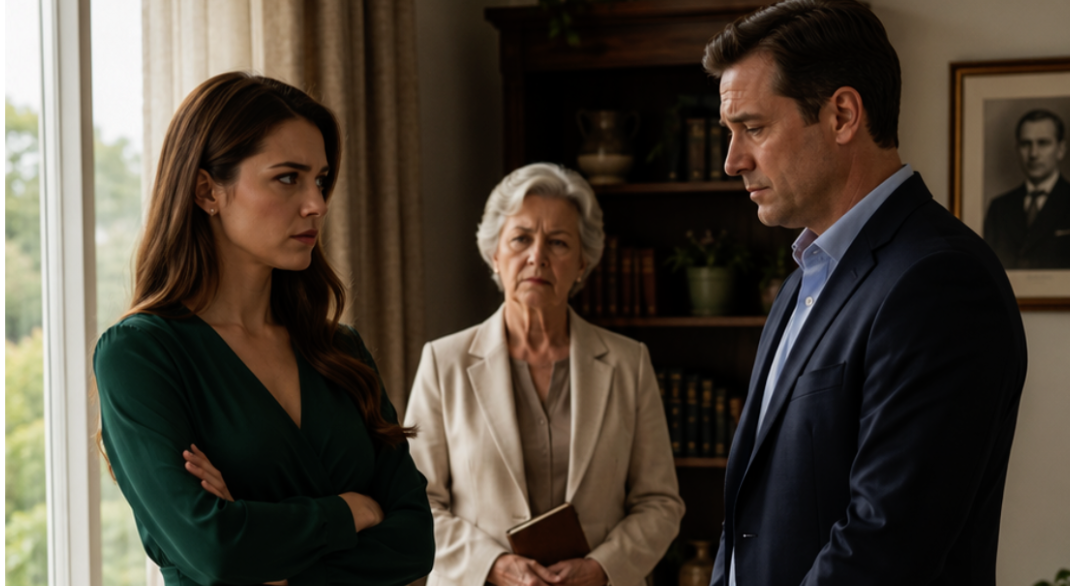
“Don’t you understand? The apartment should belong to my mother! You would never have achieved anything without us, so don’t even doubt it!”
For as long as she could remember, Anna had navigated her existence by relying on a singular, desperate mantra: Everything will be fine. Just endure it a little longer. Just a tiny bit longer.
She had endured with the quiet, tragic resilience of a stone weathering a relentless storm. Her entire life had been an exercise in swallowing her own discomfort for the sake of others. First, it was her emotionally absent father; then, a deeply toxic ex-husband who had stripped her of her confidence. Next came the tyrannical supervisor at the shopping mall, the crushing, inescapable weight of a decades-long mortgage, and the hollow, suffocating silence of her bedroom.
And then came Sergey.
But now, staring at him, her lifelong patience felt like a devastating fraud. It was a cheap psychological cosmetic—like heavy foundation plastered over a deep, purple bruise. It might successfully obscure the visible mark from the outside world, but beneath the surface, the agonizing tenderness remained, flaring up with the slightest touch.
Sergey had materialized in her life like an ambassador from a tranquil, distant continent. He was the antithesis of the chaos she had known: impeccably calm, effortlessly polite, and remarkably devoid of vulgarity. He listened with rapt attention, served her coffee in bed with gentle hands, and seemed uniquely capable of ironing out not only his crisp dress shirts but the deep, ragged wrinkles of her wounded soul.
When a woman finds herself well into her forties, carrying the scars of a thousand minor betrayals, a man like Sergey does not merely look like a good catch—he looks like an absolute mi
racle. For a long, cautious period, Anna observed him through the lens of deep suspicion. She relentlessly analyzed his actions, convinced that “It can’t be this easy. There has to be a trap somewhere.”
Yet, try as she might, she could not locate the snare. Or, perhaps, her trauma had simply trained her to look for the wrong kind of danger.
Their origin story was profoundly mundane, yet it held a certain pathetic charm. They collided in a brightly lit pharmacy. Anna stood at the counter, grimly purchasing industrial-strength migraine medication, while Sergey stood beside her, asking for motherwort drops with the mild, apologetic demeanor of an anxious pensioner.
“Quite a collection we’ve got here, huh?” he had murmured, a self-deprecating grin playing on his lips.
In that fleeting, sterile moment, something rigid within Anna’s chest uncoiled. They walked out into the chilly air together, shared a tepid cup of tea, and ended up wandering aimlessly through a chaotic shopping mall. They spent hours laughing breathlessly at a pair of ridiculous, rabbit-shaped slippers discarded in a discount bin.
Exactly six months later, Sergey arrived at her doorstep, clutching a battered travel bag like a lifeline.
“I’m tired of living alone, Anya. Unless you object…” he had mumbled, awkwardly scratching the back of his neck. He looked less like a man asking to move into a woman’s home and more like a timid neighbor asking to borrow a phone charger.
Anna did not object. Her three-room apartment on the second floor was her fortress. It had cost her immense blood, unimaginable sweat, and eight grueling years of predatory mortgage payments. But for Anna, the space itself was secondary; the true luxury was the prospect of having a living, breathing human beside her. She simply craved a partner who wouldn’t instantly default to saying, “It’s your own fault.”
The inaugural months were cinematic. They shared tender morning kisses, a neatly organized refrigerator, and delightfully silly notes plastered across the bathroom mirror. Sergey cheerfully washed the dishes, hauled heavy grocery bags from Pyaterochka without a sigh, and never once complained when she subjected him to A Woman’s Fate for the third consecutive evening. He even managed to navigate the perilous waters of her best friend, Vika—a woman whose personality was as sharp and unexpected as a needle hidden in a bra.
The psychological climate in the apartment did not change overnight. The clouds gathered with a terrifying, imperceptible slowness. It began with the erosion of presence. Sergey started coming home late, armed with a rotating arsenal of perfectly plausible excuses:
“We’re overwhelmed at work.”
“It’s the chief accountant’s birthday.”
“A colleague got divorced. I need to support him.”
Anna would nod, projecting understanding as she mechanically tossed chopped onions into a sizzling frying pan. “Of course. Go.”
But a visceral, primal instinct began to scratch at the edges of her intuition—a sound like rats scurrying frantically beneath the linoleum. He spoke less. The casual, affectionate touches evaporated. Soon, he migrated to the living room sofa, offering a litany of “supposedly” valid reasons: supposedly, his lower back was flaring up; supposedly, he didn’t want his tossing and turning to disturb her delicate sleep.
Anna was not naive, nor was she a teenager blinded by first love. The definitive crack in the facade appeared on a mundane Tuesday. Sergey had carelessly left a printed document exposed on the kitchen table.
It contained dense, bureaucratic legalese regarding a deed of gift, a spouse’s consent, and property acquired before marriage. She did not possess a law degree, but the vocabulary was a hammer blow to the skull. She did not confront him in the heat of the moment. Instead, she methodically cooked soup, her eyes locked onto the desolate street outside the window.
That evening, as Sergey mechanically chewed a homemade cutlet, she struck.
“Sergey… what were those documents on your desk? The ones about the apartment?”
He froze. The chewing stopped. Slowly, deliberately, he placed his silver fork on the porcelain plate.
“Anya, what are you talking about? My mother and I were discussing it. She’s having housing problems, you know that. She has debts, and her apartment is old. We were just considering ways to help her. Theoretically,” he stammered, his eyes darting anywhere but her face.
“With my apartment?” Anna asked. Her voice was terrifyingly calm, carrying a quiet density that should have made his bones ache.
He rolled his eyes, immediately pivoting to the defense mechanism of gaslighting. “You always dramatize everything. We’re a family, aren’t we? Or are you only interested in yourself?”
Anna remained silent, recognizing the exact shape of the trap she had finally found. She had already survived the brutal division of property with a man once before, a war that had left her with nothing but a dented saucepan and a dusty wardrobe. This apartment was her armor. It was the sole remaining fragment of the universe that belonged entirely, unconditionally to her. And now, this “miracle” of a man intended to hand it over to his mother.
Raisa Pavlovna was an entirely different species of psychological warfare. Externally, she presented as a harmless, sweet elderly woman. Internally, she operated with the relentless, crushing machinery of a military tank.
During their first encounter, she had smothered Anna against her chest, cooing the diminutive “dear Annushka.” Within a week, the invasive phone calls commenced, testing the boundaries of Anna’s domain:
“Annushka, do you happen to have any extra meat? I’m making soup…”
“You should iron Seryozhenka’s shirt. He’s never been able to manage it since childhood…”
Anna complied, bound by the social contract of familial duty. But every time the woman departed, a distinct, foreign odor lingered in the apartment—not the smell of stale socks or boiled cabbage, but the sticky, oppressive sensation that Raisa Pavlovna had deposited her unsolicited judgments directly onto Anna’s pristine pillows.
The strategy became glaringly obvious. Sergey’s vocabulary shifted; the pronoun “we” no longer referred to Sergey and Anna, but to Sergey and his mother.
Then came the audio message. Left inadvertently on the answering machine, Raisa Pavlovna’s voice echoed through the hallway:
“Seryozhenka, I’ve been thinking. Annushka doesn’t have children, does she? She doesn’t need such a large apartment. Think about how it could be transferred. A deed of gift is the most profitable option. I believe in you, son. You just need to know how to persuade her.”
When Raisa Pavlovna finally arrived to execute the plan, she did not come merely “for a visit.” She arrived laden with two massive bags, a steaming pot of cabbage soup, and her own pillow. She spoke with the booming, commanding authority of an old Soviet radio announcer, announcing she would stay “temporarily” due to a fabricated pipe issue at her own home.
She immediately annexed the territory. She claimed the spare room, violently displacing Anna’s exercise bike into the master bedroom. It stood there like a metal monument, silently screaming: “You are not the mistress here.”
The climax of the invasion occurred over breakfast. Raisa Pavlovna casually suggested that since Anna had no children, she should surrender her large office space so Raisa could move in permanently.
“The room is not empty,” Anna interrupted, the vibrating string of her patience nearing its snapping point. “My books are there. It’s my office. I work there.”
Raisa Pavlovna snorted, dismissing Anna’s livelihood as a trivial hobby. “At your age, you should rest more instead of staring at a screen all day.”
Anna stood up. “At my age, Raisa Pavlovna, I’ve already earned enough to buy a home twice. While you were living on subsidies and relying on your son’s help.”
Anna confided in Vika, whose response was characteristically blunt and piercingly accurate: “A man who lives in your apartment and doesn’t pay a single kopeck is not a husband. He’s a tenant. Just without a rental agreement.”
That night, fueled by her thirteenth cup of bitter, boiling coffee, Anna shed her martyr complex. She sat in the dim kitchen, transforming her agonizing grief into a cold, clinical military strategy. She drafted her protocol of survival:
Audit all documentation: Ensure the pre-marital purchase papers were pristine and secure.
Duplicate and protect: Create notarized copies of the deed and lock them away off-site.
Digital lockdown: Place impenetrable passwords on all personal laptops and devices.
Legal counsel: Retain a ruthless, uncompromising property lawyer immediately.
Surveillance: Activate the phone’s voice recorder and hide it beneath the living room armchair to capture every whisper of their conspiracy.
When Sergey returned the next day, triumphantly bearing orthopedic slippers as a pathetic peace offering, Anna refused to play the grateful wife.
“Slippers are not compensation for an apartment,” she stated, her voice devoid of emotion.
“You’ve lost your mind,” he hissed, the mask of the gentle, polite man fully slipping to reveal the entitled opportunist beneath. “I only wanted what was best. I wanted everyone to be comfortable.”
“Did you ever once ask whether I was comfortable?” Anna replied quietly.
The absolute breaking point—the detonation—arrived when Raisa Pavlovna formally announced her intention to stay permanently, framing it as an act of benevolent grace. “A home is not walls,” the older woman declared sweetly. “A home is love.”
Anna looked at Sergey, offering him one final chance to defend their partnership. He merely shrugged, bored, entirely complicit in his mother’s hostile takeover.
In that profound silence, the old Anna—the woman who smiled, endured, and shrank herself to accommodate the greed of others—died completely.
The following morning, Anna bypassed theatrics and went directly to the registry office to file for divorce. When she returned, Sergey scoffed, confident in his imagined leverage, demanding half of the property.
“No, it doesn’t,” Anna fired back, her eyes locked onto his with the intensity of a sniper. “I bought it before the marriage. The documents are with a notary. And don’t even think about telling me you contributed through renovations. The only thing you ever did in this apartment was break the kitchen faucet. You’re a guest. An ex-guest.”
The ensuing psychological war was brief and brutal. When Raisa Pavlovna spitefully burned Anna’s notebook, claiming it was “scrap paper,” Anna delivered her final verdict.
“Tomorrow, you will no longer be here. The local police officer will explain everything. You are not registered here. You have two days. After that, suitcase, train station, goodbye.”
Sergey attempted to escalate, his face twisting in rage as he raised a hand toward her. But Anna did not flinch. She stood her ground, her voice dropping to a dangerous whisper.
“Try it. Everything is recorded. The camera, the voice recorder—everything. My lawyer is as vicious as a starving guard dog. Touch me with one finger, and you’ll be thrown onto the street without even getting to take your suitcase.”
The cowardice inherent in all parasites took over. He turned pale; his mother trembled in the hallway, muttering pathetic complaints about “gratitude.”
“Gratitude means respect,” Anna sneered, watching them like one watches mold creeping up a wall. “You barged into someone else’s life as though you were rushing into a store during a sale.”
They evacuated that very evening, dragging their cooking pots, suitcases, and bruised egos into the cold night.
Anna systematically stripped the bed linen, threw the unfamiliar orthopedic slippers into the garbage chute, and aggressively scrubbed the floors, washing away the lingering scent of manipulation and entitlement. Finally, she sat alone in her kitchen. The silence around her rang, deep and absolute. It was no longer a hollow, suffocating void; it was the pristine, beautiful sound of reclaimed sovereignty.
She poured a glass of wine, took a deliberate sip, and smiled.
“Well, Anna, congratulations. You like yourself again.”