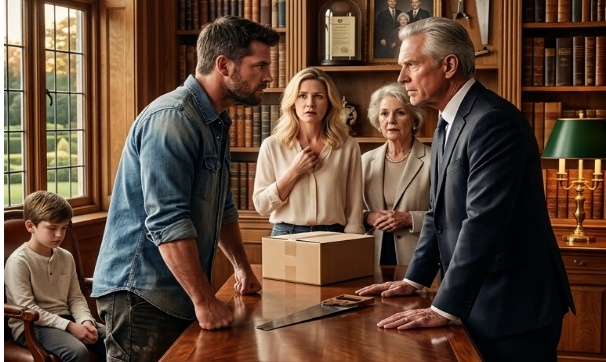
The air within my workshop usually possessed a sacred quality—a meditative blend of suspended oak dust, the sharp, medicinal tang of linseed oil, and the grounding scent of freshly shaven walnut. It was a sanctuary where time was measured not by a ticking clock, but by the gradual refinement of a curve or the smoothing of a grain. But on that Tuesday, the atmosphere was violated. It was heavy, not with the productive weight of labor, but with a humid, suffocating layer of desperation that rolled off my family in visible waves.
My father, Richard, stood at the center of the room like a displaced monolith. His tailored charcoal suit, which likely cost more than my first three lathes combined, looked absurdly out of place against the backdrop of industrial band saws and stacks of seasoning lumber. His face, usually a mask of disciplined, high-society indifference, was now etched with a raw, almost skeletal panic.
Beside him, my brother Marcus—the family’s “Golden Boy,” the Wall Street oracle—was a shadow of his former self. He sat slumped in a hand-carved Windsor chair I had spent eighty hours perfecting, staring at the sawdust on the floor as if it were the ashes of his own life. His wife, Sophia, stood behind him, her perfectly manicured nails drumming a frantic, rhythmic tattoo against her silk blouse—a sound like a cornered insect. My mother, Helen, stood trembling, her eyes darting between me and my father, her silent pleas more exhausting than a physical weight.
Then there was us. I stood by my primary workbench, my hands stained with the honest grime of my trade, while my wife, Eleanor, stood beside me. She looked every bit the “country girl” Marcus had mocked for years—wearing a simple denim apron over a flannel shirt, her hair tied back in a practical knot.
My father reached into his leather briefcase and withdrew a thick manila folder. He slid it across the workbench with a finality that made the wood groan. “Charles,” he began, his voice straining for its usual authoritative resonance but cracking at the edges. “We don’t have time for the usual stubbornness. This is the exit strategy. Everything Marcus needs to liquidate his liabilities. You just have to sign the transfer of the deed.”
I didn’t even look at the papers. I knew what they represented: the annihilation of my life’s work to patch a hole in a sinking ship that I hadn’t helped build. To understand how we reached this precipice, one must understand the hierarchy of the Blair family. For thirty-two years, I was the “offset.” In the economy of my father’s pride, Marcus was the blue-chip stock—the high-yield investment that justified the family name. His Ivy League degrees and his rapid ascent in the world of high-stakes finance were the trophies my parents displayed at every country club dinner.
I, conversely, was the “write-off.” My fascination with the tactile world—the way a chisel feels when it finds the sweet spot of a knot, or the structural integrity of a dovetail joint—was treated as a quaint, slightly embarrassing eccentricity. To Richard Blair, I wasn’t a craftsman; I was a glorified hobbyist playing in the dirt while the real men moved the world’s levers of power.
This dynamic was never more apparent than five years ago, on the day Eleanor and I were married. We chose this very land for our ceremony, beneath the sprawling canopy of an ancient oak that had stood since before the industrial revolution. We wanted a wedding that breathed. We had hay bales, local cider, and the smell of woodsmoke in the air.
During the toasts, Marcus stood up, his champagne flute glinting in the sunlight. “To Charles and Eleanor,” he’d said, his voice dripping with a patronizing smirk. “I’ve always admired Charles’s dedication to… well, to things that don’t move. I’m busy building a global portfolio, and he’s busy making sure a chair doesn’t wobble. And Eleanor—she’s so ‘earthy.’ A perfect match for a man who prefers the company of trees to the company of CEOs. Some are born to build empires, and some are born to build birdhouses.”
The laughter that followed wasn’t joyous; it was a collective sigh of superiority from my father’s side of the aisle. I felt Eleanor’s hand tighten in mine. She didn’t flinch. She looked at Marcus not with anger, but with a terrifyingly clinical observation. “They’re just particle boards, Charles,” she had whispered to me later that night. “Beautiful veneer on the outside, but held together by cheap glue and sawdust. One good soak, and they’ll crumble.” Three years later, the “particle board” began to swell. We were invited to Marcus and Sophia’s mansion in the Hamptons—a glass and steel monstrosity that felt more like a museum of ego than a home. I had brought a housewarming gift: a coffee table I’d crafted from reclaimed cherry wood, polished until it felt like liquid silk.
Sophia had looked at it as if I’d handed her a bucket of pond water. “How… rustic,” she murmured, before signaling a waiter to move it to the “patio area,” where it was eventually used as a stand for empty cocktail glasses.
Throughout the night, Marcus paraded me around like a court jester. “This is my brother, the artist,” he’d tell his colleagues. “He’s the last of the Mohicans—actually works with his hands! Tell them, Charles, how many days does it take to make a single table? My firm makes that in thirty seconds of algorithmic trading.”
I remember looking at Marcus then—his pupils dilated with the adrenaline of “foresight,” his chest puffed out as he bragged about “shorting the dinosaurs.” He was convinced he could see the future because he was the one betting on the failure of others. He didn’t realize that when you build an empire based on the collapse of others, you eventually run out of ground to stand on.
The first crack appeared a year later when my sister Laura called me, her voice a fragile thread of anxiety. “Charles, don’t tell Dad I called, but Marcus is hemorrhaging. He made a massive, leveraged bet against a new green-tech sector, and it’s not failing. It’s soaring. He’s used client funds to double down, trying to force a market correction that isn’t coming.”
The “Golden Boy” had gambled with the house’s money, and the house was about to call in the debt. Which brings us back to the workshop, the manila folder, and the smell of desperation.
“You have a duty, Charles,” my father barked, his patience evaporating. “Family name. Legacy. You’re sitting on sixty acres of prime development land that you’re wasting on a ‘hobby.’ We have a developer ready to pay eight figures. It covers Marcus’s legal fees, it settles the SEC inquiry, and it keeps your brother out of a jumpsuit.”
“And what about my life?” I asked. “What about my business? My home?”
“You can do your ‘woodwork’ anywhere,” my mother sobbed. “But Marcus… he needs his status. He needs his career. He’s the one who carries the Blair reputation!”
It was the ultimate confirmation of my invisibility. To them, my reality was a fungible asset, a sacrifice to be burned on the altar of my brother’s incompetence. They didn’t see a man; they saw a safety net.
My father turned his gaze to Eleanor. “Eleanor, talk some sense into him. You’re a smart girl. You know what it’s like to struggle. Think of the security this money would bring you. You could leave this shed behind. You could have a real life.”
Eleanor took a step forward. Her presence suddenly shifted. The “country girl” persona, the quiet, observant wife, vanished. In its place was someone whose steel was so cold it lowered the temperature of the room. She looked my father directly in the eye—not as a daughter-in-law, but as an equal, or perhaps, a superior.
“I think there’s been a major misunderstanding here, Richard,” she said.
The room went dead silent. The use of his first name was a social hand grenade.
“The misunderstanding,” Eleanor continued, her voice as precise as a surgeon’s scalpel, “is that you think you’re in a room with a carpenter and his wife. You think you’re looking at a piece of family land. And you think you’re being ‘generous’ by offering to liquidate our lives to save a man who tried to profit from the destruction of others.”
She walked to the workbench and tapped the manila folder. “This contract is worthless. Not just because Charles won’t sign it, but because he can’t sign it.”
My father scoffed. “He inherited the deed. It’s in his name.”
“It was in his name,” Eleanor corrected. “Two years ago, as part of the initial capitalization for my company, Charles transferred the land to an LLC—TimberForge Innovations—as a capital asset. He holds a minority stake. I am the founder, CEO, and majority shareholder. Legally, I control every square inch of this soil. And I don’t sell to developers.”
My brother Marcus let out a strangled sound. “TimberForge? That’s… that’s the polymer startup. The carbon-sequestering wood treatment guys?”
Eleanor smiled, but there was no warmth in it. “It’s nice to know you read the trade journals, Marcus. Though I wish you’d read them more carefully before you decided to short our stock. My lawyers tell me that your ‘catastrophic loss’—the one that triggered your margin calls and your current legal nightmare—was a massive, leveraged bet against a ‘green-tech dinosaur’ that was allegedly all hype.”
She leaned in closer to Marcus, whose face was now the color of curdled milk. “That dinosaur was me, Marcus. While you were bragging about ‘building empires’ at your parties, I was in that ‘little shed’ in the back, perfecting a cellular-level infusion process that makes sustainable timber stronger than steel. We have seventeen international patents. Our current valuation is north of fifty million dollars. You didn’t just bet against a company; you bet against your own family. And you lost.” The silence that followed was heavy and absolute. It was the sound of a lifetime of assumptions shattering. My father looked at the “birdhouse builder” and the “country girl” and saw, for the first time, the reality of what we had built. We weren’t the “write-offs.” We were the ones who had created actual value while they were trading in illusions.
The arrival of Julian Croft, one of the most powerful architects in the country, was the final punctuation mark. He entered the workshop with an air of reverence, ignoring my family entirely. “Dr. Stone,” he said, shaking Eleanor’s hand. “I’ve brought the final partnership agreements. Fifteen million for the first phase of the Seattle project. We want TimberForge to be the skeleton of the entire development.”
Fifteen million. The number hung in the air like a physical blow. It was more than Marcus had lost, and it was being handed to us for the “hobby” they had spent decades deriding.
My father tried to speak, but his voice was a ghost. “Charles… we didn’t know… if you have this kind of capital, you can still help your brother. You can loan him—”
“No,” I said. It was the easiest word I’d ever spoken. “This isn’t about capital, Dad. It’s about integrity. You came here to take. You didn’t come to ask. You saw my life as a resource to be mined. You don’t get to benefit from the strength of the wood you tried to chop down.”
I watched them leave—a procession of ghosts. My father, broken; Marcus, staring into the abyss of a criminal trial; my mother, still unable to comprehend that the “Golden Boy” was made of lead.
Later that evening, my sister Laura visited. She told me the truth my father was too proud to admit. He had taken out a second mortgage on the family home and invested his entire retirement fund into Marcus’s last “big play.” He hadn’t just been trying to save Marcus; he had been trying to save himself from his own blind faith in his favorite son. They had all bet on the wrong Blair.
Today, the workshop is different. It’s still filled with the smell of oak and linseed oil, but there’s a new energy here—the hum of innovation, the quiet confidence of a life built on a solid foundation. Eleanor and I walk the land every evening, past the old oak tree where it all began.
I’ve realized that my family was right about one thing: I am a woodworker. But they misunderstood the nature of the craft. To build something that lasts, you have to understand the grain. You have to know where the weaknesses are, and you have to respect the material. They tried to build their lives out of particle board and prestige, and they were shocked when the first storm washed them away.
We built ours out of heartwood. And as any craftsman will tell you, heartwood doesn’t break. It only grows stronger with time.
I’m curious—have you ever had to stand your ground against those who were supposed to be your foundation? Have you ever had to prove that your “hobby” was actually your empire? I’d love to hear your thoughts in the comments. Your support and your stories are what keep this workshop running.