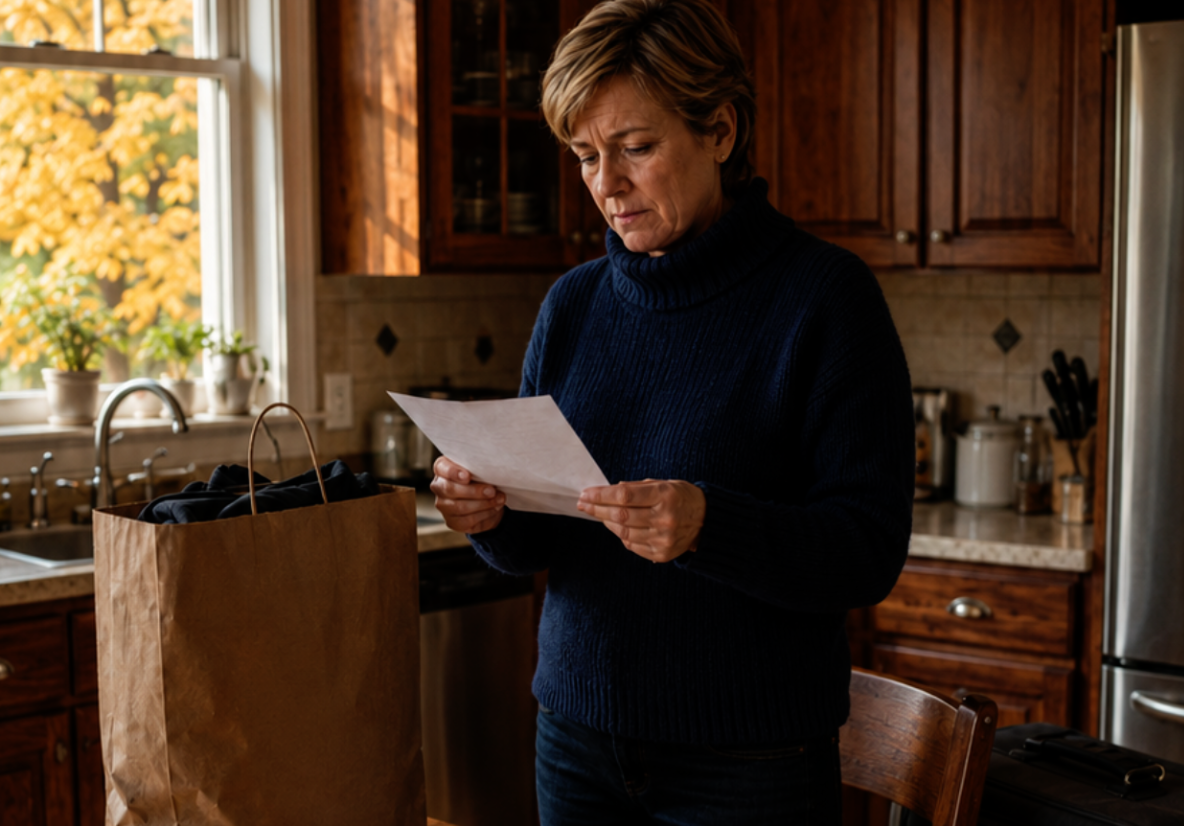
“I Have My Own Family, and Nobody Asked You to Do Any of That,” My Sister Said. So I Left Alone
“Who will pick you up?” the nurse asked, tapping her pen against the form.
She was sitting sideways at the desk, her glasses slipping down the tip of her nose, looking not at me but at the empty field.
“After you’re discharged,” she explained. “We can’t let you leave alone. Those are the rules here. Someone has to come and sign for you.”
“And what if there’s no one?”
Olga Vladimirovna—that was the name on her badge—looked up.
“Everyone has someone. A son, a husband, a neighbor. Angelina Gordeyevna, I’m not rushing you, but this field has to be filled in.”
“My sister,” I said. “Write down my sister. Diana.”
She wrote it down and read the number back to me so I could confirm it. I knew the number by heart, even though it was saved in my phone anyway.
I walked home, two bus stops away, and spent the entire way trying to find the right words.
There was a piece of paper taped to the door of my kitchen cabinet. Three lines in my handwriting: Wednesday—pick up Matvey from after-school care; Saturday—groceries; Sunday—take Alisa to dance class.
The note had been hanging there for three years, since the summer when Semyon left the factory and they fell on hard times financially.
Every Saturday I wheeled my shopping trolley over to their place. Four grocery bags fit inside if I packed them upright: buckwheat, chicken, yogurt cups for the children, laundry detergent—which they somehow always ran out of on Fridays.
Diana would open the door, say, “Oh, you really shouldn’t have,” and disappear into the kitchen to unpack everything.
Not once did she ask how much it had cost.
I called her on Monday at eight, after they had already had dinner.
“Di, I’m having surgery on May twelfth,” I said. “My back. The doctor says afterward I won’t be allowed to lift anything heavier than a kettle for a month and a half.”
“Oh,” Diana said. “That’s awful. Where are you having it done?”
I named the hospital. She made sympathetic noises. I could hear the television in the background, and one of the children was laughing at a cartoon.
“I need someone to pick me up,” I said. “And for the first three or four days, I need someone nearby. Bring me food, go to the pharmacy. That’s all.”
The television became quieter.
“Gel, come on,” she said. “You understand yourself. I have my own family. Matvey, Alisa, Senya has shifts. I can’t split myself in half.”
“I don’t have anyone else, Di.”
“What about Alisa?” she said. “Alisa is fifteen, her exams are coming up. I’m not pulling her away from studying.”
“I’m not asking for Alisa.”
“Then why me? Hire someone. There are plenty of caregivers now. You can find one through an ad in a day.”
“I don’t have money for a caregiver.”
“Well, that’s not really my problem,” she said. “Gel, I’m telling you honestly, I don’t have the capacity. I’m at work, I’m at home, I’m helping with homework. Nobody ever asks how I’m doing either.”
I stood in front of the cabinet, looking at the tape that had yellowed around the edges.
And then she said it.
“And anyway, Gelya, nobody ever asked you to do all that. You decided to do it yourself. You didn’t owe us anything, and now we don’t owe you anything either.”
I didn’t cry.
I wasn’t even surprised, and that was the worst part.
“Fine,” I said. “Then I won’t pick up Matvey on Wednesday. And I won’t bring groceries on Saturday.”
She laughed.
“What, are you offended now? Oh, come on. You’ll get over it and call me yourself.”
I hung up first.
Then I opened my banking app, found the recurring transfer that went to her card on the twenty-fifth of every month, and pressed “cancel.”
The app asked whether I was sure.
I pressed it again.
On Wednesday, my phone started ringing at a quarter past three.
I didn’t answer once.
Not at 3:15, not at 3:30, not at five.
Eighteen missed calls.
Then a message in capital letters:
“WHERE ARE YOU?”
Then another one:
“He’s sitting at school alone with his backpack on his knees.”
I had told her on Monday that I wouldn’t be coming on Wednesday. Out loud, in plain words, without hints.
She had simply decided to test whether I was bluffing.
At six, she texted that she had picked him up herself and that I was insane.
So she could do it after all.
The boy had spent an extra hour at school because of both of us.
I still dream about it.
She didn’t call again before my surgery.
The operation took place on the scheduled day.
Roza Filippovna from the seventh floor picked me up from the hospital. She called a taxi, came up to my ward, and packed my things into the same little trolley I had brought with me.
She was also the one who signed the register.
Olga Vladimirovna looked at the signature, then at me, but said nothing.
For the first week, I lived on soup that Roza Filippovna cooked for herself and immediately poured half of into a jar for me.
She brought it over at ten in the morning, placed it on the table, and left, because during the first few days I couldn’t really talk. The medication made everything swim.
“Don’t think you’re burdening me,” she said on the fourth day. “I’m cooking anyway. You just lie down and don’t try to be a hero.”
She put the jar down and glanced at my phone, lying faceup on the pillow, silent since morning.
“Does your sister know you had the operation?”
“She knows.”
She never asked about it again.
Not once during all the days I was recovering.
Diana called twice during that time.
The first call came on the third day after the operation.
“Gel, listen, I can’t find Matvey’s uniform. The blue one, for PE. Did he leave it at your place?”
“He did.”
“Where is it?”
I told her.
She said, “Uh-huh,” and hung up.
She didn’t ask about the hospital.
The second time was at the very end of May.
“How are you?” she asked cheerfully. “Are you walking already?”
“I am.”
“Listen, Matvey starts summer vacation on the first. When will you be completely better? We’ve got nowhere to put him. Camp doesn’t start until July.”
I was sitting on a stool in the hallway because I still wasn’t allowed to sit on anything soft, and I stared at the trolley beside the coat rack.
“Never,” I said.
“What do you mean?”
“I mean I’m not taking him in June. Or July. Or August.”
“What, are you still sulking? Because of that little thing?”
“No.”
“Then why?”
“Just no.”
She said I had become strange and that Mom was right.
Twenty minutes later, Mom called.
Serafima Danilovna has a talent for starting from far away.
First she talked about her blood pressure, then about a neighbor whose daughter-in-law wasn’t behaving properly, and finally she got to the real point.
“Diana is the younger one,” Mom said. “You’re the older sister. God gave you health and brains, so you carry the load. She has two children, and you have nobody.”
“Mom, come stay with me,” I said. “Stay for a few days. I’ve never asked you for anything in my life.”
She fell silent.
“Gelochka, it takes me two hours and a transfer to get to you. You know that.”
“I know,” I said, and hung up first.
That same evening, I gathered everything belonging to Diana’s children that had accumulated in my apartment: the blue PE uniform, Velcro slippers, two notebooks, a child’s umbrella.
I put it all in a bag and left it by the front door.
Then I sent Diana one message:
“Matvey’s things are in my hallway. Pick them up yourself. I’m not bringing them.”
There was no reply.
But on Saturday, the doorbell rang.
It was Alisa.
She stood on the landing with a backpack over one shoulder and a jar of fruit compote in her hands.
Fifteen years old, tall, wearing her father’s windbreaker, and exactly the same as she had been at six: shifting from foot to foot and avoiding eye contact.
“Mom sent this,” she said. “And she also said you’d help me with my essay. My teacher told me to rewrite it or I’ll get a C.”
I let her in.
I put the kettle on and took out some pancakes Roza Filippovna had made for everyone.
We spent an hour working on the essay.
It was about Chatsky and why he eventually left.
Alisa chewed on her pen and said she didn’t feel sorry for Chatsky but for Sophia, because Sophia spent her whole life in her father’s house and never learned to make her own choices.
I thought the girl was smarter than all of us.
“Are you really never coming to our place again?” she suddenly asked. “Mom said you’re offended for life.”
“I’m not offended.”
“Then what is it?”
“I’m tired,” I said. “Eat your pancakes.”
She was quiet for a moment, dipping a pancake into sour cream.
“You’ve been coming over ever since I was little,” she said. “I thought all aunts did that.”
“They don’t.”
She picked at her pancake with a fork.
“Aunt Gel, did you give Mom money for a tutor last fall? She said you did.”
“I did.”
“There wasn’t any tutor,” Alisa said without looking up. “Mom said it was too expensive, so I studied by myself with video lessons. Please don’t be angry with her, okay? I tried. I’m just struggling with literature, not English.”
I told her I wasn’t angry.
Then she reached into the pocket of her windbreaker.
“This is for you. I almost forgot.”
In her palm lay a seashell.
Large, pink inside, with a little hole for a cord.
“Where is that from?”
“Kemer. Mom and Dad flew there in May. I wanted to bring it to you right away, but Mom said I could give it to you later.”
The kettle clicked off.
I was standing with my back to it.
“In May,” I repeated.
“Yeah. Ten days. Matvey and I stayed with Grandma. She took us to the movies. Twice.”
A car honked downstairs.
Alisa grabbed her backpack, picked up the bag containing Matvey’s uniform from beside the door, kissed me on the cheek, and ran downstairs.
I took a cardigan from the coat rack and followed her.
Semyon was sitting behind the wheel with the window open, smoking into his fist.
When he saw me, he threw the cigarette away and got out.
“Gel, hi. How are you?”
“When did you book the trip?” I asked.
He glanced toward the car, where Alisa was already sitting in the back wearing headphones, and gently closed the door.
“In March,” he said. “There was a promotion. Early-booking discount.”
March.
A month before I called Diana and asked her to stay with me for the first few days after surgery.
“So you already knew everything when I called.”
“Gel, I told her,” he said, rubbing the back of his neck. “I told her directly: Gelya is alone, we need to go see her, at least for the weekend. And she said, ‘Gelya will manage. She always manages.’”
“And you?”
“And I went on the trip,” he said, spinning his keys around one finger. “Don’t think I’m the good guy here. I’m telling you this because I want you to know I was against it. I still have to bring my daughter to your place. I still have to look you in the eye.”
“Then look,” I said.
He drove away.
I stood in front of the building, watching someone beating a rug out of a third-floor window.
I had been bringing them groceries because they supposedly didn’t have enough money, and for all those years I had told myself the same thing:
If my sister is struggling, I can’t feel good while she feels bad.
It turned out they had enough.
They simply had somewhere else to take from.
I gave money for a tutor in the fall.
There was no tutor.
But there had been Kemer.
Ten days.
And a seashell as a souvenir for me.
That evening, I called Diana.
“I know about March,” I said. “And about the English tutor.”
“So what?” she asked. “Am I not allowed to have a vacation? I’m a human being too. My back hurts too, by the way. And the money was already mine. I can spend it however I want.”
“You can,” I said. “And so can I.”
“What are you implying?”
“Nothing. Just don’t call me asking for things anymore. Anything.”
A week later, Mom called and invited me to Matvey’s birthday.
On June twenty-eighth, about ten people gathered at Mom’s place.
There was a table set up in the living room, Olivier salad, Mom’s neighbor Aunt Nyura, Mom’s friend and her husband, Diana’s godmother.
Matvey was turning nine.
I brought him a construction set—a big one with a motor. He had been talking about it for six months.
He squealed and carried the box into the other room.
We sat down.
We drank a toast to the birthday boy.
Aunt Nyura asked how my health was, and I said I was fine.
Diana was serving salad onto her husband’s plate.
“She’s saving for resorts now,” Diana said. “Our Gelya counts every penny these days. Apparently, we still owe her something.”
Everyone laughed except me.
“Gelochka, she’s the younger one,” Aunt Nyura said. “She has two children on her hands, you have to understand. My Lenka lives alone too, no children, and she still helps me and takes care of her nephews. That’s what family is for.”
“The children have nothing to do with it,” Diana’s godmother said. “They haven’t done anything wrong. Why take it out on them?”
Mom said nothing and smoothed the tablecloth with her palm.
I wiped my hands on a napkin and stood up.
Not because I had planned a speech.
I stood because I couldn’t remain seated any longer.
“One hundred and eighty thousand,” I said. “Over three years. I didn’t calculate it—the bank did. I checked my statement in April because I was trying to find money for a health resort and realized I didn’t have any.”
The room went silent.
Even the clicking of construction pieces from the next room stopped.
“Besides that, there were groceries every Saturday, money for English lessons, jackets before September, and summer camp twice. I didn’t count any of that.”
“You’re actually going to say all this out loud?” Diana asked. “In front of people?”
“I am,” I said. “I had surgery on May twelfth. During those same days, you and Senya were in Kemer. Mom was taking care of your children and taking them to the movies. Mom, you knew.”
Mom looked at me.
“I knew,” she said. “What did you expect me to do? Ruin your sister’s vacation? Decent people don’t make scenes like this at the table.”
“Decent people,” I repeated. “All right.”
Diana began speaking quickly, loud enough for everyone at the table to hear.
She said I was twisting everything around, that it had been their first proper vacation in nine years, that I was sticking my nose into someone else’s finances, and that I had given them the money voluntarily.
Nobody had forced me.
I listened until she finished.
“Nobody forced me,” I agreed. “Correct. I carried it over myself. And I stopped myself.”
“Well, nobody forced you in the first place,” Diana said.
“No.”
I looked at her across the table.
“I don’t have children of my own, Di. I brought you groceries, and in return I got Wednesdays with Matvey and Sundays with Alisa. I was buying myself a place at your table. That’s what I was doing.
“And I thought it was like putting money into a bank account. You keep depositing and depositing, and then when you’re in trouble, you come and withdraw something. Just a little. Just once.
“But it wasn’t a deposit.
“I simply gave.
“And that was it.
“There was nothing to get back.”
“So what now?” she asked. “Nothing at all?”
“Nothing. Not one ruble. Not one Wednesday. Not one Saturday. No jackets in September, no summer camp. I’m not explaining anymore. And I’m not doing it anymore.”
“You’ll regret it,” Diana said.
“Maybe.”
I went into the other room, where Matvey was sitting on the floor among the pieces of his construction set.
I ruffled his hair and told him he was doing great and wished him a happy birthday.
He didn’t even look up.
Then I took my handbag and walked into the hallway.
“You have a heart of stone, Gelya,” Mom said behind me.
At home, I put the kettle on, walked over to the kitchen cabinet, and caught the edge of the tape with my fingernail.
It peeled away with a crack, taking a strip of paint with it.
The note curled into a little tube in my hand.
I stood there for about a minute, staring for no particular reason at my own handwriting.
Then I dropped it into the trash and sat down at the table.
For the first time in all those years, I didn’t know what I was doing on Wednesday.
On August fifth, my phone rang at seven in the morning.
“Gel. Gel, please don’t hang up.”
Diana spoke quickly, without her usual “oh” or “listen.”
“They’re sending me to Voronezh for training. Starting on the twelfth. Two weeks. If I don’t go, they’ll lay me off. They’ve already cut two people in our department. Senya is away on rotation until September and can’t leave. Alisa leaves for camp the same day—it’s a school-sponsored trip, already paid for. Mom has been in Lipetsk since the first, staying with her cousin until September.”
She took a breath.
“There’s nobody to leave Matvey with. Take him for two weeks. I’m asking you.”
It was the first time in our entire lives that she had used the words “I’m asking you.”
I stood by the window.
On the windowsill was an envelope containing my voucher for a health resort near Kislovodsk.
My check-in date was the exact same day.
The doctor had recommended it back in spring, right after I was discharged.
I bought the voucher in July with the same money that used to leave my account every twenty-fifth of the month, adding some of my vacation pay.
“I have a train that day,” I said. “To the health resort. Twelve days.”
“Reschedule it,” she said.
“No.”
“Gel, this is a child. It’s Matvey. You’ve carried him in your arms since he came home from the maternity hospital.”
“I have.”
“And now you just don’t care?”
“No, I do care,” I said. “But I’m not taking him.”
“You’re abandoning him!”
“I never took responsibility for him, so I can’t abandon him.”
She screamed for another five minutes.
That I was vindictive.
That I had been storing up resentment my whole life, waiting for an excuse.
That their family was going to fall apart because of me.
I didn’t defend myself.
And that was the first time I realized how incredibly simple it was not to explain yourself.
At lunchtime, I received a message from Alisa:
“Aunt Gel, please. He’s little. He’s waiting for you.”
I stared at the message for about twenty minutes.
Then I typed:
“No, Aliska.”
And put the phone into the pocket of my robe.
By evening, Diana had posted a message in the family group chat:
Her sister had refused to take her own nephew.
The child had been left with nobody.
That was the kind of family support we apparently had.
People started calling.
Aunt Nyura said she had never expected this from me.
The godmother said I had every right not to give them money, nobody could argue with that, but a child was completely different.
Mom called from Lipetsk, and her voice sounded unfamiliar.
“What are you doing?” she said. “She’s going to come to me now. With two children. On my pension. Did you think about that?”
“I did,” I said. “Mom, everyone has the right to take care of themselves. Diana has that right—she used it in May. You have that right—you’re in Lipetsk. And I have that right too.”
“It’s not the same thing,” Mom said.
“It’s exactly the same thing.”
She hung up.
On the tenth, Roza Filippovna came upstairs to see me.
She brought a jar of pickles and sat down on the stool in the hallway.
“Take the boy,” she said immediately. “They’ll move your health-resort booking to September. You won’t lose it. But that boy will remember this for the rest of his life.”
“I’m not taking him, Roza Filippovna.”
“That’s cruel.”
“Maybe it is,” I said. “But in May, you were the one who came to pick me up. Not them.”
She waved her hand dismissively and left.
That evening, she still brought me cabbage pies for the journey.
On the eleventh, Semyon wrote to me.
He had left his work rotation early and was staying home with his son.
He lost everything he would have earned in August.
On top of that, he ended up owing money.
On the twelfth at seven in the morning, I walked out of my building with one bag over my shoulder.
The trolley stayed in the storage room between the skis and a bucket.
Roza Filippovna waved to me from her window.
On the train, I took a lower berth, drank tea from a glass in a metal holder, and spent the entire journey to Mineralnye Vody watching other people’s vegetable gardens pass outside the window.
Two months have passed.
Diana hasn’t called since August.
Her message is still sitting in the family group chat. I don’t go in there anymore.
Mom came back and calls once every two weeks to ask whether I need anything, using the tone people use when speaking to neighbors from the same apartment building.
Alisa doesn’t write at all.
Last week, Mom casually mentioned that Matvey had asked her why Aunt Gelya no longer comes on Wednesdays.
I didn’t ask what she told him.
On Wednesdays at six, I’m at the swimming pool.
They told me to start swimming as soon as my back allowed it, but my Wednesdays used to be occupied.
Yesterday, I was being registered for day treatment at the same hospital, and Olga Vladimirovna once again asked whose name we should put down.
I gave her Roza Filippovna’s name—the neighbor from the seventh floor.
She had agreed back in May.
Back then, I simply didn’t know that you were allowed to put a neighbor’s name in that field.
Did I choose the wrong moment to refuse them, in the very month when everything happened to go wrong for them at once?
Maybe.
But on Wednesday at six, I’ll be back in the water.
Forty-five minutes.
And for those forty-five minutes, I belong to no one.