“Since I’m a stranger to you, then we’ll settle things like strangers,” the daughter-in-law replied to her mother-in-law after the court case
“The house has already been transferred to Viktor. You understand, blood is blood,” her mother-in-law said, pouring compote as calmly as if she were talking about the weather.
Marina froze with the ladle suspended over the pot. Steam from the borscht drifted through the kitchen, while inside her chest everything suddenly turned cold, as though someone had flung a window wide open on a freezing winter night.
“Excuse me, Nina Arkadyevna, what did you just say?”
“You heard me.” Her mother-in-law took a sip from her glass. “I transferred the little house in Malinovka to my younger son. He has a big family, three children. You and Kostya are still young. You’ll acquire something of your own.”
Marina slowly lowered the ladle. She turned toward her husband. Kostya was sitting at the table, picking at his salad with a fork and looking anywhere but at her.
And his silence told her everything.
He knew.
Something quietly clicked inside Marina, as though an invisible key had turned.
Seven years.
For seven years, she had gone to Malinovka every summer and nearly every weekend. She painted the fence, weeded the garden beds, whitewashed the walls of the old house that her mother-in-law called “the family nest.”
For seven years, Nina Arkadyevna had stroked Marina’s hand and repeated:
“Marinochka, you’re the owners here. Everything I do is for you. Someday all of this will be yours.”
All of this will be yours.
“Kostya,” Marina called softly. “Did you know?”
Her husband shrugged without lifting his eyes.
“Marin, not now. Not in front of Mom.”
“When, then?” Her voice trembled, but she kept it under control. “When you’ve finally divided everything up without me?”
Her mother-in-law carefully placed her glass on the oilcloth-covered table.
“Don’t raise your voice in my house,” she said with dignity, pursing her lips. “It is still my house. And my land. I can leave it to whomever I want.”
Marina wiped her hands on her apron. For some reason, her fingers were trembling.
She went out onto the veranda, which smelled of dried apples and old wood.
She had spent so many evenings there—cleaning berries for jam, sorting currants, listening to her mother-in-law’s endless stories about how difficult it had been to raise two sons alone.
Marina had warmed milk with honey for her when she caught a cold. She had run three kilometers to the pharmacy, heated the bathhouse, carried water.
Her mother-in-law followed her outside and stood in the veranda doorway with her arms crossed.
“You have to understand,” she began, her voice suddenly soft and syrupy like jam. “I didn’t do it out of spite. Viktor has a harder life than you do. Three children, and his wife doesn’t work. You and Kostya are strong, you both earn good money. It won’t be difficult for you to buy something yourselves. The house will go to Vitenka. That’s what family does.”
“What family does,” Marina echoed.
“Of course.” Her mother-in-law gave a faint smile. “You didn’t seriously think I would transfer the house to you, did you? Who are you to me? A daughter-in-law. Today you’re Kostya’s wife, and tomorrow, God forbid, you might separate. Viktor is my own son. If we’re being truthful, you’re an outsider to me.”
An outsider.
For seven years, Marina had been the most needed person.
The most convenient one.
And now she was an outsider.
“Nina Arkadyevna,” Marina said, trying to keep her voice steady. “We invested more than three hundred thousand rubles into this house. A new roof, plumbing, rebuilding the stove. Our own money. Do you remember?”
“Well, you spent every summer vacationing here,” her mother-in-law shrugged. “You used the place. Consider it payment for your stay.”
Marina turned toward the window.
Behind the glass, old apple trees swayed—the same trees she and Kostya had pruned every spring. The September sun gilded the dry grass.
And suddenly she understood the most important thing.
This had been planned.
Not yesterday.
A long time ago.
For years, her mother-in-law had kept Marina there with the promise, “Someday everything will be yours,” while simply waiting for the right moment to transfer the house to her other son.
And Kostya knew.
He had known and remained silent.
“Where’s Kostya?” Marina asked without turning around.
“In the garden, chopping firewood. Go cool off first, then you two can talk.”
Marina walked down the porch steps.
Her husband stood beside the woodpile, wiping his forehead with his sleeve. A big, strong man—and yet he was avoiding her gaze like a guilty schoolboy.
“When did you find out?” she asked without any introduction.
Kostya buried the axe in the chopping block.
“Marin, why are you getting so worked up? Mom is right about some things. Vitka really is struggling.”
“When did you find out, Kostya?”
He remained silent for a moment, staring at the ground.
“In the spring,” he finally forced out. “Mom told me. I thought somehow it would all work itself out.”
In the spring.
For six months, he had slept beside her in the same bed, eaten the dinners she prepared, and made plans with her.
For six months, she had dreamed aloud about how, after retirement, they would move permanently into that house, keep bees, and plant a cherry orchard.
And he had listened while knowing there would never be any orchard for them.
The house was no longer theirs.
“And you kept quiet,” she said. It wasn’t a question.
“What difference would telling you have made?” Kostya spread his hands. “It was Mom’s decision. What could I do?”
“You could have told me. I’m your wife.”
“Oh, here we go. Don’t make this into something bigger than it is. We’ll buy our own country house someday. Big deal.”
Marina stared at her husband and felt as though she were seeing him clearly for the first time.
No.
Not seeing him for the first time.
Recognizing him.
She had simply refused to admit it before.
He had always been like this.
When his mother mocked Marina’s cooking in front of guests, Kostya laughed along with everyone.
When Nina Arkadyevna came over without warning and rummaged through their closets under the pretext of “putting things in order,” Kostya disappeared into the garage.
When his mother called and demanded that he drop everything and come to her “this very second,” Kostya went running.
A mama’s boy.
Marina had pushed those words away for all seven years.
Now they stood in front of her in their full, undeniable truth.
“I understand,” she said.
Then she went inside to pack a bag.
“Where are you going?” Kostya hurried after her.
“To my mother’s. Back to the city.”
“Marin, come on. It’s getting late. The buses aren’t running anymore.”
“I’ll call a taxi. I have a mother too, Kostya. A real one.”
Her mother-in-law appeared on the porch.
“That’s right,” she nodded with satisfaction. “Go away for a while and think with a clear head. You’ll understand that I’m talking sense.”
Marina threw the bag over her shoulder.
At the gate, she turned around.
“You know what hurts most of all, Nina Arkadyevna? I genuinely considered you my second mother.”
And she walked out through the gate.
Her mother opened the door, took one look at her daughter, and understood everything without a word.
Tamara Ivanovna had always understood her daughter without words.
That was simply the way it had always been between them.
“Come in,” she said simply. “I’ll put the kettle on.”
They sat in the cramped little kitchen where Marina had grown up.
The same polka-dot oilcloth on the table. The same smell of dried mint.
Everything here was genuine, without hidden meanings.
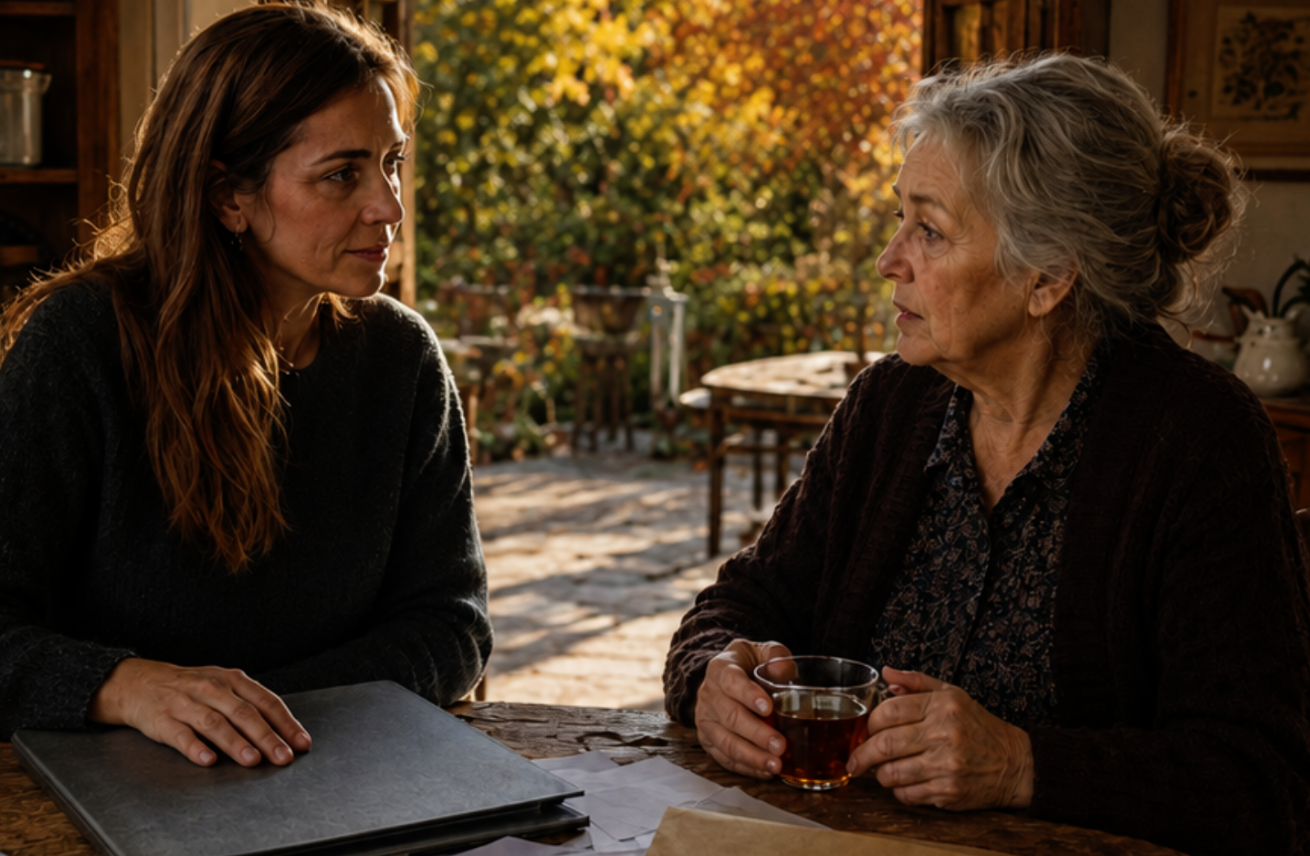
“Well,” her mother said as she poured the tea. “Tell me.”
And Marina told her everything.
About the notary.
About being called an “outsider.”
About Kostya knowing for six months and saying nothing.
Her voice broke a couple of times, but she held herself together.
Tamara Ivanovna listened without interrupting.
Then she said:
“I warned you, remember? Before the wedding. I told you to look closely at how his mother treats her son. If she can twist him around her finger, eventually he’ll let her do the same thing to you.”
“You did,” Marina admitted.
“Well, there you go. That Nina of yours has always controlled Kostya completely. And it suits him. Mom makes the decisions, Mom does the thinking, Mom chooses who’s to blame.”
Marina wrapped both hands around her cup.
Slowly, warmth returned to her fingers.
“Mom, I don’t know what to do now.”
“What’s there to know?” Tamara Ivanovna shrugged. “Keep living. Just use your head instead of your heart.”
“But I invested so much. My energy, my money, my heart.”
“You said you put money into that house?” her mother narrowed her eyes. “Did you keep the paperwork?”
Marina looked up.
“What paperwork?”
“Receipts for materials and work. You’re an accountant, sweetheart. Don’t tell me you didn’t keep records.”
And then Marina remembered.
Of course she had.
Out of professional habit.
Working in accounting had taught her that every kopeck belonged in a spreadsheet.
When they started renovating the house, she created a separate file.
Roofing materials. Pipes. Bricks for the stove. Payments to the workers.
Everything was there—with receipts and screenshots of bank transfers.
The file had simply been sitting in cloud storage for several years.
“I kept everything,” she said slowly. “Mom, I still have all of it.”
“You see?” Tamara Ivanovna smiled. “Your head isn’t just there to hold a hat.”
The next morning, Marina took an unpaid day off from work.
She sat down at her laptop and opened the old file.
The numbers appeared in neat rows before her.
Three hundred and twelve thousand rubles.
That was how much she and Kostya had spent on someone else’s house.
Technically, the money had been theirs together, but Marina had always earned more, and almost every expense had been paid from her bank card.
Transfers to the contractor.
Payments at the building supply store.
Everything had come from her account.
Then she opened another file.
Her personal savings, which she had quietly put aside “just in case.”
Over seven years, the amount had grown to almost five hundred thousand rubles.
Neither Kostya nor her mother-in-law knew about it.
Marina had never been someone who bragged about money.
She stared at the screen for a long time.
Then she began calculating seriously.
Kostya called around lunchtime.
“So, have you calmed down? When are you coming home?”
“Kostya,” Marina said. “I want the money we spent on the renovations returned. Three hundred and twelve thousand. I have every receipt.”
Silence filled the line.
“What nonsense are you talking about? What receipts? We’re a family.”
“A family that transferred the house to another son without asking me. So if that’s how things are, let’s settle everything fairly. You all love fairness, don’t you? I invested my money in someone else’s property. I want it back.”
“Marina, you’ve lost your mind. Mom won’t give you anything.”
“Then I’ll go to court. I have all the documents. Receipts, transfers, the contract with the construction crew. It’s called unjust enrichment. I spoke to a lawyer this morning.”
That part was completely true.
“The prospects are good.”
Kostya breathed heavily into the phone.
“And one more thing,” Marina added calmly. “I’m filing for divorce.”
Nina Arkadyevna stormed into Tamara Ivanovna’s apartment the very next day.
Marina happened to be there with her mother.
Her mother-in-law burst inside like a whirlwind—red-faced, disheveled, and without her usual mask of calm dignity.
“What kind of performance is this?!” she demanded from the doorway. “What court?! What money?! Have you decided to destroy the family?!”
Tamara Ivanovna slowly came out of the kitchen, wiping her hands on a towel.
“Nina Arkadyevna,” she said evenly. “No one shouts in my home. Either we speak like civilized people, or you can leave.”
Her mother-in-law stopped short.
She glanced around the cramped hallway and pursed her lips.
“I came to talk,” she said more quietly. “Peacefully.”
“Come in. Would you like some tea?”
“I don’t need your tea.”
They sat down in the living room.
Nina Arkadyevna nervously fiddled with the handle of her handbag.
“Marina,” she began again, her voice returning to its habitual sweetness. “Come on, sweetheart. I didn’t mean any harm. I only wanted what was best. Vitenka is struggling, and you two are young.”
“Nina Arkadyevna,” Marina replied calmly, without emotion. “I’m not angry anymore. Really. You made your decision. That’s your right. It’s your house. But I’ll make my own decision too. I invested three hundred and twelve thousand rubles in the renovations. I have all the receipts. I want the money returned. That’s all.”
“Where am I supposed to get that kind of money?!” her mother-in-law exclaimed, throwing up her hands. “I only have my pension!”
“You have a house. The same house Viktor is receiving. Let him compensate me. Or you can do it. Work it out among yourselves. It no longer concerns me.”
Her mother-in-law turned pale.
“You… you have no conscience. I treated you like my own daughter…”
“Like your own daughter?”
For the first time, Marina raised her voice.
“Yesterday, you called me an outsider. In front of your son. In front of my husband. So since I’m an outsider, then we’ll settle things like outsiders. According to the law. With receipts and documented payments.”
Nina Arkadyevna opened her mouth.
Then closed it again.
For the first time in seven years, she had nothing to say.
“And Kostya?” she finally managed. “You’re destroying your family!”
“You destroyed the family,” Marina said quietly. “When you went to the notary behind my back. And your son destroyed it when he kept quiet for six months. I’m only drawing the final line.”
The divorce and the court case proceeded in their own time.
At first, Kostya was furious. He called and accused her of everything imaginable.
Then he began showing up to reconcile—confused and pathetic.
“Marin, come on. Let’s put everything back the way it was. Mom overreacted. I’ll talk to her.”
“It’s too late, Kostya,” Marina would answer. “You should have talked six months ago. With me. Instead, you stayed silent.”
“I didn’t know what to do!”
“That’s exactly the problem. You never know what to do. Your mother always decides everything for you. And you know what? I don’t want to be married to a mama’s boy anymore. I want a husband. A grown man.”
He didn’t understand.
He looked at her with wounded eyes, like a child whose toy had been taken away.
And Marina thought sadly:
There it was.
Her mother-in-law had never allowed her son to fully enter adult life.
And he had never particularly wanted to.
The court case lasted five months.
The lawyer had been right.
The receipts, bank transfers, and contract with the construction crew formed a solid body of evidence.
Nina Arkadyevna hired an attorney and tried to argue that the money had been “a gift to the family.”
But a gift had to be proven as such, and Marina had never gifted the money.
She had invested it.
And she had kept records.
The court ruled in Marina’s favor.
Her mother-in-law was ordered to repay the full three hundred and twelve thousand rubles.
Nina Arkadyevna paid it back in installments, grudgingly and angrily.
But she paid every ruble.
When Viktor discovered that the house had come with this unexpected financial burden, he wasn’t pleased either.
The relationship between the brothers and their mother began to crack.
But that was no longer Marina’s story.
Six months after the divorce, Marina stood inside an empty one-bedroom apartment on the outskirts of the city.
Her apartment.
Three hundred and twelve thousand rubles recovered through the court.
Nearly five hundred thousand in personal savings that nobody had known about.
And a mortgage—a small, manageable one, calculated down to the last ruble by her accountant’s mind.
It all came together.
It was enough for the down payment on a small apartment of her own in a new building.
The bare walls smelled of fresh plaster.
Outside the window were construction cranes and newly built apartment blocks.
Far from the city center.
But it was hers.
Entirely hers.
No conditions.
No promises that “one day all of this will be yours.”
Tamara Ivanovna walked around the apartment, inspecting every corner.
“It’s small,” she said. “But bright. The windows face south. That’s good.”
“I chose it myself, Mom. I earned the money myself. I bought it myself.”
“I know, sweetheart.” Her mother put an arm around her shoulders. “I’m proud of you.”
Marina looked through the window at the gray winter courtyard and the thin branches of young trees planted along the new road.
In a few years, they would grow.
The courtyard would become green.
For now, everything was bare and empty.
And everything was still ahead of her.
She would do the renovations herself, the way she knew how.
Except this time, she would be doing them for herself.
Every receipt.
Every tile.
Every roll of wallpaper.
For her own home.
Her phone chimed.
A message from Kostya:
“How are you? Maybe we could meet and talk?”
Marina looked at the screen.
Then she slipped the phone back into her pocket without replying.
Not today.
And not tomorrow.
That story was over.
Another one was beginning.
Her own.
“Mom,” she said. “Let’s have some tea. I only have one stool and a kettle here so far, but the kettle is the important part.”
Tamara Ivanovna laughed.
“It is, sweetheart. The most important part.”
They drank tea from paper cups, taking turns sitting on the only stool and looking at the bare walls that concealed their promise of a future.
And for the first time in a long while, Marina felt light.
Her mother-in-law never called again.
Kostya wrote a few more times, then stopped.
People said he was still living with his mother.
Nina Arkadyevna had taken her son back under her wing once again—feeding him, looking after him, making decisions for him.
Maybe that was exactly how he liked it.
Maybe he had never wanted anything different.
But Marina had wanted something different.
And now she had it.
Her own apartment.
Her own life.
Her own mind—the one that had calculated everything correctly.
She thought about it in the evenings while sitting by the window with a cup of tea.
About how long she had tried to be convenient for everyone.
How hard she had worked to earn love from people who had never intended to give it to her.
How afraid she had been of ending up alone—only to discover that being alone with herself was far more peaceful than belonging to a family that merely tolerated her out of politeness.
Sometimes, the kindest thing you can do for yourself is stop being convenient for people who call you an outsider.
Everything would be all right for her.
She knew that for certain.
Because now everything depended only on her.