My Godfather Left Me a Restaurant and Nine Million Rubles. My Mother-in-Law, Who Hadn’t Eaten at My Table for Three Years, Asked to Come to Dinner
“Nastya, I’ve been thinking… Maybe it’s time we forgot old grudges? After all, family is sacred.”
Just like that. No introduction.
Galina Borisovna called on Wednesday morning while Nastya was still sitting in the notary’s office, rereading the documents for the third time, unable to believe they were real.
A restaurant.
A bank account.
A will with her name on it.
Her godfather had died quietly, the same way he had lived. His heart. Seventy-two years old, half his life spent behind a stove and the other half behind a restaurant counter. He had no children, his wife had left long ago, and he had built Dubravushka—a small, cozy restaurant two blocks from the park—himself, from the ground up, driven by a single dream.
And now all of it belonged to Nastya.
Nine million two hundred thousand rubles in the account. A two-story building with a veranda. A staff of fourteen people.
And a phone call from her mother-in-law exactly three days after the news had somehow spread through the family group chat.
Nastya put her phone back into her bag and stared out the taxi window for a long time.
The July city floated past her: dusty linden trees, benches still wet from the night’s rain, women carrying grocery bags near the vegetable stalls.
Ordinary life.
And she owned a restaurant.
Three years.
For three years, Galina Borisovna had not crossed the threshold of their apartment.
After that incident involving the country house—a loud, ugly argument that ended with shouting in the stairwell and a slammed door—her mother-in-law had declared Nastya “a stranger” and stopped even greeting her when they happened to meet.
Mitya, Nastya’s husband, pretended that this was somehow normal. As usual, he positioned himself between them, calming his mother over the phone and telling Nastya:
“You know what she’s like. She’ll get over it.”
She didn’t.
Not for three years.
And suddenly it was “Nastenka.”
“Family is sacred.”
When Nastya got home, Mitya already knew.
He was sitting in the kitchen with a mug in front of him, staring at the table.
“Mom wants to come over for dinner,” he said without looking up.
“I heard.”
“Nastya…”
“Mitya, I don’t mind.”
She put her bag on a chair, opened the refrigerator, and stared inside without any real purpose.
“Let her come. But tell me honestly: did she call me herself, or did you ask her to?”
The pause lasted about three seconds.
Long enough.
“She called you herself,” he said.
Nastya closed the refrigerator.
Mitya was a good man. Truly.
He didn’t drink, didn’t cheat, and worked honestly as an engineer at an automotive components factory. He was calm and predictable.
But whenever he had to choose between his mother and his wife, he always chose peace.
Just peace.
He didn’t want to argue with anyone.
And perhaps that was the hardest part—not his anger, not betrayal, but this quiet, endless diplomacy inside his own home.
Galina Borisovna arrived on Saturday at seven in the evening, wearing a white blouse and carrying a cake from a pastry shop.
It was an expensive cake. Nastya recognized the box. She sometimes bought pastries from that place herself.
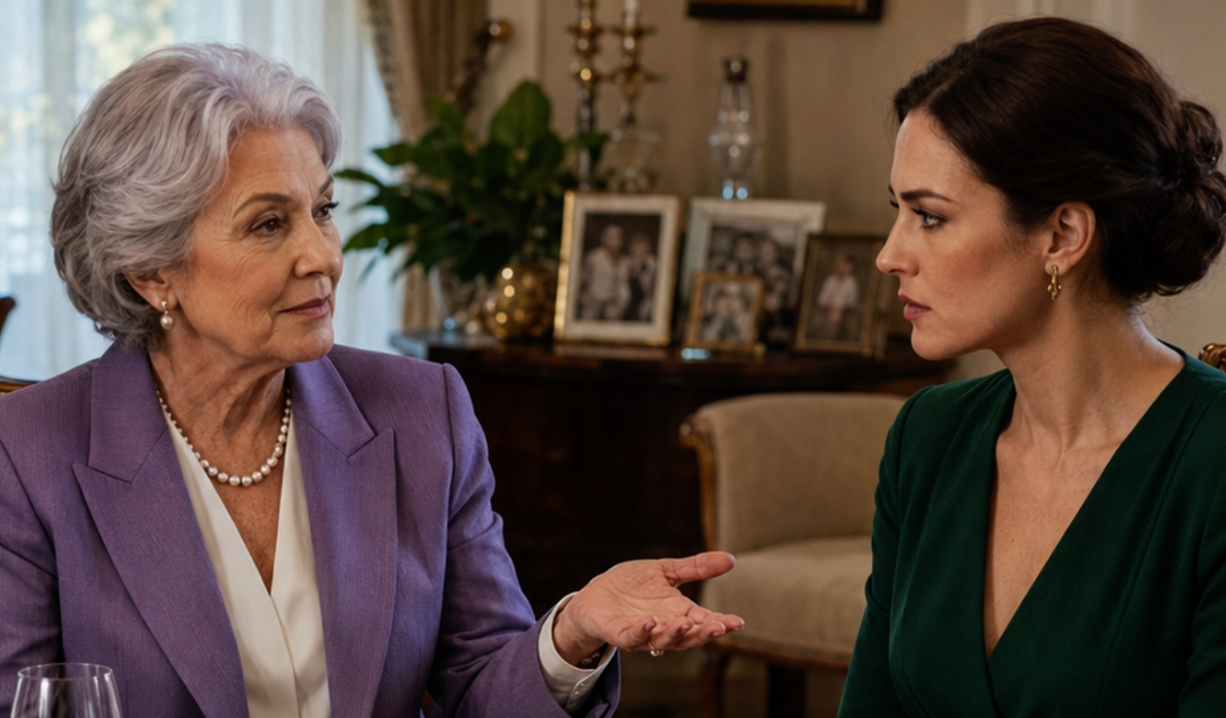
“Nastenka, look how much you’ve grown,” her mother-in-law said, examining the hallway with the air of someone doing them a favor by being there.
Grown.
Nastya was thirty-four years old.
At the table they talked about the weather, the neighbors, and how the city had once again dug up the main street.
Galina Borisovna ate neatly, dabbed her lips with a napkin, and complimented the salad.
Mitya poured the wine and kept glancing from his mother to his wife like a referee watching two fighters in a ring, ready to stop the match at any second.
But there was no fight.
Nastya smiled and passed the bread.
She knew how to wait.
Her godfather had taught her that when she worked for him as a waitress during her university years.
“A guest will always eventually tell you what they want,” he used to say. “You just have to give them time.”
Uncle Grisha.
Grigory Pavlovich Voronov.
A big, loud man who always smelled of coffee and a leather apron.
He had called her six months before his death.
For no particular reason, or so it had seemed.
They talked about autumn and about the pain in his knee whenever it rained.
Then, at the end of the conversation, he said:
“You’re the only person I have who never asked me for anything. That’s why you’re going to get everything.”
Nastya laughed.
She thought he was joking.
He wasn’t.
“You know,” Galina Borisovna said when they moved on to tea, “I’ve heard that the restaurant needs serious investment. Apparently it needs repairs, and the staff is unstable…”
“Where did you hear that?” Nastya asked.
“Oh, people talk.”
Her mother-in-law shrugged.
“I only mean that if you need help, Mitya and I are always—”
“Mom,” Mitya said quietly.
“What do you mean, ‘Mom’? I’m talking business! Petya knows people in a construction cooperative who deal with commercial property. They could evaluate it, take a look. Maybe it would be more profitable to sell it rather than struggle with it…”
Nastya placed her cup carefully on the saucer without making a sound.
There it was.
That was why she had come.
Not to make peace.
Not to “forget old grudges.”
She had come to examine the restaurant—or, more precisely, to examine what could be done with it.
And Petya was Galina Borisovna’s brother, a quiet man who always seemed to have money, with sharp eyes and a habit of discussing other people’s property as though it already belonged to him.
“Galina Borisovna,” Nastya said, her voice perfectly even, “I’m not planning to sell it. I’m going there on Monday to meet the team. Uncle Grisha spent twenty years building Dubravushka. It’s important to me to preserve what he created.”
“Of course, of course,” her mother-in-law said quickly. “I’m just saying, if anything…”
“I understand. Thank you.”
Mitya poured more tea.
Galina Borisovna ate another slice of cake.
The conversation shifted to gardening. Her mother-in-law had a country house, and apparently the tomatoes were especially good that year.
Nastya listened while thinking about something completely different.
On Monday, for the first time, she would enter Dubravushka as its owner.
The head chef was Arkady. She remembered him from her student days. He probably already knew about the inheritance and was waiting for her.
Among the fourteen employees, there would also be people Nastya had never met.
And for the last three days, some of them had probably been looking at her photograph online and wondering what would happen next.
She also thought about Petya.
He would call.
Soon.
He definitely would.
Galina Borisovna left at half past nine.
In the hallway, she hugged Nastya quickly and stiffly, the way people hug distant acquaintances.
“You’re doing well,” she said. “You’ll manage.”
The door closed.
Mitya helped clear the table.
He remained silent for a while, then said:
“She’s just worried about you.”
“I know.”
“You’re not angry?”
Nastya looked at her husband.
A good man.
A confused man.
“No, Mitya. I’m not angry.”
She put the plates in the sink, wiped the table, and went into the bedroom.
She took out a notebook she had bought the previous week—a thin, squared one.
At the top of the page she wrote:
“Monday. Dubravushka.”
Then she began making a list of questions she intended to ask Arkady.
Outside, darkness was settling over the city.
Somewhere in the distance, beyond the park, the windows of a two-story building with a veranda glowed warmly.
Her building.
Nastya arrived at Dubravushka at ten in the morning, before opening time, when the staff were only beginning to arrive and everything could still be seen as it truly was, without the polished appearance prepared for customers.
She stopped outside the entrance and simply stood there for a minute.
The wooden sign had darkened slightly with age.
Two pots of geraniums stood on either side of the steps. Uncle Grisha had always loved geraniums. He used to call them “honest flowers.”
The glass door was spotless.
The handle shone.
Someone had been taking care of the place.
Inside, it smelled of coffee and something herbal.
Basil, perhaps.
The dining room was small, with about twelve tables, wooden paneling along the walls, and warm-colored lampshades.
Everything looked slightly old-fashioned.
But alive.
Not dead.
“Anastasia Sergeyevna?”
Arkady came out of the kitchen.
Nastya remembered him differently—younger, sharper.
Now he was a broad, solid man of around fifty, with short gray hair at his temples and hands permanently marked by his profession: calluses, burns, the lingering smell of spices.
“Arkady Nikolayevich.”
She held out her hand.
“Just Nastya, if you don’t mind.”
He shook it firmly and without unnecessary words.
Then he looked her over briefly, assessing her without rudeness, simply studying her the way professionals study a newcomer entering a business where mistakes can be expensive.
“Come on. I’ll show you around.”
They walked through the restaurant for almost an hour.
The kitchen.
The storeroom.
The second floor, where there was a small banquet hall that had barely been used during the previous two years.
Arkady spoke briefly and practically: where the plumbing leaked, what equipment was outdated, which suppliers were reliable, which ones caused trouble.
Nastya listened and took notes.
“Grigory Pavlovich was ill during his last year,” Arkady said when they returned downstairs and sat at a table in the corner. “He hardly came here. We managed on our own. I kept everything going.”
There was no boasting in his words.
Just a statement of fact.
“I can see that,” Nastya said. “Thank you.”
He nodded and looked through the window.
Outside, the July street was already alive with cars, voices, and a cyclist in a yellow jacket.
“Are you planning to sell?” he asked.
“No.”
Arkady nodded again.
This time, it was as though he had made some internal decision.
“Then you need to meet Vera Anatolyevna. She’s our administrator. She came three months ago on someone’s recommendation.”
A short pause.
“Grigory Pavlovich didn’t have time to get to know her properly.”
Nastya looked up.
There was something in his tone.
Not fear.
More like a quiet warning sign beside a road.
“And did you?”
“Enough,” Arkady said as he stood. “She’ll be here at eleven.”
Vera Anatolyevna entered exactly at eleven.
Her punctuality seemed almost deliberately precise.
She was around forty-five, slender, wearing a light gray suit. Her hair was pulled tightly back.
Her smile was professional.
Her eyes were quick, attentive, missing nothing.
“Anastasia Sergeyevna, I’m so pleased to meet you. We were all terribly worried. There was so much uncertainty after Grigory Pavlovich passed away…”
“I understand,” Nastya said. “There’s no uncertainty anymore.”
“Of course, of course.”
Vera Anatolyevna sat across from her and neatly folded her hands on the table.
“I’d like to bring you up to speed. I have several proposals for optimizing expenses. I’ve prepared spreadsheets…”
“I’ll look at them later. First, I want to speak with every employee.”
A tiny hesitation.
Almost invisible.
“Of course. I can organize meetings, coordinate schedules…”
“There’s no need to organize anything,” Nastya said calmly. “I’ll walk around myself. I just want to meet everyone.”
Vera Anatolyevna’s smile widened.
But her fingers tightened slightly against the tabletop.
By lunchtime, Nastya knew everyone.
Two waitresses, Dasha and Polina, both young and visibly nervous.
Taisiya, the dishwasher, fifty years old and as calm as a mountain.
Two cooks.
Arkady’s assistant.
Ruslan the bartender.
The cleaner.
And Zhenya, the cashier—a quiet twenty-two-year-old girl at her first job.
Zhenya looked at Nastya as though she were waiting for a verdict.
“Everything’s fine,” Nastya told her. “I’m not firing anyone.”
Zhenya exhaled so strongly that Nastya almost laughed.
Nastya left around three, when the restaurant had already opened.
The first lunch customers had arrived.
Arkady was making noise in the kitchen.
Dasha carried a tray across the dining room.
Ordinary life.
Living life.
On the steps outside, Nastya stopped and checked her phone.
Four missed calls.
One from Mitya.
Two from an unknown number.
And one from…
Pyotr Borisovich Galkin.
Her mother-in-law’s brother.
Exactly as she had expected.
She put her phone away.
She would call him back.
Just not now.
Not here.
That evening, while Mitya was in the shower, Galina Borisovna called again.
“Well? Did you meet the staff?”
“Yes. Everything’s fine.”
“Petya says he called you.”
“I saw it. I’ll call him tomorrow.”
“Nastya, don’t take this the wrong way, but he really understands these things. He has contacts in the rental administration. He could—”
“Galina Borisovna,” Nastya interrupted, and there was neither irritation nor apology in her voice, only a calm firmness, “I am not selling the restaurant. I am not leasing it. I work there now. Please thank Petya for his interest, but I don’t need help managing my property.”
A pause.
“Well… as you wish.”
“Good night.”
Nastya ended the call and looked at her notebook.
The list had doubled in size during the day.
Renovating the second floor needed to come first.
The banquet hall was sitting unused when it could potentially generate a third of the restaurant’s revenue.
There was also the produce supplier recommended by Vera Anatolyevna.
Nastya needed to check the contract terms.
Arkady had casually mentioned that the prices were “strange.”
Strange.
An interesting word.
Nastya circled the line.
Tomorrow she would ask for the original contracts.
All of them.
From the last three months.
They would see exactly what Vera Anatolyevna had been “optimizing.”
Nastya didn’t receive the contracts immediately.
Vera Anatolyevna said the folders were with accounting, the accountant worked off-site, and the accountant would only be available on Thursday.
She explained everything lightly, with a smile, as if it were completely insignificant.
But Nastya noticed something.
While Vera spoke, she didn’t blink even once.
Not once.
“All right,” Nastya said. “Thursday.”
Then she went to Arkady.
The chef was working on a sauce when she entered the kitchen.
Without turning around, he said:
“I have the contracts. Copies. I made them just in case when Vera Anatolyevna started changing suppliers.”
Nastya stopped.
“Why didn’t you tell me immediately?”
“I wanted to see what kinds of questions you would ask.”
He finally turned toward her.
“You’re asking the right ones.”
He took an ordinary cardboard folder from a drawer beneath the preparation table.
Inside were printed documents and several handwritten notes in the margins.
Nastya sat on a tall stool by the wall and started reading.
The picture was ugly.
During the previous three months, Vera Anatolyevna had replaced four suppliers: meat, fish, dairy products, and baked goods.
Every new supplier charged more than the old one.
Twenty percent more.
Thirty percent.
In one case, forty percent.
And in the contract for fish deliveries, the supplier representative was listed as Baltprom LLC.
Founder:
Galkin P. B.
Pyotr Borisovich.
Nastya closed the folder.
Through the kitchen window, she could see part of the backyard: an old apple tree, a wooden fence, and a cat sitting on top of it.
A perfectly peaceful scene.
So that was how it worked.
Vera Anatolyevna arrived “on recommendation.”
Whose recommendation, Nastya wondered?
She replaced the suppliers.
Expenses rose.
Profits fell.
The restaurant began to look like a struggling business.
Then Petya appeared with his contacts in property management and explained to the new, supposedly confused owner that perhaps it would be better to sell before things got worse.
Clever.
Almost.
“Arkady Nikolayevich,” Nastya said, “how long ago did you figure this out?”
“A month ago.”
He stirred the sauce.
“But I’m an employee. It wasn’t my restaurant.”
“It is now. Will you tell me when something doesn’t look right?”
He glanced at her.
“I will.”
On Thursday, Nastya arrived with a lawyer.
He was young, meticulous, wore round glasses, and specialized specifically in small businesses and situations that appeared accidental on the surface but were actually part of a system.
His name was Anton.
Vera Anatolyevna met them in the lobby.
The smile was still there.
The suit was flawless.
But when she noticed the folder beneath Nastya’s arm—the same one Arkady had given her—something flickered across her face.
Barely noticeable.
They spoke in Uncle Grisha’s office, a small room on the second floor where his belongings were still untouched.
A mug with an anchor on it.
Last year’s calendar.
A photograph of Dubravushka on opening day.
Nastya deliberately hadn’t removed anything.
Anton spoke calmly and in detail.
Irregularities in the contracts.
Conflicts of interest.
Possible consequences.
Vera Anatolyevna listened with a stone-faced expression.
Finally, she said:
“I acted in the restaurant’s interests.”
“The restaurant’s interests require paying forty percent more for fish?” Nastya asked.
Silence.
“I am prepared to submit my resignation voluntarily,” Vera Anatolyevna finally said.
Her voice remained steady.
But beneath the table, Nastya could see that her fingers had curled into a fist.
“That would be reasonable,” Anton said.
Vera Anatolyevna left that same day.
By Friday, her belongings were gone from the office.
The staff remained quiet.
Not because they were afraid, but because of that particular sense of relief people experience when something that has been pressing down on them is finally removed and they don’t quite know how to describe it.
Zhenya smiled at Nastya from the cash register in the way people smile only when they are genuinely happy.
Nastya eventually met with Pyotr Borisovich.
She called him herself.
She chose the location herself.
A café beside the park, on an open terrace in the middle of a July afternoon.
He arrived casually, wearing a linen shirt, with the relaxed manner of a man who had absolutely nothing to hide.
Nastya appreciated the performance.
The conversation was brief.
She placed a printed copy of the contract with Baltprom LLC on the table along with Anton’s legal opinion—two pages, clear and organized point by point.
Pyotr Borisovich looked at the documents.
He picked up his coffee.
Took a sip.
“Nastya, let’s talk like adults…”
“I am talking like an adult. The contract with your company has been terminated. Anton will send the formal notice today. If you have any complaints, communicate through my lawyer.”
He was silent for a moment.
Then he smiled.
Not angrily.
Almost with the sort of respect shown by people accustomed to losing gracefully.
“Grigory chose well when he chose you.”
Nastya put the papers back into her bag and stood.
She didn’t call Galina Borisovna.
Mitya found out himself—from his mother, from Petya.
He pieced everything together and came home quiet, wearing the guilty expression Nastya knew by heart.
“You could have told me,” he said.
“You would have tried to reconcile everyone,” she replied without anger. “That’s what you always do.”
He didn’t argue.
He sat down and rubbed his face with both hands.
“Mom didn’t know about Petya’s scheme. I think she genuinely didn’t know.”
“Maybe.”
Nastya put a bowl in front of him.
She had made chicken soup, simple and plain, exactly the way Uncle Grisha had taught her: nothing unnecessary, so you could really taste the broth.
“But she brought him into our life. And into my restaurant.”
Mitya stared at his soup.
“So what happens now?”
“Nothing. We keep living.”
It was neither forgiveness nor a sentence.
Just the truth.
A month later, the second floor of Dubravushka reopened as a banquet hall.
Arkady created a new seasonal menu using local ingredients.
The new administrator, whom Nastya had chosen herself, turned out to be a meticulous, quiet man of around thirty-five.
But he personally verified every supplier.
On Saturday evening, after closing time, Nastya sat alone on the veranda.
July was coming to an end.
The air had grown softer.
The geraniums beside the entrance were blooming as though they intended to bloom forever.
She took out her notebook.
Almost everything on the first page had been crossed out.
Done. Resolved. Closed.
She turned to a fresh page and wrote one word at the top:
“Dubravushka.”
Then, after a moment’s hesitation, she wrote another beneath it.
“Mine.”
Somewhere deep inside, in the place where anxiety normally lived, everything was quiet.
Uncle Grisha had known what he was doing.
And now she did too.
Galina Borisovna called on Sunday morning.
Nastya was already at the restaurant. She had come early, before the staff, simply to sit in silence with a cup of coffee.
“Nastya,” her mother-in-law said.
Her voice sounded different.
There was no sugary softness.
No “Nastenka.”
“I didn’t know about Petya’s plan. I want you to know that.”
Nastya looked out the window.
A man was walking down the street with a dog. The dog was pulling at its leash, trying to reach a puddle.
“I believe you,” Nastya said.
“He and I… we’re not speaking right now.”
“That’s between you and him, Galina Borisovna.”
A pause.
A long, unfamiliar one.
“You’re strong,” her mother-in-law finally said.
There was no admiration in her voice.
No sentimental affection.
She said it simply as a fact.
“I didn’t expect that.”
Nastya smiled faintly.
“Neither did I.”
They said goodbye without unnecessary words.
No promises.
No “let’s start over.”
Just a conversation between two people who had finally seen each other without decorations or pretenses.
Arkady arrived at half past eight, as always.
He placed his usual mug beneath the coffee machine and looked around the dining room to make sure everything was in place.
Then he noticed Nastya sitting by the window.
“How did you sleep?”
“Well,” she said. “For the first time in a long while.”
He nodded and went into the kitchen.
He didn’t ask anything else.
He knew when words were unnecessary.
Nastya finished her coffee, closed the notebook, and stood.
She walked to the entrance and pushed open the door.
The July morning entered with warm, slightly humid air, the scent of sun-warmed wood, and, somewhere in the distance, fresh bread from the bakery around the corner.
The geranium beside the entrance stood like a guard.
Red.
Stubborn.
Her uncle’s.
Nastya touched one of its leaves.
Rough.
Alive.
And thought that she should buy two more pots.
The veranda was large.
There was plenty of room.
She went back inside.
The door closed softly behind her.
The day was beginning.