— Mom, why is there some lady sleeping on my bed?
Eight-year-old Kirill stood in the doorway of his room, pointing into the depths of the space where, on the bottom bunk, on top of his cars-themed blanket, a strange elderly woman was half-reclining. She scrolled through her phone and didn’t even look up.
Marina froze at the threshold of her own apartment, still in her jacket and boots. A strong smell of boiled cabbage—something never once cooked in this house—wafted from the kitchen. Shopping bags lined the hallway. Three, four, five in total—big, checkered ones like people take to the wholesale market. Someone else’s slippers sat in a neat row by the wall.
— Kirill, come here, — Marina said quietly and pulled her son in close.
Her mother-in-law peeked from the kitchen. Nina Arkadyevna was grinning from ear to ear, wiping her hands on a towel—Marina’s towel, the waffle one with the roosters.
— Marinachka! We’ve been waiting and waiting for you. Come in, why are you standing there like that? I made real cabbage soup, not like your store-bought ones.
— Nina Arkadyevna, — Marina swallowed. — Who is in the kids’ room?
— Oh, that’s Zoya, my cousin. She just got off the commuter train, so she’s tired. She’ll rest for an hour or so, is that alright? You don’t mind, do you?
Marina slowly shifted her gaze from the kitchen to the hallway, then to the kids’ room. Five bags. A strange woman on her son’s bed. Her mother-in-law in an apron at the stove. And that cabbage smell that seemed to have soaked into everything.
— Where’s Artyom? — she asked about her husband.
— Your Artyom’s at work, where else? He’ll be back in the evening. Come on, take off your coat, why are you just standing there like a stranger?
Marina had inherited this apartment from her grandfather. Not a huge place—a three-bedroom in a panel building on the outskirts, with a view of the tram loop. But it was hers. Her grandpa, Pyotr Nikolaevich, made the deed over to her right after she graduated college. He took her to the notary, made sure everything was officially signed.
— Here you go, granddaughter, — he’d told her back then. — Your own roof means nobody can kick you out. Remember: whoever owns the door, owns their fate.
Back then, Marina had laughed at her grandfather’s philosophy. Now she stood in her hallway, remembering his words word for word.
After marrying Artyom, he moved in with her. It made sense—why pay rent when you have your own place? Artyom was easy-going, hard-working. He helped fix the place up: they repainted the walls, put down new laminate flooring, replaced the kitchen faucet. Marina was grateful. But the place stayed hers—that was grandpa’s decision, and that’s what the papers said.
Her mother-in-law rarely visited before today. Nina Arkadyevna lived out in the country, in her own house, and only came for big holidays. Each time she crossed the threshold, she’d give every room a long, critical look—as if imagining how she’d rearrange everything if she had her way.
Artyom came home just before nine. By then, Marina had already fed Kirill and tucked him in her own bedroom—since that mysterious Zoya was still in the kid’s room—and washed a mountain of dishes left after lunch by her mother-in-law and her cousin. Nina Arkadyevna had settled in front of the TV in the living room, feet up on the ottoman, loudly commenting on the series as if she were the only one there.
“Oh, my provider is home!” she exclaimed with joy when she saw her son. “Tyoma, are you hungry? I made some cabbage soup.”
“Later, Mom.” Artyom caught his wife’s glance. “Marina, what’s wrong?”
Marina silently nodded toward the bedroom. She walked in first, waited for her husband, then closed the door behind them.
“Artyom, what’s going on in my apartment?”
“What do you mean?” He sat down on the edge of the bed and started pulling off his socks. “Mom came to stay for a bit. Didn’t I mention it?”
“You didn’t mention it. And about ‘staying for a bit’—there are five bags in the hallway. No one brings that much luggage for just a weekend.”
Artyom sighed. It was that sigh Marina had learned to recognize—a sigh of someone bracing for an unpleasant conversation, deciding to just wait it out like rain under an awning.
“Look, here’s the thing. Mom’s having problems with her house. The roof is leaking, it needs major repairs. She’ll stay with us for now, until things get sorted.”
“And how long is ‘for now’?”
“Well, about a month. Or however long the repairs take.”
“So why is her sister here?”
“Zoya? She’s here to help Mom around the house. It’s tough for her to handle everything alone.”
Marina sat across from her husband. Through the wall, the TV blared, and her mother-in-law was laughing loudly at something.
“Artyom, do you realize you brought two people into my home without asking me?”
“Come on, Marina, what do you mean ‘my home’,” her husband winced. “We’ve been living here for six years. It’s our home.”
“It’s ‘ours’ when it’s about washing the dishes. But when it comes to who moves in here, suddenly it’s just mine. Because the apartment is under my name. And I decide who lives in it, too.”
“Are you serious right now? That’s my mother. She needs help. And you’re making this about whose apartment it is.”
“I’m not making it about that. I’m saying you should’ve talked to me first. Before she arrived. Before her sister put herself on our son’s bed.”
Artyom waved her off and lay down, turning toward the wall.
“Let’s talk in the morning. I’m tired.”
Marina sat in the dark for a long time. Eventually, the TV next door went quiet, but she just couldn’t fall asleep for a long while.
The first week was tough. Nina Arkadyevna took full control of the kitchen. She cooked her way—lots of fat, heavy portions, always with fried onions, which gave Marina a headache by nightfall. The groceries in the fridge kept getting rearranged according to some mysterious system, Marina’s favorite tea disappeared, replaced by cheap tea bags that smelled like hay.
Zoya, the sister, turned out to be a quiet woman but always around. She would mop the floors three times a day, moving furniture, dusting places no one asked her to, and once rearranged all of Marina’s books on the shelf by color, making it impossible to find anything.
“But it looks prettier this way,” Zoya shrugged when Marina asked her.
On the eighth day, Kirill came home from school in tears.
“Mom, Grandma Nina said that now I’m going to sleep in your bedroom on a fold-out bed. And she and Aunt Zoya will be in my room. Because it’s too cramped for them together.”
Marina put down her spoon. Her heart started pounding.
“Who said that?”
“Grandma Nina. She already packed up my toys in a box.”
Marina got up and went to the kid’s room. Sure enough: half of Kirill’s shelves were emptied, his toy cars dumped in a cardboard box, and a strange nightgown was already laid out on his bed.
“Nina Arkadyevna.” Marina’s voice trembled, but she kept it steady. “Why are the child’s things in a box?”
Her mother-in-law appeared in the doorway, unruffled, with a towel draped over her shoulder.
“Marina, just think about it. Zoe and I are cramped together in one room, we’re not young, you know. But little Kirill? He’s a kid, he’ll sleep just fine on the folding bed. Kids can sleep anywhere.”
“Kirill will sleep in his own room. Like he always has.”
“What kind of mother are you?” Her mother-in-law threw up her hands. “Poor child can’t sleep on a folding bed, but you don’t care about two elderly women being uncomfortable? That’s just selfish, Marina. Clearly, that’s how you were raised.”
Marina felt herself blushing—not from shame, but from the anger starting to boil inside her. She took a slow, deep breath.
“Put the toys back on the shelf. Please. And don’t go into my son’s room again without my permission.”
“Well, aren’t you bossy,” her mother-in-law muttered as Marina walked away. Quiet, but loud enough for her to hear.
That evening, Marina tried to talk to her husband again.
“Artyom. Your mother tried to kick Kirill out of his own room. She wants the child to sleep on a folding bed while she and her sister take the kid’s room.”
“So what?” Artyom didn’t even look up from his phone. “Seriously, Kirill could sleep with us for a week. What’s the big deal?”
“A week? Artyom, they’ve been here eight days already. And it doesn’t look like they’re leaving anytime soon.”
“Come on, Marina, just be patient. They’re family.”
“They’re your family. For me, your mother has been running my house for eight days, pushing my child out of his room, and calling me selfish.”
“Don’t exaggerate.”
Marina looked at her husband for a long moment. And for the first time, she saw it clearly: he was never on her side. He just never had to choose before.
On the tenth day, Grandpa’s old neighbor—Granny Valya—called. The elderly woman had known Marina since she was a baby and lived just a floor below where Pyotr Nikolaevich used to live.
“Marina, you really should come over and check things out. Your mother-in-law was here, asking our concierge all sorts of questions—about how to get a share of the apartment, how to get someone registered here so they can’t be kicked out. I was walking by and overheard some of it. Be careful, dear.”
Marina thanked her and hung up. Her temples throbbed. Registered so they can’t be kicked out. Get a share of the apartment.
That evening, after her husband came out of the shower, she confronted him directly:
“Artyom. Your mother’s been asking how to get a share of my apartment. And how to get registered here. Did you know about this?”
Artyom froze with a towel in his hands. And that half-second pause—no more—was all Marina needed to understand everything.
“Well… we talked about it,” he finally admitted. “Just as a thought. My mom’s situation with her house is uncertain, and you… well, you have plenty of space. I thought if we register her here, it’ll be easier for her to get her pension and see the local doctor.”
“You want to register your mother. In my apartment. Forever.”
“Not forever. Just temporarily.”
“Artyom, you can’t just unregister someone who’s registered, especially if they refuse to leave. It’s not just a piece of paper. It gives her the right to live here. Forever. Do you understand this or are you pretending you don’t?”
Her husband stayed silent. And in that silence, Marina heard her answer.
— And about the share. — She spoke quietly now, almost calmly, but inside she was trembling. — You discussed with her how to carve out part of my apartment for yourselves.
— Not ‘carve out’! — Artyom snapped. — I invested in those renovations! The laminate, the painting, that dumb faucet! I have a right!
— You were investing in the apartment where you live with your wife and son. In your own home. Turns out, you were really just saving up for a share.
— I thought we were a family!
— Family, — Marina echoed. — Family means making decisions together. Not the husband whispering with his mother in corners and running to the concierge to figure out how to get around his wife.
She thought the worst was behind her. She was wrong.
Two days later, Marina came home from work earlier than usual—her boss had let her go. She unlocked the door with her own key and heard an unfamiliar man’s voice coming from the kitchen. It was calm, slick, with the rustle of paper in it.
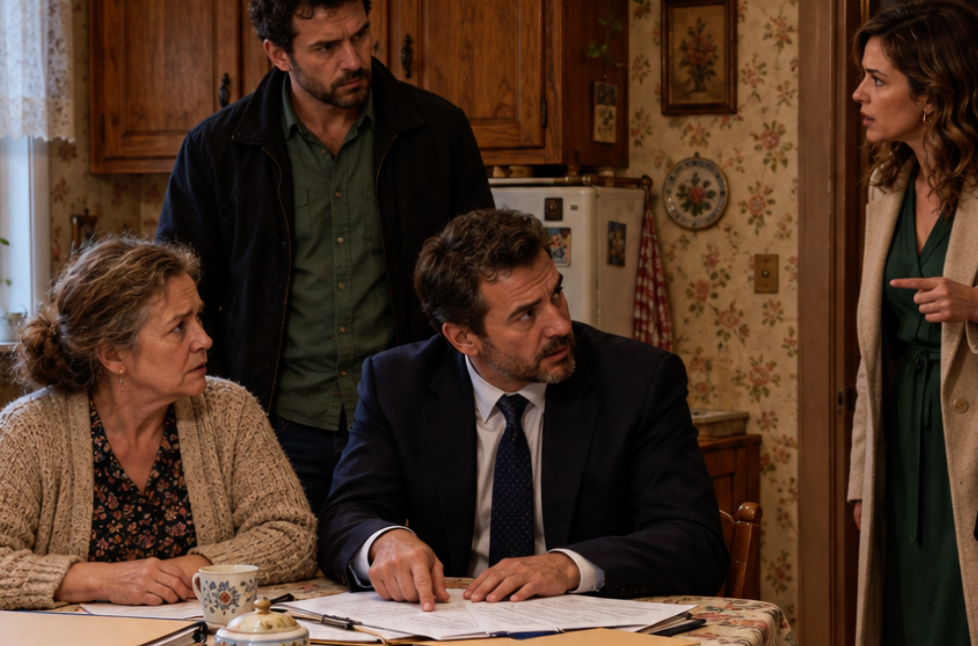
At her kitchen table, four people were sitting: her mother-in-law, her mother-in-law’s sister Zoya, Artyom, and an unfamiliar man in a gray suit with an open folder full of documents in front of him.
— And here’s the lady of the house, — the man said, getting up. — Perfect timing. We’ve been waiting for you.
— Who are you? — Marina didn’t move from the doorway.
— Marina, this is Gennady Lvovich, — Artyom blurted out. — He’s a lawyer. Family matters. We were just… discussing something.
— And what exactly were you discussing at my table?
Her mother-in-law stood up, adjusted her cardigan, and her voice suddenly lost all that honeyed sweetness—it became remarkably firm.
— Marinachka, sit down. This is a serious talk. We’ve consulted with some very smart people. Here’s the thing. Tyoma has been investing in the apartment for six years—that’s one. By law, he’s entitled to a share—that’s two. Kiryusha is his son, his heir, and he needs to be protected too—that’s three. And as for me, the grandmother, where am I supposed to go in my old age if something happens? I’ll register my residency here, as family, all official.
The lawyer gently slid the papers over to Marina.
— Olga Anat… sorry, Marina Sergeyevna. This isn’t anything scary. Just a registration application for a resident at this address. And an agreement to recognize part of the property as jointly acquired, considering your husband’s contributions. Sign these, and all issues are settled, everyone’s happy, the family stays at peace.
Marina looked at the documents. The neat lines, the empty signature slots. Then she looked up at her husband. Artyom kept his eyes on the table.
— Tyoma, — she said quietly. — Look at me.
He looked up. His eyes didn’t show guilt—just a kind of childish resentment, as if he was the one being mistreated here.
— You set all this up. While I was at work earning for us, you brought a lawyer into my home to take a piece of my inheritance. And permanently register your mother here.
— Marina, this is fair…
— Don’t talk to me about fairness.
She turned her gaze to the lawyer. She picked up the pen from the table. Her mother-in-law leaned forward, eyes shining with triumph. Zoya stopped breathing. Artyom tensed.
Marina turned the pen in her fingers. Then put it back on the table.
— Gennady Lvovich. Thank you for coming. Please gather your papers and leave.
— Marina Sergeyevna, don’t rush, take some time to think…
— I have thought. Take your documents.
The lawyer glanced at her mother-in-law. She had gone pale.
— Marinachka, don’t be foolish…
“Now,” Marina said, scanning the kitchen, “I’ll finally say what all of this has actually been about. So listen closely, everyone.”
She walked over to the window and opened the vent wide — the smell of fried onions was so strong, it was almost impossible to breathe. Then she turned around.
“Pack your things. And leave my apartment. All of you. Nina Arkadyevna — you. Zoya — you too. And you, Artyom. Yes, you as well.”
Silence filled the kitchen. Even the lawyer froze, folder in hand.
“You… mean me?” Artyom started to rise. “Marina, what’s going on? I’m your husband!”
“You were. I’ll file for divorce myself. And for now — yes, you too. Pack your bag.”
“You have no right!” his mother cried out. “My son lives here! My grandson! We’re not going anywhere!”
“I do,” Marina replied calmly, and that calmness made her mother-in-law fall silent. “The apartment is registered to me, by deed of gift. None of you are registered residents here — Nina Arkadyevna, despite all your efforts, you didn’t manage in time. And without registration or ownership, you’re all guests in my home. And guests who behave this way, I can ask to leave. Gennady Lvovich, please confirm this for the lady so she doesn’t make a scene.”
The lawyer cleared his throat, looking somewhere off to the side.
“Formally… the owner really does have the right. Yes.”
“You see?” Marina opened the kitchen door wider. “Start packing.”
They took a long, noisy time leaving. Nina Arkadyevna made sure the entire building heard her lamenting how an old, sick woman was being thrown out onto the street. Zoya silently forced things into checkered bags. Artyom dashed between his mother and wife, repeating, “let’s talk this over,” “this is insane,” “Marina, please reconsider.”
Marina did not reconsider.
She called them a taxi, carried the bags downstairs herself — just to get it over with sooner — and stood by the entrance, arms folded, as her mother-in-law got into the car, lips pursed, shooting daggers at her former daughter-in-law as if trying to burn a hole through her.
Artyom was the last to approach. He had a travel bag slung over his shoulder. His face looked like that of a beaten dog.
“Marina. What about Kirill?”
“Kirill is staying with me. You’re his father; you’ll see him. We’ll discuss everything — calmly, through reasonable people, not behind my back with lawyers. But he’ll be living here. At home.”
“You’re destroying our family.”
Marina looked at him. And suddenly realized she wasn’t angry anymore. She just felt sad.
“Tyom. I didn’t destroy our family. I just called things by their real names.”
He stood there a moment longer. Maybe he was waiting for her to chase after him, grab his sleeve, or say, ‘stay.’ She didn’t. Artyom got into the taxi. The car drove away.
Kirill got home from school an hour later. He saw that the checkered bags were gone from the hallway, that the unfamiliar slippers had disappeared, that his bedroom door was open and his toy cars were back on the shelf.
“Mom, where is everyone?”
Marina kneeled in front of her son.
“Grandma Nina and Aunt Zoya went back to their place. And Dad will be living somewhere else for now.”
“Forever?”
“I don’t know yet, sweetheart. But you’ll still see him — he’s not going anywhere. He’s your dad.”
Kirill thought for a moment.
“Will I get to sleep in my own room again now?”
“Just you. Always.”
“And Grandma won’t call me selfish anymore?”
Marina hugged her son tight, tighter than ever.
“No one will ever say that to you again. Ever.”
They went into the kitchen. Marina threw open both windows—finally letting out that heavy cabbage and onion smell. She dug deep into the cupboard to find her favorite tea, hidden who knows where by her mother-in-law. She brewed two cups—strong for herself, lighter with milk for her son.
“Kiryusha, how about we order pizza?” she suddenly suggested. “Tonight. Just because.”
“With sausage?”
“Whichever kind you want.”
Her son’s face lit up.
They sat at the table—just the two of them, in a silence no longer disturbed by loud TV shows or unsolicited advice. Outside, the tram rang as it looped around the circle. The air no longer smelled of cabbage, but of freshness—the cool evening breeze drifting in from the street.
That night, after putting Kirill to bed, Marina went back into the kitchen. She poured herself some tea and sat by the window. There was a lot of unpleasantness ahead—divorce, talks with lawyers, explanations for her son, judgmental glances from mutual friends that her mother-in-law was likely already telling all about ‘heartless Marina.’ Ahead was all the hard, exhausting work that always seems to fall on a woman’s shoulders after a man starts something like this.
But Marina wasn’t afraid.
It would have been much scarier to stay. To sign those papers. To agree to a ‘temporary’ registration that would last forever. To stay silent about the bags in the hallway, about another woman in her son’s bed, about the boxed-up world of her child.
She remembered her grandfather. When he handed her the keys, Pyotr Nikolaevich said, “Whoever owns the door owns their destiny.”
All her life, Marina thought that was about locks and square footage. Only now did she realize: her grandfather wasn’t talking about the apartment. He was talking about a line. About that invisible boundary a person draws around themselves—and that no one should cross without permission. Not even family. Especially not those who use the word ‘family’ to try to erase it.
Marina finished her tea. She washed the cup, set it in the rack to dry. Turned out the lights.
And for the first time in weeks, she fell asleep in her own home the way everyone should—in peace, knowing that in the morning, no stranger would rattle pots in her kitchen, move her things, or try to tell her how to live.
The door was locked. The key was right where it belonged. And the mistress of that door—and her own destiny—was once again Marina herself.