The Husband Was Sure His Obedient Wife Would Hand Over the Millions and Walk Away With Nothing — But the Night Before the Deal, She Accidentally Read His Messages
“Sign here, here, and at the bottom of the last page. In blue ink,” Stepan said, placing three thick folders on the kitchen table. “Tomorrow at ten sharp, we’re meeting the notary. Be ready early so I don’t have to wait for you in the car.”
Veronika silently wiped the countertop with a damp sponge, carefully going around the folders, then placed the cloth beside the sink. Stepan did not even look at her. He was scrolling through something on his phone, frowning and tapping impatiently on the screen. He was wearing an expensive shirt she had bought for him the week before, and he smelled of fine cologne. A man who handled serious matters. A businessman.
“Stepan, what are these documents?” she asked quietly, drying her hands on a towel. “You said we were only selling part of the company.”
He sighed heavily, put down his phone, and gave her that look. The condescending, exhausted look of an adult forced to explain something obvious to a child.
“Veronika, don’t get involved in legal details. GlobalTech is buying the entire package. The investors want a clean structure. One beneficiary, one signature. I’m transferring all the assets to the holding company. You’re withdrawing as a founder of our old company, signing a waiver of any claims to the intellectual property, and then we close the deal.”
“A waiver of claims? But I wrote the algorithm.”
Stepan smirked. He picked up his cup, took a sip of cold tea, and grimaced.
“You wrote lines of code, Veronika. You sat at home in the warmth while I ran from meeting to meeting, searched for investors, and built the brand. The software is just a tool. Without my marketing and connections, your code would still be sitting on a hard drive. We’re a family. The money will belong to both of us. But the person who understands how the market works should control it. Tomorrow, wear that gray suit. And please, at the notary’s office, just keep quiet and sign where I tell you.”
He stood up, grabbed his car keys, and walked into the hallway. The front door slammed shut.
Veronika remained alone in the kitchen. She went to the table and opened the top folder. Tiny print. Complicated legal language. An agreement transferring exclusive rights. And at the very end, almost as though it had been slipped in by accident, there was an agreement dividing their property in the event of divorce.
She slowly sat down.
She read the pages carefully.
According to the documents, if they divorced, she would receive the country house outside the city and the old car. All bank accounts, shares in the new holding company, and the rights to the software platform would go to Stepan.
Permanently.
She was forty-three years old. She had been married to Stepan for twenty-two of them.
Once, they had started out together in a rented one-room apartment. She worked as a systems administrator and took extra jobs at night. He tried selling office equipment, failed repeatedly, and got himself into debt.
She paid off those debts with her salary.
Later, when their son started school, Veronika became interested in neural networks. For three years, she developed the architecture of a program capable of analyzing huge volumes of medical data.
Stepan had said then, “Let’s try selling it.”
He registered the company in his own name, giving her a nominal fifteen-percent share. She did not argue. She was more comfortable behind a computer than sitting in conference rooms.
For the past five years, Stepan had practically lived on airplanes and in restaurants. He had become respectable-looking, started using fashionable business terminology, and developed a habit of interrupting people.
Veronika remained in the background.
She fixed bugs, wrote updates, and carried the entire technical support operation on her shoulders.
That evening, Veronika opened Stepan’s laptop. He had forgotten it on the sofa in the living room while rushing out to dinner with business partners.
The screen asked for a password.
Stepan had changed it recently, apparently deciding to be cautious, but that was hardly an obstacle for Veronika. Bypassing ordinary user protection took her only a couple of minutes, especially since, despite all his sophistication, Stepan had predictably chosen a ridiculously simple combination.
An email from his lawyer was still open in the mail application.
“Stepan, the documents are ready. If she signs the transfer of rights and the marital agreement in this version tomorrow, you’ll be completely protected. After the GlobalTech deal closes, you can file for divorce. The money will be transferred to the Cyprus account, and she won’t be able to get anywhere near it. As agreed, you keep the apartment—it was purchased in your mother’s name.”
Below it was Stepan’s response, sent two hours earlier:
“Excellent. She’ll sign. She doesn’t understand anything in those papers; she’s used to nodding along. The main thing is to get the patent.”
Veronika carefully closed the laptop.
The apartment was silent.
Only the refrigerator hummed in the kitchen.
She walked to the window and stared at the evening traffic lights for a long time.
She felt as if her skin had been stripped away.
Twenty-two years.
All those conversations about we’re a team, our future, I’m doing all this for us.
He was preparing to throw her out onto the street.
To leave with nothing the woman who had created the product that had earned him millions and who had raised his son.
He thought she was stupid.
An obedient function.
A convenient household appliance that happened to generate code.
Veronika returned to the kitchen. She poured herself a glass of water and drank it in small sips.
Then she went into her study—a small room lined with shelves of technical books—and switched on her work computer.
The familiar dark interface of her development environment illuminated the screen.
She remembered how six months earlier Stepan had hired new programmers to “accelerate scaling” and had forbidden her from interfering in their work.
“You don’t understand corporate standards, Veronika. Take a break,” he had told her.
But the core architecture of the system remained her creation.
None of the newly hired young programmers had been able to understand the deepest layers of the neural network.
She knew her code the way a mother knows her child’s face.
And as its architect, she had always retained control.
Veronika opened a protected archive containing the software.
Her fingers moved quickly across the keyboard.
She was not going to destroy the system.
She simply activated a module that had been built into its architecture from the very first day.
The digital licensing system.
When she had originally created the foundation of the program, she had included a protection mechanism that could only be removed with her personal electronic key.
Without that key, the program could operate in demonstration mode, but the moment anyone tried to transfer it to new servers or compile a corporate version, the system locked completely.
Stepan knew nothing about it.
He had never read technical documentation, preferring colorful presentations.
Veronika entered several commands into the terminal.
She updated the license status in an international open-code registry where, two years earlier, she had registered the basic algorithm under her maiden name.
From that moment onward, commercial use of the software core required the author’s direct, notarized digital signature.
Not the signature of the owner of some intermediary company.
The author’s signature.
She pressed Enter.
The system displayed a short message:
“Changes saved.”
Veronika shut down the computer, prepared the bed, and went to sleep.
Surprisingly, she fell asleep almost immediately, without sleeping pills.
Stepan was irritated the next morning.
He drank his coffee standing up and constantly checked the time.
“You have your passport?” he asked without even saying good morning.
“Yes.”
“I’ll carry the documents myself. Representatives from GlobalTech will be at the notary’s office. Behave properly and don’t ask stupid questions. I’ll tell you where to sign.”
Veronika put on dark trousers and a simple white blouse. She tied her hair into a neat bun.
The notary’s office was located inside a glass business center downtown.
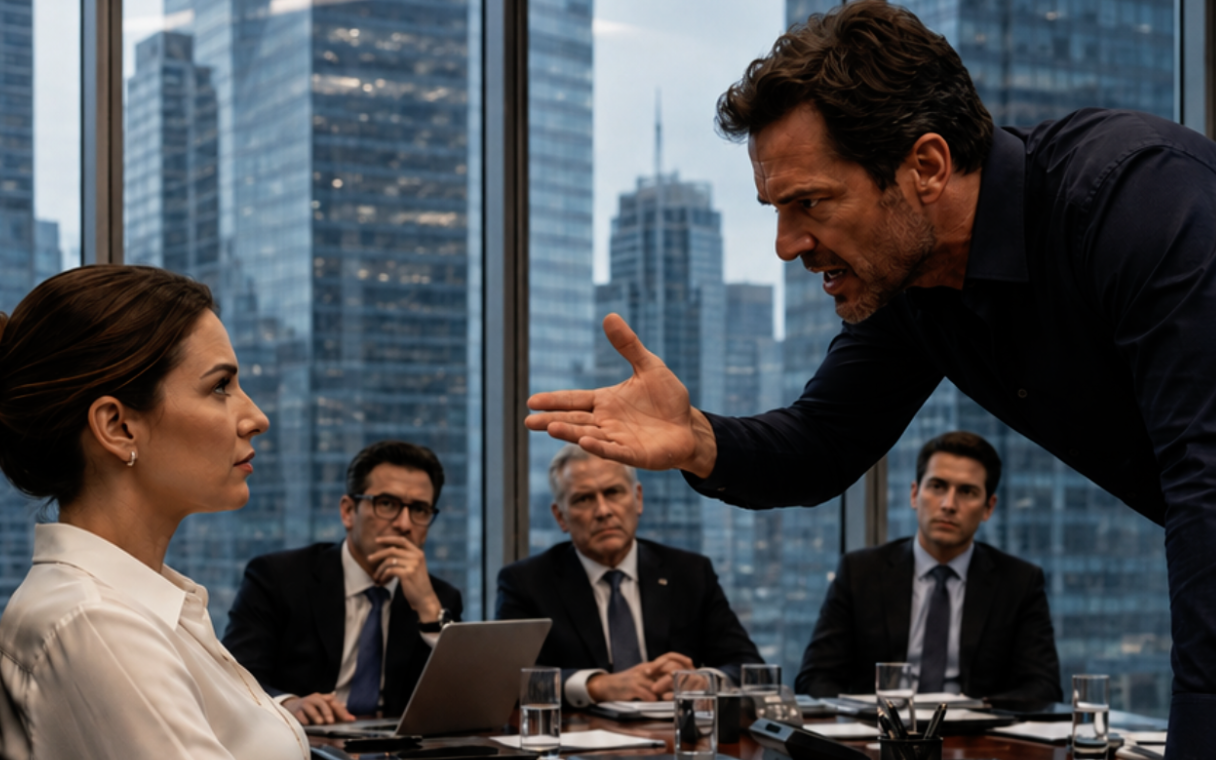
Three people were already waiting for them in a spacious conference room with panoramic windows.
A respectable man in a suit—the CEO of GlobalTech.
A young lawyer with a laptop.
And the acquiring company’s technical director, a man wearing glasses and a sweater.
Stepan entered the room wearing a broad, confident smile. He shook hands, cracked jokes, and offered everyone coffee.
He introduced Veronika with a careless gesture.
“And this is my wife, Veronika. A nominal co-founder. She’s here to give us her autograph so we can get to the important part.”
The CEO of GlobalTech nodded politely to her, then turned back to Stepan.
“Stepan Nikolaevich, we are prepared to sign the purchase agreement. The twenty-million figure has been approved. But before we put our seals on anything, our technical department must complete the code verification. It’s just a formality, as you understand.”
“Of course, of course,” Stepan said, leaning comfortably back in his leather chair. “My people gave you full access yesterday. Download it, test it, do whatever you need.”
GlobalTech’s technical director stared at his laptop screen.
His expression became increasingly focused.
He frowned, typed something quickly, then tried again.
“Stepan Nikolaevich,” he finally said, looking up. “We have a problem.”
“What problem?” Stepan asked with a patronizing smile. “Are the servers down?”
“No. We downloaded the program,” the technical director replied flatly. “But when we attempted to launch it on our servers, the system locked. It requires the creator’s personal digital key.”
“What key?” Stepan snapped, irritated. “I gave you every administrator password.”
“Administrator passwords provide access to the interface,” the technical director explained. “But the neural network core itself is patented and encrypted. There is a smart contract embedded in the code. The rights to the architecture do not belong to your company, Stepan Nikolaevich. They belong to an individual.”
GlobalTech’s lawyer quickly pulled his colleague’s laptop closer, examined the screen, and turned toward the CEO.
“It’s true, Viktor Sergeevich. The core algorithm is registered in an international copyright registry. The owner is Veronika Sergeevna Morozova.”
A heavy silence fell over the conference room.
Stepan slowly turned his head toward his wife.
The smile disappeared from his face, replaced by confusion and rapidly growing anger.
“Veronika,” he hissed through clenched teeth. “What does this mean? What key? Remove the lock immediately.”
Veronika sat perfectly still.
She was not gripping her handbag.
She was not avoiding his gaze.
She looked directly at Stepan.
“I’m not removing the lock, Stepan.”
“Have you lost your mind?” His voice rose, and he forgot there were other people in the room. He leaned forward, pressing both hands against the table. “You’re destroying the deal! Tell them how to disable it. Now!”
“It cannot be disabled,” Veronika replied calmly.
Then she looked at GlobalTech’s CEO.
“I wrote the algorithm. The rights to it have always belonged to me. Stepan’s company only had a temporary license to use my code for distribution. That license expired last night.”
The CEO of GlobalTech leaned back in his chair.
He was an experienced businessman and immediately understood the balance of power.
He looked at Stepan, whose face was red and who was almost choking with anger, and then at the calm, composed Veronika.
“Stepan Nikolaevich,” the CEO said, his voice suddenly icy, “you attempted to sell us an asset that does not belong to you. That is called fraud.”
“This is a mistake!” Stepan shouted, sweat appearing on his forehead. “She’s my wife! We’re married! It’s marital property!”
“Intellectual property registered before the creation of your holding company and protected by an individually named author’s patent is not divided in divorce without the author’s explicit consent,” GlobalTech’s lawyer said, still looking at the screen. “According to the documents you provided us, you claimed that the company owned full exclusive rights. You lied.”
Stepan suddenly turned toward Veronika.
Fear mixed with hatred in his eyes.
The same man who had planned the night before to leave her with a used car now looked pathetic.
“Veronika, come outside with me,” he said, attempting to grab her by the elbow. “We need to talk. You don’t understand what you’re doing. We’re going to lose the money!”
Veronika calmly but firmly pulled her arm away.
“I understand exactly what I’m doing, Stepan. I read your messages with Mark.”
Stepan froze.
The color drained from his face, leaving his skin an unpleasant gray.
He opened his mouth to say something, but no words came.
“I know about the Cyprus accounts,” Veronika continued in an even, quiet voice that carried to every corner of the room. “I know about the divorce. And the apartment. You wanted to take everything I created and throw me out.”
She stood and adjusted the strap of her handbag over her shoulder.
The CEO of GlobalTech stood as well.
“Veronika Sergeevna,” he said, completely ignoring Stepan. “Our company is interested in your algorithm. It truly is ahead of the market. If you are the sole rights holder, we would like to discuss the terms of purchasing the patent directly from you or licensing it.
“With you personally.”
“I’m willing to discuss it, Viktor Sergeevich,” Veronika replied with a nod. “My attorney will contact your legal department tomorrow morning. Goodbye.”
She turned and walked toward the door.
“Veronika!” Stepan shouted after her.
There was panic in his voice now.
“Veronika, stop! You can’t do this! I have loans secured against this deal! They’ll tear me apart!”
She did not turn around.
She stepped into the corridor and called the elevator.
The doors silently closed, cutting off her husband’s shouting.
Outside, the air was fresh.
Veronika took the subway, even though she could afford any taxi she wanted.
She wanted to be among ordinary people.
Sitting in the train car, watching stations flash past the window, she felt a strange emptiness inside her.
Slowly, that emptiness began filling with peace.
At home, she pulled a large suitcase from the closet.
She did not pack everything.
Only her clothes, documents, books, and hard drives containing backups.
The framed photographs, the little gifts Stepan had bought her, the expensive dinnerware they used when entertaining important people—she left all of it exactly where it was.
She zipped the suitcase closed.
Then she looked around the living room one last time.
This house was no longer her home.
Perhaps it had never truly been her home at all.
It was Stepan’s office.
His fortress.
A place where she had worked as an unpaid servant and programmer.
In the hallway, she placed her apartment keys on the cabinet.
A month later, the divorce was finalized.
Stepan did not appear in court. He sent his lawyer instead.
GlobalTech’s deal with his company collapsed completely.
When the investors learned about the falsification involving the intellectual-property rights, they demanded their money back.
To repay his debts, Stepan was forced to sell the very apartment that had been registered in his mother’s name and declare his company bankrupt.
Veronika signed a direct contract with GlobalTech.
She did not sell them the patent.
Instead, she granted the company an exclusive license to use the algorithm and became the head of a new division.
She rented a bright apartment near a park, bought herself a powerful new computer, and finally got a dog—a golden retriever she had dreamed of owning for ten years but that Stepan had always forbidden because of the shedding.
Sometimes, in the evenings, she sat on the balcony with a cup of hot tea, looking at the trees and listening to the silence.
There were no more condescending remarks in that silence.
No more rules imposed by someone else.
There was only her own life.
A life she had earned.
And she knew with absolute certainty that the code of that life had been written by her alone—
without a single mistake.