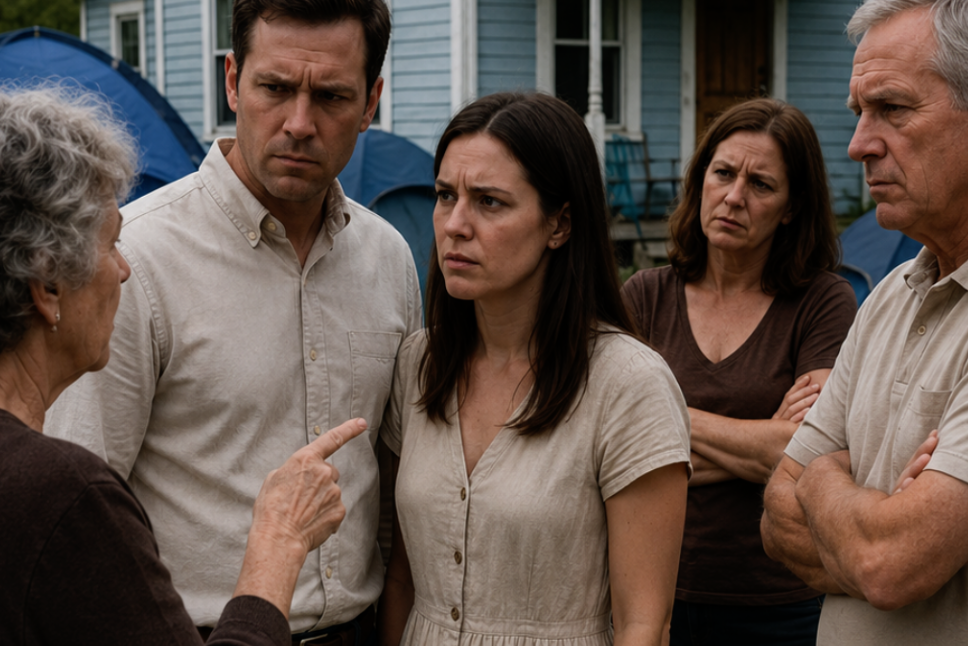
The relatives were offended that I hadn’t invited them to my new house by the sea. They demanded a share of Grandma’s inheritance
Irina read aloud, gripping the sheet of paper tighter with every paragraph.
“This is nonsense,” Vadim said. “The apartment had one owner. The sale was legal. I don’t owe anyone anything. They’re talking about doing the decent thing? Where was their decency when we were sleeping in the car?”
She looked up.
“Do you think they’ll leave us alone?”
“No. But it doesn’t matter anymore. We have everything we need to keep them out of our lives.”
She nodded, but anxiety was already burning in her eyes. Not for the walls. For their peace. For the possibility that, after all those years of struggle, they might once again be forced to prove their right to what was theirs.
And if necessary, they would.
Two weeks passed.
The heat was thick and sticky, like melted honey. The sea glittered beyond the horizon, and at last the house had become truly quiet.
Until Saturday morning.
Vadim woke to a dull thud. At first, he thought he had imagined it. Then he heard a voice. And another one. A man and a woman. Laughter. The creak of the gate.
He looked out the window—and froze.
There were tents in the yard. Real camping tents. One blue, the other orange. Beside them stood a car with Moscow license plates and two people: Uncle Kostya and his twenty-year-old second cousin Masha, holding a portable Wi-Fi speaker.
“What are you staring at?” Kostya shouted cheerfully. “We’ve been driving all night! Came here to breathe some sea air! You don’t mind if we stay here for a week or two, do you?”
Vadim could barely breathe.
He walked outside barefoot, wearing only shorts.
“Are you out of your minds? Who invited you?”
“Why would anyone need to invite us? The house is basically shared property—a family house. We wrote you a letter, remember? You’ll sort all that out eventually. In the meantime, we’ll enjoy the fresh air. Don’t worry, we won’t even go inside. We brought tents, a camping stove. We’ll just fill up some water from your place, and everything will be fine!”
Kostya was already fiddling with the barbecue grill.
Vadim silently turned around and went back inside.
Irina was sitting in the kitchen with a cup of tea. She wasn’t looking at him. She was staring at the table.
“You saw them?” he asked.
She nodded.
“I can’t do this anymore. Everything inside me is tightening up. It feels like we’re under their control again.”
“Not theirs. Only while we stay silent. If we speak up, we’re not,” she said, getting to her feet. “Now.”
They went outside together.
Irina walked ahead. She was wearing the same shirt she used to wear when she poured concrete during construction.
Her eyes were cold.
“Get out,” she said.
“Ira, what’s wrong with you? We’re family. We’ll live in a tent. We’re not asking you for anything!” Masha protested. She had already spread a towel across the lawn.
“The lawn is mine. The land is ours. The house is ours. You are nobody here. You weren’t invited.”
“Oh, come on!” Kostya waved dismissively. “You could at least offer us some tea. This isn’t very decent of you.”
“And what you’re doing is decent? You barged in without permission. Tents, a barbecue—the entire neighborhood will be watching this circus. We didn’t let you in. You’re trespassers.”
“Are you threatening us?” Kostya narrowed his eyes. “Going to call the police?”
“Try staying. You’ll find out.”
They didn’t leave until evening.
They littered, slammed the car doors loudly, but eventually drove away.
They never came back.
The next day, their neighbor Valentina brought over some pies.
“You know, you did well,” she whispered to Irina. “You didn’t let them walk all over you.”
But the peace didn’t last long.
A week later, Vadim’s mother arrived.
Alone.
She came carrying string shopping bags as though she were going to the market. One was filled with pickled food, the other with blankets and slippers.
“I’ve made a decision,” she announced as soon as she crossed the threshold. “I’m going to rent out my apartment and live with you for a while. Fresh air, nature. You wouldn’t throw your own mother out, would you?”
Irina almost dropped her cup.
“Mom, we don’t have room. We’re still renovating. And you didn’t arrange this with us.”
“I’m not a stranger! It’s not like you’re running a private resort. You’ve got a house by the sea—you’re supposed to welcome relatives! And besides, I’m demanding my share too. You sold your apartment, didn’t you? You deprived my granddaughter of her inheritance. That means I have rights!”
Vadim remained silent for a moment.
Then he said:
“No, Mom. Leave. You’re crossing our boundaries.”
“What did you just say?”
“I don’t owe anyone anything. Grandma left the apartment to me, not to you. She could have left it to anyone she wanted, but she chose me. None of you asked how I was doing. None of you helped. None of you were involved. And now suddenly you’ve decided that I owe you something?”
“You’re my son!”
“And I’m a person. I have the right to my own home. My own peace. My own family.”
His mother left screaming.
The next day, another storm erupted in the family group chat.
New accusations appeared, along with comments about “ingratitude” and “greed.” Someone even posted an old photo of Grandma with captions saying that “she would never have approved of this.”
But one day, it all stopped.
Unexpectedly.
One morning, the group chat fell silent.
Not a sound.
No screenshots.
No voice messages.
Irina looked out the window. Seagulls drifted along the horizon.
“They got tired,” she said. “Or they finally understood.”
“Or they found someone more willing to put up with them,” Vadim said with a smirk.
Summer passed.
The neighbors began dropping by for visits. Valentina and her husband came over. The local librarian brought them some old books as a gift. A fisherman taught Vadim how to catch flounder in deeper water.
And the relatives never called again.
“You know,” Irina said one day, “what they lost wasn’t a house. They lost an illusion. The illusion that you can do nothing, contribute nothing, and then simply show up one day and take whatever you want.”
“We stopped them from living in that illusion,” he said with a nod. “Now they can live in reality.”
And from that day forward, the house by the sea belonged only to them.
Not because that was what the documents said.
But because they had suffered for it.
Day after day.
At night, in the rain, through arguments, concrete dust, fear, and faith.
No one else had any right to it.
Except them.