“Don’t you dare wear makeup again!” my mother-in-law shouted as she splashed fruit compote into my face. I silently called the police.
We lived in her apartment. More precisely, in the apartment belonging to Alla Petrovna, my mother-in-law. Vadim and I had no home of our own. The mortgage we had applied for two years earlier was stuck in the stage of “approved, but no funds available.”
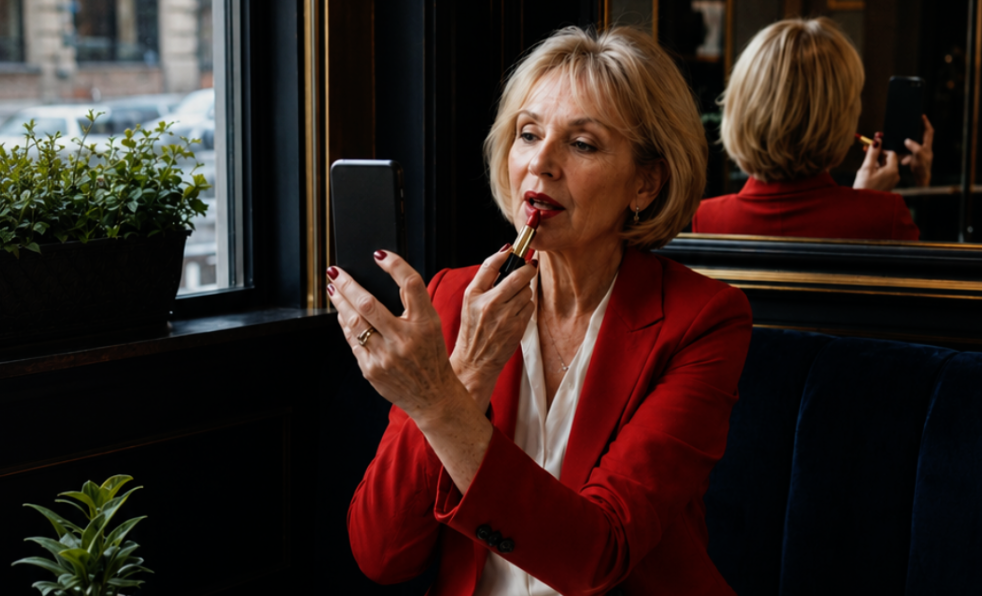
I worked remotely at a call center. The red lipstick I had bought the previous week from a kiosk in an underground passage was the only bright spot in my life. Every morning, before I started calling clients, I painted my lips. It was a kind of ritual.
Alla Petrovna could not stand that lipstick.
“Disgusting,” she would say, wrinkling her nose whenever I went into the kitchen to make tea. “You look like a woman of easy virtue. Vadim, do you see how your wife paints herself up?”
Vadim remained silent, staring at his phone. He worked as a taxi driver, came home late, and was always tired. At home, all he wanted was peace and quiet.
But there was no peace and quiet.
There was Alla Petrovna and my lipstick.
I was washing the dishes after dinner. Vadim had left for his shift, so the two of us were alone. Alla Petrovna sat in the kitchen, drinking tea and watching me scrub a frying pan.
“Do you know how much that paint costs?” she asked without looking at me. “For that money, you could buy decent meat instead of those sausages you two eat.”
“The lipstick cost two hundred rubles,” I replied evenly. “I bought it with my own money.”
“With your own money,” she mimicked. “And who pays for this so-called job of yours? My son! He brings money into the household while you sit around in headphones, chattering nonsense and painting your face.”
I said nothing.
That was her favorite weapon: belittling my income. I earned half as much as Vadim, but I paid for groceries and utilities, and sometimes even lent Alla Petrovna money when her pension ran short.
One day, I returned exhausted from my only trip to the office that week, my feet rubbed raw from my shoes. I entered the apartment and took them off.
My lipstick, which I had left on the small cabinet in the hallway, was covered in white streaks. Alla Petrovna was rubbing it against something, trying to clean a stain from the wardrobe door.
“What are you doing?” I asked.
“Oh, this scribbling stick of yours?” she replied calmly. “I was removing a stain from the door. You’re always leaving greasy fingerprints everywhere. Don’t worry about it. You can buy another one. With your own money.”
She said “your own” with such contempt that my jaw tightened.
That evening, I complained to Vadim. He was lying on the sofa with his eyes closed, waving me away weakly.
“Natasha, Mom is old. Just buy another one. Why are you making such a scandal over a few pennies? She wants what’s best for you. If you didn’t wear such bright makeup, there wouldn’t be a problem. Get used to it.”
“Get used to it,” I repeated.
Something tightened inside me.
I looked at him, at the man I had married five years earlier, and suddenly understood that he was not on my side.
He was over there, on the sofa.
Neutral.
Then guests came over: Alla Petrovna’s sister and her husband. I set the table. No one intended to help me.
I dressed up for the occasion, put on my favorite dress, and painted my lips.
My protection.
My mask of confidence.
At the table, Alla Petrovna smiled at the guests and said:
“Our daughter-in-law is quite the actress! She practically glows. She belongs in a theater, not a call center. Vadim, you should buy her a theater ticket. She already looks like she’s wearing stage makeup.”
Everyone laughed.
I smiled, even though the sound of their laughter made me feel sick.
The guests exchanged glances. Aunt Galya, Alla Petrovna’s sister, pursed her lips.
“Alla, stop picking on the girl. So she wears makeup. Let her. She’s still young.”
“Young?” my mother-in-law snorted. “At her age, I had already helped my husband become somebody and built a house. What has she done? Clothes and lipstick, that’s all.”
I picked up the salad bowl and went into the kitchen.
Vadim did not follow me.
He remained seated, eating and listening to his mother.
Then came an ordinary day.
I was working, and Alla Petrovna was watching television. Around five o’clock, I went into the kitchen to make tea and heat up my lunch. I was wearing headphones, so I did not hear her approach.
“Natalya,” she said sternly.
I turned around and removed one earphone.
My lips were painted. I had reapplied the lipstick after lunch.
“That disgusting stuff again,” she hissed through clenched teeth. “How long are you going to keep this up, Natalya? You’re thirty-five years old. Who do you think wants to see a mouth like that?”
Her voice was quiet, almost gentle.
But every word was filled with hatred.
I looked at her and suddenly understood that I would not back down this time.
I opened my mouth to answer.
She stepped forward, grabbed the pot of cherry compote she had made that morning, and threw its contents into my face.
The compote was sticky, sweet, and warm.
It ran down my hair, my neck, and beneath my collar.
I stood there, numb.
Red drops fell onto my light-colored blouse.
The glass on the table remained intact. I could see it clearly.
“Don’t you dare wear makeup again!” she screamed. “I don’t want to see it in my house! Do you hear me?”
I wiped my face with my sleeve.
The compote was warm, not scalding. About that, at least, she had not lied.
I took out my phone and dialed 112.
“Hello,” I said calmly, looking directly into Alla Petrovna’s eyes.
Suddenly, all the anger drained from her face.
“I’ve been attacked. Someone threw compote into my face and insulted me. Please come to this address…”
“Compote?” she shouted. “Are you stupid? It was only compote! It was warm!”
“I want to file a complaint,” I continued. “For verbal abuse and disorderly conduct.”
Vadim arrived an hour later.
The police officers were already writing the report. Alla Petrovna was sobbing, pressing a handkerchief to her eyes and claiming that she was the real victim, that her daughter-in-law was hysterical and had insulted her first.
Vadim looked at me.
My face was red from the sugar and from rubbing it with my sleeve. My hair was disheveled, and my blouse was soaked.
He said nothing.
“What have you done?” he whispered when the police officers stepped into the hallway. “She’s my mother. You could have just gone to your room. Why did you call the police?”
I looked into his eyes.
There was only fear there.
And irritation.
“I’m leaving.”
“Where are you going?”
“To a friend’s place. I’m not staying here. And you’re not coming with me. You’re staying, aren’t you? Because she’s your mother. Because dinner is waiting.”
I took a new lipstick from the shelf in the bathroom.
The same kind. The one that cost two hundred rubles.
Clean and untouched.
I placed it in my bag.
It was the only thing I took.
A small red tube.
The thing she hated so much.
I went to stay with my friend. Three days later, I rented a room in a shared apartment outside the city.
I filed for divorce.
Vadim called many times. First, he threatened me. Then he begged me. Then he went back to saying:
“Mom is old. You’re the one who was wrong.”
I listened in silence and ended the call.
Alla Petrovna wrote about me on social media. She claimed her blood pressure had risen, that she had not meant to do it, and that I had provoked her.
I did not respond.
Then she wrote that I was a hypocrite and that she had suffered a heart attack.
I read it and felt nothing.
No anger.
No hurt.
Only emptiness.
When I returned to the apartment to collect my things, Vadim stood by the door, staring at the floor.
Alla Petrovna was in her room, wailing loudly and theatrically.
I picked up that same red lipstick from the hallway cabinet and turned toward him.
“You know,” I said, looking into his eyes, “I thought that if I endured everything, I would become a good wife. I thought that if I stayed silent, life would be easier for you. I thought that if I stopped wearing lipstick, she might love me more.”
I paused.
“I was wrong. She didn’t want to change me. She wanted to destroy me. And you allowed her to do it.”
Vadim raised his head.
His eyes were filled with tears.
“Natasha, forgive me,” he whispered.
“It’s too late.”
I went outside.
It was a cold autumn evening.
I took out the lipstick, opened it, and painted my lips in the darkness of the apartment building’s entrance.
Just as carefully as I did every morning.
I smiled at my reflection in the glass door.
The smile came out crooked.
But it was the smile of a free woman.
I still paint my lips every day.
And you know what?
I got married again.
This time, to a man who brings me coffee and kisses those red lips even when there is no time for breakfast.
He likes the color.
But that is not the moral of the story.
The point is not that I found another man.
The point is that I found myself.
And I remembered one lesson that I learned the hard way:
A person who asks you to change before they can love you will never truly love you.
They are simply waiting for you to disappear.
And to survive, you do not need to make yourself invisible.
You need to leave.
And take your lipstick with you.