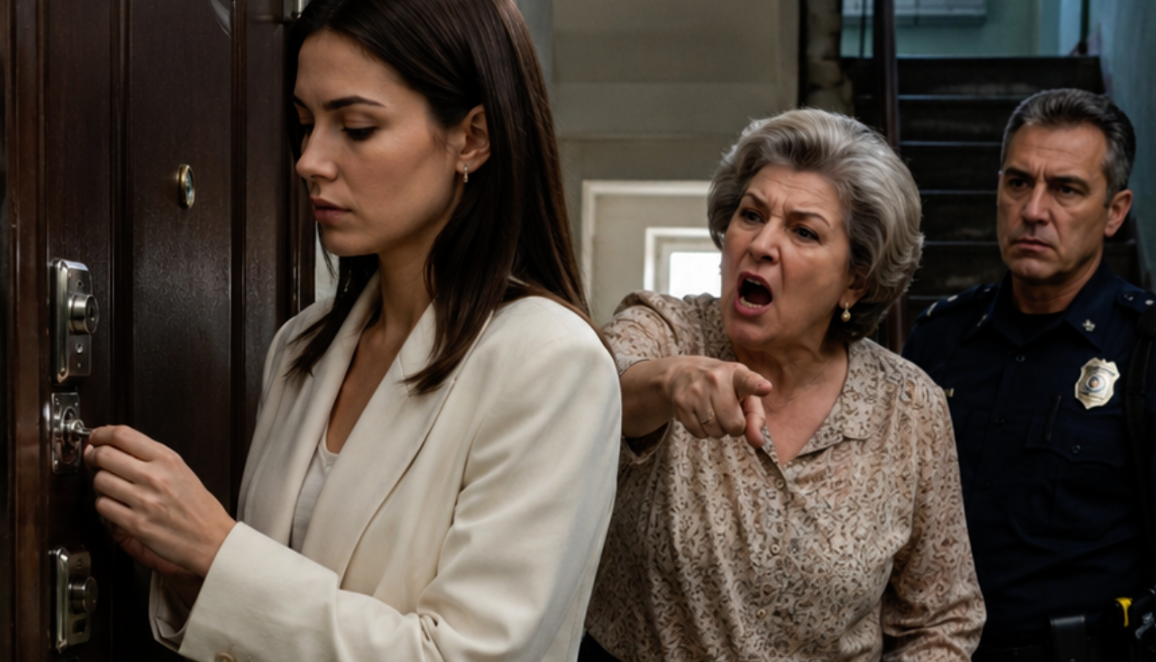
“Anya, dear, my daughter is going to be the mistress of your apartment.”
My mother-in-law delivered the statement with the breezy nonchalance of someone discussing the purchase of a new floral tablecloth. We were seated at her dining table, the air heavy with the sweet, buttery scent of her signature Napoleon cake. Tatyana Vasilyevna delicately dabbed the corners of her mouth with a paper napkin and beamed at me, her eyes entirely devoid of warmth.
I smiled back instinctively. For a fleeting second, my brain refused to process the words. I assumed it was one of her bizarre, passive-aggressive jokes—the kind she would immediately wave off with a condescending sigh about my generation’s lack of humor.
“What exactly do you mean?” I asked, slowly lowering my silver dessert spoon onto the saucer.
“Lena is getting a divorce, as you well know,” Tatyana Vasilyevna continued smoothly. “Living with Andrei has become impossible. He is verbally abusive and is practically forcing her out onto the street. The poor girl is in desperate need of her family’s support right now. Dima and I discussed the situation at length,” she gestured casually toward my husband, “and we have made the decision that Lena will stay with you. Your apartment is exceptionally large. It has two spacious rooms. She will occupy one of them.”
Dima was sitting directly beside me, suddenly fascinated by the faded geometric pattern of the plastic tablecloth. His fork nervously mashed the remaining flakes of pastry on his plate into a fine powder.
“You already knew about this?” I asked, my voice dropping to a quiet, dangerous register.
“Anya, what is the big deal?” He finally dragged his eyes upward, looking defensive rather than apologetic. “My sister needs a roof over her head. You’re not a monster, are you? She isn’t a stranger.”
“She isn’t a stranger, so that entitles her to legally occupy my home?” Despite my best efforts, a slight tremor entered my voice. “The apartment my parents purchased for me entirely before we even met?”
My mother-in-law physically recoiled, her face contorting as though I had uttered a vile profanity.
“Oh, here we go with this nonsense,” she scoffed, waving a hand dismissively. “‘My parents bought it. I am the sole owner.’ You are legally married to my son, Anya. That means everything you possess belongs to the both of you. Lena will arrive tomorrow morning. She will have her belongings transported by lunchtime, and by tomorrow evening, we will all sit down for tea together as one unified, larger household.”
I turned to look at Dima. He remained utterly silent. It was not merely the silence of a man avoiding conflict; his posture—slumped, arms crossed—made it abundantly clear that he considered his mother’s decree final.
“Dima, say something,” I pleaded.
“Mom is absolutely right,” he snapped, his voice sharp with irritation. “Stop being so incredibly selfish. Lenka is on the verge of homelessness, and you are sitting on all those empty square meters. We will live together like a proper family. A commune. She can help you with the cooking and look after the little one. You are constantly complaining about how exhausted you are.”
“I am always complaining that I’m tired?” I repeated in a near whisper, the sheer gaslighting making my head spin.
“Aren’t you?” He finally locked eyes with me, his gaze hard. “You are on maternity leave. You just sit at home all day. Lenka will get a job and contribute financially to the household while you push the stroller around the park.”
“And did it occur to anyone to ask me? Does my opinion carry any weight in my own home?”
My mother-in-law spread her hands in a gesture of mock benevolence. “Anya, dear, what relevant opinion could you possibly offer? You are a junior member of this family, and in a proper family, the elders formulate the decisions. Dima and I have meticulously planned everything out. Lena will take the room with the balcony. We took the liberty of measuring it, and her sofa will fit flawlessly. If it begins to feel a bit too crowded for you, you can simply pack a bag and stay with your parents for a while. They have that lovely house outside the city with plenty of fresh air. Dima and Lena can get the household organized in your absence.”
I looked slowly around the table. My mother-in-law’s face was glowing with triumphant satisfaction. Dima was meticulously picking a microscopic crumb off the table with his fingernail. My father-in-law sat in his armchair, eyes glued to the television screen, feigning sudden deafness.
In that suffocating dining room, I achieved perfect, crystalline clarity. They had not made a proposal. They had made an executive ruling, delivering the news to me with the same disregard one might use when placing a bowl of cheap kibble before a dog.
And so, I smiled.
It was a broad, remarkably sincere smile—so intense that even Tatyana Vasilyevna blinked in wary surprise.
“All right, Tatyana Vasilyevna,” I said cheerfully. “Should I hand Lena the spare keys right now in front of you, or give them to her when she arrives tomorrow?”
A stunned silence fell over the table. My mother-in-law exchanged a victorious glance with Dima, her face blossoming into genuine delight.
“You see, Dimochka?” she crowed. “You were so worried your wife would cause a hysterical scene! She is a sensible, practical girl. Tomorrow, Anya. Tomorrow is fine. Lena will arrive by taxi with her suitcases. It is your strict responsibility to welcome her as the senior mistress of the home. She is older than you and possesses vastly more household experience. Honestly, she can teach you a great deal. You don’t take particularly good care of your husband, anyway. I’ve noticed you don’t even iron his shirts properly.”
Dima nodded in smug agreement. He looked at me with a sickening expression of condescension, as though I had finally managed to pass a basic obedience test.
I politely declined a second slice of cake, citing my need to prepare the apartment for our new “guest.” Dima opted to stay behind at his mother’s to finalize the logistics of the move.
I walked out of the building, climbed into the driver’s seat of my car, and sat in the absolute darkness for a full minute. My hands gripped the leather steering wheel with such force that my knuckles turned bone white.
They had absolutely no idea that I had just finalized my own plans. By tomorrow morning, my apartment would feature entirely different hardware.
The drive home was a blur of neon streetlights and echoing phrases. Your responsibility is to accept her. If it gets too crowded, stay with your parents. Stop being selfish. But the most unforgivable sentence belonged to my husband: Dima and I discussed it and decided. He had negotiated the surrender of my property with his mother, behind my back.
Upon entering the apartment, I gently woke my two-year-old son, Misha. I called a premium taxi service and packed a tactical emergency bag: Misha’s clothes, every vital document I possessed, my jewelry box, and my laptop. Forty minutes later, I stood on my parents’ porch.
My mother opened the door. She took one look at my face, the heavy bag, and the sleeping toddler in my arms. Without uttering a single interrogating syllable, she stepped aside.
“What has happened?” she finally asked, once Misha was tucked into the guest bed and we were seated in her kitchen.
“Mom, I need your lawyer’s direct number. And I need a heavy-duty locksmith who works graveyard shifts.”
My mother quietly poured two cups of chamomile tea, retrieved her leather-bound address book, and handed it to me. No judgments. No unnecessary questions.
At 2:00 AM, I returned to my empty apartment. Dima’s unwashed coffee mug still sat on the counter; his running shoes littered the hallway. Methodically, and without a shred of emotion, I gathered his entire existence. Clothes, shoes, important documents, grooming supplies—all of it was aggressively shoved into two massive suitcases. I placed his toothbrush and razor on the very top, zipped them shut, and dragged them to the front door.
At 3:00 AM, my phone buzzed.
“Anya, staying at Mom’s tonight. Tomorrow we welcome Lenka. Bake an apple cake for the table.”
I left him on read. I spent the next hour photographing my property deed, the purchase agreement, and the notarized deed of gift from my parents, officially dated three years prior to my wedding day. I emptied our small safe of cash and bank cards. Then, I sat in the armchair and waited for the dawn.
At exactly 7:00 AM, Nikolai Petrovich, a burly locksmith with a heavy toolbox, arrived. I requested two high-security Cerberus locks—one lever, one cylinder—and replaced the secondary deadbolt for good measure. By 8:00 AM, the door was a fortress.
I paid Nikolai double his rate and locked the door from the inside.
Click. Click. Click. The sound was heavy, metallic, and permanent.
At 8:30 AM, a message popped up in the family group chat from Tatyana Vasilyevna: “Lena is in the taxi. Arriving in 30 minutes. Anya, welcome your sister with open arms.”
I typed my response, ensuring the tone was surgically cold:
“The move-in is permanently canceled. This apartment is my exclusive personal property. Dima, your belongings are packed and waiting in the hallway outside the door. Collect them before noon, or they will be carried to the dumpster.”
The chat immediately detonated.
Forty minutes later, the assault began. Lena did not ring the doorbell; she hammered on the reinforced steel with her fists and something heavy, likely a shoe heel.
“Open this door!” she shrieked. “Aunt Tanya told me this is my room now!”
I walked calmly to the threshold but did not touch the locks. “Lena, lower your voice. There is no room for you. I am the sole owner of this property. You are not moving in.”
“Have you completely lost your mind?!” she screamed, her voice echoing down the stairwell. “Mom and Dima made the decision! You are a nobody! Dima is registered here, and you are just an accessory! I’m calling the police right now!”
“Please do,” I replied evenly. “When they arrive, we can discuss Article 139 of the Criminal Code—attempted unlawful entry into a residence. It carries a penalty of up to three months of detention. Are you interested?”
Silence fell over the landing.
“Dima!” she wailed into her phone a moment later. “Your psychotic wife locked me out!”
My phone immediately rang. Husband.
“What the hell do you think you are doing?” Dima roared. “Open that door! People in the building are staring!”
“Let them stare,” I said. “Dima, your suitcases are outside. You can throw away your old keys.”
“You changed the locks?! You have no right! This is our family home!”
“The apartment was purchased by my parents before our wedding. You have zero ownership rights. Your mother has zero rights. I am initiating the legal process to cancel your registration. If you wish to fight, we will do it in a courtroom. Do not come near this door.” I ended the call.
Ten minutes later, a polite ring sounded. I looked through the peephole to see a uniformed police officer, flanked by a smug Tatyana Vasilyevna.
I opened the door, physically blocking the threshold as my mother-in-law tried to snake her way inside.
“Who are you according to your passport?” I demanded.
“I am your husband’s mother!” she spat.
“You are a legally unrecognized guest. You may not enter.”
The officer cleared his throat. “She is actually correct, ma’am. Please wait on the landing.”
When they demanded I let Lena in because Dima was registered there, I presented my pristine folder of documents. The officer inspected the premarital deed of gift, checked my passport, and nodded.
“Citizen,” the officer addressed my mother-in-law, “there are absolutely no legal grounds for your daughter to reside here. The owner objects. This is a civil dispute.”
Tatyana Vasilyevna exploded, citing her status as an “Honored Teacher” and claiming Dima had invested money in renovations. I calmly informed the officer that my parents had paid for the contractors, and I had the receipts to prove it.
When my mother-in-law refused to leave, the officer handed her a noise complaint filed by my neighbor. I added that I had security camera footage and audio recordings of Lena’s profanity.
Fifteen minutes later, the landing was empty.
I locked the door, slid down the wall to the floor, and looked at my hand. My thin, gold wedding ring felt like a shackle. I slid it off my finger and left it on the hallway cabinet beside a framed photograph of a marriage that no longer existed.
My mother-in-law was not finished. On the fourth day, Child Protective Services called. Tatyana Vasilyevna had filed a malicious report alleging I was living an immoral lifestyle and endangering my son.
I invited them over immediately.
When the two female inspectors arrived, they found a pristine apartment, a fully stocked refrigerator, a laughing toddler, and a meticulously organized folder containing pediatric health records and a psychological evaluation proving I was simply exhausted from motherhood, not an addict.
“Why do you believe this report was filed?” the senior inspector asked, peering over her glasses.
I handed her the printed threats, the police report, and the audio transcripts. “Because I refused to let my sister-in-law commandeer my premarital home. They are weaponizing your agency to punish me.”
The inspector’s lips tightened into a thin line. She closed her folder, assured me they would file a report validating my home as a safe environment, and advised me to establish a formal visitation schedule to block future harassment.
That afternoon, Lena requested a meeting at a local café, begging for a truce. She arrived wearing carefully applied foundation over a bruised cheek, crying about her mother’s physical abuse and begging to stay for “just a couple of nights.”
I almost pitied her, until I noticed her eyes darting nervously to her phone on the table. When I stood up to use the restroom, I intentionally bumped the table, knocking her phone to the floor. As I picked it up, the screen lit up with a message from ‘Mommy’:
“Keep playing on her sympathy. She’s an idiot and falling for it. Just secure one room.”
I placed the phone back on the table and locked eyes with her. “The performance is over, Lena. Tell your mother that if she approaches me again, I will file counterclaims for psychological harassment and defamation.”
It was time to take the offensive. I drafted an anonymous post in our city’s largest social media community. I named no one, but I uploaded the crystal-clear audio recordings of the hallway confrontation. I detailed the entitlement, the CPS weaponization, and the betrayal.
The post exploded. Fifteen thousand views in twenty-four hours. Hundreds of women rallied in the comments, recognizing the toxic dynamics of their own lives.
Enraged, Tatyana Vasilyevna filed a defamation complaint with the police. We were all dragged into a stuffy investigator’s office.
“She made me a laughingstock!” my mother-in-law shrieked to the exhausted Police Major. “I am an Honored Teacher!”
My lawyer calmly cited Article 12 of the Civil Code, defending my right to record for self-preservation. The Major played the audio loudly in the small room. Hearing her own vicious words played back in a police station finally shattered Tatyana Vasilyevna’s armor.
“This woman is the victim,” the Major told my mother-in-law coldly. “You attempted unlawful entry. Would you like me to open a criminal case against you right now?”
She turned white and remained silent.
As we left the station, she tried to corner me one last time, threatening to ruin my reputation in the city’s committees. I simply held up my phone, showing her the viral post. “Enjoy your fame, Tatyana Vasilyevna. People are already recognizing your voice on the streets.”
She recoiled as if struck by lightning, turned, and fled.
Six months later, the divorce was finalized. The court officially stripped Dima of his registration at my address and mandated a strict, supervised visitation schedule for Misha.
Without me to terrorize, Tatyana Vasilyevna’s empire imploded. Lena moved to the outskirts of the city to escape her, and my quiet father-in-law finally packed his bags and fled to another town.
I gutted my apartment. I tore down the hallway wallpaper I had chosen with Dima and replaced it with a bright, vibrant floral pattern. I bought a brand-new, heavy-duty front door.
On the day the renovations were completed, I stood in the hallway breathing in the scent of fresh paint and absolute sovereignty. I took three gleaming, freshly cut keys from my purse.
Click. A deep, reassuring sound. Nobody would ever again dictate who slept in my home.
My phone chimed. It was Dima.
“Anya, Mom is begging for forgiveness. Maybe we can start over? Forget everything?”
I looked at the keys resting in my palm. I snapped a photograph of them against the backdrop of my beautiful new door and uploaded it to my status with a single caption:
“Some doors are better left closed forever.”
Then, I turned off my phone, made myself a cup of tea, and enjoyed the beautiful, unbroken silence of my home.