“Our Entire Family Is Ashamed of You—Remember That!” the Mother-in-Law Declared, Not Knowing the Whole Family Had Already Been Drinking Tea at Her Daughter-in-Law’s Home for Two Weeks and Keeping Quiet
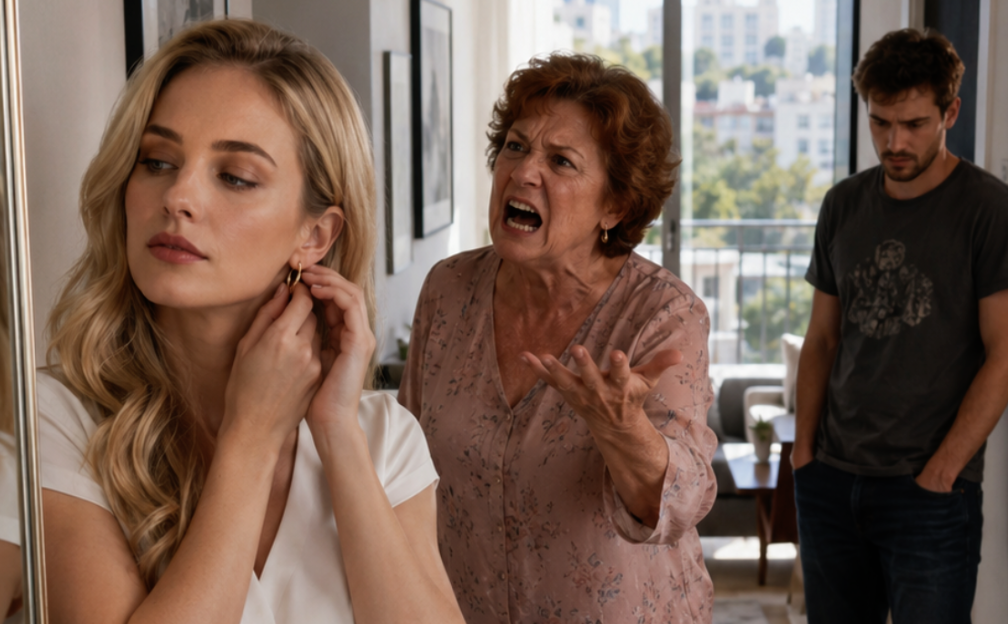
“Do you even understand what kind of person you are?!” Nina Arkadyevna stormed into her son’s apartment as though she were charging into occupied territory. “You’re a disgrace! That’s what you are. A disgrace to our entire family!”
Oksana did not turn around immediately. She was standing in front of the hallway mirror, fastening an earring—a small gold one shaped like a teardrop.
Her hands were not trembling.
That was the strangest part. Her hands were completely steady.
“Good afternoon, Nina Arkadyevna,” she said evenly.
“What’s good about it?!” her mother-in-law cried, throwing up her hands. There was something theatrical and rehearsed in the gesture. “I just spoke to Lyudmila Vasilyevna! She told me everything!”
Oksana finally turned around.
She looked at her mother-in-law—her dyed red hair, stretched-out stained sweater, and the expression of a woman who had spent her entire life believing that the louder she spoke, the more right she became.
“And what exactly did Lyudmila Vasilyevna tell you?” Oksana asked.
But Nina Arkadyevna was no longer listening.
She marched past her into the living room, inspected the space like a public-health officer conducting an official inspection, and pursed her lips.
“Dima!” she shouted. “Dima, come out here!”
Dima came out of his office looking like a man who had been interrupted in the middle of something extremely important.
Although Oksana knew he had only been watching short videos in there.
For an hour.
She had heard the unmistakable sounds coming through the door.
“Mom, what happened?” he asked with a yawn.
“What happened?!” Nina Arkadyevna pointed at Oksana. “This happened! Your wife is disgracing our entire family! Our whole family is ashamed of you—remember that!” she announced solemnly.
There was so much prepared grandeur in those words that Oksana almost admired her.
Almost.
Because Oksana knew something Nina Arkadyevna did not.
It had all begun two weeks earlier with a single phone call.
Oksana worked as a financial analyst at a small but highly reputable company. It was not as though she announced it to everyone she met. She simply did her job.
Numbers. Reports. Excel spreadsheets. Negotiations.
Sometimes until late in the evening.
Nina Arkadyevna considered it all “women’s nonsense” and had repeatedly told Dima that a proper wife stayed at home.
Dima always nodded in response.
He always nodded.
But two weeks earlier, Tamara had called.
Tamara was Dima’s older sister. She lived in a neighboring district, and she and Oksana had never been especially close.
Tamara’s voice had sounded strange—quiet, almost guilty.
“Oksana, can you come over? Not to Mom’s place. To mine.”
Oksana went.
There she found three people waiting for her: Tamara, Tamara’s husband Gennady, and Nina Arkadyevna’s elderly cousin, eighty-year-old Zinaida Petrovna, who had come from Voronezh and was staying with Tamara.
They were drinking tea.
They looked at Oksana like people who had needed to say something for a long time but had never found the courage.
“Do you know that Mom wants to transfer ownership of the country house?” Tamara asked.
Oksana did not know.
But she listened very carefully.
It turned out that while Oksana was at work, Nina Arkadyevna had visited a notary. She had asked for advice on how to change the ownership arrangement for the country property.
The plot had been purchased during Dima and Oksana’s marriage using Oksana’s money, but it had been registered solely in Dima’s name.
Solely in her son’s name.
So that “that woman” would receive nothing “if something happened.”
“If something happened?” Oksana repeated quietly.
Tamara lowered her eyes.
“Mom has wanted Dima to divorce you for a long time. She says you’re not suitable for him. That you’re too independent. That you haven’t had children in three years, so it must be your fault. She has already found someone else for him. Her friend’s daughter.”
Zinaida Petrovna said nothing, but nodded.
Gennady looked out the window.
Oksana remained silent for a moment too.
Then she asked only one question.
“Does Dima know?”
The way Tamara lowered her eyes again told Oksana everything.
That was why, while Nina Arkadyevna stood in the middle of her living room declaring that the entire family was ashamed of her, Oksana felt a strange calm inside.
It was not coldness.
It was not anger.
It was simply clarity.
Like the figures in a well-prepared financial report.
“The whole family, you say?” Oksana repeated.
“The whole family!” Nina Arkadyevna even puffed out her chest. “I spoke to everyone! They all agree!”
Oksana looked at Dima.
He stood near the wall, staring somewhere past her—at the corner, at a painting, at anything that would save him from meeting her eyes.
“Dima,” she said. “Do you think the same thing?”
“Well… Mom is right that…” he began, then stopped.
“Right about what?”
“That we need to have a serious conversation.”
Nina Arkadyevna drew a triumphant breath.
Oksana nodded once.
Slowly.
“All right,” she said. “Let’s have a serious conversation.”
She took her work bag from the coat rack—a heavy leather bag—and looked at her mother-in-law with an expression that made Nina Arkadyevna take a small step backward.
“But not today. I have a meeting.”
“Where are you going?!” Nina Arkadyevna shouted after her. “We’re not finished!”
“I know,” Oksana said from the doorway. “We’re only beginning.”
Then she left.
Outside, she took out her phone and dialed a number.
One ring.
Two.
Three.
“Anton Sergeyevich? Good afternoon. This is Oksana Belova. Do you remember telling me to call if I ever needed help? Well, I’m calling. I need a consultation regarding family property law. Would today be convenient?”
The voice on the other end responded immediately, calm and businesslike.
“Of course. I’ll see you at six.”
Oksana put away her phone and continued down the street.
Inside her bag was a folder of documents she had assembled a week earlier.
Carefully.
Methodically.
Without unnecessary words.
The whole family was ashamed of her, apparently.
She almost smiled.
For two weeks, the entire family had already been drinking tea in her apartment whenever Nina Arkadyevna was not around.
They had kept quiet.
They had watched.
And they had waited to see how everything would end.
Oksana knew how it would end.
Anton Sergeyevich received her at exactly six o’clock.
His office was small but serious. There were no unnecessary decorations, only shelves filled with folders and a narrow window overlooking the courtyard.
Offices like that inspired trust.
Not through luxury, but through order.
Oksana placed the folder on his desk.
Anton Sergeyevich opened it and leafed through the documents silently and attentively. From time to time, he made notes in pencil.
“The country house is registered in your husband’s name,” he said at last. “But if we can prove it was purchased with your money, that changes the situation.”
“I have bank statements from that period. The transfers,” Oksana said. “I kept everything.”
Anton Sergeyevich looked at her over his glasses.
“You prepared in advance.”
“I’m an analyst,” she replied simply. “I always prepare in advance.”
He gave an almost imperceptible nod, the kind of respect that did not need to be spoken aloud.
They talked for more than an hour.
By the time Oksana stepped outside, darkness was already falling.
She stopped at the edge of the sidewalk, took out her phone, and saw seven missed calls.
Five from Dima.
Two from Nina Arkadyevna.
She did not call either of them back.
The apartment was quiet when she returned.
Dima was sitting in the kitchen with a mug and the expression of a man who had finally been caught by his conscience—or something resembling it.
Nina Arkadyevna was already gone.
Apparently, she had left once she realized the performance was over.
“Oksana,” Dima began.
“Dima, I’m tired,” she said without stopping. “Tomorrow.”
“No, wait.”
He stood up.
That was unexpected, because Dima rarely stood up first.
Normally, he waited for difficult situations to dissolve on their own.
“I need to tell you something.”
Oksana stopped and looked at him.
He seemed different—not sluggish and evasive as usual, but somehow focused.
It was unfamiliar.
“I know about Nikita,” he said.
A second of silence passed.
“What exactly do you know?” she asked cautiously.
“That he calls you. That you meet at work. That Mom…” He swallowed. “That Mom hired someone to follow you.”
Oksana felt something shift sharply inside her.
It was not fear.
It was cold fury, the kind she knew how to keep under control.
“Nina Arkadyevna hired someone to follow me,” she repeated slowly, testing the words. “To spy on me.”
“Three weeks ago. I found out by accident. She left her phone here, and there were messages with some man named Vadim. Photographs of you leaving the business center with Nikita Gromov.”
Nikita Gromov.
Oksana closed her eyes for a second.
Nikita was her colleague.
They had been working together on a major project. They met in conference rooms and sometimes had lunch in the café across from the office while discussing figures.
That was all.
Nothing more.
“Dima,” she said, “Gromov is my colleague. We’ve been working on the same project for four months.”
“I know,” he said.
“What?”
“I know he’s your colleague.” Dima placed the mug on the table. “I checked. Not through Mom. On my own. I found information about the company and the project. Everything matched.”
Oksana stared at him as though she did not recognize him.
“Then why are you telling me this?”
“Because Mom doesn’t know that I know.”
He finally looked directly at her, without his usual evasiveness.
“She thinks she has compromising evidence. She plans to use those photographs. In court. If it comes to divorce, she wants to portray you as an unfaithful wife so the court will take her side in the property dispute.”
Oksana slowly lowered herself into a chair.
So that was it.
That was the plan.
Not merely to transfer the country house quietly.
First, create a reason.
Then cause a scandal.
A divorce.
A court case.
And prepared photographs that could be interpreted however they wanted.
“Dima,” she said quietly, “why are you telling me?”
He was silent for a long time.
A car passed outside. Somewhere upstairs, someone turned on a television.
“Because I’m an idiot,” he said at last. “I have been for a long time. I didn’t understand it yesterday, but yesterday it became especially clear.”
“That isn’t an answer.”
“Tamara called me.”
He sat down again and clasped his hands on the table.
“After you visited her. She said, ‘Dima, do you understand what Mom is doing to your wife? Do you understand what you’re allowing?’ And I… I couldn’t answer. Because no, I didn’t understand. I was just drifting. Mom spoke, and I nodded. It was easier. It had always been easier.”
Oksana looked at him.
This man had lived with her for four years.
For four years, she had watched him choose what was easy.
And never choose her.
“And now what?” she asked.
“I want to tell Mom that I know about Vadim. About the surveillance.”
His voice was steady, but his hands betrayed him. His fingers kept tightening and loosening.
“I want to tell her that this is the end. That she is no longer allowed into our lives.”
“You already said that three years ago. After the renovation incident.”
“I know.”
“And a year ago, after she threw my things out of the storage room because she decided her jars of pickled vegetables belonged there.”
“I know,” he repeated.
“Dima.”
Oksana placed both hands on the table.
“I already went to see a lawyer today.”
He did not flinch.
He simply nodded slowly, like a man receiving confirmation of something he had already suspected.
“I’m not asking you to stop,” he said. “I’m asking you to give me a chance to do what I should have done a long time ago. One conversation with my mother. With you present. Without her performance and without my silence.”
Oksana looked at him for a long time.
It had grown completely dark outside.
The kitchen smelled of coffee, which he had made while waiting for her.
She only noticed it now.
Two mugs.
He had prepared two.
“All right,” she said at last. “One conversation. But I’ll be there. And this time, no nodding.”
Dima raised his head.
“No nodding,” he agreed.
For the first time in a very long while, Oksana could not say with certainty what would happen next.
It was unfamiliar.
She always knew what would happen next.
Nina Arkadyevna arrived at noon the following day without warning, as usual, wearing the expression of someone who believed she had the right to enter any place at any time.
She carried a bag filled with wrapped packages.
Her face wore the expression of a victor.
Dima opened the door himself.
“Oh, my son!” she said, leaning in to kiss him. “Where is that woman?”
“Oksana is in the living room,” he said evenly. “Come in, Mom. We need to talk.”
Something in his voice made her cautious.
She walked into the living room and stopped.
Oksana was seated at the table, straight-backed and calm, with a folder in front of her.
Nina Arkadyevna assessed the situation instantly and immediately changed roles—from triumphant victor to wounded victim.
“Dima, what’s going on? Why is the atmosphere so unpleasant? I only came to visit my son…”
“Sit down, Mom,” Dima said.
She sat slowly and with dignity, pursing her lips.
“I want to ask you something,” Dima began.
His voice was unlike anything Oksana had heard from him before.
There was no apology in it.
No softness.
“Do you know a man named Vadim Streltsov?”
Nina Arkadyevna blinked once.
“I don’t know any Vadim.”
“Mom.”
Dima placed a phone on the table with the screen facing upward.
The correspondence was visible on it.
“I read this. Not yesterday. Three weeks ago.”
The silence that followed was brief but dense.
“You went through my phone?!” Nina Arkadyevna’s voice instantly rose. “You’re checking up on your own mother?! I have sacrificed my whole life for you—”
“No,” Dima interrupted.
Quietly, but he interrupted her.
“Not now. This conversation isn’t about me or you. You hired someone to follow my wife.”
“I was protecting you!”
“From what?”
“From her!”
Nina Arkadyevna pointed at Oksana.
“She goes around with some man while you sit at home! I have photographs!”
“He’s her colleague,” Dima said. “I checked. They’re working on a project together. I’ve known for three weeks.”
Nina Arkadyevna opened her mouth.
Then closed it.
“You… knew?”
“I knew,” he confirmed. “And I stayed quiet. I thought you would calm down. But you didn’t. You went to a notary.”
That was the moment his mother genuinely lost her composure.
It was obvious.
She even leaned back slightly, like someone who had unexpectedly been struck in return.
“Tamara told you,” she breathed.
It was not a question.
It was a statement.
“Tamara is concerned about the family,” Dima said. “Unlike some people.”
“This is betrayal!”
Nina Arkadyevna sprang to her feet.
The bag of packages fell to the floor, but she did not even look down.
“You conspired against me! My own family!”
Oksana had remained silent the entire time.
Now she opened the folder and placed several sheets of paper on the table.
“Nina Arkadyevna,” she said, “these are bank statements from the period when the country property was purchased. It was bought with my money. I am prepared to prove that in court. If you wish to continue, then continue. I already have a lawyer.”
Her mother-in-law looked at the papers.
Then at Oksana.
Then at Dima.
“Dima,” she said in a different voice—soft and almost pitiful. “Are you allowing her to speak to your mother like that?”
“She’s speaking normally,” Dima replied. “You’re the one who has been speaking abnormally for three years. And I pretended not to notice.”
Something inside him had shifted completely.
Oksana could see it.
It was as though, after walking through a swamp for years, he had finally planted his foot on solid ground.
Nina Arkadyevna understood it before she could invent her next move.
She picked up the bag from the floor, straightened herself, and looked at her son with the expression of a deeply offended woman.
“Our entire family is ashamed of you,” she said to Oksana, quietly and almost solemnly.
It was her last trump card, saved for an emergency.
“Remember that.”
And then Oksana allowed herself to do something she had never done in three years.
She smiled.
“Nina Arkadyevna,” she said, “would you like to know what Tamara told me when I visited her two weeks ago? She told me that your entire family has been drinking tea in my apartment for two weeks whenever you aren’t around. All of them. Tamara, Gennady, Zinaida Petrovna from Voronezh. They have been keeping quiet and waiting. And all of them, as it happens, are wishing me good luck.”
Nina Arkadyevna stood there staring at her.
“You’re lying,” she said.
But her voice no longer held its former confidence.
“Call Tamara,” Oksana suggested simply.
Her mother-in-law did not call.
She turned around and left quickly without saying goodbye.
Only the slam of the door remained behind her, like the final line in a badly acted play.
Dima stood at the window for a long time.
He watched his mother climb into a taxi in the courtyard—her back straight, her lips pressed together, still carrying the bag of packages she had never opened.
“She’s going to feel unwell,” he said at last.
“I know,” Oksana replied.
“She’ll call in three days and say her blood pressure is high.”
“I know.”
“And what am I supposed to do then?”
Oksana walked over and stood beside him at the window.
“Find out whether her blood pressure is really high,” she said. “If it is, help her. If it isn’t, politely hang up.”
Dima was silent.
“I don’t know how to hang up.”
“You’ll learn,” she said without cruelty. “It isn’t difficult. The first time is the hardest.”
The taxi disappeared around the corner.
The courtyard became empty.
Dima turned to her.
“Are you going to take the documents back from the lawyer?”
“I’ll leave them with him for now,” Oksana replied. “Just in case.”
He nodded.
Without resentment.
“That’s the right thing to do.”
They remained silent for a while longer.
Outside, an ordinary day continued. Someone was walking a dog. Teenagers were riding scooters. A small window opened in the building across the courtyard.
“Oksana,” he said quietly, “I’m not promising that everything will immediately become different. But I want to try. For real.”
She looked at him for a long time.
Four years was not a short time.
But neither was it enough for everything to be resolved by a single conversation.
“All right,” she said at last. “We’ll try. But we have an agreement.”
“What agreement?”
“No nodding.”
Dima gave a faint smile for the first time that day.
“No nodding.”
Tamara called that evening.
“So, how did it go?” she asked.
“Fine,” Oksana replied.
“Mom has already called me twice. She says all of you conspired against her.”
Something resembling laughter could be heard in Tamara’s voice.
“I told her yes. We conspired. Over tea.”
Oksana laughed unexpectedly.
It came easily.
“Thank you, Tamara.”
“You’re welcome,” Tamara said simply. “Family isn’t only Mom. It’s all of us. Someone should have explained that to her a long time ago.”
Oksana ended the call and looked at the folder of documents lying at the edge of the table.
Let it remain there.
For now.
She closed it and put it in a drawer.
Nina Arkadyevna called two days later, not three, as Dima had predicted.
Apparently, she could not wait any longer.
“My blood pressure is high,” she announced in a tragic voice. “One hundred seventy over one hundred.”
Dima picked up the phone, listened, and said:
“Mom, call a doctor. I’ll call you tomorrow.”
Then he hung up.
Oksana watched him from the kitchen doorway.
He stood there with the phone in his hand, staring at the screen for a long time, as though he could not believe he had actually done it.
“The first time,” she said quietly.
“The first time,” he agreed.
A doctor did eventually visit Nina Arkadyevna.
She had called an ambulance to make the situation more convincing.
Her blood pressure turned out to be one hundred forty over ninety.
Her usual level, according to the paramedic, who prescribed the same medication she normally took.
Tamara informed Dima in a message, adding at the end:
Don’t worry. She’s alive.
Dima showed the message to Oksana.
She nodded.
“Good.”
They did not discuss the matter again.
A month later, Oksana collected the documents from Anton Sergeyevich.
Not because everything had become perfect.
Life did not become perfect at the snap of one’s fingers.
She took them back because the folder in the desk drawer pressed on her every day like an unspoken word.
And Oksana did not like unspoken words.
The country house remained registered in Dima’s name.
For now.
Anton Sergeyevich told her to call if she ever needed him.
She saved his number.
On Saturday, Tamara and Gennady came over.
There was no special occasion.
They brought a cake and a bottle of good wine.
They stayed until late in the evening, talking about all sorts of things—work, Gennady’s plan to buy a car, and Tamara’s decision to enroll in Spanish classes.
They did not mention Nina Arkadyevna.
When the guests left, Dima cleared the table and washed the dishes himself, without being reminded.
“That was a nice evening,” he said.
“It was,” Oksana agreed.
She looked at him and thought that perhaps people really were capable of changing.
Slowly.
Awkwardly.
With occasional steps backward.
But capable.
Perhaps.
It would take more than one day to find out.
Yet for the first time in a long while, she was not afraid of the test.