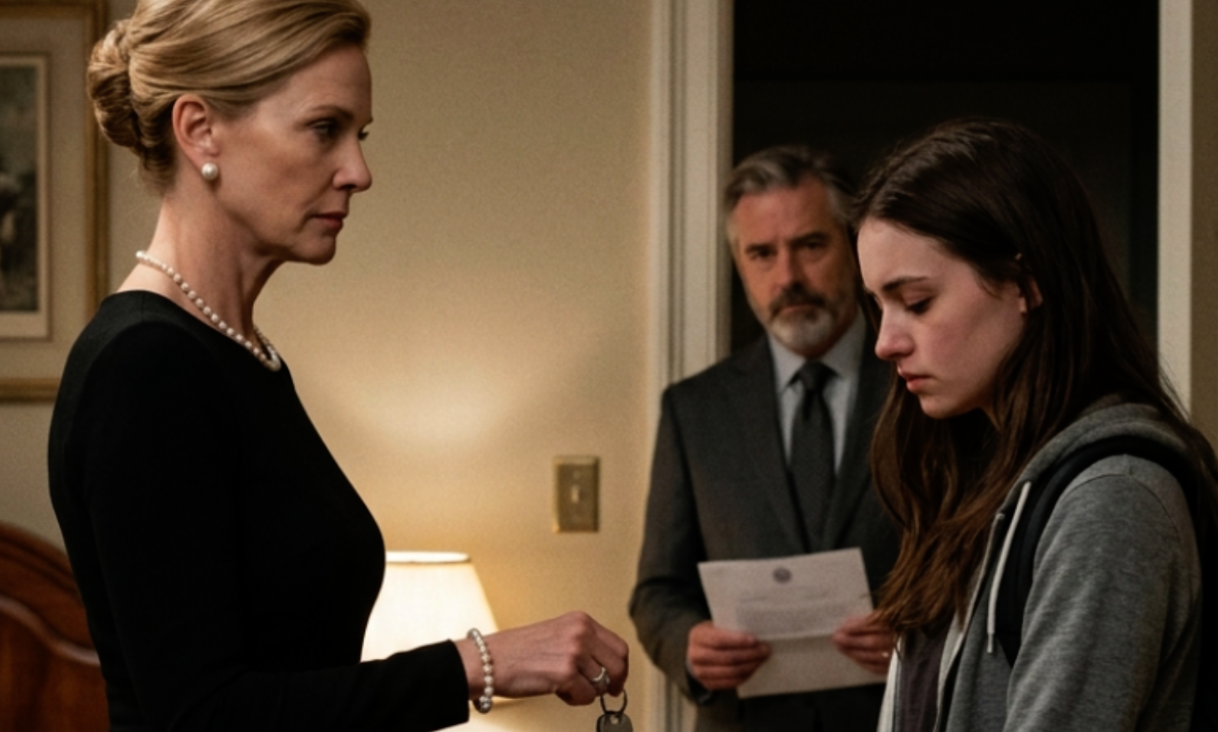
“Leave the keys on the nightstand,” Margarita said in an even voice, nudging an old sports bag toward Anya with the toe of her house slipper. “I’ve already waited far too long.”
Anya did not understand the meaning of those words right away. All day, there had been people in the house: relatives had come, neighbors had stopped by, everyone had remembered her father. Forty days. Only toward evening had the house finally grown quiet.
It seemed there should have been at least some human warmth left in the home. But as soon as the door closed behind the last guest, her stepmother seemed to throw off her mourning mask.
“Margarita Eduardovna, it’s already late,” Anya said quietly. “Where am I supposed to go now?”
“That is not my concern. You are twenty years old. You are an adult. Stay with friends, rent a room, figure it out. You no longer have anything to do with this house.”
The hallway smelled of wax from the memorial candles. It had been only forty days since her father had passed away. All those days, she had lived as if in a fog: answering calls, accepting condolences, lying awake at night, still waiting for the lock to click and for him to walk into the house — tired, slightly stooped, with his warm smile and his familiar words: “Anyuta, are you home?”
But instead, Margarita stood in the corridor in a perfectly ironed black dress, with a cold face and dry eyes.
“Dad only just died,” Anya breathed. “And you’re throwing me out at night?”
“Don’t try to play on my pity. I am his lawful widow, and I need to put this place in order. Tomorrow morning people will come, we’ll replace some of the furniture, and then we’ll start the renovations. I have no intention of living among your things.”
Anya lowered her eyes to the bag. Inside were jeans, a sweater, a phone charger, her father’s old photograph, and a stuffed teddy bear she had once hidden under her pillow.
She had packed almost mechanically when Margarita said, “You have five minutes.” There were no tears. Only coldness — thick and heavy, making it difficult to breathe.
Margarita walked to the door and flung it open.
“Go, Anna. And no scenes.”
A damp wind burst into the house, brushed the curtain in the hallway, and stirred a strand of hair at Anya’s temple. The girl bent down for the bag, and at that moment headlights flashed at the gate.
Margarita raised her head irritably.
“Who else has shown up?”
A minute later, a tall man of about fifty-five stood on the threshold. He wore a dark coat and held a leather folder in his hands.
His face was calm, composed, without fuss. He removed one glove, nodded briefly, and looked first at Margarita, then at Anya.
“Good evening. I’m here to see Anna Mikhailovna. My name is Viktor Anatolyevich Odintsov. I am Mikhail Nikolayevich’s lawyer.”
Margarita instantly tensed.
“This is not the time for visits. We are expecting no one.”
“But I was supposed to come today,” the man replied just as calmly. “Today specifically. That was Mikhail Nikolayevich’s instruction.”
Anya froze.
“You knew my father?”
“For many years. And I would like to come in. This conversation is important. For both of you.”
Margarita pressed her lips together.
“We are in mourning. What conversation could there possibly be?”
Viktor Anatolyevich took out his identification and handed it to her. She cast a quick glance at it but did not take it in her hands.
“Fine,” she said, stepping aside. “Five minutes. No more.”
They went into the living room.
The dishes from the memorial meal still stood on the small table, slices of lemon were drying on a plate, and in the corner beneath the lamp, the frame with her father’s photograph gleamed dimly. Anya involuntarily looked at the picture and felt the pain tighten inside her again.
Margarita sat down in an armchair and crossed one leg over the other.
“I’m listening.”
Viktor Anatolyevich did not sit. He opened the folder, carefully took out several documents, and placed them on the table.
“I will begin with the most important thing. The house you are currently standing in is not part of Mikhail Nikolayevich’s estate.”
Margarita smirked.
“Really? And why is that?”
“Because this house was never marital property. Mikhail Nikolayevich inherited it from his mother before he married you. Here is the certificate of inheritance, the archival extract, and the extract from the Unified State Register of Real Estate.”
The smile slowly disappeared from Margarita’s face.
“Suppose that’s true. What does it change?”
“A great deal,” the lawyer replied. “Three months ago, Mikhail Nikolayevich executed a notarized deed of gift. The house and the land were transferred into Anna Mikhailovna’s ownership. The transfer of title was officially registered. The sole owner of this house is Anna Mikhailovna.”
Anya did not even understand what she had heard at first.
“What?..”
Viktor Anatolyevich turned his gaze to her and repeated a little more gently:
“Your father made sure in advance that you would have a home. He did not want you to be left without a roof over your head after he was gone.”
Margarita jumped up so sharply that the armchair almost tipped over.
“This is some kind of mistake. He would never have done that behind my back.”
“He did it precisely because he did not want you to know in advance.”
“You’re lying.”
The lawyer slid the extract toward her.
“You may see for yourself. The registration date and the owner’s surname are listed here.”
Margarita scanned the lines. Then she read them again. Her fingers began to tremble.
Anya looked from her to the papers and back again. Her ears were ringing. It was as if someone had suddenly opened a window in a room where there had long been no air to breathe.
And at that moment, a memory surfaced.
A week before he went to the hospital, her father had sat in the kitchen late in the evening, though he usually went to his study after nine. His tea had gone cold in front of him. He turned a spoon between his fingers and looked at Anya for an unusually long time, as if he wanted to say something but could not bring himself to do it.
“If it ever becomes very hard,” he had said then, “don’t be too quick to think you’re alone.”
She had only smiled in response, deciding it was just another of her father’s worries. In recent weeks he had tired more quickly than usual, spoken little, and seemed to be listening to something inside himself. Now those words came back to her with such force that her eyes began to sting.
“Why?” Margarita asked hoarsely. “Why did he do this?”
Viktor Anatolyevich folded his hands on the folder.
“Because by the time the deed of gift was prepared, Mikhail Nikolayevich already knew enough to stop trusting you.”
The living room became so quiet that the ticking of the clock in the dining room could be heard.
“What are those words supposed to mean?” Margarita said slowly.
“What I am about to say next is not news to you. But it may be news to Anna Mikhailovna. Back in winter, the company’s chief accountant informed Mikhail Nikolayevich about strange payments under contracts with two new contractors. The contractors turned out to be companies with no employees, no equipment, and only a short history of existence. Money was being transferred for ‘consulting services’ and ‘marketing support’ that no one in the company had ever seen.”
Margarita turned pale.
“I am not obliged to discuss this with strangers.”
“I am not a stranger. I represented Mikhail Nikolayevich’s interests. On his instructions, an internal audit was conducted. After that, he revoked all powers of attorney issued to you and restricted your access to financial documents.”
“That’s not true.”
“It is true. I have copies of the orders and bank notifications in my possession. And we also have certain information. One of the recipients of the money was an organization registered to a person with whom you, Margarita Eduardovna, met not only on business matters.”
Anya felt her palms grow icy.
“What is he talking about?” she asked barely audibly.
Margarita turned sharply toward her.
“Don’t you dare listen to this nonsense.”
But Viktor Anatolyevich had already taken another envelope from the folder.
“Mikhail Nikolayevich did not want to involve his daughter in the details while he was alive. He hoped to finish everything quietly and without scandal. He did not have time. However, he left written instructions on when and in what order the documents were to be handed over. Today, immediately after the fortieth day, I was supposed to come here personally. He assumed that you would begin acting quickly.”
Margarita looked at him with a new expression. The former arrogance was gone; only growing unease remained.
“What other documents?”
“Payment statements, the auditor’s report, copies of correspondence between your acquaintance and the nominal director of one of the companies, as well as information gathered by the company’s security service. It will be enough for the materials to be submitted tomorrow to the economic security department along with a statement.”
Margarita sank back into the chair as if her legs had suddenly gone weak.
Anya could not take her eyes off her.
With painful clarity, small details flashed through her memory — details she had never paid attention to before: the way Margarita became irritated when her father asked her to bring him documents; how she closed the door to his study too quickly; how one night she whispered on the phone in the kitchen and instantly cut the conversation short when she noticed Anya.
Her father had seen it all. He had known. And he had remained silent.
“He couldn’t have not told me,” Margarita said quietly. “He couldn’t.”
“He could,” the lawyer answered calmly. “And he would have told you only after he had completed all the formalities. He was very afraid of one thing: that after his death, you would try to push Anna Mikhailovna out of the house before she learned the truth.”
Margarita lifted her head. Her gaze became sharp, almost vicious.
“And what if I don’t leave?”
“Then tomorrow morning the district police officer, a locksmith, and a representative of the security company will come here. The locks will be changed, and your belongings will be removed according to an inventory. But I don’t think it will come to that. Until the very end, Mikhail Nikolayevich hoped that at least at the conclusion of this story, you would not make a disgraceful scene.”
That sentence struck harder than a shout.
Margarita sprang up, grabbed her phone, and quickly moved toward the window. Her fingers were shaking. She dialed a number and, without asking permission, put the call on speaker.
“Igor, pick up… pick up already…”
He did not answer immediately.
“Yes,” a man’s voice said. “What happened?”
“We have problems,” Margarita whispered hurriedly. “The house isn’t mine. He transferred everything to the girl. And they’ve found something with the payments too. I need you to come.”
There was a pause on the other end.
“What do you mean, ‘not yours’?”
“I mean exactly that. He managed to transfer everything. You said that after the fortieth day we’d be able to act calmly.”
“I said if everything was clean. And if you didn’t check the documents, that’s no longer my problem.”
“Don’t start. I don’t have time for this right now. Just come.”
The man exhaled shortly.
“Margarita, listen carefully. I’m not coming to you. And delete this number now. Deal with it yourself.”
“Just like that?” Her voice broke. “Are you serious?”
“What did you think, that I’d carry your suitcases?” irritation entered his voice. “You promised one thing and got something else. Adios.”
The call ended.
Margarita slowly lowered the hand holding the phone.
The room became so quiet that Anya could hear her own breathing.
An hour earlier, this woman had stood in the hallway deciding her fate. Now she herself suddenly had no support, no certainty, and no person for whose sake all of this had perhaps been started.
A strange feeling rose in Anna. Not joy. Not gloating. More like a tired, bitter understanding: retribution comes quietly; it simply removes everything unnecessary from a person in a single minute.
Viktor Anatolyevich closed the folder.
“You have until morning, Margarita Eduardovna, to gather your personal belongings. A car will arrive at nine. Everything else can be handled through your representative, if you have one.”
Margarita turned sharply toward Anya.
“You won’t really do this, will you? After everything… after I lived with your father, cared for him…”
Anya remained silent for a long time. Then she took a step forward.
Her chest still hurt, but the cold had already begun to recede. In its place rose a quiet, firm strength.
“You wanted to throw me out at night,” she said. “I won’t do the same. You have until morning. But in the morning, you will leave. And you will leave the keys on the nightstand.”
Margarita looked at her as if she were seeing not a confused girl, but an adult woman for the first time.
“You’re cruel.”
“No,” Anya answered quietly. “But this is my house now.”
Margarita wanted to say something else, but stopped herself. Upstairs, the stairs creaked as she slowly went to pack her things.
Viktor Anatolyevich waited a little, then took a white envelope from the inner compartment of the folder.
“Mikhail Nikolayevich asked me to give this to you only after the conversation.”
On the envelope, in familiar handwriting, was written: “To Anechka.”
Anna carefully opened the letter.
“Anyuta,
If you are reading these lines, then the hardest conversation is already behind you. Forgive me for not telling you everything at once. I wanted very much to protect you from this filth as much as I possibly could.
I transferred the house to you because I was afraid for you. A person who believes another’s property is their own rarely stops in time.
You may learn things about me that are not very pleasant. Yes, I did not understand everything right away. Yes, I made a mistake. But I beg you: do not allow my mistake to settle in your heart in place of trust in life. People leave, illusions collapse. But a home is the place where you feel safe and at peace.
Let this place become good again. Laugh, open the windows in the morning, bake your favorite apple charlotte, invite your girlfriends and friends over. And remember: you were never alone.
I love you.
Dad.”
The letters blurred before her eyes. Anya pressed the letter to her chest and cried — quietly, soundlessly, the way people cry not from helplessness, but because they no longer have to hold themselves together with the last of their strength.
Viktor Anatolyevich tactfully turned toward the window.
“I’ll stay downstairs a little longer,” he said. “Then I’ll leave. Tomorrow morning I’ll send my assistant: she’ll help make an inventory and contact the notary about the remaining matters. Don’t worry, you won’t be left alone.”
“Thank you,” Anya managed to say. “For coming today.”
“That is not my merit,” he replied. “Your father thought everything through very carefully. He simply wanted to protect you in time.”
The night dragged on endlessly.
From upstairs came footsteps, the slamming of wardrobe doors, the dull thud of a suitcase hitting the wall. Then everything would fall silent, and the house seemed to listen to itself. Anya sat in the kitchen, staring into the black window and remembering.
How her father laughed when she could not learn to ride a bicycle as a child.
How he taught her to fry syrniki and secretly added more vanilla than necessary.
How he once said, “Don’t be afraid if you feel the truth is on your side. The only frightening thing is taking the first step.”
Toward morning, Margarita came down to the kitchen. Her hair was no longer styled as usual, her gaze was wandering, and she wore a light-colored coat. A small suitcase rolled behind her. She had not taken any large things — either she had not had time, or she had realized it was useless to argue.
She stopped at the threshold.
“I could contest all of this,” she said dully.
Anya raised her eyes to her.
“You could. But you know why you won’t.”
Margarita gripped the suitcase handle.
“You are very much like him. And that always irritated me.”
The confession sounded so unexpected and so pathetic that Anya suddenly saw the whole truth clearly: standing before her was not a fatal victor, but a deeply empty person who had mistaken someone else’s house for her own for too long, and someone else’s life for a convenient ladder upward.
“The car will be here soon,” was all Anya said.
Margarita nodded. She walked to the nightstand in the hallway, placed the set of keys on it, and, without saying goodbye, went out into the yard.
A few minutes later, a car door slammed outside the window. The car drove away. And with that sound, something sticky and heavy, something that had accumulated in the air for years, seemed to leave the house.
Anya slowly walked through the rooms.
She opened the living room window. Cool April air entered the house, fresh and clean. Her father’s photograph still stood on the small table. She straightened the frame, threw away the dried lemon, gathered the dishes, and suddenly caught herself realizing that for the first time in many weeks, she was not afraid of the next hour.
There were many difficulties ahead: the notary, paperwork, conversations, investigations, other people’s questions. But the worst had already happened — and it had already ended.
She took the letter in her hands again, walked to the window, and watched as morning slowly rose above the rooftops.
A home truly was not in the walls. A home was in memory, in honesty, in the right to stop looking back. And perhaps it was also in the ability, one day, to close the door on the past without hatred, but also without any desire to bring back those who had betrayed you.
And would you be able to forgive a person who smiled with you at the same table while secretly preparing someone else’s fate for you?