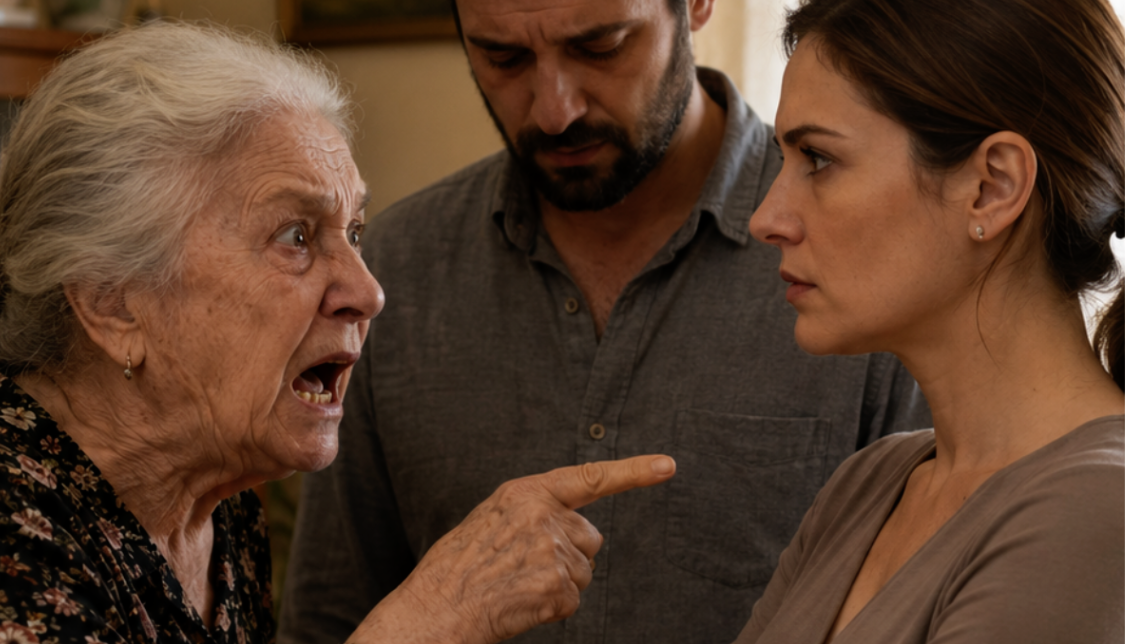
“Damn you!” Igor shrieked, and a white flash flew across the room: a vase with artificial daisies smashed against the wall. Glass scattered across the floor, catching the light from the lamp, and one shining shard grazed Anna’s leg.
She did not even flinch.
“Have you completely lost your mind?!” Her voice broke into a scream. “Kirill is sleeping!”
“What the hell are you doing?!” He rushed to the table, grabbed his phone, and jabbed at the screen as if he wanted to punch a hole through it with his finger. “The card doesn’t work! I’m standing in the store like a complete idiot! My mother is waiting, and I don’t have a single kopeck!”
“Because I blocked access,” Anna answered quietly but firmly.
“What?”
“The account. I closed the account.”
He froze as if he had been struck.
“What do you mean… why?”
“Think about it. Maybe I know how to count too. This month alone, you pulled out almost one hundred thousand! And all of it was ‘for Mom’s boots,’ ‘for Mom’s medicine.’ What is she doing, plating her legs with gold?”
Igor turned crimson.
“She is my mother, do you understand?! She raised me! I owe her!”
“And you don’t owe me anything?” Anna pressed her hands against the wall as if trying not to fall. “We have a loan, utilities, a child… and you’re sponsoring her wardrobe!”
“Shut up.” He stepped closer, the veins in his neck swelling. “Restore access.”
“No.”
“Restore it, I said!”
A cry came from the nursery. The boy whimpered in his sleep, then began sobbing loudly and desperately.
“See what you’re doing!” Igor shouted. “You’re frightening the child!”
“You’re the one frightening him,” Anna said, walking past him, “with your yelling!”
Kirill was sitting on the bed, his eyes full of tears, clutching a plush tiger cub in his hands. Anna sat down beside him, hugged him, and stroked his head.
“It’s all right, my sweet boy, everything is all right…”
But inside her, everything was the opposite. Not “all right,” but a lump.
Heavy, sticky, bitter.
She understood: this time, it was not just another fight. It was the point of no return.
Twelve years together, and all of it wasted. How many times had she forgiven those “transfers for Mom,” closed her eyes to “I lent it to a friend,” “I bought some tools,” “I’m helping a relative.” But yesterday evening, she had finally reached her limit. She opened the banking app and scrolled down.
And she saw it.
In six months, almost four hundred thousand.
At that moment, her knees almost gave way.
“Go to Daddy,” she said quietly to Kirill when he stopped sobbing. “Mommy will step out for a little while, all right?”
She pulled on her jacket and took her bag.
“Where are you going?” Igor stood by the door, his hands clenched into fists, his eyes wild.
“To get some air.”
“You’re not leaving until you restore access.”
“Move.”
“No.”
The phone on the couch began to vibrate.
“There, you see!” He shoved the screen in her face. “Mom is calling! She’s standing in the store, waiting! Because of you!”
Anna walked around him and left. She slammed the door.
The stairwell smelled of dampness and dust. The air was heavy, autumnal — October had crept in unnoticed.
Outside, the wind cut to the bone. The evening city was gray, like an old bedsheet: puddles, wet leaves, a traffic light blinking lazily. Anna walked to the bus stop, not thinking about where she was going. She simply wanted to leave. To get away from his voice. From the accusations, the shrieking, the endless excuses.
The bus arrived almost immediately. She sat by the window and pressed her forehead against the glass.
Her son had been left at home, and her heart clenched — but she knew Igor would not touch him. He had never raised a hand. Not to the boy. To her, sometimes with words, with pressure, but not physically.
Not yet.
When the bus reached the city center, Anna got off. The shopping mall glowed with lights and smelled of coffee and vanilla. People passed by with shopping bags; someone was laughing. Everyone had their own life.
Hers had cracks.
She wandered between the storefronts until she found a café on the third floor. She ordered a cappuccino. She sat there, holding the cup with both hands to warm herself.
Her phone kept twitching on the table, the screen lighting up. “Igor,” “Igor,” “Igor.” Then “Igor’s Mom.” Then him again.
Anna tapped “Silent.”
She had not even had time to calm down when a message came from an unknown number:
“I need to speak with you. It concerns Igor. Very important. Café Amaretto, in one hour. Address: 18 Kotov Street.”
She read it three times.
Was it a scammer? But something else pricked inside her — intuition.
She decided to go.
The café turned out to be small and old, with a peeling sign and the smell of cinnamon. A woman was sitting at the far table. Young, about thirty, tired, wearing a cheap jacket. Anna was about to turn around when the woman suddenly stood up and awkwardly adjusted her belly.
Pregnant.
“Are you Anna?” she asked quietly, as if afraid of her own voice. “I’m Valeria. May I speak with you for a minute?”
Anna sat down. She felt the air leaving some hidden place inside her.
“I’m sorry, I understand this is… unexpected,” Valeria spoke quickly, stumbling over her words. “I am not your enemy. I just have to tell you the truth. Igor and I have been together for two years. And… the child is his. I’m five months pregnant.”
The words hit like a slap.
Two years.
Five months.
Anna stared without blinking. Then she forced out:
“Why are you telling me this?”
“Because he is deceiving both you and me.” Valeria twisted a napkin in her hands, cracking her fingers. “He told me you had separated. That he lived alone, that he just ‘hadn’t finalized the divorce.’ And today I saw his messages — he wrote to you, ‘I’ll be late, meeting at work.’ I realized he had been living with you all this time.”
Anna was silent for a long time. She looked at Valeria, at the belly under her jacket. A new life was moving there, and that seemed especially cruel.
“The money,” Anna said quietly. “The money he ‘transfers to his mother’…”
“To me,” Valeria nodded. “For rent. I’m not working, the pregnancy is difficult. He helps me and says, ‘It won’t be long, soon we’ll live together.’”
There it was.
Everything fit.
Anna laughed — briefly, without joy.
“Well then, congratulations to both of us. Two women, one salary.”
“I’m sorry. I didn’t know. If I had known…”
“Oh, don’t bother.” Anna waved it off. “He is a master. He can wrap everyone around his finger, make his mother look like a saint, and himself like a martyr.”
They sat in silence. Outside the window, autumn rain drew trails across the glass.
“What are you going to do now?” Valeria asked.
“I don’t know. Not yet. And you?”
“I’ll have the baby. After that, we’ll see.”
Anna nodded. She took out her phone.
Fifteen missed calls, three messages from her mother-in-law. The last one cut like a knife:
“If you don’t return the money, you’ll regret it.”
Anna showed the screen to Valeria.
“There, you see. A mother with a noble soul.”
“He told me about her too,” Valeria said with a sad smirk. “That she was sick, that I ‘shouldn’t interfere with her.’ And when I offered to help, he nearly shouted at me.”
Anna finished her cold coffee and stood up.
“It’s time. I need to put everything in its place.”
When Anna entered the apartment, Igor was standing by the window. His hands were in his pockets, his face angry like a cornered wolf’s.
“Where were you?” he hissed. “The child was sitting alone!”
“I know. He was with you. Is everything all right?”
“No, everything is not all right! Have you completely lost your mind?” He took a step forward. “Where did you go?”
Anna met his gaze directly.
“To your Valeria.”
He froze. Only for a second, but it was enough.
“What?”
“She is pregnant. By you. And you’re supporting her.”
He said nothing. Then he turned away.
“It’s not like that.”
“Of course it isn’t. It’s never ‘like that’ with you. Except she is carrying your child. And you’re buying that child a future at my expense.”
She stepped closer.
“Igor, I’m filing for divorce.”
“Don’t you dare.”
“Too late.”
He smirked viciously.
“You think you’ll win? The apartment is shared.”
“No. It’s mine. I bought it before the marriage.”
He spun around sharply, his eyes bloodshot.
“I will never forgive you for this.”
“You don’t have to. I’m not expecting you to.”
He muttered something, swore, and slammed the door.
Anna was left alone.
The apartment was quiet. She could hear water murmuring in the pipes.
She went to her son. He was sleeping, his face buried in the pillow. His cheeks were damp, his lashes stuck together.
Anna sat down beside him and pressed her palm to his hair.
“Everything will be all right, sweetheart,” she whispered. “We’ll get through all of this.”
The following days dragged on like wet cotton.
Igor slept at home but spoke only through clenched teeth. The television thundered as if replacing conversation between them.
Her mother-in-law appeared on the third day, without calling. She barged in with a key she had once begged from him.
“You destroyed my family!” she screamed from the doorway. “Because of you, my son will become homeless!”
Anna raised an eyebrow.
“Your son destroyed everything himself.”
“He is a man! All men fool around! Clearly, you failed to keep him!”
Kirill, frightened and clinging to his mother, began to cry.
“You see,” Anna said calmly, “even the child can’t stand your voice.”
Raisa Petrovna threw up her hands, mumbled something, and left, still cursing.
The door slammed behind her, leaving the smell of expensive perfume and cheap malice.
Anna exhaled.
She was no longer afraid. Only cold. Cold and empty.
She went to the window. The October evening spread gray haze across the sky; lights flickered in the distance.
Her phone blinked with a new message.
“Anya, you are not to blame. Thank you for telling me. Take care of yourself.”
From Valeria.
Anna looked at the screen, then at her reflection in the glass.
“Take care of yourself…” she repeated quietly. “And who ever took care of me?”
She turned off the light and lay down on the bed beside her son.
A week passed.
It seemed like such a short time, but during those days Anna became so tired it felt as though she had been dragging a wagon full of bricks.
The home had become alien. The silence — hostile. The air — heavy, as if before a storm.
Igor lived there too, on the couch. He had no intention of moving out. He walked around gloomy and silent, but angry — it was visible in his eyes.
Anna could feel it: the storm was close.
On Friday evening, when she came home from work, his voice rang through the apartment:
“We need to talk.”
She tiredly took off her jacket.
“Again?”
“Yes.”
He was standing by the window, phone in hand.
“I saw a lawyer,” he said. “The apartment gets split in half.”
“Are you an idiot?” Anna could not hold back. “I bought it before the marriage!”
“Prove it.”
“I have the documents.”
“You think the court will believe you?”
She looked at him for a long time, coldly.
“Igor, I’m tired of this. Move out. Today.”
“Don’t hold your breath,” he sneered. “I’m not leaving. This is my home too.”
Anna said nothing. She simply walked past him and locked herself in the room.
He remained standing outside the door. Then he threw something against the wall — a sound like a mug breaking.
Kirill woke up and began to cry.
“Mom, is he angry again?” the little boy whispered.
“Shh. Sleep, my sweet boy. Soon everything will be quiet.”
In the morning, the apartment door flew open without a knock.
Raisa Petrovna stormed in like a hurricane. With a bag, with her voice, with accusations.
“What have you done?!” she shouted from the doorway. “My son says you want to throw him out!”
Anna turned away from the sink, where she had been washing dishes.
“He said it correctly. I do.”
“You’ve become shameless, little girl! Who do you think you are? This is his home, he is the man here!”
“The man, you say?” Anna wiped her hands and looked straight at her. “Then let him pay for the utilities, the loans, and the internet. The man, you say…”
“You ungrateful woman!” her mother-in-law shrieked. “My Igoryosha bent over backward so you would have everything!”
“Really? I thought he was bending over backward for his Valeria.”
Raisa Petrovna stopped short.
“What?”
“Nothing.” Anna took a towel and headed toward the nursery. “Everything is fine over there, isn’t it? Go sort things out with your daughter-in-law.”
Her mother-in-law shifted from foot to foot, then hissed:
“I will never forgive you for this. You ruined my son.”
“He ruined himself.”
Igor burst out of the room.
“Mom, that’s enough, leave!” he shouted.
“I won’t leave until she tells me to my face that she will stop tormenting you!”
Anna turned around.
“To your face, you say? Fine. I won’t. I’ll simply throw both of you out.”
Raisa Petrovna flared up and began shouting. Kirill started crying.
Anna went to him, picked him up, and left the apartment.
The door slammed behind her like a gunshot.
Outside, an icy wind was blowing. October was nearly spent — ahead lay November, short days, grayness, wet mittens, and the smell of frozen asphalt.
Anna took Kirill to kindergarten, then went to work.
In the metro — people, tired faces, the smell of coffee from thermoses, sleepy silence.
She caught her reflection in the glass — dull eyes, but alive.
She had not broken.
That meant it was already not so bad.
At work, her supervisor called her into the office.
“Anna Sergeyevna,” she began carefully, “I understand things are difficult for you right now. But there is an option that might help.”
“What option?”
“Our branch in Kaliningrad. They need specialists there, and housing is provided. The salary is higher. A six-month assignment, and afterward you can stay.”
Anna froze.
“Kaliningrad?”
“Yes. Think about it.”
She nodded. She left the office with the feeling that a little light had switched on somewhere inside her.
A new life.
The sea.
Far away from all this filth.
That evening at home — there they were again.
Igor and Raisa Petrovna. Sitting at the kitchen table, discussing a “plan of action.”
Anna came in and silently put down her bag.
“Oh, you’re back,” Igor smirked. “We’ve been thinking.”
“Terrifying already.”
“You owe me compensation for moral damages.”
Anna burst out laughing.
“What?”
“I’ll sue,” he continued. “I have a witness.” He nodded toward his mother. “She saw how you abused me.”
Anna took out her phone and turned on the voice recorder.
“Please repeat that,” she said calmly. “For the record.”
Raisa Petrovna froze.
“What?”
“Everything you just said. The part about ‘abuse’ too.”
“You were recording?!” Igor roared.
“Yes,” she answered simply. “For the last four days. All your visits, all your threats. I have an entire archive. Do you want to listen?”
She turned on the recording.
Igor’s voice came from the speaker:
“I’ll take everything from you! The apartment and the child! You’ll dance for me!”
Then Raisa Petrovna’s voice:
“You snake! Women like you should be thrown out onto the street!”
Anna turned it off.
“In my opinion, not bad material for court.”
Raisa Petrovna went pale.
“My blood pressure…”
“Then take your pills,” Anna answered coldly. “And leave. Both of you.”
Igor came right up to her, hissing:
“You’ll pay for this.”
“Not anymore, Igor. It’s already too late.”
Half an hour later, the door slammed — they had left.
Anna leaned against the wall and exhaled.
The apartment became truly quiet.
No voices, no screaming.
Only the refrigerator hummed and the clock ticked.
The next day, she called her supervisor.
“I agree,” she said briefly. “Kaliningrad. When do I leave?”
“In two weeks. Will you manage?”
“I will.”
The divorce went through quickly.
At first, Igor acted tough, then quieted down. Apparently, he understood he had lost.
When Anna hinted that the recordings could be shown not only to the judge, he stopped trying to assert his rights.
Child support was assigned — pennies, but she did not need it.
The main thing was freedom.
Kaliningrad greeted them with wind.
Salty, sharp, smelling of the sea.
From the very first day, Kirill was happy: he ran along the beach, collected pebbles, and shouted at the seagulls.
Anna stood on the shore, watching the waves strike the concrete slabs, and for the first time in a long while, she felt she could breathe easily.
They rented a cozy apartment in the old city, with a view of the rooftops. She liked the work, and the people were calm.
Sometimes in the evenings, she took out her phone and reread the old messages.
“Restore the account.”
“You’ll regret it.”
“Nobody needs you.”
She deleted them one by one.
Now she knew: she was needed.
By herself.
By her son.
That was enough.
One day, a message arrived.
Unknown number.
“Anna, thank you for telling me everything. I gave birth to a boy. I named him Lyosha. Igor disappeared as soon as he learned I wasn’t going to ask him for money. But I’m happy. My son is the best thing I have.”
Anna replied:
“Mine too.”
December.
Thin ice had formed near the shore. The sky was low and heavy.
The letter from the court came unexpectedly:
Igor had tried to sue for the apartment.
He lost.
The judge listened to the recordings, studied the documents, and ruled: the home belonged entirely to Anna. Moreover, Igor was obligated to pay compensation.
Fifty thousand.
Pennies.
But pleasant.
Anna smiled. Not from joy — from a sense of justice.
She had not broken.
She had not sunk.
She had not drowned.
She had pulled herself out.
That evening, she and Kirill went for a walk by the sea.
Snow was just beginning to fall — sparse and light.
Kirill dragged a sled behind him, even though there was nowhere to ride it.
“Mom, look! A ship!” he shouted, pointing into the distance.
In the gray haze, a huge tanker really was moving, its lights blinking like stars.
Anna sat down on a bench beside her son.
“Beautiful, isn’t it?”
“Uh-huh. When will we sail on a ship?”
“In the summer,” she smiled. “We definitely will.”
He wrapped his arms around her neck and pressed himself against her.
She inhaled the smell of his hair — warm, familiar, beloved.
Ahead of them was a new life.
Without hysterics, without lies, without fear.
Only the sea, the wind, and her — Anna, finally a free woman, who had pulled herself out of the swamp, had not waited for a miracle, but had made one herself.
And if anyone had asked her whether she was happy, Anna would have answered simply:
“Yes. Now — yes.”