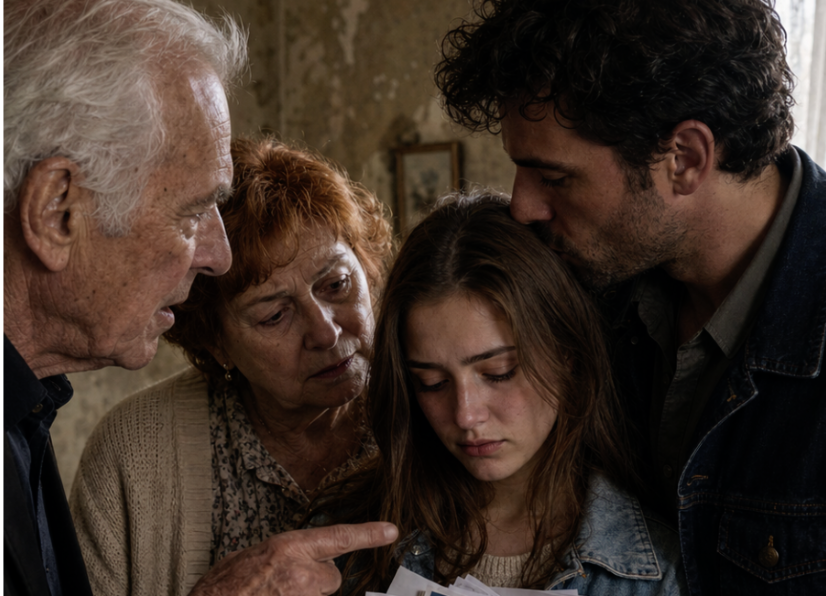
“I told you not to run the dishwasher after ten. The whole house hums. I can’t rest!”
Natalya froze with a plate in her hands. Vladimir Sergeyevich was standing in the doorway, pulling his terrycloth robe closed. His gray hair stuck out in every direction after sleeping on the couch.
“I’m sorry, I didn’t mean to…” Natalya put the plate back on the table. The remains of Olivier salad had dried onto the porcelain.
“In someone else’s house, you must follow the rules,” her father-in-law said, adjusting his glasses on the bridge of his nose. “How many times do I have to repeat it?”
Natalya nodded, looking at the tower of plates near the sink. Salad bowls, cups, and saucers were piled on top of one another. On the stove, a frying pan with burnt oil had gone cold.
Vladimir Sergeyevich turned around and shuffled down the hallway in his slippers. The clock above the refrigerator showed half past ten. Natalya turned on the tap and reached for the sponge. The hot water burned her fingers.
Natalya was dusting the porcelain shepherdesses in the living room when she heard a familiar cough behind her.
“You’re wiping it with the wrong side of the cloth again,” Lyudmila Pavlovna said from the doorway, arms crossed over her chest. “How many times must I tell you? Microfiber is for glass, flannel is for porcelain.”
“All right, Mom,” Natalya answered automatically, turning the cloth over. The same thing for the fourth year. The fourth year of “temporarily.”
From the kitchen came her father-in-law’s voice:
“Artyom! Don’t hold the spoon in your fist! Like some kind of brute!”
Their three-year-old son was sitting at the massive oak table, his legs dangling in the air. Vladimir Sergeyevich was looming over him, correcting the child’s fingers on the spoon.
“Dad, he’s still little,” Igor tried to defend him, but his father only waved him off.
“In our family, everyone has held utensils properly since the age of two.”
Natalya bit her lip. Four years ago, when Igor was laid off from the factory, they had thought it would be for a month or two at most. Renting an apartment was too expensive, and they were saving every kopeck for a mortgage down payment. “Stay with us for now, there’s enough room,” her mother-in-law had generously offered. Igor found a job six months later, but the salary was half as much. After Artyom was born, they had to forget about having a place of their own—diapers, formula, and doctors ate up all their savings. “For now” had stretched into four years.
The phone vibrated in the pocket of her apron. It was her mother’s number.
“Natashechka, call me back urgently when you can speak alone,” her mother’s voice trembled with excitement. “Do you remember Uncle Kostya, your father’s second cousin? He died a month ago and left me a plot of land near Klin. I spoke with a realtor—it can be sold for a very good price. The money is yours, Natasha. It will be enough for an apartment. Small, but your own.”
Natalya froze with the cloth in her hand. The porcelain shepherdess smiled at her with rosy cheeks.
“Have you fallen asleep over there?” her mother-in-law asked irritably. “You still have the whole cabinet to wipe down.”
Natalya woke up to the smell of burnt porridge. Her mother-in-law had forgotten to turn off the stove again. Going down to the kitchen, she silently scraped the burnt crust from the bottom of the pot. Her hands moved mechanically, while her thoughts wandered far away—to that very apartment Igor had told her about.
For several days, she walked around as if in a fog. Falling asleep on the narrow sofa in the walk-through room, she imagined white walls without darkened portraits of someone else’s relatives. She saw a nursery where Maxim could scatter toys without fearing a shout. A kitchen—her own kitchen—where no one would stand behind her with the comment, “You’re cutting the onion wrong.”
“Dreaming again?” her mother-in-law entered the kitchen, shuffling in worn-out slippers. “Did you buy the milk?”
“It’s in the fridge,” Natalya said, turning toward the window.
Yesterday Igor had brought up the apartment again. He showed her photos on his phone—an ordinary two-room flat in a residential district, but it would be theirs. Natalya saw how nervous he was.
“How will we tell your parents?” she had asked then.
Igor was silent for a moment, then put his arm around her shoulders.
“We’ll manage.”
But Natalya remembered their previous attempt to talk. Back then, Vladimir Sergeyevich had risen from the table, pushing away his half-eaten borscht.
“We took you in. You still have to earn this independence of yours.”
Now, drying plates with a towel, Natalya felt something new inside. Not fear, but determination. Let there be a scandal. Let them refuse to speak for weeks. She would endure it—for Maxim, for their little family.
Artyom was laying out puzzles on the floor when Lyudmila Pavlovna entered the living room.
“Clean that up immediately! Guests will be here in an hour!”
The boy hurriedly gathered the cardboard pieces into the box. One slipped from his hands and rolled under the sofa.
“Clumsy child!” his grandmother jerked him by the arm. “Who did you get that awkwardness from?”
Natalya was ironing Igor’s festive shirt in the corner of the room. In the kitchen, the housekeeper hired especially for her father-in-law’s anniversary was clattering dishes.
“Natalya, are you at least going to put on a decent dress?” her mother-in-law looked her up and down. “Don’t disgrace the family in front of the Smirnovs.”
By seven in the evening, the apartment was filled with guests. Vladimir Sergeyevich sat enthroned in his armchair, receiving congratulations. Gifts were piled on the coffee table—cognac, books, an expensive pen.
Natalya placed a box set of his favorite author’s works in front of her father-in-law. It had cost a third of her salary, but she had hoped for a truce.
“Thank you,” he nodded dryly, not even unwrapping the gift.
At the table, Artyom reached for some bread and knocked over a glass of juice with his elbow. An orange puddle spread across the white tablecloth.
“Artyom!” his grandmother shrieked. “Butterfingers! How many times must I tell you not to fidget at the table!”
The boy shrank into his chair, his eyes filling with tears.
After the third toast, Igor stood up and cleared his throat.
“Dad, Mom, we wanted to tell you something… We’ve decided to move out. Natasha’s mother is helping us buy an apartment.”
Silence hung over the table. Neighbor Smirnova froze with her glass at her lips.
“So,” Vladimir Sergeyevich’s voice trembled with rage, “you’ve decided to abandon us?”
“Dad, we just want to live separately…”
“She turned you against us!” his father jabbed a finger at Natalya. “She destroyed the family!”
Lyudmila Pavlovna burst into tears into her handkerchief.
“We helped you, and you… traitors!”
“This isn’t betrayal,” Natalya said firmly, rising to her feet. “This is a normal life.”
“Get out!” her father-in-law roared, throwing down his napkin. “I don’t want to see your feet in this house again!”
The front door slammed behind them. Natalya carried sleepy Artyom, while Igor dragged a bag with the child’s things—they hadn’t had time to take anything else. Only the emergency light was burning on the stair landing.
Silence filled the car. Artyom sniffled in his sleep in the back seat, his nose pressed into his stuffed rabbit. Igor couldn’t start the engine for a long time—his hands were shaking.
“I’m sorry,” he breathed, looking at the fogged-up windshield. “I didn’t think my father would…”
Natalya said nothing. Tears ran down her cheeks, but inside she felt strangely light. As if a heavy backpack had been taken off her shoulders after a long climb uphill.
“Natasha, I’m sorry. Only now do I understand what it was like for you. Every day.”
She turned to him. In the dim light of the car, his face seemed very young—just like ten years ago, when they had first met.
“Don’t,” she whispered. “We’ll manage.”
Igor found her hand and squeezed her cold fingers. Natalya intertwined them with her own—tightly, like on their first date in the park.
The car finally started. They drove out of the courtyard, leaving behind the lit windows of his parents’ apartment. Artyom smacked his lips in his sleep, clutching his rabbit tighter.
“Where are we going?” Igor asked at the traffic light.
“To Mom’s. And tomorrow we’ll start looking for our own place.”
Uncertainty lay ahead, but Natalya smiled through her tears.
Cardboard boxes were piled in the hallway of the new apartment. Artyom dragged a plush bear over the threshold, pulling it across the dusty floor. Natalya unpacked the dishes, unwrapping old newspapers.
“Mom, can I jump on the sofa here?” her son asked, peeking into the living room.
“You can,” she smiled, and the boy ran and flopped onto the cushions.
Igor was painting the wall in the children’s room. The light blue paint went unevenly over the old plaster, but he carefully applied a second coat. The dried-out parquet creaked underfoot.
“The table has arrived,” he shouted from the room. “We’ll pick it up tomorrow. The neighbor will help with his car.”
They had found the dining table through an ad—massive, with peeling varnish, but sturdy. Like the rest of the furniture: a secondhand chest of drawers, chairs from acquaintances. Only the sofa was new—for Artyom.
In the evening, they sat in the kitchen, drinking tea from mismatched mugs. Artyom was drawing at his little table, sticking out his tongue with effort. He didn’t look over his shoulder, didn’t flinch at every sound.
“You’re smiling,” Igor noticed, hugging his wife.
“Really?”
Natalya hadn’t even noticed. In recent weeks, they hadn’t argued once. Igor came home from work and hugged her first thing, instead of going to report to his parents.
The phone stayed silent. Igor’s mother didn’t answer calls, and his father declined them, citing busyness. Igor frowned at the dark screen.
“They’ll come around,” Natalya said quietly. “Time heals.”
Natalya was flipping pancakes in the frying pan when the intercom rang. Artyom ran to the receiver, standing on tiptoe.
“Who is it?”
There was silence through the speaker, then a familiar voice sounded:
“It’s Grandpa. Open the door.”
Igor froze with his coffee mug halfway to his mouth. Natalya turned off the stove.
Vladimir Sergeyevich stood on the doorstep. His gray hair was tousled by the wind, and shadows lay beneath his eyes. He was holding a cardboard box.
“Artyom’s toys,” he muttered. “Found them in the garage.”
Artyom peeked out from behind his mother’s back and reached for the box. Inside were his old toy cars and building blocks.
Her father-in-law shifted from one foot to the other, looking somewhere over their heads.
“I think…” he cleared his throat. “I should have understood earlier that children have the right to live their own lives.”
“Come in,” Natalya stepped aside. “Would you like some tea? I just made pancakes.”
Vladimir Sergeyevich slowly entered, looking around the hallway with its handmade coat rack. Quiet music drifted from an old radio in the kitchen. The table was covered with a checkered tablecloth, and dry rowan branches stood in a vase.
He sat on the offered chair and accepted a cup. Artyom climbed onto his lap, showing him a new drawing.
“It’s nice here,” her father-in-law said softly.
Natalya nodded. The hatred had gone away together with the fear. Here, within her own walls, she could be herself.