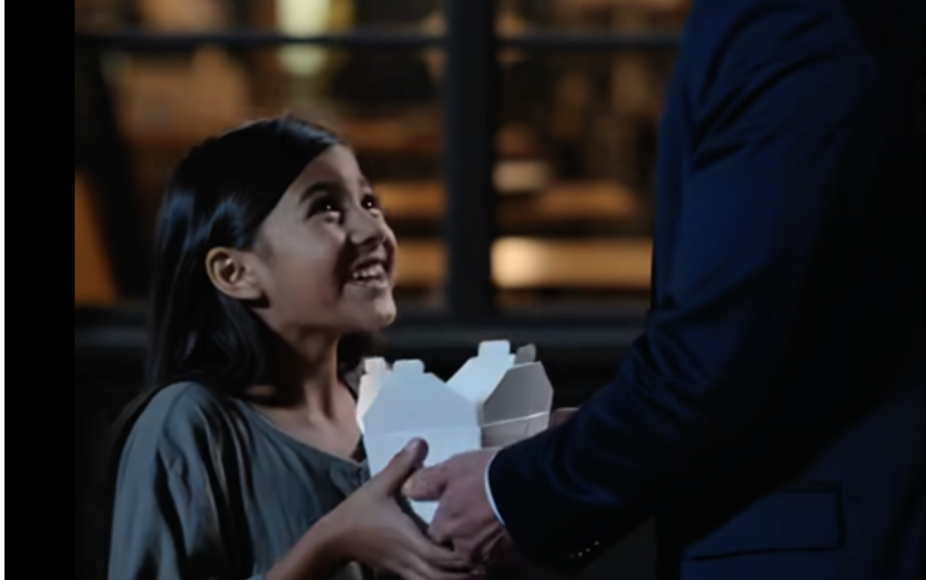
He thought he was giving one meal to one hungry girl.
That was all.
Just a white takeout box.
Just a small act of kindness outside a softly lit restaurant.
Just enough food to get one poor child through the night.
The little girl took it with both hands like it was something precious.
Her oversized gray dress hung loosely from her thin shoulders.
Her eyes lit up with a gratitude too big for a child her age.
“Thank you, sir,” she said.
The man gave her a gentle smile.
“You’re welcome.”
And that should have been the end of it.
But the girl didn’t sit down nearby.
She didn’t open the box.
She didn’t even peek inside.
She turned and ran.
Fast.
Too fast for someone who was supposed to be starving.
The man stood there for one confused second, watching her disappear into the blue-black night.
Then something in him shifted.
Concern.
Curiosity.
A feeling he couldn’t explain.
So he followed her.
Down uneven cobblestones.
Past dim alley lights.
Through a colder, quieter part of the city where the warm restaurant glow could no longer reach.
He kept expecting her to stop and eat.
But she never did.
Instead, she slipped into a tiny bare room hidden behind a peeling door.
The man slowed and stayed just outside, still hidden by shadow.
Then he looked in—
and his entire face changed.
Inside that room were children.
Several of them.
Small. Thin. Waiting.
The little girl opened the takeout box, and the younger children rushed closer with shining eyes.
“Did you get food?” one of them asked.
The girl smiled and nodded.
She poured the white rice into a dark pan and began dividing it carefully, making the little they had look like enough.
An older woman sat weakly in the background, watching in silence.
Then the girl held out the first portion and said softly:
“You eat, mama. I already ate at school.”
The man froze outside the doorway.
Because he knew instantly—
that was a lie.
He looked at the girl’s face again.
At the way she kept smiling so the others wouldn’t worry.
At the way she gave away every bite without hesitation.
And then the older woman, with tears already in her eyes, looked at the child and whispered something that made the man’s blood run cold:
“You said the same thing yesterday.”
Just for a second.
Then she forced it back.
Small. Brave. Heartbreaking.
The younger children were already eating, too hungry to notice.
But the man standing outside noticed everything.
The lie.
The fear.
The practiced way she moved as if this was not unusual at all.
The older woman tried to push the food back toward the girl.
“No,” she said weakly. “You eat this time.”
But the little girl shook her head.
“I’m not hungry,” she whispered.
Another lie.
The man lowered his eyes for a moment, fighting something in his chest he was not ready to name.
Then one of the smaller children looked up from the pan and asked innocently:
“Will the restaurant man help us again tomorrow?”
The girl stopped moving.
The room fell quiet.
Even the older woman looked down.
Finally, the girl answered in a tiny voice:
“No. We can’t ask twice. Good people stop helping when they see how much you really need.”
Those words hit the man harder than anything else.
Because she didn’t say them with anger.
She said them like a child who had already learned the rules of disappointment.
He stepped forward before he had time to think.
The door creaked.
Everyone inside went still.
The little girl spun around, terrified at first, as if she thought she had done something wrong.
But the man was standing there with tears in his eyes.
He looked at the food in the pan.
At the children.
At the weak mother.
Then back at the girl.
And when he finally spoke, his voice broke.
“You gave away the only meal I gave you.”
The girl lowered her head.
“They were hungrier,” she whispered.
The man covered his mouth for a second, trying not to fall apart in front of them.
Then he took a slow breath and said the words none of them were expecting:
“Wait here.”
The girl’s face changed immediately.
Fear.
Not hope.
Fear.
Because children who survive on almost nothing do not trust promises.
But less than twenty minutes later, headlights filled the alley.
One car.
Then another.
The children ran to the doorway.
The little girl stood frozen.
The man stepped out carrying bags.
Not one.
Not two.
So many bags the driver had to help him.
Food.
Blankets.
Medicine.
Milk.
Fruit.
Bread.
Warm containers of soup.
The older woman began to cry the moment she saw it.
The smallest child whispered, “Is all of that for us?”
The man looked at the little girl first.
Only her.
And said softly:
“No child should have to lie about eating so everyone else can survive.”
She started crying then.
Not loudly.
Just the silent kind that comes when a person has been strong for too long.
He knelt in front of her and placed one warm box in her hands.
“This one,” he said, “is for you. And tonight, nobody takes your portion away. Not even you.”
The girl stared at him, trembling.
Then the older woman said through tears:
“Why would you do this for strangers?”
The man looked around the room once more and answered quietly:
“Because I thought I was feeding one child.”
A pause.
Then:
“But she was feeding an entire family with her own hunger.”
The end.