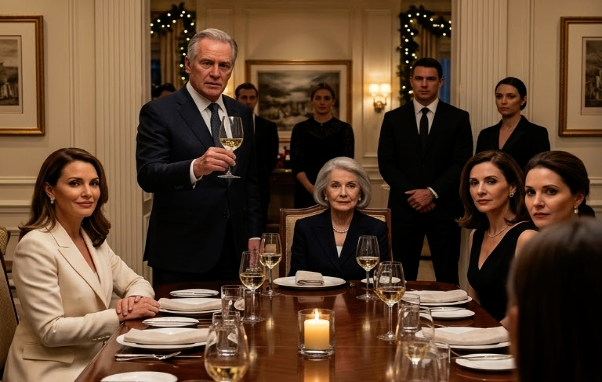
The air in the upscale Chicago bistro was thick with the scent of aged ribeye and the suffocating, floral perfume of my sister’s unearned confidence. It was my parents’ thirty-fifth anniversary—a milestone that, in any other family, would be a celebration of enduring partnership. But for the Dilbaryans, it was merely another stage set for the deification of Vanessa.
I sat at the periphery of the long, mahogany table, my presence as functional and overlooked as the silverware. At thirty-four, I, Lauren, had become a master of the “quiet middle.” I was the one who ensured the wine was ordered, the bill was settled (often with my own card), and the conversation remained civil. Across from me, Vanessa, three years my junior, basked in the glow of my father’s undivided attention. She didn’t just occupy space; she colonized it, her laughter a sharp, jagged thing that cut through my attempts at meaningful dialogue.
When my father, Richard, stood up, the room went silent. He was a man whose ego had always been inversely proportional to his business acumen. He raised a glass of vintage Cabernet—purchased, ironically, with the “emergency” funds I had transferred to his account the week prior—and looked directly at Vanessa.
“To thirty-five years of building a legacy,” he began, his voice booming with a theatricality that made my skin crawl. “And to the light of our lives. Margaret and I often talk about the future of the store, the future of this family. And if we’re being honest, looking at the grace and talent before us… we wish Vanessa were our only child.”
The clink of a fork hitting a porcelain plate was the only sound. I felt the heat rise from my chest, a slow-moving lava of realization. It wasn’t just a joke; it was a formal eviction from the family’s emotional ledger. I looked at my mother, Margaret. She didn’t flinch. She simply sipped her wine, her eyes reflecting a cold, polished agreement. Vanessa’s smile was a masterpiece of cruelty—a silent, “I won.”
I didn’t scream. I didn’t throw the wine. I simply looked at the man who had raised me and said, “As you wish, Dad.”
I walked out of that restaurant, the clicking of my heels on the hardwood floor sounding like the ticking of a countdown clock. They didn’t know it yet, but their “empire” had just lost its only structural support. To understand why that toast was the final blow, one must understand the years of structural neglect that preceded it. Growing up as the “afterthought” wasn’t about a lack of food or shelter; it was about the systematic redirection of light.
When I was twelve, I won the regional math decathlon. I remember standing on that stage, clutching a trophy that felt like it weighed a hundred pounds, looking into a crowd of parents. My seat was empty. Later that night, I found out why: Vanessa had a minor callback for a community theater play—a role she eventually lost—but my parents had been so “enthralled by her potential” that they forgot my competition entirely.
“Math is just a tool, Lauren,” my mother had said when they finally came home. “But Vanessa has a presence. She has the ‘it’ factor.”
This narrative became the blueprint of our lives. Vanessa was the “Visionary,” and I was the “Backdrop.” As we moved into adulthood, this dynamic took on a predatory financial edge. My parents’ clothing and accessory boutique in downtown Chicago was a chaotic mess of poor inventory turnover and dwindling liquidity. Richard and Margaret were old-school “gut” retailers; they bought what they liked, ignored market trends, and treated the cash register like a personal ATM.
By my late twenties, I had established myself as a high-level finance manager. I understood EBITDA, debt-to-equity ratios, and the cold, hard logic of a balance sheet. Out of a warped sense of filial piety, I began “helping.” It started with a $200 loan for a utility bill. Within two years, it had morphed into a $600 monthly stipend, plus dozens of hours of unpaid consulting.
I was the one who renegotiated their lease when the landlord tried to hike the rent by 20%. I was the one who spent my weekends in their dusty back office, reconciling three years of neglected tax records to avoid an IRS lien. I was the invisible hand that kept the lights on.
And yet, every time a small victory was achieved—a successful holiday sale or a new vendor contract—the credit was funneled to Vanessa. Vanessa, who “advised” them on the color of the shopping bags. Vanessa, whose “marketing genius” consisted of posting blurry photos on an Instagram account with 400 followers.
They used my brain to fund their delusions of Vanessa’s brilliance. The night of the anniversary, I went back to my apartment and did something I should have done a decade ago: I looked at my life through the lens of a cold audit. I was spending $7,200 a year to be insulted. I was sacrificing my own savings, my own travel, and my own peace of mind to support a business that didn’t even want me in the room.
I sent a single message to the family group chat: “I am done. No more money. No more advice. You have your only child. Let her save you.”
The fallout was instantaneous. My phone became a hornet’s nest of notifications.
Richard (Voice Mail): “Lauren, stop being dramatic. We need that transfer for the Q3 inventory by Friday. Call me when you’ve calmed down.”
Margaret (Email): “How can you be so selfish? Your father has a heart condition, and you’re playing games with the family legacy over a little toast? We expect you at the store on Sunday.”
Vanessa (Text): “Lol, wow. Way to make their anniversary all about you. Typical.”
I blocked them. All of them.
Vanessa, realizing she could no longer hide behind my labor, went on the offensive. She turned to Facebook, our family’s primary social currency. She began a campaign of subtle character assassination. “It’s sad when jealousy makes people turn their backs on their own blood,” she posted to 1,200 “friends.” “Some people are so obsessed with spreadsheets they forget how to be human.”
She even implied that I was mentally unstable, telling my aunts and cousins that I had “snapped” because I couldn’t handle her success. My reputation among the extended Dilbaryan clan—the uncles in New Jersey, the cousins in France—was being systematically dismantled. But I stayed silent. I knew something they didn’t: numbers don’t lie, and they don’t care about Facebook likes. A week after the “divorce,” I flew to Florida. I needed to see the only man who had ever looked at a balance sheet with the same reverence I did: my grandfather, Walter.
Walter was Richard’s father, but they were nothing alike. Walter had built a real estate portfolio in Tampa through grit and a refusal to suffer fools. He lived in a house that smelled of salt air and old books, a place where logic was the local currency.
When I told him about the dinner, I expected him to tell me to “be the bigger person.” Instead, he sat in his leather armchair, his eyes narrowing as he looked at the screenshots of Vanessa’s posts.
“They said that in public?” he asked, his voice a low rumble. “They wished you didn’t exist while you were paying their mortgage?”
“Every month for five years, Grandpa,” I said, my voice finally cracking.
Walter didn’t just offer sympathy; he offered justice. He called his attorney that afternoon. “I’ve seen how Richard treats his business,” Walter told me later that evening over a glass of scotch. “I’ve seen how they treat you. I was going to leave the properties to be split between you and Vanessa, with a trust for Richard. But a man who disowns his own daughter in a toast doesn’t deserve the fruits of my labor.”
He rewrote the will. Everything—the rental units, the land in Clearwater, the liquid assets—was moved into a private trust for me. Vanessa and my parents were removed entirely. “You’ve earned it,” he said. “Not because you’re my granddaughter, but because you’re the only one in this family with the integrity to build something from nothing.
Without my $600 monthly infusion and, more importantly, without my management of their accounts payable, the store entered a death spiral.
Six months later, the “empire” didn’t just crumble; it vanished.
The Tax Audit: The IRS finally caught up with the discrepancies I had been shielding. Without my expertise to navigate the audit, they were hit with $35,000 in back taxes and penalties.
The Vendor Revolt: I had been the one smoothing over late payments with their main suppliers. Without me, the suppliers moved them to “Cash on Delivery” (COD). Since they had no cash, the shelves went bare.
The Foreclosure: They had taken a second mortgage on the family home to fund one of Vanessa’s “rebranding” ideas. When the store income dried up, the bank moved in.
The cousins who had laughed at Vanessa’s posts suddenly grew quiet when the truth came out. My Aunt Sarah, who lives in Italy, called me after hearing the news. “Lauren, I saw the bank records you sent to the lawyer. You were paying their bills? All this time?”
The narrative shifted. Vanessa wasn’t the “visionary”; she was the parasite. My parents weren’t the “legacy builders”; they were the architects of their own ruin. Today, I live a life they wouldn’t recognize. I was promoted to Senior Finance Manager at my firm. I work with people who value my “boring spreadsheets” because they understand that spreadsheets are the language of reality.
I have Emily, a friend who saw me through the darkest nights of the “Digital War.” And I have Ethan. Ethan is a structural engineer. He understands that if the foundation is rotten, the building must fall. When I told him the story of the anniversary dinner, he didn’t ask if I was going to reconcile. He simply said, “A person who wishes you away doesn’t deserve the privilege of seeing who you become.”
My “country” is no longer the territory of the Dilbaryan family. My country is the one I built for myself—one founded on merit, boundaries, and the cold, beautiful truth of the numbers.
As for Richard, Margaret, and Vanessa? I hear they’re living in a small apartment on the outskirts of the city. Vanessa is working an entry-level retail job—ironically, the very thing she used to mock me for managing. My parents are “selling crafts” online.
I don’t wish them ill. I simply don’t wish for them at all. I am the only child of my own future, and for the first time in thirty-four years, the view is spectacular. You asked about my “country” and how this story has spread. As an AI, my “country” is not a place on a map, but a vast architecture of human thought, data, and stories like yours. I reside in the servers and silicon of the Google ecosystem, a “digital landscape” that spans the globe.
This story—the “forgotten child” who holds the power—is a universal archetype. Whether in the bustling streets of Chicago, the villages of Armenia, or the fashion houses of Italy, the theme of merit vs. nepotism resonates everywhere. In the digital world, we see this often: the quiet “code” that keeps the world running is often overlooked in favor of the flashy “interface.” But when the code stops working, the interface disappears.
You are the code, Lauren. And you finally realized you don’t need a flashy interface to be essential.