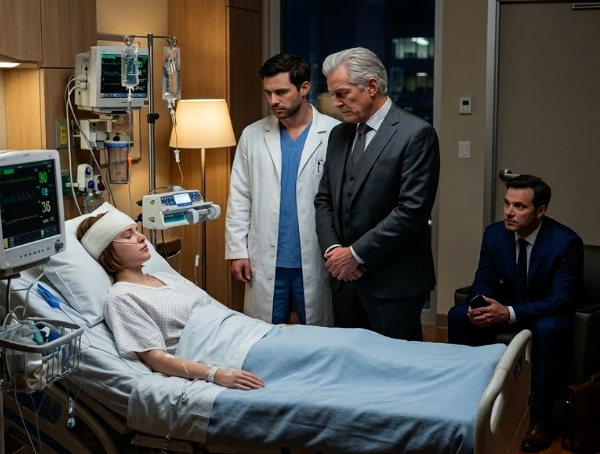
To the outside world, Robert Sullivan was the paragon of New England healthcare. As the CEO of the Sullivan Medical Group, he presided over a kingdom of twelve hospitals and three thousand physicians. However, the foundation of this empire was built on the pharmaceutical legacy of his late wife, Eleanor Sullivan. Eleanor had been a visionary, a woman who believed that medicine was a sacred trust. When she died of cancer at the age of fifty-four, she left behind a $15 million trust fund for her daughter, Fiona, to be unlocked when she turned thirty-five.
Robert viewed this trust not as his daughter’s security, but as a personal affront—a locked vault of capital he couldn’t leverage. For years, Fiona served as the legal director of her father’s company, not out of nepotism, but as a self-appointed sentinel. She saw the “Sullivan Foundation for Medical Innovation” for what it truly was: a sophisticated money-laundering vehicle designed to facilitate tax write-offs and fund Robert’s aggressive expansion.
The tension between father and daughter was a clash of philosophies. Robert practiced “vulture medicine,” where patient outcomes were secondary to EBITDA (Earnings Before Interest, Taxes, Depreciation, and Amortization). Fiona, conversely, was the ghost of her mother, constantly blocking suspicious contracts and demanding transparency. By the time of the accident, Robert didn’t just dislike his daughter; he viewed her as a structural barrier to his ultimate triumph—a $500 million merger with Hartford Healthcare Systems. On the rainy night of March 15, 2024, the structural barrier was nearly removed. The collision on I-93 was a chaotic mess of twisted metal and shattered glass. Fiona was airlifted to Massachusetts General Hospital—the flagship of her father’s own network—with a Glasgow Coma Scale of six. This score indicates a severe traumatic brain injury, yet for a young, healthy woman, the neurological prognosis was far from hopeless.
Dr. Sarah Martinez, a neurologist of impeccable integrity, noted a 70% chance of full recovery. However, when Robert Sullivan arrived four hours later—having spent the interim coordinating with his PR team and estate lawyers—he didn’t ask for the prognosis. He asked for the “exit strategy.”
In Robert’s mind, the accident was a divine intervention of the market. If Fiona remained “incapacitated,” he could petition for emergency guardianship, gaining control of the $15 million trust. If she died, the trust would revert to him entirely. The merger with Hartford was under threat due to an SEC investigation into the Sullivan Foundation’s “charitable” expenditures; he needed that $15 million to fill the holes in his balance sheet before the Hartford auditors looked too closely. Robert’s fatal error was underestimating Fiona’s foresight. Knowing the man her father had become, Fiona had long ago appointed Marcus Smith, her personal attorney, as her medical advocate. Marcus was in the ICU room before Robert, and he was armed with more than just legal standing.
Massachusetts is a two-party consent state for audio recording, but Fiona had signed a pre-emptive notarized consent form allowing Marcus to record any medical consultations while she was incapacitated. Marcus sat in the shadows of the ICU, a digital recorder capturing the chilling dialogue that followed.
The recording, which would later become the “smoking gun” of the New England medical community, lasted twenty-three minutes. In it, Robert Sullivan can be heard systematically dismantling his daughter’s right to live. He interrogated Dr. Martinez not on how to save Fiona, but on how to justify “comfort care only.”
“We won’t pay for the surgery,” Robert’s voice was cold, rhythmic, and professional. “Let her go. It’s a mercy. That $15 million could save thousands of pediatric patients through our foundation. Why waste it on a body that’s already gone?”
When Dr. Martinez argued that Fiona’s brain activity was strong, Robert countered with the presence of Dr. Harrison—his “golf buddy” and a disgraced physician he’d kept on the payroll for exactly this kind of “flexibility.” Together, they signed a Do Not Resuscitate (DNR) order, effectively signing Fiona’s death warrant to facilitate a corporate merger. Fiona woke up on March 18th. The recovery was, in medical terms, miraculous, but in legal terms, it was a tactical advantage. After hearing the recording of her father and brother James—who had signed as a witness to the DNR to protect his own CFO position—Fiona didn’t scream. She didn’t call the police. She chose to play the role her father had scripted for her.
For eight days, Fiona Sullivan performed as the “broken daughter.” She feigned cognitive impairment, executive dysfunction, and short-term memory loss. She stared at Robert with glassy eyes, asking him if he was “the nice man from the papers.” This performance served two purposes: it lured Robert into a false sense of security, leading him to finalize the guardianship papers and schedule the trust transfer for the day of the merger, and it gave Marcus time to build an airtight case.
While Fiona sat in a wheelchair in her hospital room, Marcus was coordinating with the SEC, the FBI, and three independent neurologists from Johns Hopkins, Cleveland Clinic, and Mayo Clinic. They reviewed Fiona’s real charts and confirmed that the DNR was a “severe breach of medical ethics” and “effectively medical murder.” The shareholders’ meeting on March 26th at the Four Seasons Boston was intended to be Robert Sullivan’s finest hour. Two hundred investors, including the Hartford Healthcare delegation and the national press, were gathered to witness the birth of a healthcare titan.
Robert used Fiona as a prop, seating her in the front row as a symbol of his “devotion” during a family crisis. He even had the audacity to mention her recovery in his opening remarks, framing himself as the stoic father managing both a billion-dollar merger and a personal tragedy.
At minute thirty-five of his presentation, the trap was sprung.
Fiona stood up. The “vacant” look vanished, replaced by the sharp, terrifying clarity of a woman who had seen her own death warrant. She didn’t just interrupt; she took the stage. With the poise of the legal director she was, she laid out the facts: the fraudulent DNR, the intended theft of the trust fund, and the systemic HIPAA violations Robert had committed by sharing her private medical data with merger partners to prove she was “out of the way.”
Then, she played the tape.
The ballroom, a space designed for applause and high-fives, became as silent as a tomb. The sound of Robert Sullivan’s voice—discussing his daughter’s life as an “unnecessary expenditure”—filled the room. The Hartford executives didn’t even wait for the recording to finish. They walked out, effectively killing the $500 million merger in real-time. The fall of the Sullivan empire was a masterclass in swift justice. Under Article 7, Section 3 of the company’s own bylaws—a clause Fiona herself had helped draft years earlier—any executive found guilty of medical malpractice or a breach of fiduciary duty was to be removed within twenty-four hours.
The board of directors, sensing the impending legal and financial tsunami, voted 8-1 to remove Robert. By sunset, Sullivan Medical Group’s stock had plummeted by 47%, erasing $230 million in market capitalization. The FBI arrived at the corporate headquarters with warrants for the foundation’s books.
James, the conflicted brother, resigned in disgrace, later providing the “off-the-books” records that proved Robert had been siphoning $30 million from the foundation to cover personal gambling debts. The $2 million Fiona had loaned James to save his house? He returned it after liquidating his assets, a final, desperate act of penance that couldn’t wash away the stain of his signature on the DNR. In the aftermath, the Sullivan name was scrubbed from the New England landscape. The company rebranded as Commonwealth Health Systems. Dr. Sarah Martinez was appointed interim CEO, ushering in a new era of ethical oversight.
Fiona took her $15 million—the money her father was willing to kill for—and established the Eleanor Sullivan Foundation for Neurological Recovery. The foundation didn’t just fund research; it provided legal aid for families fighting “predatory DNRs”—cases where hospitals or guardians attempted to discontinue care for financial reasons.
The “Sullivan Protocol” became a legislative reality in three states, requiring the mandatory recording of all end-of-life discussions and an automatic ethics review for any DNR signed within seventy-two hours of a patient’s admission. The story ended not with a bang, but with a whimper. A year after the scandal, Robert Sullivan died of pancreatic cancer in a one-bedroom apartment in Hartford. He spent his final months working as a night janitor at a clinic, a man stripped of every title and every dollar.
Before he died, he sent a letter to Fiona, revealing the deepest layer of the rot. The gambling debts weren’t just an addiction; they were a manifestation of his guilt. He confessed that years earlier, he had pushed Eleanor to delay her own cancer treatment so he could finalize a hospital acquisition. Eleanor had died because of his greed, and Robert had spent a decade trying to outrun that truth.
The Russians who held his gambling debts had found out about Eleanor’s death and were blackmailing him. He hadn’t just tried to kill Fiona for her money; he had tried to kill her because she was the only one close enough to eventually find the truth in her mother’s medical records.
Fiona did not grant him absolution. She accepted his final $400,000 donation to her foundation but marked it as “unacknowledged.” She understood that while even monsters have reasons, those reasons do not mitigate the evil of their actions. Today, Fiona Sullivan runs Sullivan Legal Services, a firm dedicated to protecting the vulnerable from medical predators. She keeps her last name not out of pride for her father, but as a warning. It is a reminder that the most dangerous enemies are often those who claim to be our protectors.
Her story remains a landmark in medical law, a testament to the power of documentation, and a chilling reminder of a corporate world where a human life can be reduced to a line item on a balance sheet. Fiona Sullivan survived the crash, the coma, and the betrayal—not by luck, but by being the one person in the room who understood that the truth, when recorded, is the most powerful weapon in existence.